Black Friday Traffic Quality: A Peak Season Playbook
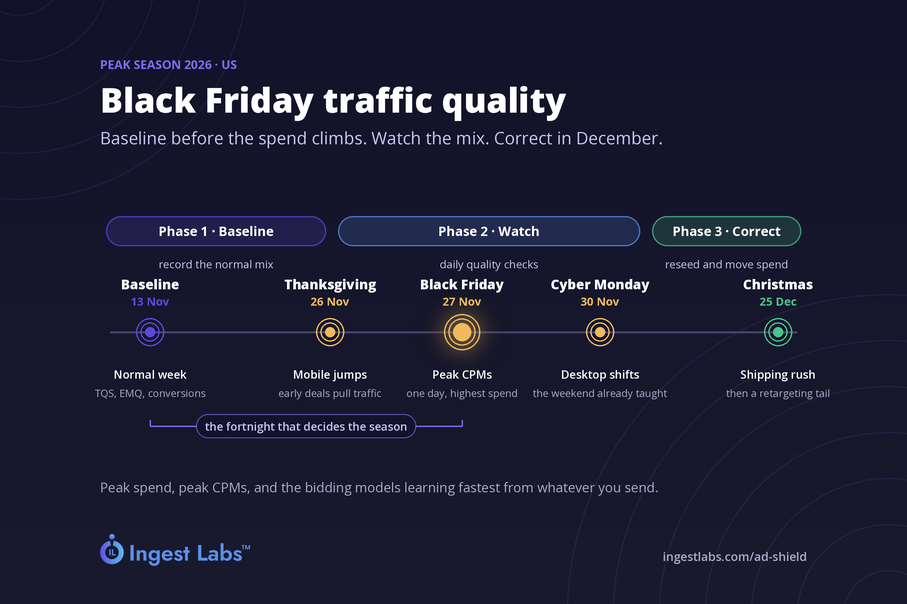
Short answer: Black Friday breaks measurement in a particular way. Budgets peak, auction prices peak, and ad platforms re-learn who to target while your traffic mix is at its least normal. Discount-led and automated traffic arrives on the same wave, gets counted as conversion signal, and shapes bidding through the highest-spend fortnight of your year. The fix is a sequence rather than a tool change: baseline your traffic quality by 13 November, watch it daily from Thanksgiving on 26 November through Cyber Monday on 30 November, then correct what the peak exposed before the Christmas run-in on 25 December. Teams selling into India as well have an advantage worth using, because Diwali fell on 8 November, nineteen days before Black Friday, which is enough time to read one peak and apply what it showed you to the next one.
The dates, and what each does to your data
| Date 2026 | Moment | What it does to your measurement |
|---|---|---|
| Fri 13 Nov | Baseline week closes | Your last chance to record what normal looks like before spend climbs |
| Thu 26 Nov | Thanksgiving | Mobile share jumps; early deals pull discount-hunting traffic forward |
| Fri 27 Nov | Black Friday | Highest spend and highest CPMs of the year, in a single day |
| Mon 30 Nov | Cyber Monday | Desktop and work-hours traffic; the weekend's signal is already training bids |
| Fri 25 Dec | Christmas | Shipping-deadline surge, then a retargeting-heavy tail |
The window that decides the season is not Black Friday itself. It is the fortnight before it, when your campaigns are learning and nobody is watching quality.
Why peak season punishes bad signal
Three effects land at once.
Spend rises. The same share of poor-quality traffic costs more in absolute terms when daily budgets double or triple.
Auction prices rise. Every impression served to someone who was never going to buy costs more in late November than in September.
The models are learning fastest. Google is explicit that its bidding uses Bayesian learning to "continuously improve these models as it accrues conversion rate data at more granular levels", and that it weights recent data more heavily. Feed those models sessions from traffic that does not buy, during the weeks that carry the most weight, and the bids you get in January were shaped by the noise you sent in November.
There is a fourth effect specific to sale periods. Coupon-hunting and automated deal-scraping look like high intent: fast visits, product pages, add-to-carts, no purchase. Google removes what it calls invalid traffic, defined as "traffic that doesn't represent genuine interest in your business", from campaign metrics and billing. But the industry baseline underneath that filtering is list-based: the IAB Tech Lab Spiders and Bots list exists to support the industry standard for detecting invalid traffic by naming known robots. A real browser on a real device, with no intention of buying, is on no such list.
Phase 1: Baseline, by 13 November
You cannot tell whether peak traffic is unusual without knowing what ordinary looks like.
-
Record a full week of ordinary trading: traffic quality mix, Meta Event Match Quality (scored 1 to 10), GA4 purchases, and platform-reported ROAS. Ad Shield scores every visitor with a Traffic Quality Score, so the baseline is a distribution rather than a yes or no.
-
Run a tag audit, so you enter the peak knowing no event is silently broken.
-
Decide your rules now: what a low score should do, whether that is blocking, filtering out of conversion data, or routing for review.
-
Freeze tracking changes from 20 November. No new tags, no container edits, no pixel swaps inside the window unless something is broken.
-
If you expect a conversion-rate swing on specific days, tell the platform in advance. Google recommends seasonality adjustments for "short events of 1–7 days", which is exactly the shape of Black Friday weekend.
Phase 2: Watch, 26 to 30 November
-
Check quality daily. A weekly reporting rhythm hides a three-day problem that costs real money at peak CPMs.
-
Watch the mix, not the total. Traffic doubling is expected. Your low-quality share doubling is not.
-
Watch new campaigns hardest. Broad prospecting, new geographies and open programmatic placements are where poor-quality traffic concentrates. Branded search rarely is.
-
Keep low-score sessions out of your conversion signals. This is the single most valuable action of the season, because it stops the bidding model learning from traffic that never converts.
-
Resist restructuring mid-peak. Pause the one worst placement if something is clearly wrong, and leave the rest until the window closes.
Phase 3: Correct, 1 to 20 December
-
Compare the peak distribution against your baseline. Which campaigns, placements and geographies lost quality?
-
Reseed audiences that were polluted during the weekend. Lookalikes built on low-quality converters keep underperforming until you rebuild them.
-
Recheck Event Match Quality. Guest checkout rises during sales, so identity gaps widen exactly when volume peaks.
-
Move budget away from the placements that degraded, before the Christmas run-in spends it.
-
Write the review while the data is fresh. Next year's baseline week starts from this document, not from memory.
If you also sell into India: use the rehearsal
Diwali fell on 8 November this year, nineteen days before Black Friday. For cross-border teams that is not a coincidence to note, it is a free rehearsal.
The Indian festive peak stresses the same campaign structures, often with the same creative and the same prospecting logic, at lower CPMs. Whatever it revealed about which campaigns bring volume at low quality applies directly to the US window, and you have nineteen days to act on it. Three questions worth asking before 27 November:
-
Which prospecting campaign had the worst quality mix during the Indian peak, and is the same structure live for Black Friday?
-
Did guest-checkout rates rise enough during Diwali to drag Event Match Quality down? If so, the same identity gap is about to widen at higher spend.
-
Which placements did you pause in November, and has anyone turned them back on for the US push?
Teams that only sell into the US have no rehearsal, which makes the baseline week on 13 November more important rather than less.
The one-page version
-
By 13 November: baseline quality, Event Match Quality and conversions on a normal week.
-
From 20 November: freeze tracking changes.
-
26 to 30 November: check daily, watch the mix rather than the total, keep low-score sessions out of conversion signals, including sessions driven by AI agents.
-
1 to 20 December: compare against baseline, reseed audiences, move budget before the Christmas run-in.
-
January: write the review, and set next year's baseline date in the calendar now.
Frequently asked questions
When should I check traffic quality before Black Friday?
Two weeks before, so the baseline comes from ordinary trading rather than from the peak itself. For 2026 that means a full normal week closing on 13 November, ahead of Thanksgiving on 26 November and Black Friday on 27 November. Leaving it until the weekend means measuring the peak with nothing to compare it against.
Does invalid traffic increase during Black Friday?
Traffic of every kind rises during a sale, and the automated and low-intent share typically rises with it, because discount-scraping concentrates around promotions. The greater risk is timing rather than volume: peak spend and fast algorithmic learning mean poor-quality signal costs more in late November than at any other point in the year.
Will my ad platform's fraud filtering handle it?
It removes a great deal, and that work is real. Google defines invalid traffic as traffic that does not represent genuine interest and removes it from metrics and billing. But the standard underneath it is list-based detection of known spiders and bots. It does not grade traffic that looks human and has no intent to buy, and it does not stop those sessions being used as conversion signal in your own measurement.
Should I change campaigns during Black Friday weekend?
Avoid restructuring. If you expect a conversion-rate swing on specific days, use a seasonality adjustment, which Google recommends for short events of one to seven days. Mid-peak rebuilds destroy the before-and-after comparison you need in December, and the algorithm re-enters learning at the worst possible moment.
What should I do if quality drops on Black Friday itself?
Keep low-score sessions out of your conversion signals, pause the single worst placement if one stands out, and hold everything else until Cyber Monday has passed. Then do the full comparison in the first week of December, when a clean read is possible.
How does the Indian festive season help a US peak?
Diwali on 8 November falls nineteen days before Black Friday, and most cross-border teams run the same campaign structures in both. Whatever the Indian peak showed about campaign quality can be fixed before US spend goes live at higher CPMs, which is a rehearsal single-market teams do not get.
Sources
-
Google Ads Help, How our bidding algorithms learn
-
Google Ads Help, About seasonality adjustments
-
Google Ads Help, Managing invalid traffic
-
IAB Tech Lab, Spiders and Bots list