Festive Sale Traffic: Quality Playbook for India
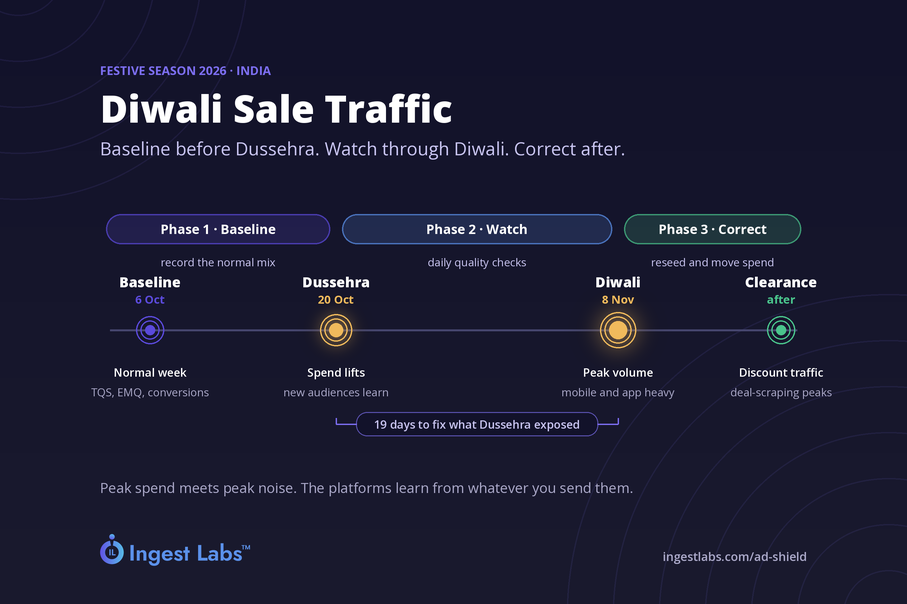
Short answer: India's festive season breaks measurement in a specific way. Budgets rise from Navratri onward, CPMs climb, and ad platforms re-learn who to target while your traffic mix is at its least normal. Invalid and low-intent traffic rides in on the same wave, gets counted as conversion signal, and shapes bidding through the highest-spend weeks of your year. The fix is a sequence, not a tool switch: baseline traffic quality two weeks before Dussehra on 20 October, watch quality daily through Diwali on 8 November, then correct what the peak exposed. Festive traffic in India is mobile-heavy, discount-led and full of first-time visitors, which is exactly the mix in which low-quality sessions are hardest to spot and most expensive to learn from.
The festive calendar, and what each window does to your data
India's festive season is not one spike. It is three, and they stress your measurement in different ways.
| Window | Key date 2026 | What it does to your data |
|---|---|---|
| Navratri to Dussehra | Dussehra, Tue 20 Oct | First big spend lift; new prospecting audiences go live and start learning |
| Diwali | Diwali, Sun 8 Nov | Highest traffic volume of the year; mobile and app heavy, many first-time visitors |
| Post-Diwali clearance | The weeks after 8 Nov | Discount-led traffic, when deal-scraping and coupon-hunting activity is at its heaviest |
The 19 days between Dussehra and Diwali are the useful part. Dussehra is big enough to show you how your campaigns behave under load, and early enough that you can still change something before the larger peak. Most teams skip that review, because nobody plans a check between two festivals.
Why peak season is when bad traffic costs the most
Three things happen at once.
Your budget goes up. The same share of invalid traffic takes a larger absolute amount of money when daily spend triples.
Auction prices go up. Peak CPMs mean every impression served to a non-buyer costs more than it did in September.
The algorithms are learning. This is the part teams underestimate, and the platforms are explicit about it. Google says its bidding models use Bayesian learning to “continuously improve these models as it accrues conversion rate data at more granular levels”, weighting recent data more heavily. Feed those models sessions from traffic that was never going to buy and they will look for more of the same, at exactly the moment you can least afford it. Google's own remedy for short promotional spikes is a seasonality adjustment, which it recommends for “short events of 1–7 days” — a tool for telling the algorithm what to expect, not for cleaning up what you already sent it.
There is a fourth effect specific to sales periods. Discount-hunting behaviour and automated deal-scraping look a lot like high-intent shopping: fast visits, product page views, add-to-carts, no purchase. Platform filtering catches a great deal, and Google removes invalid traffic — which it defines as “traffic that doesn't represent genuine interest in your business” — from campaign metrics and billing. But the industry baseline underneath that filtering is list-based: the IAB Tech Lab Spiders and Bots list exists to support the MRC's General Invalid Traffic detection standard by naming known robots. A real device with a real browser and no intention of buying is on no such list.
The playbook
Three phases, dated against the Indian festive calendar. Dussehra is the first peak, Diwali the big one.
Phase 1: Baseline, two weeks before the peak
You cannot tell whether peak traffic is unusual if you do not know what normal looks like.
-
Record your current traffic quality mix for a full week of ordinary trading. Ad Shield gives every visitor a Traffic Quality Score (TQS) from 0 to 100, so the baseline is a distribution, not a yes or no.
-
Record Meta Event Match Quality, which Meta scores out of 10 from the customer information parameters your server sends and the share of events matched to a Meta account, plus GA4 purchase counts and platform-reported ROAS for the same week.
-
Check what is firing. Run a tag audit so you enter the peak knowing no event is silently broken.
-
Check consent handling. India's DPDP rules apply to the same festive traffic you are about to buy, and consent state has to be honoured server-side, not only in a banner.
-
Set rules before the rush, not during it. Decide now what a low score should do: block it, keep it out of conversion signals, or route it for review.
-
Freeze tracking changes. No new tags, no container edits, no pixel swaps inside the peak window unless something is broken.
Phase 2: Watch, during the peak
-
Check quality daily, not weekly. A seven-day reporting rhythm hides a three-day problem that costs real money.
-
Watch the mix, not the total. Traffic doubling is expected. The share of low-score traffic doubling is not.
-
Watch new campaigns hardest. Broad prospecting, new geographies and open programmatic placements are where low-quality traffic concentrates. Branded search is rarely the problem.
-
Keep low-score sessions out of your conversion signals. This is the most valuable single action of the whole season, because it stops the bidding algorithm learning from traffic that never converts.
-
Do not panic-edit campaigns on a single day's data. If you expect a conversion-rate swing for a specific sale, tell the platform in advance with a seasonality adjustment rather than restructuring mid-peak.
Phase 3: Correct, after the peak
Run this twice: in the 19 days between Dussehra and Diwali, then again after Diwali, before the clearance push.
-
Compare the peak distribution against your baseline. Which campaigns, placements and geographies lost quality?
-
Rebuild audiences that were polluted during the peak. Lookalikes seeded with low-quality converters will keep underperforming until you reseed them.
-
Recheck Event Match Quality. Guest-checkout rates rise during festive sales, so identity gaps widen exactly when volume peaks.
-
Move spend away from the placements where quality fell, before Diwali week makes that budget more expensive.
-
Write down what you changed. The clearance weeks, and next year's Navratri, should start from evidence rather than memory.
What this looks like in practice
A typical Indian festive plan puts new prospecting campaigns live in early October, scales them hard into Dussehra, then pushes the largest budgets of the year through Diwali week. If the Dussehra window shows that one prospecting campaign brought high volume at low quality, that is worth acting on before the same structure carries three times the spend on 8 November.
That sequencing advantage only exists if someone is measuring quality during the first window. Monthly reporting is too slow; the Diwali budget will already be committed.
Where Ad Shield fits
Ad Shield scores every visitor across six dimensions: intent signal, engagement, device authentication, geo validity, session depth and conversion fit. The score drives rules you define, so low-quality traffic is blocked, filtered out of conversion data, or routed for review before it reaches your platforms. Those decisions sync to Google Ads, Meta, LinkedIn, The Trade Desk, DV360, Reddit, Snapchat and TikTok.
For this season, the useful part is the baseline. Knowing your normal distribution before 20 October gives you something to compare peak days against. Without it, you are reading peak numbers with nothing to read them against.
If you want to start with diagnosis rather than a product, run the free Site Intelligence audit. It reports what is firing, what is missing and what share of your traffic looks invalid.
The one-page version
-
By 6 October: baseline traffic quality, Event Match Quality and conversions on a normal trading week. Freeze tracking changes.
-
Dussehra week: check quality daily, watch the mix rather than the total, and keep low-score sessions out of conversion signals.
-
21 October to 7 November: compare against baseline, reseed polluted audiences, move budget before Diwali CPMs peak.
-
After Diwali: repeat the review before the clearance push, and write it down while the data is fresh.
Frequently asked questions
Does bot traffic increase during festive sales?
Traffic of all kinds rises during festive sales, and the share that is automated or low-intent typically rises with it, because discount-scraping and deal-hunting activity concentrates around promotions. The risk is less about volume than timing: peak spend and fast algorithmic learning mean poor-quality signal costs more during Dussehra and Diwali than at any other point in the year.
When should I check traffic quality before Diwali?
Two weeks before your first peak, so the baseline comes from ordinary trading. For 2026, that means baselining by around 6 October, ahead of Dussehra on 20 October, then reviewing in the 19 days between Dussehra and Diwali on 8 November. Leaving it until Diwali week means measuring the peak with nothing to compare it against.
Will my ad platform's own fraud filtering handle it?
It removes a lot, and that work is real: Google defines invalid traffic as traffic that does not represent genuine interest in your business, and removes it from campaign metrics and billing. But the industry standard underneath it is list-based detection of known spiders and bots. It does not grade traffic that looks human and has no intent to buy, and it does not stop those sessions being used as conversion signal in your own measurement.
What should I do if quality drops mid-peak?
Don't rebuild campaigns during the peak. Keep low-score sessions out of your conversion signals, pause the single worst placement if one stands out, and hold everything else until the window closes. Mid-peak restructuring destroys the comparison you need afterwards.
I sell in India and the US. Does this change anything?
The three phases are the same, but you get a rehearsal. Diwali on 8 November falls 19 days before Black Friday on 27 November, so whatever the Indian peak reveals about campaign quality can be fixed before US spend goes live at higher CPMs. We cover the US window, and that hand-off, in a separate post.
Should I pause tracking changes during the festive season?
Yes, with one exception: fixing something that is broken. New tags, container edits and pixel changes during a peak introduce measurement breaks exactly when the data matters most and when nobody has time to debug.
Sources
-
Google Ads Help, How our bidding algorithms learn
-
Google Ads Help, About seasonality adjustments
-
Google Ads Help, Managing invalid traffic
-
Meta for Developers, Dataset Quality API: Event Match Quality
-
IAB Tech Lab, Spiders and Bots list