Unified Customer Profile: How to Build One in 7 Steps (2026)
Updated November 23, 2026
Short answer: A unified customer profile is one record per customer. It joins identifiers, attributes, behaviour, transactions and consent from every system the customer touches: website, app, CRM, email, support and stores. You build it in four steps. First collect first-party data with consent, ideally server-side. Then resolve identities with deterministic rules on identifiers such as customer ID and hashed email, adding probabilistic matching only where it's needed. Next merge records using clear survivorship rules. Finally keep the profile updated and enforce consent before activation. The business case rests on personalization and data quality. McKinsey found 71% of consumers expect personalized interactions and 76% get frustrated when they don't get them; personalization most often lifts revenue by 10–15%. Gartner estimates poor data quality costs organizations at least $12.9 million a year on average. Measure success by join rate, duplicate rate and profile freshness, not by profile count.
What a unified customer profile contains
A unified customer profile, sometimes called a single customer view, a 360-degree view or a golden record, combines everything you know about one person into one record that other systems can use.
| Component | Examples | Typical source |
|---|---|---|
| Identifiers | Customer ID, hashed email and phone, first-party cookie or device IDs, app user ID | Website, app, CRM, sign-up forms |
| Attributes | Name, location, preferences, account type, loyalty tier | CRM, account settings, surveys |
| Behaviour | Page views, product views, searches, email opens, app sessions | Website and app events, email platform |
| Transactions | Orders, returns, subscriptions, lifetime value | Ecommerce platform, POS, billing |
| Service history | Tickets, chats, ratings | Support tools |
| Consent and preferences | Marketing opt-ins, cookie choices, channel preferences, deletion requests | Consent platform, preference centre |
| Derived scores | Churn risk, propensity to buy, segment membership | Analytics, models |
Consent belongs on the profile itself. If the profile doesn't record what a person agreed to, every downstream system has to guess.
Why it matters
| Finding | Figure | Source |
|---|---|---|
| Consumers who expect personalized interactions | 71% | McKinsey, November 2021 |
| Consumers frustrated when personalization doesn't happen | 76% | McKinsey, November 2021 |
| Typical revenue lift from personalization | 10–15% (5–25% by company) | McKinsey, November 2021 |
| Revenue from personalization, fast-growing vs slower companies | 40% more | McKinsey, November 2021 |
| Average annual cost of poor data quality | At least $12.9 million | Gartner, 2020 research |
Without a unified profile, the same customer looks like several people. Marketing sends a discount to someone who bought yesterday, support can't see recent orders, and attribution splits one journey into several "new" users. See our cross-device attribution guide for the measurement side of this problem.
How identity resolution builds the profile
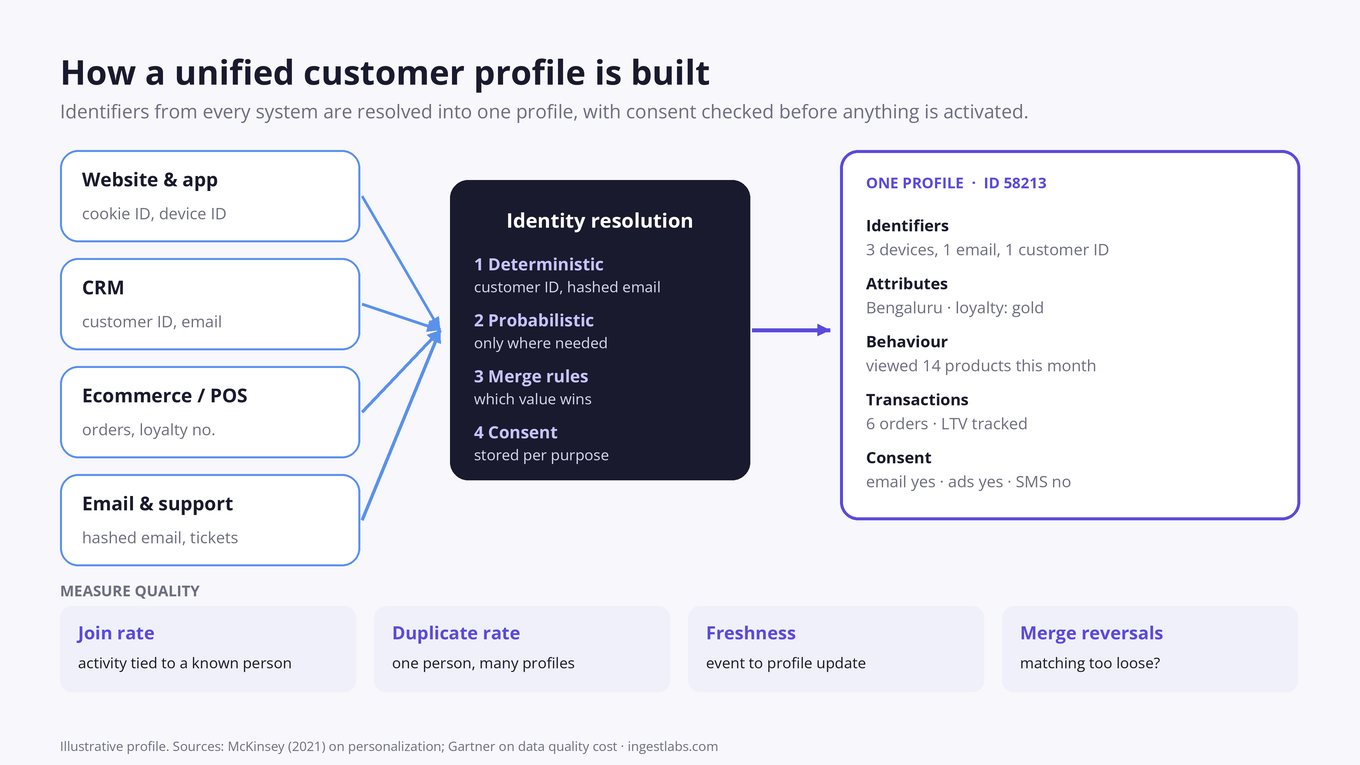
Identity resolution decides which records belong to the same person. The result is stored in an identity graph: a map of every identifier linked to each person, with one persistent profile ID.
| Method | How it matches | Strength | Risk |
|---|---|---|---|
| Deterministic | Exact match on a shared identifier, such as customer ID, login, or hashed email or phone | High accuracy, explainable | Misses people who never log in or share an email |
| Probabilistic | Scores similarity across signals such as name, address, device and behaviour | Higher reach | False merges, where two people become one profile |
| Hybrid | Deterministic rules first, probabilistic scoring for the rest, with thresholds by use case | Balances reach and accuracy | Needs monitoring and clear thresholds |
Two errors matter, and they pull in opposite directions:
-
False merges join two different people. One person gets another's emails, or worse, sees another's data. That makes a false merge a privacy risk, not just a marketing error.
-
Missed matches leave one person split across several profiles. The result is duplicate messages, wrong frequency, and a lifetime value that looks too low.
For anything customer-facing or regulated, lean on deterministic matching. Use probabilistic matching for analytics, where a small error rate is acceptable.
Where to build a unified customer profile
| Option | How it works | Best for |
|---|---|---|
| Packaged CDP | A vendor platform collects data, resolves identity and activates audiences | Marketing-led teams that want one tool |
| Warehouse-native (composable) | Profiles are built in your data warehouse (BigQuery, Snowflake, Databricks); separate tools activate them | Teams with a data team and an existing warehouse |
| CRM-centred | The CRM holds the master record and other systems sync to it | B2B and sales-led businesses with lower event volumes |
Whichever you choose, the profile is only as good as the events and identifiers feeding it. For budgeting, see our CDP pricing guide.
How to create a unified customer profile: 7 steps
-
List your sources and identifiers. Record every system that holds customer data and which identifiers each one has: customer ID, email, phone, cookie ID, device ID or loyalty number.
-
Choose a primary key and an identifier hierarchy. Usually customer ID first, then hashed email, then hashed phone, then device and cookie IDs. Write down which identifiers may link profiles and which may only enrich them.
-
Collect first-party events with a durable ID. Assign every visitor a first-party identifier on first visit, and send events server-side, so the ID survives browser limits and ad blockers.
-
Link identities at known moments. Login, sign-up, checkout and email clicks are where an anonymous visitor becomes known. Make sure those events carry both the anonymous ID and the known ID.
-
Set merge and survivorship rules. When two records conflict, decide which value wins: most recent, most trusted source, or most complete. Keep a history so you can reverse a bad merge.
-
Attach consent and enforce it at activation. Store consent with the profile, and check it before any audience is sent to an ad platform or email tool. Hash identifiers before they leave your systems. See our PII handling guide.
-
Monitor quality and keep profiles fresh. Track the metrics below every month, and update profiles as events arrive, not only in a nightly batch.
Metrics to track profile quality
| Metric | What it tells you | How to calculate |
|---|---|---|
| Join rate | How much activity is tied to a known person | Events or orders with a known profile ID ÷ total |
| Duplicate rate | How often one person has several profiles | Profiles sharing a deterministic identifier ÷ total profiles |
| Profile completeness | Whether key fields are filled in | Profiles with all required fields ÷ total profiles |
| Freshness | How quickly new activity reaches the profile | Time from event to profile update |
| Consent coverage | Whether you can legally activate the profile | Profiles with a recorded consent state ÷ total profiles |
| Merge reversals | Whether matching rules are too loose | Merges undone after review ÷ total merges |
A rising join rate is the clearest sign the programme is working. A rising merge-reversal rate is the clearest sign your matching is too aggressive.
Common problems and fixes
| Problem | Cause | Fix |
|---|---|---|
| Many profiles per customer | Logins and emails not captured on key events | Pass the known ID on login, sign-up and checkout events |
| Profiles merged wrongly | Probabilistic thresholds too loose, or shared devices and emails | Tighten thresholds; never merge on shared or role emails such as info@ |
| Stale data | Nightly batch updates only | Stream events and update profiles as they arrive |
| Low match rate with ad platforms | Unnormalized or unhashed identifiers | Normalize and SHA-256 hash email and phone before sending |
| Activation blocked by legal | Consent not stored with the profile | Record consent per purpose and check it before activation |
How Ingest Labs fits
Ingest ID assigns a durable first-party identifier to every visitor and links it to known identities, such as a login or hashed email. That gives you the identity layer a unified profile depends on. Ingest IQ collects events server-side with that ID attached and forwards them to your CDP, warehouse and ad platforms. Event IQ shows how resolved journeys behave across channels. Read our complete guide to server-side tracking for the collection setup.
FAQ
What is a unified customer profile?
A unified customer profile is a single record per customer. It combines identifiers, attributes, behaviour, transactions, service history and consent from every system the customer interacts with. Also called a single customer view or golden record, it lets marketing, analytics and service teams act on the same up-to-date information.
How do you create a unified customer profile?
List your data sources and identifiers, then choose an identifier hierarchy, usually customer ID, then hashed email, then device IDs. Collect first-party events with a durable ID, and link identities at login, sign-up and checkout. Next, set merge rules and attach consent. Finally, monitor join rate, duplicate rate and freshness every month.
What is the difference between deterministic and probabilistic matching?
Deterministic matching links records only when they share an exact identifier, such as a customer ID or hashed email, so it is accurate and explainable. Probabilistic matching scores similarity across signals like name, address and device to reach more people, but it can wrongly merge two people. Most teams use deterministic rules first and probabilistic scoring selectively.
Do I need a CDP to build a unified customer profile?
Not necessarily. A packaged CDP is one option. You can also build profiles in your data warehouse and use separate tools to activate them, or use your CRM as the master record. The right choice depends on your data team, event volume and existing tools. Every option needs clean first-party events and reliable identifiers.
How do you keep customer profiles accurate?
Capture known identifiers on login, sign-up and checkout events, and stream updates as events arrive rather than in nightly batches. Use deterministic matching for customer-facing uses, and never merge on shared emails. Keep a merge history so errors can be reversed, and track duplicate rate, join rate and merge reversals monthly.
Sources
-
McKinsey & Company, "The value of getting personalization right—or wrong—is multiplying," November 2021
-
Gartner, "Data Quality: Best Practices for Accurate Insights" (citing Gartner research from 2020; checked November 23, 2026)
-
Amperity, "Identity Resolution: Deterministic vs. Probabilistic," April 7, 2026