Marketing Attribution: The Complete 2026 Guide
Marketing Attribution: The Complete 2026 Guide
Marketing attribution is the practice of assigning credit for a conversion to the marketing touchpoints that contributed to it. It answers a deceptively simple question — which of your channels actually produced this sale? — and almost every marketing team believes it has the answer wrong.
They are usually right that it's wrong. They are usually wrong about why.
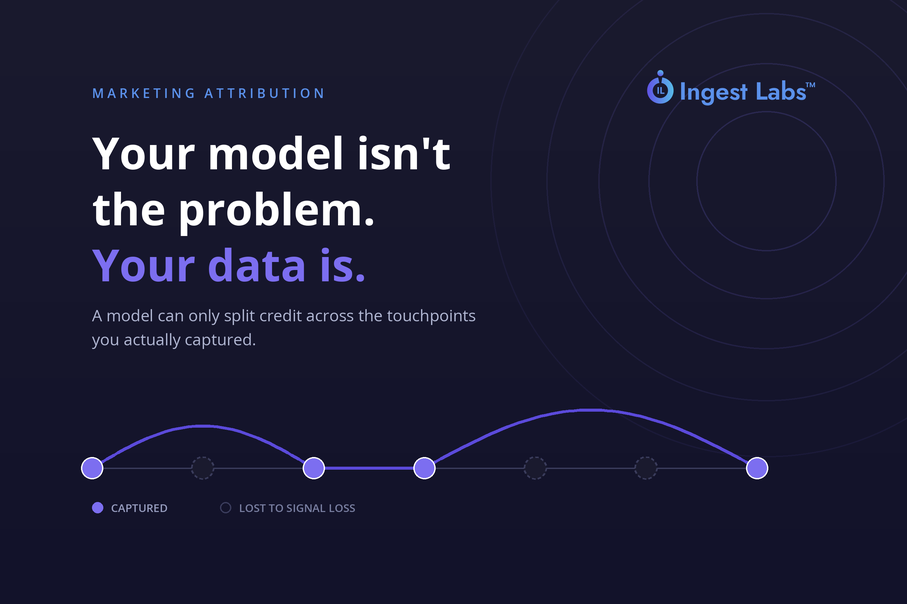
The instinct, when the numbers don't reconcile, is to change the model. Last-click undercounts the top of the funnel, so teams move to linear, then to time-decay, then to data-driven, and each migration produces a different set of numbers that is equally impossible to defend. The model was never the problem. A model distributes credit across the touchpoints you recorded. It cannot distribute credit across the ones you lost.
This guide covers what attribution is, how the models differ, where each one breaks, and — the part most attribution content skips — how to find out whether your data is complete enough for the model choice to matter at all.
What marketing attribution actually is
Marketing attribution is the process of identifying which marketing touchpoints contributed to a conversion and assigning each one a share of the credit. It turns a sequence of interactions — an ad impression, a search click, an email open, a direct visit — into a defensible answer about which spend produced revenue.
Three things have to work for it to produce a trustworthy number:
-
Collection. Every touchpoint has to be recorded. A touchpoint blocked by a browser, an ad blocker or a consent decision does not exist as far as the model is concerned.
-
Identity. Those touchpoints have to be recognised as belonging to the same person across sessions, devices and channels. Without that, one customer becomes four strangers.
-
Assignment. Only then does the model decide how credit is split.
Attribution content overwhelmingly discusses step three. Steps one and two decide whether step three means anything.
Why attribution broke — and it wasn't the model
Four changes over roughly five years removed a large share of the touchpoints that attribution models were designed to read.
Browser restrictions****. Safari's Intelligent Tracking Prevention caps first-party cookie lifetime set via JavaScript at seven days, and in many cases twenty-four hours. Firefox blocks known trackers by default. A returning customer with a thirty-day consideration window is, to a client-side tracking setup, a new visitor.
Ad blockers****. A meaningful share of e-commerce traffic runs an extension that prevents client-side tags from firing at all. Those sessions convert. They simply convert invisibly.
Platform changes. iOS's App Tracking Transparency and the shrinking of platform-side attribution windows removed cross-app signal that used to stitch journeys together.
Consent regimes****. GDPR, CPRA and now India's DPDP Act mean a share of visitors are never tracked by design — and that share is not random.
The result is not a small measurement error. It is a systematically biased sample. Channels that reach cookie-friendly, non-blocking, consenting users look better than they are. Channels that don't, look worse. Switching from last-click to data-driven attribution on that sample produces a more sophisticated wrong answer.
The five attribution models, and when each one lies
| Model | How it assigns credit | Best used when | Where it lies |
|---|---|---|---|
| Last click | 100% to the final touchpoint | Short, single-channel purchase paths | Systematically over-credits branded search and retargeting; erases discovery |
| First click | 100% to the first touchpoint | Measuring top-of-funnel discovery specifically | Ignores everything that closed the sale |
| Linear | Evenly across all recorded touchpoints | Long considered purchases with genuine multi-channel influence | Treats a passing impression as equal to a decisive click |
| Time decay | Weighted toward touchpoints nearer the conversion | Short sales cycles where recency genuinely matters | Structurally favours bottom-funnel channels; quietly defunds awareness |
| Data-driven | Algorithmically, from observed conversion paths | High conversion volume and complete path data | Most sensitive to missing data of any model — it learns from the gaps |
The pattern worth noticing: the more sophisticated the model, the more damage incomplete data does. Last-click on a broken dataset is crude but predictable. Data-driven attribution on a broken dataset confidently learns the wrong pattern and reports it with high certainty.
That is why "we upgraded to data-driven attribution and the numbers got stranger" is such a common experience. The model didn't fail. It faithfully modelled a sample with holes in it.
The data layer beneath the model
If the model is only as good as the touchpoints beneath it, three things determine whether attribution is worth running at all.
Server-side collection****. Moving event collection from the browser to a server you control means events are sent from your infrastructure rather than from a client that browsers, extensions and network filters are actively restricting. It does not defeat consent — consented-out users stay out, correctly — but it removes the technical losses that have nothing to do with a user's choice.
Identity resolution****. Recognising a returning customer without relying on third-party cookies is what turns four fragmented sessions back into one journey. Without it, the multi-touch models in the table above have nothing multi-touch to work with. This is what Ingest ID exists to do, and it's the least discussed and most decisive part of the stack.
Deduplication and match quality****. When the same conversion arrives via both a browser pixel and a server event, it has to be recognised as one conversion. Platform-side match quality — Meta's Event Match Quality, scored from 1 to 10 — determines whether the platform can tie a server event back to a real person at all. Low match quality means the event is delivered and largely wasted.
Event IQ sits above all three, unifying the events once they've been collected cleanly and attributed to a resolved identity. The order matters: unification of bad data produces confident bad reporting.
How to diagnose your own attribution gap
This takes an afternoon and requires nothing from any vendor.
-
Compare platform-reported conversions to backend orders for the same period. Ad platforms will over-report in aggregate because of overlapping claims, but the shape of the gap tells you where signal is missing.
-
Check your direct traffic share. In most e-commerce GA4 properties, direct above roughly 30–40% is a session-persistence failure rather than genuine direct traffic. Sessions whose source was lost land in direct.
-
Segment by browser. Compare conversion rate and attributed revenue for Safari against Chrome. A large unexplained gap is a measurement artefact, not a customer behaviour insight.
-
Look at your platform match quality scores****. In Meta Events Manager, an Event Match Quality below roughly 6 out of 10 means a large share of your server events cannot be tied to a person.
-
Count your new-versus-returning ratio. An implausibly high share of "new" customers is identity fragmentation showing up as acquisition.
If steps 2 through 5 come back clean, your attribution model choice is the next lever. If they don't, model choice is the wrong conversation.
What we see across our own implementations
These are observations from Ingest Labs deployments, not published industry research. They are directional and reflect the e-commerce and D2C brands we work with rather than the market as a whole.
-
Direct traffic share above 60% in GA4 has, in our implementations, almost always resolved to session persistence failure rather than genuine direct visits.
-
Meta Event Match Quality below 6 is common before identity work and is the single most reliable predictor that server-side events are being delivered without being usable.
-
The largest recoveries we see come from identity resolution rather than from event collection alone — collection restores the event, identity restores the journey.
Ingest Labs measures attribution accuracy of up to 99% after full implementation. One documented case study recorded 96.4%. We do not claim complete attribution, and any vendor who does is describing a mathematical impossibility under current consent law.
Choosing a model once your data is sound
With complete collection and resolved identity in place, model choice becomes a real decision rather than a way of changing the answer.
-
Short path, single channel, high volume: last click remains defensible and is far easier to explain to a finance team.
-
Considered purchase, genuine multi-channel influence: a multi-touch model — linear if you need transparency, time decay if recency genuinely drives your category.
-
High volume and complete path data: data-driven attribution will outperform, and only under those two conditions.
-
Any of the above: run one incrementality test per quarter. Attribution describes correlation across recorded paths. Only a holdout test tells you what would have happened without the spend.
Frequently asked questions
What is marketing attribution?
Marketing attribution assigns credit for a conversion to the marketing touchpoints that contributed to it, so teams can tell which channels actually produced revenue.
Which attribution model is most accurate?
No model is inherently most accurate. Accuracy is determined more by the completeness of the underlying data than by the model. Data-driven attribution performs best on complete, high-volume path data and worst on incomplete data.
Why don't my ad platform numbers match my backend orders?
Platforms count conversions they can claim, and multiple platforms claim the same conversion. Separately, browser restrictions, ad blockers and consent choices remove touchpoints entirely. The first cause inflates; the second deletes.
Does server-side tracking fix attribution?
It fixes collection, which is one of three requirements. Without identity resolution and deduplication, server-side collection delivers more events without producing a more accurate journey.
Is attribution still possible under GDPR and DPDP?
Yes, for consented users. Attribution under consent regimes means measuring a consented subset accurately rather than estimating an unconsented population.
How long before attribution changes show up in reporting?
Collection changes appear within days. Identity and model changes need a full purchase cycle before comparison is meaningful — for most ecommerce brands, thirty to ninety days.