Littledata vs Ingest Labs: Which Fits Your Shopify Stack?
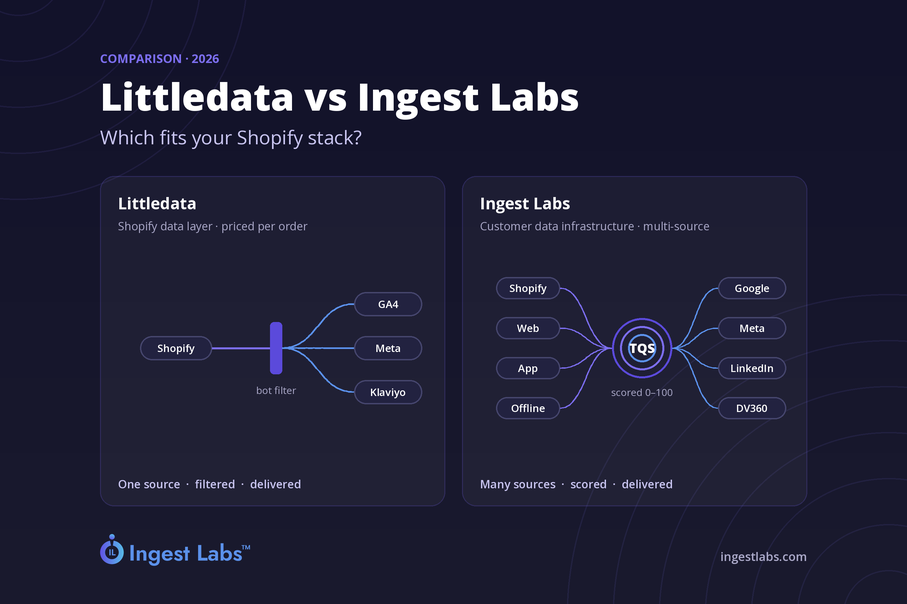
Short answer: Littledata is a Shopify-native data layer. It captures browser and server events once and sends the same purchase data to GA4, Google Ads, Meta, TikTok, Klaviyo and other destinations, with no Google Tag Manager required. It is priced by orders tracked, from $0.35 per order or $199 a month on the Scale plan. Ingest Labs is customer data infrastructure. It covers server-side tagging, identity resolution, traffic quality scoring and tracking audit, across Shopify, other web properties, mobile apps and offline sources, and is not priced per order. Choose Littledata if your revenue lives on Shopify and you want accurate purchase signals with a fast, code-free setup. Choose Ingest Labs if meaningful signal sits outside Shopify, or if the problem is traffic quality and data governance rather than getting events delivered.
The comparison most people are actually making
If you're reading this, you're usually in one of three places.
You're shortlisting server-side tracking for a Shopify store, and Littledata came up next to Elevar and Stape. You're already on Littledata and your stack has grown past the store: an app, a POS, a second storefront, a B2B portal. Or your events arrive cleanly, yet ad platforms still optimise toward customers who never come back.
Those are different problems. The first favours Littledata more often than not. The second and third are where the answer changes.
What each platform actually is
Littledata calls itself "the data layer for Shopify". It has been on the Shopify App Store since January 2017, carries the Built for Shopify badge, and holds a 4.8 rating across 140 reviews. It tracks every purchase server-side from Shopify, so conversions reach destinations even when ad blockers, iOS privacy settings or accelerated checkouts hide them from browser pixels.
Its destinations cover the Shopify growth stack: GA4, Google Ads, Meta Conversions API, Microsoft Advertising, Pinterest, TikTok, Klaviyo, Attentive, Recharge and Segment. Every plan includes headless and Hydrogen support, subscriptions, Shopify Markets, bot protection, an event editor (in beta), Persistent ID and a profit signal feature (in beta). Setup is code-free, and Littledata states that Google Tag Manager is not required.
Ingest Labs is customer data infrastructure built as five products. Ingest IQ handles server-side tagging. Ingest ID handles cookieless identity resolution. Event IQ unifies analytics and event orchestration. Ad Shield scores traffic quality. Site Intelligence audits the tracking already on your site. It offers 35+ dedicated integrations and 100+ total connectors, and holds SOC 2 Type II and MACH Alliance certification.
It is not Shopify-specific. That cuts both ways, and it's the first thing to be clear about.
Where the two overlap, and where they split
This comparison is closer than most. Littledata is not a delivery-only pipe.
Both resolve identity. Littledata's Persistent ID is an identity graph. It stitches anonymous sessions to known customers across devices and keeps them for up to a year, well past the roughly one-week limit browsers put on client-side cookies. Ingest ID does the same job with cookieless, first-party identity resolution. For a Shopify-only store, the practical gap here is smaller than vendor pages suggest.
Both deal with bots, in different depth. Littledata builds bot filtering into every plan, so obvious non-human traffic doesn't reach your destinations. Ad Shield goes further. It gives every visitor a Traffic Quality Score (TQS) from 0 to 100 across six dimensions: intent signal, engagement, device authentication, geo validity, session depth and conversion fit. You then set rules to block, filter or route low-score traffic for review, and push those decisions to Google Ads, Meta, LinkedIn, The Trade Desk, DV360, Reddit, Snapchat and TikTok. The question is not bots versus no bots. It's a pass/fail filter versus a scored quality layer that informs bidding across paid media.
They split on scope. Littledata's architecture starts and ends with Shopify. Ingest Labs collects from web, mobile and offline sources into one stream, and syncs to warehouses such as Snowflake and BigQuery. If Shopify is your only source of revenue signal, the split doesn't matter. If it isn't, it decides the comparison.
Side-by-side
| Littledata | Ingest Labs | |
|---|---|---|
| Category | Shopify data layer | Customer data infrastructure |
| Platform scope | Shopify and Shopify Plus, including headless and Hydrogen | Shopify, plus other web, mobile and offline sources |
| GTM required | No, code-free setup | No, configuration is in-platform |
| Identity resolution | Persistent ID, cross-device, up to a year | Ingest ID, cookieless first-party identity resolution |
| Bot and invalid traffic | Bot filtering on every plan | Ad Shield: 0–100 TQS, rules to block, filter or review |
| Ad destinations | Google Ads, Meta, Microsoft, Pinterest, TikTok | Google, Meta, TikTok, plus LinkedIn, The Trade Desk, DV360, Reddit, Snapchat |
| Email and SMS | Klaviyo, Attentive, with abandoner identification | Via integrations |
| Tracking audit | Not a stated function | Site Intelligence: free audit plus Chrome extension |
| Data quality monitoring | Not a stated function | Data Integrity Score |
| Pricing model | Per order tracked | Quoted on volume, not per order |
| Third-party validation | 4.8 on Shopify App Store (140 reviews), Built for Shopify | 4.4/5 on Gartner Peer Insights (55 ratings), SOC 2 Type II, MACH Alliance |
| Best fit | Shopify-only store that wants accurate purchase signals fast | Multi-source stack, paid media beyond Meta and Google, or a traffic-quality problem |
The pricing question
Pricing is less of a lever here than it is against Elevar, and it's worth being precise about why.
Littledata has three plans. Flex costs $0.35 per order with no monthly minimum. Scale starts at $199 a month with 1,500 orders included, then $0.15 per order up to 3,000 and $0.06 beyond that. Plus starts at $990 a month with 10,000 orders included, then $0.03 per order up to 50,000, $0.02 up to 100,000 and $0.01 beyond. Littledata's own pricing page shows lower figures ($159 and $792 a month), which appear to be the annual-billing rates. Verify on Littledata's pricing page before quoting a number internally.
Worked from those list prices, the monthly bill looks like this:
| Monthly orders | Cheapest Littledata plan | Monthly cost (USD) |
|---|---|---|
| 1,000 | Scale | $199 |
| 5,000 | Scale | $544 |
| 10,000 | Scale | $844 |
| 25,000 | Plus | $1,440 |
| 50,000 | Plus | $2,190 |
| 100,000 | Plus | $3,190 |
Two things stand out. First, Littledata's overage rates fall steeply with volume, so it stays cheap per order at scale. At 100,000 orders the effective rate is about three cents an order. Second, it is still order-priced: the bill tracks the metric you are trying to grow, and it only counts orders. Product views, add-to-carts and checkout starts, where audience building actually happens, don't show up in the price.
Ingest Labs is not priced per order. Pricing is quoted on volume, based on your traffic and the products you need. To compare like for like, bring your twelve-month order and event forecast to a quote, and set it against the Littledata figures above.
If your only question is cost for a Shopify-only store, Littledata's pricing is hard to argue with. Weigh the two on scope, not on per-order arithmetic.
Where Littledata is the better choice
You're Shopify-only and want it solved this week. Littledata is built around Shopify's checkout, Markets, subscriptions and Hydrogen. Setup is code-free, and you don't need a GTM container.
Your growth engine is Klaviyo or Attentive. Littledata identifies opted-in cart and checkout abandoners and sends them to your email and SMS flows. It reports that abandonment audiences grow by around 30% with Persistent ID. If email and SMS carry a big share of revenue, that is a focused strength.
You run subscriptions on Recharge. Recharge is a native destination, and subscription events are included on every plan.
You want to bid on margin. The profit signal feature (in beta) sends margin rather than revenue to ad platforms. That's a useful signal for stores with a wide spread of product margins.
Your volume is high but your stack is simple. At 50,000 to 100,000 orders a month, Littledata's Plus plan runs about $2,190 to $3,190 a month at list price. For a single-store Shopify business, that's efficient.
If two or more of those describe you, the straight recommendation is Littledata.
Where Ingest Labs is the better choice
Your revenue signal isn't only on Shopify. A mobile app, retail POS, a B2B ordering portal, a lead-gen site, offline conversions from a call centre. Littledata's Shopify focus becomes a boundary the moment meaningful volume sits outside the store. Ingest Labs brings these into one event stream and one identity graph.
You buy media beyond Meta and Google. If LinkedIn, The Trade Desk, DV360, Reddit or Snapchat carry real budget, you need quality and conversion signals flowing there too. Ad Shield pushes traffic-quality decisions to all of them.
You need to score traffic, not just filter it. A pass/fail bot filter removes the obvious. It doesn't tell you which human-looking traffic is low-intent, geo-invalid or unlikely to convert. TQS does, and the rules engine acts on it before that traffic trains your bidding.
You need to audit before you buy anything. Site Intelligence reports what is firing, what is missing and what is broken across your tags, for free. Run it first. It often shows whether you have a delivery problem, which any competent server-side tool will fix, or a quality problem, which fewer will.
You face enterprise procurement. SOC 2 Type II and MACH Alliance certification matter in security and architecture reviews. Littledata's pricing page does not list a SOC 2 attestation; ask them directly if procurement requires one.
Migrating without losing a clean baseline
If you move in either direction, the risk is a measurement gap in the changeover week that makes every later comparison unreliable.
-
Baseline Meta Event Match Quality (scored 1 to 10), GA4 purchase count and platform-reported ROAS before touching anything.
-
Run both pipelines in parallel for two weeks, deduplicating on event_id so Meta doesn't double-count.
-
Cut over one destination at a time, starting with the lowest-spend platform.
-
Keep the old pipeline running for a full attribution window after cutover, not just a week.
The full sequence is in our complete guide to server-side tracking.
A decision framework in four questions
-
Is more than 20% of your revenue signal generated outside Shopify? Yes: Ingest Labs. No: continue.
-
Does more than a fifth of paid media run outside Meta and Google? Yes: Ingest Labs. No: continue.
-
Do you suspect human-looking but low-quality traffic is inflating your conversions? Yes: run the free Site Intelligence audit first, then decide. No: continue.
-
Do you want accurate Shopify purchase signals live this week with no code? Yes: Littledata.
Most Shopify-only stores with a Meta, Google and Klaviyo stack should choose Littledata. That's the shape of the market, not a concession.
The verdict
Littledata and Ingest Labs overlap more than most pairs in this category. Both run server-side, both resolve identity, and both keep obvious bots out of your ad platforms. Littledata does this with real Shopify depth and pricing that stays efficient at volume.
Ingest Labs answers a wider question: how do you unify every source of customer data, score its quality, and govern it across every channel you buy? If your business ends at the Shopify checkout, you probably don't need that. If it doesn't, you do.
Not sure which one you're facing? Run the free Site Intelligence audit. It shows what's firing, what's missing and what's broken before you commit to either.
Frequently asked questions
What is Littledata used for?
Littledata is a Shopify data layer. It captures browser and server-side events from a Shopify store and sends consistent purchase and customer data to GA4, Google Ads, Meta, TikTok, Microsoft Ads, Pinterest, Klaviyo, Attentive, Recharge and Segment. It is set up without code and does not require Google Tag Manager.
How much does Littledata cost?
Littledata prices by orders tracked. Flex is $0.35 per order with no minimum. Scale starts at $199 a month with 1,500 orders included. Plus starts at $990 a month with 10,000 orders included, with lower per-order overages at higher volume. Annual billing lowers the monthly rate. Check Littledata's pricing page for current figures.
What is the best Littledata alternative?
It depends on the problem. For a Shopify-only swap, Elevar and Stape are the closest matches. For stores with data outside Shopify, paid media beyond Meta and Google, or a traffic-quality problem, customer data infrastructure such as Ingest Labs is a different category of answer. See our best server-side tracking tools for Shopify.
Littledata vs Elevar: what's the difference?
Both are Shopify-focused server-side tracking tools priced by order volume. Littledata is code-free and does not need GTM. Elevar is built on a prebuilt GTM data layer and server-side GTM, which gives teams that work in GTM more control. See our Elevar vs Ingest Labs comparison for Elevar's detail.
Does Littledata filter bot traffic?
Yes. Bot filtering is built into every Littledata plan. It keeps obvious non-human traffic out of connected destinations. It is a filter rather than a scored quality layer, so it does not grade human-looking traffic by intent or conversion likelihood.
Is Ingest Labs a direct Littledata replacement?
For Shopify event delivery and identity, yes: Ingest IQ and Ingest ID cover that. But Ingest Labs is a five-product platform that also scores traffic quality, audits tracking and unifies non-Shopify sources. A Shopify-only store that needs only purchase signals is buying more than it needs.
How long does migration take?
Plan two weeks of parallel running, then keep the old pipeline alive for one full attribution window. Same-day cutovers create a measurement gap that undermines the comparison you're trying to make.
Does server-side tracking make me GDPR compliant?
No. Server-side tracking changes where data is processed, not whether you have a lawful basis to process it. You still need consent management, and consent state must be honoured server-side.