Elevar vs Ingest Labs: Which Fits Your Shopify Stack?
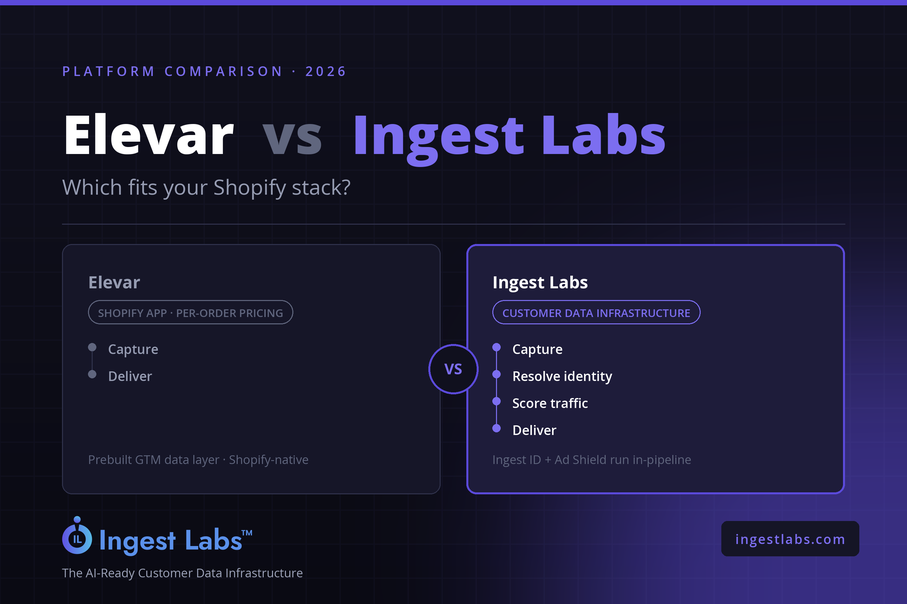
Short answer: Elevar is a Shopify-native conversion tracking app built on a prebuilt GTM data layer, priced by monthly order volume from around $225/month. Ingest Labs is a broader customer data infrastructure platform — server-side tagging, identity resolution and traffic-quality filtering — that isn't priced per order and isn't Shopify-only. Choose Elevar if you want fast, Shopify-specific conversion delivery. Choose Ingest Labs if order-based pricing breaks at your volume, or if your problem is signal quality rather than signal delivery.
The comparison most people are actually making
If you've landed here, you're usually in one of three situations.
You're on Elevar and your invoice has started climbing with your order count. You're evaluating server-side tracking for the first time and Elevar came up as the default Shopify answer. Or you've already fixed delivery — your events are arriving — and your ad platforms still can't attribute properly, which means the problem was never delivery.
Those are three different problems, and only the last one changes the answer decisively. Let's take them in order.
What each platform actually is
Elevar is a Shopify conversion tracking application. Its core asset is a prebuilt ecommerce data layer — product, customer and attribution fields structured correctly without custom development work — paired with server-side event delivery to GA4, Meta CAPI, Google Ads, TikTok, Pinterest and Klaviyo. It's an approved Shopify Checkout Extensibility partner and supports Shopify Markets. Elevar reports installation on roughly 6,300 Shopify stores and holds a 4.6 rating on the Shopify App Store.
Its architecture leans on server-side Google Tag Manager. You get a container, and the tag logic inside that container is yours to configure and maintain.
Ingest Labs is a customer data infrastructure platform. Server-side tagging is one of five products rather than the whole product: Ingest IQ handles server-side tagging, Ingest ID handles identity resolution, Event IQ handles analytics and orchestration, Ad Shield scores traffic quality, and Site Intelligence audits your existing tracking. It's SOC 2 Type II certified and MACH Alliance certified, with 35+ dedicated integrations and 100+ total connectors. On Gartner Peer Insights it holds 4.4 out of 5 across 55 ratings in the Tag Management category, with 92% of reviewers rating four stars or higher.
It is not Shopify-specific. That's a genuine trade-off in both directions, and it's the first thing to be honest about.
The architectural difference that drives everything else
Elevar's model is capture and deliver. Structure the data layer correctly, then route events server-side so they survive ad blockers, ITP and consent-stripped cookies. That model works, and for most stores it's the majority of the value.
Ingest Labs' model is capture, resolve, score, then deliver. Between collection and delivery, two things happen that don't happen in a delivery-only pipeline:
Identity resolution. Ingest ID stitches events to a persistent profile across sessions and devices before they're forwarded. A returning customer on a new device isn't a new anonymous user. This matters most where checkout-as-guest rates are high and email capture is inconsistent — the exact situation that caps Meta match rates in the low 80s no matter how clean your delivery is.
Traffic quality scoring. Ad Shield assigns an Audience Integrity Score from 0–100 using user-agent analysis, IP intelligence and behavioural signals, before events reach the platform. A delivery-only pipeline is agnostic about what it delivers — it will forward bot traffic to Meta CAPI as faithfully as it forwards a real purchase, and Meta will optimise against it.
That's the substantive difference. Not "server-side vs client-side" — both are server-side. The question is what happens to an event in the seconds between collection and delivery.
Side-by-side
| Elevar | Ingest Labs | |
|---|---|---|
| Category | Shopify conversion tracking app | Customer data infrastructure |
| Platform scope | Shopify / Shopify Plus, including headless | Shopify, plus web, mobile and offline sources |
| Core architecture | Prebuilt GTM data layer + server-side GTM | Server-side collection with identity resolution and traffic scoring in-pipeline |
| GTM knowledge required | Yes — tag logic lives in your container | No — configuration is in-platform |
| Identity resolution | Session enrichment | Persistent cross-session, cross-device profiles (Ingest ID) |
| Invalid traffic filtering | Not a stated function | Ad Shield, 0–100 Audience Integrity Score |
| Tracking audit | Real-time event logs and delivery alerts | Site Intelligence — free audit plus Chrome extension |
| Data quality monitoring | Delivery monitoring | Data Integrity Score |
| Third-party validation | 4.6 on Shopify App Store | 4.4/5 on Gartner Peer Insights (55 ratings) · SOC 2 Type II · MACH Alliance |
| Best fit | Shopify-only store that needs conversion delivery fixed quickly | Multi-source stack, high order volume, or a signal-quality problem |
The pricing model question
This is where most switching decisions are actually made, so it deserves precision rather than a jab.
Elevar prices by monthly online orders. Public figures reported through mid-2026 put the paid tiers around $200/month for 1,000 orders, $450 for 10,000 and $950 for 50,000, with per-order overages of roughly $0.15, $0.04 and $0.03 respectively; the Shopify App Store listing shows "from $225/month." High-volume merchants above 100,000 monthly orders are handled by custom arrangement. Pricing changes — verify against Elevar's own pricing page before you commit to a number internally.
Two things follow from an order-based model.
The first is straightforward: your tracking bill scales with the thing you're trying to grow. Double your orders and your measurement cost roughly doubles, even though the marginal cost of processing order 10,001 is effectively zero. Some teams are fine with that; it's at least legible. Others find it becomes the third-largest line item in the martech stack by the time they're at scale.
The second is subtler and worth more attention. Order-based pricing prices the outcome, not the input. A Shopify store fires far more non-order events than orders — product views, add-to-carts, checkout starts, subscription renewals, refunds. Those events are where audience-building and mid-funnel optimisation actually happen, and an order-priced model doesn't reflect their volume in either direction.
Elevar's counter-argument here is legitimate and you should weigh it: order-based pricing is predictable, easy to forecast, and Elevar doesn't gate features by tier — the entry plan gets the same tracking capability as the top plan. That's a genuinely customer-friendly structure and rarer than it should be.
Ingest Labs isn't priced per order. [[Insert current pricing model and entry point — do not publish this section with a placeholder.]]
Where Elevar is the better choice
Being straight about this makes the rest of the page more credible, and it's also just true.
You're Shopify-only and want this solved this week. Elevar's install is genuinely fast, the data layer is prebuilt for Shopify's schema, and you won't need a developer for a standard configuration. If your requirement is "get accurate purchase events into Meta and GA4 and stop thinking about it," that's the product's centre of gravity.
You already run GTM and want to keep control. If your team is comfortable in a server-side container and wants tag logic under its own hand, Elevar's architecture fits that working style rather than fighting it.
You're under roughly 1,000 orders a month. At that volume, order-based pricing is cheap and the cost objection doesn't apply yet. Cross that bridge later.
Delivery monitoring is your top requirement. Elevar's real-time event logs and automated alerting when tracking breaks are a strong, well-executed feature. Finding out two weeks late that a tag died is a real cost, and Elevar addresses it directly.
If two or more of those describe you, the honest recommendation is Elevar, and you can stop reading here.
Where Ingest Labs is the better choice
Your stack isn't only Shopify. Retail POS, a mobile app, a subscription platform, offline conversions, a separate marketing site. Elevar's strength is Shopify specificity, which becomes a constraint the moment meaningful volume sits outside Shopify. Ingest Labs unifies web, mobile and offline sources into one stream, which is a different problem shape.
Order-based pricing has stopped making sense at your volume. Somewhere past 50,000 monthly orders, the arithmetic changes character. Model it against your own twelve-month order forecast, not today's number.
Your match rates are stuck despite clean delivery. This is the clearest signal. If events are arriving — you can see them in the logs — and Meta Event Match Quality still sits in the 60s, more delivery won't fix it. The bottleneck is identity: guest checkouts, cross-device journeys, returning customers who look anonymous. That's what Ingest ID addresses, and it's structurally different from routing events faster.
You suspect you're paying to optimise against bots. If a meaningful share of your traffic is invalid and you're forwarding it to Meta CAPI, you're actively training the algorithm on non-buyers. Ad Shield scores traffic before it reaches the platform. Run Site Intelligence first — it's free — and see whether this is a real problem for you before treating it as a reason to switch.
You need certification for procurement. SOC 2 Type II and MACH Alliance certification matter in enterprise review cycles in a way they don't for a 500-order DTC store.
Migrating without breaking attribution mid-flight
If you do move, the failure mode is a measurement gap in the changeover week that makes every subsequent read untrustworthy.
Run both in parallel for two weeks. Deduplicate on event_id so Meta doesn't double-count. Baseline your current Event Match Quality, GA4 purchase count and platform-reported ROAS before you touch anything — you cannot prove a lift without a before. Cut over one destination at a time, starting with the lowest-spend platform. Keep the old pipeline warm for a full attribution window after cutover, not a full week.
The full sequence is in the complete guide to server-side tracking.
A decision framework in four questions
-
Is more than 20% of your revenue signal generated outside Shopify? Yes → Ingest Labs. No → continue.
-
Are your events arriving but your match rates still stuck below 80%? Yes → this is an identity problem; Ingest Labs. No → continue.
-
Does your twelve-month order forecast put order-based pricing above what you'd pay for a platform licence? Yes → model both. No → continue.
-
Do you want this live this week with no GTM work? Yes → Elevar.
Most stores under 5,000 monthly orders that live entirely on Shopify should choose Elevar. That's not a concession; it's the shape of the market.
The verdict
Elevar and Ingest Labs are not competing for the same job description. Elevar is the best-known answer to "my Shopify conversion tracking is broken," and it answers that question well, quickly, and with real Shopify-specific depth. Ingest Labs answers a different question: "my data infrastructure is fragmented, my identity graph is thin, and I'm not sure what my events are worth."
If you're not sure which question you're asking, that's diagnosable rather than debatable. Run the free Site Intelligence audit — it reports what's currently firing, what's missing, and what share of your traffic looks invalid. If delivery is the gap, Elevar will likely solve it. If delivery is fine and the numbers still don't reconcile, the problem is downstream of anything a delivery tool can fix.
Frequently asked questions
What is the best Elevar alternative for Shopify in 2026?
It depends on which problem you have. For Shopify-only stores that want a like-for-like swap with simpler pricing, Stape and the flat-fee Shopify tracking apps are the closest match. For stores whose issue is identity resolution or traffic quality rather than event delivery, a customer data infrastructure platform such as Ingest Labs is a different category of answer. For a full field comparison, see our best server-side tracking tools for Shopify.
How much does Elevar cost?
Elevar prices by monthly online order volume. The Shopify App Store listing shows plans from around $225/month, with reported tiers near $200 for 1,000 orders, $450 for 10,000 and $950 for 50,000 orders, plus per-order overages. Verify current figures on Elevar's own pricing page.
Does Elevar require Google Tag Manager?
Yes. Elevar's architecture is built on a GTM data layer and server-side GTM containers. Basic setup doesn't require a developer, but tag logic lives in your container and needs someone who understands it for anything non-standard.
Is Ingest Labs a direct Elevar replacement?
Not exactly. Ingest IQ covers the server-side tagging function that overlaps with Elevar, but Ingest Labs is a five-product platform that also handles identity resolution, traffic quality scoring and tracking audit. Stores that only need Shopify conversion delivery are buying more than they need.
Will switching improve my Meta Event Match Quality?
Only if your EMQ problem is caused by identity gaps rather than delivery gaps. If events aren't reaching Meta at all, any server-side tool helps. If events arrive but match on too few parameters, the fix is richer identity data — see improving Meta Event Match Quality.
Can I use Elevar and Ingest Labs together?
Technically yes, though you'd be paying twice for overlapping delivery. The more common pattern is running Site Intelligence as a free diagnostic alongside an existing Elevar install to establish what's actually broken before deciding anything.
How long does migration take?
Plan two weeks of parallel running plus one attribution window before decommissioning the old pipeline. Same-day cutovers create a measurement gap that undermines the comparison you're trying to make.
Does server-side tracking make me GDPR compliant?
No. Server-side tracking changes where data is processed, not whether you have a lawful basis for processing it. You still need consent management, and consent state has to be honoured server-side. See server-side tracking for the full definition.