How to Implement Multi-Touch Attribution Models

Marketing teams today work across multiple channels, devices, and customer touchpoints. You invest in search ads, social campaigns, email journeys, and more, yet identifying what truly drives conversions often remains unclear. Last-click reporting skews credit toward the final interaction, early touchpoints get ignored, and budget decisions rely on partial data. Over time, this leads to misallocated spend, wasted effort, and unclear performance insights.
Multi-touch attribution models address this gap by assigning value across every meaningful interaction in the customer journey. When implemented correctly, you get better insights into campaign performance, improve how marketing dollars are allocated, and better understand how customers engage with your brand.
The multi-touch attribution market is expected to reach USD 4.61 billion by 2030, expanding at a 13.66% CAGR, as businesses seek more accurate ways to measure impact. This blog walks you through what MTA is, the types of models you can use, how to implement them effectively, and outlines common challenges and ways to address them.
At a glance:
- Multi-touch attribution (MTA) provides a complete view of how all marketing touchpoints contribute to conversions, rather than relying only on last-click reporting.
- Machine learning strengthens MTA by dynamically assigning credit, recognizing patterns, and analyzing cross-channel interactions to deliver more accurate insights.
- Selecting the right attribution model, consolidating your data, mapping touchpoints, and implementing proper tracking help you achieve actionable and reliable performance measurement.
- Common challenges include fragmented data, privacy limitations, model selection, technical complexity, and stakeholder alignment, which you can address through structured processes and best practices.
What is Multi-Touch Attribution and Why It Matters?
Multi-touch attribution refers to frameworks that assign credit to each interaction a user has with your marketing touchpoints prior to conversion. Instead of giving all the credit to the first or last click, MTA recognizes that buyers typically engage with multiple channels before converting.
In practice, this means you can understand how channels such as paid search, organic social, email marketing, and referral traffic collectively contribute to outcomes.
Here’s why it matters:
- Reduced last-click dependency: Attribution moves beyond giving all credit to the final interaction and accounts for earlier touchpoints that influence intent.
- Smarter budget decisions: By identifying which channels assist conversions, you can allocate your spend based on impact instead of assumptions.
- Clearer campaign optimization: Performance insights across journey stages allow you to adjust messaging, timing, and channel mix with greater clarity.
- Privacy-aligned measurement: First-party data–based attribution supports accurate insights while aligning with privacy expectations in the US and Canada.
By mapping how touchpoints work together, multi-touch attribution provides a more reliable foundation for performance analysis and revenue-focused marketing decisions.
Also Read: Understanding Multi-Touch vs. Last-Touch Attribution
Read on to explore how machine learning enhances multi-touch attribution for more precise insights.
Role of Machine Learning in Multi-Touch Attribution
Machine learning strengthens multi-touch attribution by analyzing large volumes of interaction data and identifying patterns that static models often miss. Instead of relying on fixed rules, ML adapts attribution based on real user behavior.
Here’s how it helps in multi-touch attribution:
- Dynamic Credit Allocation: Machine learning assigns conversion credit based on how each touchpoint influences outcomes, rather than predefined weightings. This allows you to see which channels consistently drive results across customer journeys.
- Pattern Recognition Across Journeys: ML analyzes thousands of customer paths to identify recurring behaviors, drop-off points, and high-impact interactions. This works well when you manage long or complex journeys.
- Cross-Channel Interaction Analysis: Machine learning evaluates how channels work together, not in isolation. You can identify combinations that move customers forward instead of relying on single touchpoints.
- Improved Accuracy Over Time: As more data flows in, ML models continuously refine attribution logic. This helps you keep insights aligned as campaigns, audiences, and platforms change.
- Scalability for Large Data Sets: For enterprises and agencies managing high data volumes, ML handles complexity efficiently, allowing you to maintain accurate attribution without manual effort.
By applying machine learning to multi-touch attribution, you create a data-driven measurement framework that supports better budget decisions and stronger marketing outcomes.
Now, let’s look at the different models you can apply to assign credit across touchpoints.
Types of Multi-Touch Attribution Models
Different multi-touch attribution models distribute conversion credit in different ways. Each model reflects how you evaluate which interactions matter most.
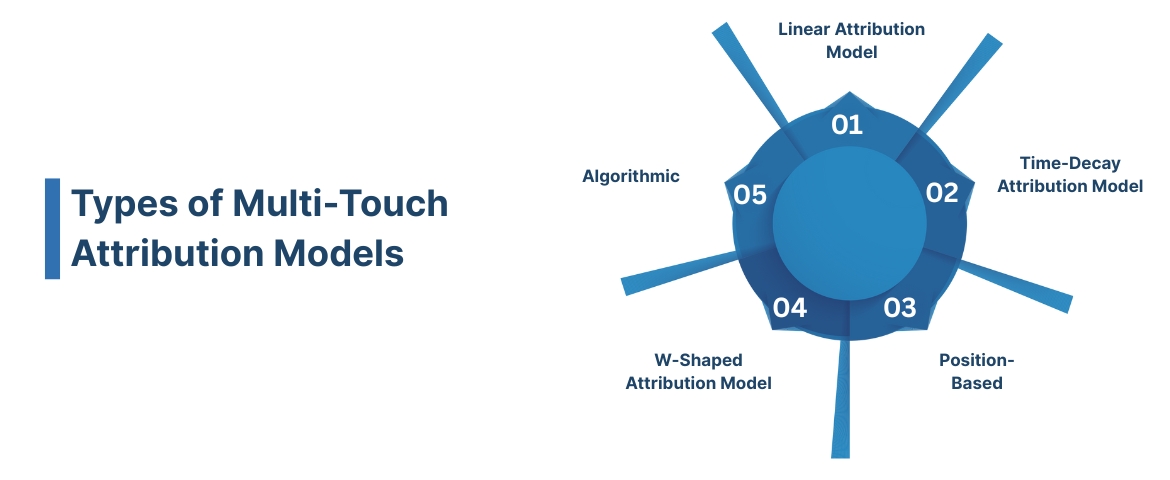
Common model types include:
1. Linear Attribution Model
This model assigns equal credit to every touchpoint in the customer journey. Each interaction carries equal weight in driving the final conversion, regardless of timing or position.
Example: A customer discovers your brand through a LinkedIn ad, visits your site via organic search, clicks a retargeting ad, and converts through an email campaign. Each channel receives 25% credit for the conversion.
Ideal use-case: Works well when you want a balanced view of how all channels contribute across longer, multi-step journeys.
Avoid when: Not ideal if certain touchpoints clearly play a stronger role than others in influencing conversions.
2. Time-Decay Attribution Model
Time-decay attribution assigns more credit to interactions that happen closer to the conversion event. Earlier touchpoints still receive credit, but less weight compared to recent engagements.
Example: A shopper clicks a paid social ad two weeks before purchase, engages with a display ad three days later, and converts after clicking a paid search ad on the same day. The paid search interaction receives the highest credit.
Ideal use-case: Best for campaigns where recent interactions strongly influence purchase decisions, such as promotions or limited-time offers.
Avoid when: Avoid using this model if early awareness campaigns are a major driver of long-term conversions.
3. Position-Based (U-Shaped) Attribution Model
Position-based attribution assigns most of the credit to the first and last touchpoints, while the remaining credit is distributed among interactions in between. This model highlights both discovery and conversion moments.
Example: A user first finds your brand through an organic blog post, engages with a paid ad, attends a webinar, and finally converts through an email. The first blog visit and final email click receive the highest share of credit.
Ideal use-case: Effective when both brand discovery and conversion triggers are equally important to your strategy.
Avoid when: Not suitable if mid-funnel engagement plays a decisive role in influencing conversion outcomes.
4. W-Shaped Attribution Model
The W-shaped model expands on position-based attribution by assigning higher credit to three key milestones: first interaction, lead creation, and final conversion, with remaining credit spread across other touches.
Example: A user clicks a paid ad, signs up for a newsletter, attends a webinar, and then converts. The first click, newsletter signup, and final conversion each receive higher credit.
Ideal use-case: Useful for B2B or high-consideration funnels where lead qualification stages matter.
Avoid when: Avoid if your funnel is short or doesn’t clearly separate lead-creation stages.
5. Algorithmic (Data-Driven) Attribution Model
Data-driven attribution uses statistical analysis or machine learning to assign credit based on actual customer behavior patterns rather than fixed rules. Credit allocation adjusts as new data becomes available.
Example: If historical data shows that users who interact with product comparison pages convert more often, the model assigns higher credit to those interactions across similar journeys.
Ideal use-case: Best for organizations with large volumes of clean, unified data across multiple channels.
Avoid when: Not recommended if your data is fragmented, inconsistent, or too limited for reliable analysis.
Each model has its merits, and in many cases, testing multiple approaches provides the best strategic direction. Selecting thoughtfully ensures your insights align with business goals and customer behavior.
Also Read: Explore Multi-Touch Attribution (MTA) for Effective Marketing
Next, let’s break down the steps to implement the multi-touch attribution model effectively.
Key Steps to Implement Multi-Touch Attribution Models
Implementing a multi-touch attribution model requires structured planning, well-organized data, and a clear view of how your marketing activities work together. Here’s a step-by-step process you can follow:
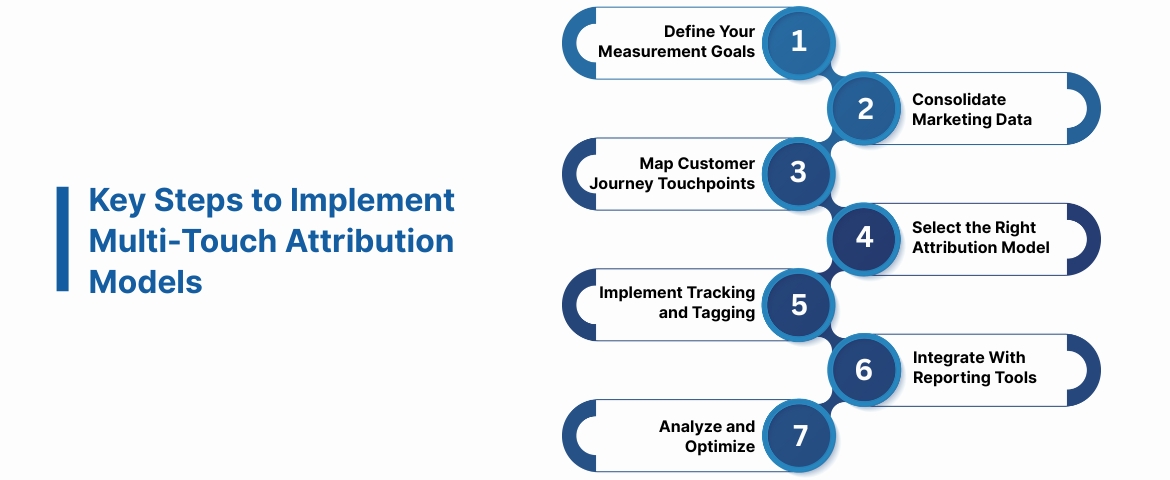
Step 1: Define Your Measurement Goals
Before setting up any attribution model, defining clear measurement goals is essential. If success is not clearly defined, the data you collect can become misleading or underused.
Your goals decide which interactions you track, how credit is assigned, and how you make decisions around budget allocation, campaign improvement, and growth strategies.
Key Areas to Define:
Goal Component
What to Consider
Business Impact
Conversion Definition
Decide which actions count as a conversion (e.g., sale, form fill, app install, newsletter subscription)
Establishes the baseline for measuring marketing effectiveness
KPIs
ROI, customer acquisition cost (CAC), engagement rate, revenue per channel
Aligns MTA insights with business outcomes that matter
Strategic Objectives
Retention, customer lifetime value, and upsell potential
Helps teams focus on long-term marketing impact rather than short-term metrics
Defining clear goals ensures your attribution framework is relevant, actionable, and capable of guiding effective marketing strategies.
Step 2: Consolidate Marketing Data
Attribution accuracy relies on complete and connected data. When interaction data is spread across ad platforms, analytics tools, CRMs, and e-commerce systems, attribution results become fragmented.
Unifying these data sources creates a single view of the customer journey and allows models to assign credit consistently.
What to bring together:
- Paid media interactions (search, social, display, video)
- Owned channels (website events, email engagement, mobile app activity)
- Conversion and revenue data from CRM or commerce platforms
- Consent and preference signals tied to user interactions
Data Consolidation Practices:
- Centralized Repository: Collect all interaction data into a unified system, such as a customer data platform (CDP) or centralized analytics hub.
- Server-Side Tracking: Capture events that may be blocked by browser restrictions or cookie limitations.
- Standardization: Use consistent event names, campaign labels, and touchpoint categories across platforms to ensure comparability.
Accurate, unified data creates a reliable foundation for attribution and prevents gaps that could misrepresent channel performance. Without consolidation, insights from MTA can be incomplete or misleading.
Step 3: Map Customer Journey Touchpoints
Understanding the full journey your customers take before converting is vital. Many businesses assume the final interaction drives conversions, but mapped journeys often show multiple channels influencing decisions.
Steps to Map Touchpoints:
- Identify Channels: List every potential touchpoint: organic search, paid search, social media, display ads, email, referral traffic, offline events, and app interactions.
- Track Sequences: Document common sequences leading to conversion to see how touchpoints interact.
- Segment Journeys: Group by audience type, campaign, or device to analyze variations in paths to conversion.
Mapping touchpoints helps you understand journey complexity and ensures that all meaningful interactions receive appropriate credit in the attribution model.
Step 4: Select the Right Attribution Model
Choosing a model that aligns with your business goals and data maturity helps you get insights you can apply directly. Each model offers a different way to assign credit, so selecting the right approach directly affects how performance is evaluated.
Comparison of Attribution Models:
Model
Best For
Advantages
Linear
Equal value to all touchpoints
Simple, easy to explain
Time-Decay
Emphasizes late-stage interactions
Highlights conversion-driving activities
Position-Based
First and last touch emphasis
Balances brand awareness and final conversion
Data-Driven
Uses historical data patterns
Most precise, dynamic allocation
Considerations for Selection:
- Evaluate historical data to determine which model best reflects actual customer behavior.
- Align the model with strategic goals, such as emphasizing acquisition, retention, or upsell opportunities.
- Involve key stakeholders to ensure alignment with marketing, analytics, and finance teams.
The right model reduces the risk of misallocated spend and supports data-backed decision-making.
Step 5: Implement Tracking and Tagging
Reliable tracking ensures every touchpoint is captured and attributed accurately. This step includes technical setup and ongoing validation to avoid data gaps.
Implementation Checklist:
- Consistent Tagging: Standardize how clicks, impressions, and conversions are tagged across platforms.
- First-Party Data Capture: Prioritize consented first-party signals to maintain compliance with regulations like CCPA and GDPR.
- Validation and Testing: Regularly test tracking setups to ensure all events and interactions are recorded correctly across web, mobile, and offline channels.
Accurate tracking is the backbone of any attribution system. Without it, even the most sophisticated models can produce misleading results.
Step 6: Integrate With Reporting Tools
Integration with reporting and analytics tools allows you to turn attribution data into insights your teams can act on. Dashboards help you review performance, compare channels, and make informed decisions faster.
Integration Best Practices:
- Visual Dashboards: Create real-time dashboards showing performance by channel, campaign, and audience segment.
- Automated Reports: Schedule regular updates to minimize manual work and reduce the risk of errors.
- Filterable Views: Enable filtering by conversion type, timeframe, or device to support targeted analysis.
Proper integration ensures your teams can easily interpret attribution data and take timely action.
Step 7: Analyze and Optimize
MTA works best as an ongoing process rather than a one-time setup. Once implemented, regular analysis and refinement help you stay aligned with changing business goals.
Optimization Practices:
- Performance Monitoring: Compare expected outcomes with model results to validate assumptions.
- Adjust Touchpoint Weighting: Modify allocation if certain interactions appear disproportionately influential.
- Regular Iteration: Update models and strategies as customer behavior, campaigns, or channel effectiveness evolve.
By consistently monitoring and refining your approach, you can improve ROI, support better budget allocation, and strengthen overall marketing performance.
By following these steps, you move beyond basic tracking toward structured, comparable measurement that supports clearer and more confident decisions.
Now, let’s examine common challenges and ways to overcome them.
Common Challenges in Multi-Touch Attribution and How to Overcome Them
Even with a good framework, implementing multi-touch attribution comes with practical challenges. Below are some common obstacles and tips to help you address each.
1. Fragmented Data Across Platforms: Marketing data often lives in separate silos, advertising platforms, analytics tools, and CRMs, which makes it harder for you to unify data into a single customer view.
Tips to Overcome:
- Centralize Data: Use a CDP or data warehouse to ingest and unify touchpoints from all major channels.
- Standardize Event Schemas: Develop consistent naming conventions and event properties across platforms.
- Automate Data Pipelines: Reduce manual data handling with automated ingestion and transformation processes.
2. Loss of Tracking Signals Due to Privacy Changes: With restrictions on third-party cookies and increased privacy controls, you may find it harder to capture consistent user signals.
Tips to Overcome:
- Prioritize First‑Party Data: Collect and control your own data to reduce reliance on third‑party identifiers.
- Implement Server‑Side Tracking: This improves reliability and bypasses some browser limitations on client‑side measurement.
- Manage Consent Transparently: Ensure clear consent collection that aligns with privacy law requirements like CCPA and other regional rules.
3. Choosing the Wrong Model for Your Business: Selecting a model that doesn’t align with your audience behavior or goals can lead you to inaccurate conclusions.
Tips to Overcome:
- Test Multiple Models: Compare outputs from different models to see which aligns best with your business outcomes.
- Align with Business Outcomes: Choose a model that supports your primary KPI, whether that’s revenue, ROAS, lead quality, or retention.
- Review Regularly: Markets evolve, and your model should too. Validate performance and tweak as needed.
4. Technical Complexity: Setting up tagging, integrating platforms, and configuring models may require skills and resources your team does not always have.
Tips to Overcome:
- Simplify Implementation: Adopt tools that remove code dependencies and simplify tagging.
- Stage Rollouts: Implement essential channels first before adding complexity.
- Provide Training & Documentation: Ensure teams understand tracking workflows and data flows.
5. Stakeholder Buy-In: Getting agreement from finance, marketing, and analytics teams on attribution models and results can be difficult.
Tips to Overcome:
- Show Budget Impact: Present examples of how attribution insights influence budget allocation.
- Share Benchmarks: Provide comparisons across models so teams see differences in results.
- Tie to Business Goals: Link attribution insights to key objectives like revenue growth, retention, or customer experience.
How Ingest Labs Can Support Your Attribution Journey?
Ingest Labs provides a suite of products designed for server-side tracking, first-party identity, and customer data intelligence; all components you need to run reliable, privacy-aware multi-touch attribution at scale.
Here’s how we can help you:
- First-Party Data Capture: Collect interaction data across web and mobile channels without relying on third-party cookies, ensuring more reliable attribution insights.
- Server-Side Tracking with Ingest IQ: Capture customer signals accurately across devices and channels, bypassing browser limitations for more precise conversion data.
- Persistent User Identification with Ingest ID: Assign a first-party identifier to each unique visitor, enabling consistent tracking across sessions and a deeper understanding of the customer journey.
- Unified Insights with Event IQ: Centralize data from multiple touchpoints and campaigns, providing actionable insights to identify high-impact channels and optimize marketing strategies.
- Privacy-First Compliance: Manage consent and implement GDPR, CCPA, and other privacy law-compliant tracking practices to maintain customer trust.
- Seamless Data Integration: Connect CRM, analytics, and marketing platforms to streamline workflows, unify customer data, and simplify multi-channel analysis.
- Actionable Reporting: Access real-time dashboards and reports that highlight attribution patterns, campaign performance, and ROI opportunities, enabling informed decision-making.
With Ingest Labs, you don’t just get data collection, you get a reliable foundation for measurement that supports smarter spending, better insights, and stronger outcomes.
Conclusion
Multi-touch attribution is essential for understanding how each marketing interaction contributes to conversions and long-term revenue. By assigning credit to multiple touchpoints across the customer journey, you gain a clearer picture of what drives results. This empowers you to allocate your budget with confidence and fine-tune strategies based on performance.
Successful implementation requires accurate data collection, intentional model selection, and continuous refinement. Partnering with expert solutions like Ingest Labs can make your MTA implementation more accurate and more practical.
Contact us today to discuss how our tools can support your attribution strategy and help you make marketing decisions that drive measurable outcomes.
FAQs
1. What data sources and tools are required for multi-touch attribution?
Multi-touch attribution needs data from CRM systems, marketing automation tools, ad platforms, web analytics, and offline sales systems. Common tools include Google Analytics, CDPs, attribution platforms, and data warehouses to unify touchpoints across channels and map them to conversions accurately.
2. How can you integrate multi-touch attribution with existing analytics platforms?
Integration usually involves connecting ad platforms, CRM, and marketing tools via APIs or data connectors. Data is then standardized and synced with analytics platforms like GA4 or BI tools, allowing attribution models to run alongside existing reports without disrupting current measurement setups.
3. What KPIs should you track to measure multi-touch attribution success?
Key KPIs include conversion rate by channel, cost per acquisition, return on ad spend, pipeline contribution, and revenue attribution accuracy. Tracking changes in budget efficiency and improved channel visibility also helps assess whether the attribution model is delivering actionable insights.
4. How does data privacy compliance affect multi-touch attribution implementation?
Data privacy laws require careful handling of user data, limiting how identifiers are collected and stored. Consent management, anonymization, and first-party data strategies become essential, which can influence tracking depth and model accuracy but ensure attribution remains compliant and sustainable.
5. What are the best practices for testing and optimizing multi-touch models?
Best practices include starting with simpler models, validating results against historical data, and running controlled experiments. Regularly review assumptions, update models as channels evolve, and compare outputs across models to ensure insights remain reliable and aligned with business goals.