Customer Acquisition: Meaning, Types and Examples (2026)
Updated November 23, 2026
Short answer: Customer acquisition is the process of turning people who have never bought from you into paying customers, and the spend, channels and measurement behind it. The main types are organic (search, content, social), paid (search, social and display ads), referral and partner, and sales-led outbound for B2B. Paid acquisition means buying that attention through ad platforms, and it now dominates budgets: Gartner's 2025 CMO Spend Survey found paid media takes 30.6% of marketing budgets. The core metric is customer acquisition cost (CAC), meaning sales and marketing spend divided by new customers won in the same period. A common health check is that customer lifetime value should be more than 3 times CAC, with CAC recovered in under 12 months. Both numbers are only as good as the attribution data behind them, so the channel that gets credit for a new customer decides where next quarter's budget goes.
What customer acquisition means
In marketing, "acquisition" means winning a new customer. It is not the same as a business acquisition, where one company buys another. Older guides, including the earlier version of this page, borrowed the M&A terms "horizontal" and "vertical" acquisition. For marketing teams, the useful split is by channel and by cost, because that is how budgets are planned and judged.
Customer acquisition covers three jobs:
-
Reach: getting in front of people who fit your ideal customer profile.
-
Conversion: turning that attention into a first purchase, sign-up or signed contract.
-
Measurement: knowing which channel produced each new customer, and what it cost.
The third job is where most acquisition programmes break. A channel that looks expensive may be under-credited because its conversions were never recorded, and a cheap-looking channel may be taking credit for customers it did not win.
Types of customer acquisition
| Type | How it works | Typical channels | What to measure |
|---|---|---|---|
| Organic | Customers find you without paid placement | SEO, AI answer engines, content, organic social, community | New customers by first-touch source, cost of content and SEO time |
| Paid | You buy reach on an ad platform | Google Ads, Meta, LinkedIn, TikTok, display, retail media | Paid CAC, ROAS, incrementality |
| Referral and partner | Existing customers or partners send new ones | Referral programmes, affiliates, marketplaces, resellers | Cost per referred customer, partner payouts |
| Sales-led (B2B) | Your team starts the conversation | Outbound email, events, account-based programmes | Pipeline created, win rate, sales cost per new account |
Most growing companies run all four. The mix matters more than any single channel, because each type has a different cost curve: organic is slow to start and cheap at scale, while paid is fast to start and gets more expensive as you saturate an audience.
What is paid acquisition?
Paid acquisition is customer acquisition through media you pay for: search ads, paid social, display, video and retail media. You pay per impression, click or result, and the platform's algorithm decides who sees the ad, based on the conversion signals you send back.
It is now the largest single line in most marketing budgets. Gartner's 2025 CMO Spend Survey of 402 marketing leaders found that marketing budgets held at 7.7% of company revenue, and paid media took 30.6% of that budget, or 2.4% of revenue. Digital channels accounted for 61.1% of total marketing spend. Within digital, paid search had the largest share at 13.9%, ahead of display at 12.5% and social advertising at 12.2%.
Gartner also noted that media price inflation means CMOs are getting less for each dollar. That makes paid CAC the number finance teams watch most closely.
How to calculate customer acquisition cost (CAC)
CAC = total sales and marketing cost in a period ÷ new customers acquired in that period
Teams usually track two versions:
-
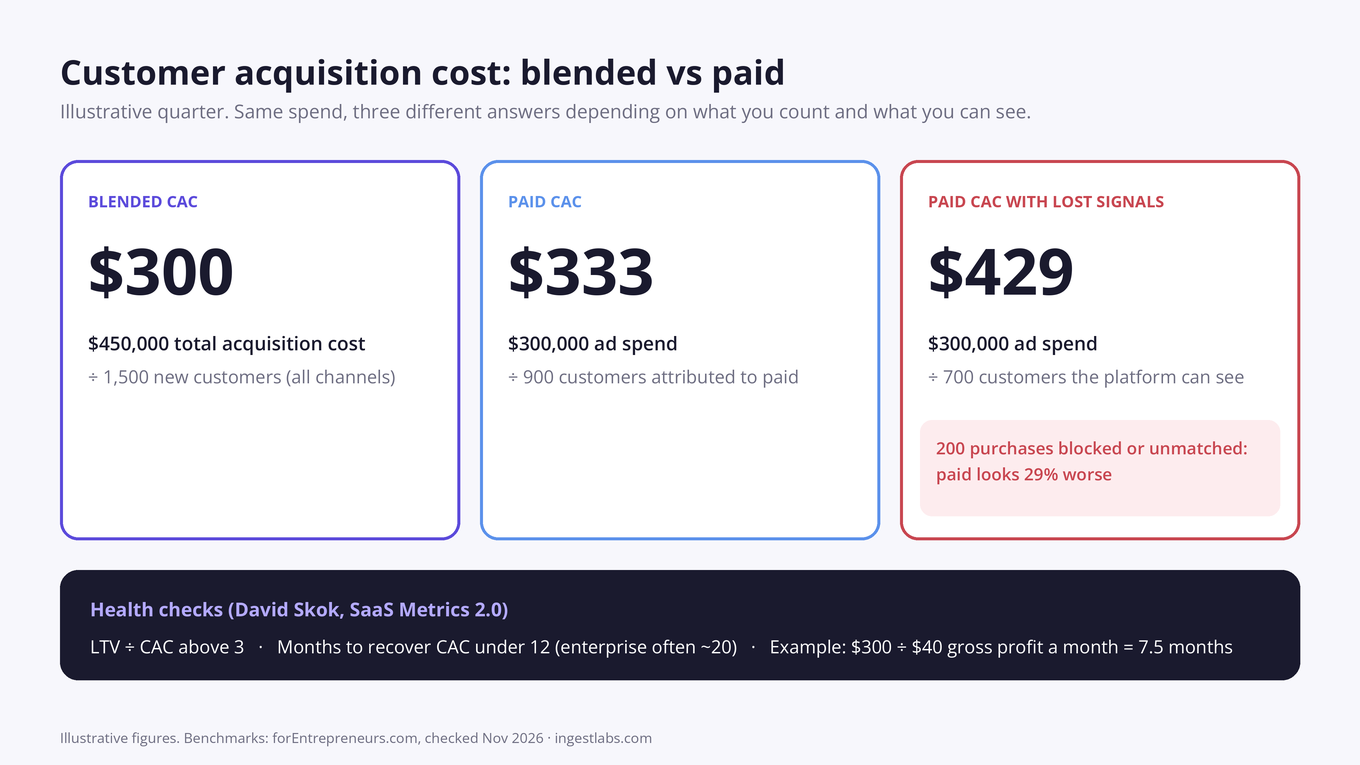
Blended CAC counts every new customer and all acquisition spend, including salaries, tools and agencies.
-
Paid CAC counts only ad spend and only customers attributed to paid channels.
Here is a worked example with illustrative numbers:
| Line | Value |
|---|---|
| Quarterly ad spend | $300,000 |
| Salaries, tools and agency fees for acquisition | $150,000 |
| New customers in the quarter (all channels) | 1,500 |
| New customers attributed to paid channels | 900 |
| Blended CAC ($450,000 ÷ 1,500) | $300 |
| Paid CAC ($300,000 ÷ 900) | $333 |
| Average gross profit per customer per month | $40 |
| Months to recover blended CAC ($300 ÷ $40) | 7.5 months |
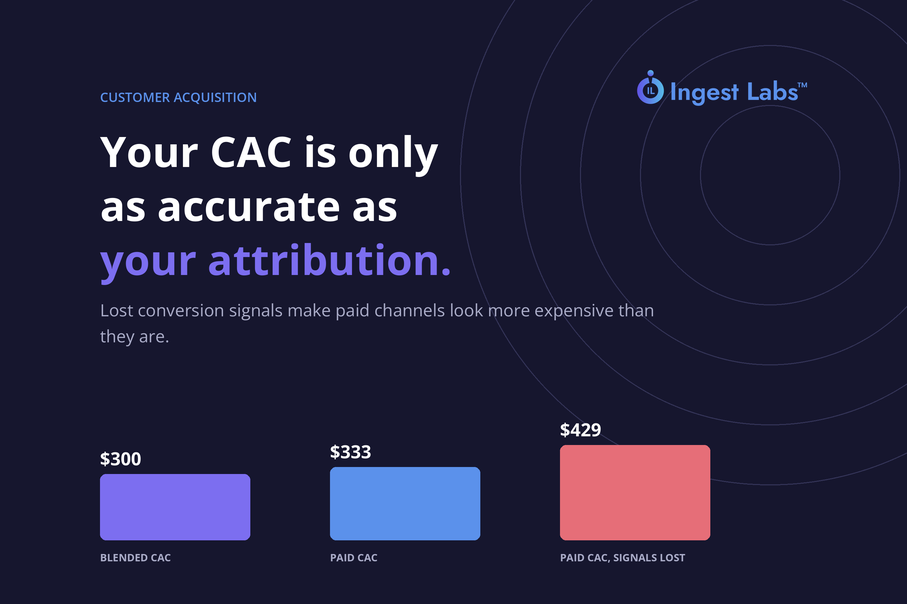
The paid CAC line depends entirely on attribution. If 200 of those paid customers were never recorded as paid, because a purchase event was blocked or arrived without click IDs, the platform reports 700 customers instead of 900. Paid CAC then appears as $429, 29% higher than it really is, and the channel looks worse than it is.
What is a good CAC? Benchmarks to use with care
Two benchmarks come up in most acquisition reviews:
-
LTV to CAC above 3. Investor David Skok introduced this guideline in his SaaS Metrics 2.0 work, saying the best SaaS businesses run higher than 3 and sometimes reach 7 or 8. He has also said he arrived at 3 by observation rather than from a formal study.
-
CAC payback under 12 months. Skok's original guideline was 12 months or less. He later noted that healthy enterprise businesses with a land-and-expand model often take around 20 months, and suggested improving anything above 24 months.
Treat the widely quoted claim that acquisition costs "5 to 25 times" more than retention with caution. It traces back to a 2014 Harvard Business Review explainer that gave the range without citing a specific study. Your own ratio, calculated from your own data, is the number to plan with.
Customer acquisition examples
Four common patterns, and the measurement trap in each:
-
B2B SaaS, paid search to demo. A software company bids on category terms, sends traffic to a demo page, and counts a customer when the contract is signed. CAC must include sales time, and the conversion happens weeks after the click, so the CRM's closed-won event has to flow back to Google Ads as an offline conversion.
-
D2C brand, Meta prospecting. A consumer brand runs broad prospecting campaigns and lets Meta's algorithm find buyers. The algorithm learns from the Purchase events it receives, so missing or duplicated events directly raise CAC.
-
Marketplace partner listing. A retailer lists products on a third-party marketplace and pays per sale. CAC is the commission plus any promoted-listing spend, but the customer relationship and data may stay with the marketplace.
-
Referral programme. A subscription business gives existing customers a credit for each referral. CAC is the credit plus programme costs, and referred customers often retain better, which raises their LTV.
How to measure acquisition correctly
Acquisition numbers fail in three predictable places:
-
Which report you read. In Google Analytics 4, the User acquisition report is scoped to new users and credits each user's first source, while the Traffic acquisition report is scoped to sessions. A user who first arrives from Google and returns ten times directly shows all 11 sessions under Google in User acquisition, but only 1 there in Traffic acquisition. Use User acquisition to judge which channels win new customers.
-
Lost conversion signals. Ad blockers, browser tracking limits and consent choices stop some browser-side purchase events from reaching ad platforms. Server-side tracking sends the same events from your own server, so platforms see more of the customers they helped acquire. Our guide to server-side tracking covers the set-up.
-
One customer, many devices. A buyer who clicks an ad on a phone and buys on a laptop can look like two people. Without identity resolution, the purchase is credited to "direct" and paid CAC is overstated. See our cross-device attribution guide.
How Ingest Labs fits
Ingest IQ handles server-side tagging, so purchase and lead events reach Google, Meta and other platforms from your server rather than only from the browser. Ingest ID keeps a first-party identifier across devices and sessions, so a returning customer is not counted as new and the original channel keeps its credit. Event IQ brings ad-platform, analytics and order data into one view, so blended and paid CAC come from the same numbers. For the cost side of the equation, see our guides to CAC and ROAS.
FAQ
What is customer acquisition?
Customer acquisition is the process of winning new paying customers, together with the channels, spend and measurement behind it. It covers reaching people who fit your target profile, converting them into a first purchase or contract, and recording which channel produced each customer and at what cost. It differs from a business acquisition, where one company buys another.
What is paid acquisition?
Paid acquisition is winning customers through media you pay for, such as search ads, paid social, display and retail media. You pay per impression, click or result. Gartner's 2025 CMO Spend Survey found paid media takes 30.6% of marketing budgets, the largest single share, which is why paid CAC gets close attention from finance teams.
How do you calculate customer acquisition cost?
Divide total sales and marketing cost for a period by the number of new customers acquired in that period. Blended CAC uses all spend and all new customers. Paid CAC uses ad spend and only the customers attributed to paid channels. For example, $450,000 of spend and 1,500 new customers gives a blended CAC of $300.
What is a good LTV to CAC ratio?
A widely used guideline is that customer lifetime value should be more than 3 times CAC, introduced by investor David Skok for SaaS businesses. He suggested recovering CAC within 12 months, while noting that enterprise businesses often take around 20 months. Treat both as starting points and set targets from your own margins and retention.
What is the difference between user acquisition and traffic acquisition in GA4?
The User acquisition report shows new users and credits each one to the source of their first visit. The Traffic acquisition report shows sessions and credits each session to its own source, whether the user is new or returning. Use User acquisition to see which channels bring in new customers, and Traffic acquisition to see what drives repeat visits.
Sources
-
Gartner, "Gartner 2025 CMO Spend Survey Reveals Marketing Budgets Have Flatlined at 7.7% of Overall Company Revenue," May 12, 2025 (checked November 23, 2026)
-
Gartner, "Gartner Survey Finds Digital Channels Account for 61.1% of Total Marketing Spend," June 2, 2025 (checked November 23, 2026)
-
David Skok, "SaaS Metrics 2.0" and "SaaS Metrics 2.0 – Definitions," forEntrepreneurs (checked November 23, 2026)
-
SaaStr, David Skok "Driving SaaS Success Using Key Metrics" transcript (origin of the 3x guideline)
-
Amy Gallo, "The Value of Keeping the Right Customers," Harvard Business Review, October 29, 2014
-
Google Analytics Help, "[GA4] User acquisition report vs. Traffic acquisition report" and "Traffic-source dimensions" (checked November 23, 2026)