Split Testing Tools in 2026: How to Choose the Right One
Updated November 23, 2026
Short answer: The right split testing tool depends on who runs the tests and where. Marketing teams testing web pages usually pick a visual-editor platform such as VWO, Optimizely Web Experimentation, AB Tasty, Convert or Kameleoon, or Adobe Target in an Adobe stack. Product and engineering teams testing features use feature-flag platforms such as Statsig, Eppo, LaunchDarkly, PostHog or GrowthBook. Mobile app teams often start with Firebase A/B Testing, and Shopify stores can use Shopify Rollouts or a Shopify testing app. The market has changed since 2023. Google Optimize shut down on September 30, 2023. Datadog bought Eppo in May 2025, and OpenAI agreed to buy Statsig for $1.1 billion in September 2025. Heatmap tools such as Hotjar and Microsoft Clarity do not run split tests; they explain why a variant won. Choose on four things: who builds the variants, where the test runs, where results are analyzed, and your traffic.
What split testing software does
Split testing software shows different versions of a page, feature or app screen to randomly assigned groups of visitors, then measures which version performs better on a goal such as purchases or sign-ups. "Split testing" and "A/B testing" are usually used to mean the same thing. Strictly, a split URL test sends visitors to two different URLs, while an A/B test changes elements on one page.
Every serious tool does four jobs:
-
Assigns visitors to a version at random and keeps them there on return visits.
-
Delivers the variant, in the browser, on the server or inside an app.
-
Records exposure and conversions for each version.
-
Runs the statistics to tell you whether a difference is likely to be real.
Tools differ mainly in how they do jobs 2 and 4, and in who they're built for.
Split testing tools in 2026, by category
Visual-editor platforms for marketing and CRO teams
These run tests in the browser through a script on your site, with a visual editor so marketers can build variants without code. Most also offer server-side testing for developers.
| Tool | Best for | Notes |
|---|---|---|
| VWO | Mid-size marketing and CRO teams | Visual editor, A/B, split URL and multivariate tests; VWO FullStack adds server-side testing |
| Optimizely Web Experimentation | Larger marketing and digital teams | Web experimentation plus personalization; Feature Experimentation is a separate product for developers |
| AB Tasty | Marketing teams that also want personalization | Web experimentation and personalization; integrates with Hotjar |
| Convert | Agencies and privacy-conscious teams | A/B, multivariate, split URL and multipage tests |
| Kameleoon | Teams that want web and feature testing in one platform | Web and feature experimentation |
| Adobe Target | Enterprises already on Adobe Experience Cloud | A/B testing and automated personalization inside the Adobe stack |
| Crazy Egg | Small teams that want heatmaps and simple tests together | Lightweight A/B testing alongside heatmaps and recordings |
Feature-flag and product experimentation platforms
These run tests in your code through SDKs. Engineers wrap a feature in a flag, then the platform splits users and measures the impact. They suit pricing logic, search ranking, onboarding flows and anything a browser script can't safely change.
| Tool | Best for | Notes |
|---|---|---|
| Statsig | Product teams running many experiments | A/B testing, feature flags and real-time decisioning. OpenAI agreed to acquire it in September 2025; Statsig said it would keep operating independently from Seattle |
| Eppo (Eppo by Datadog) | Data teams with a central warehouse | Warehouse-native analysis. Acquired by Datadog in May 2025 and still sold as Eppo by Datadog |
| LaunchDarkly | Engineering teams focused on release control | Feature management first, with experimentation on top |
| PostHog | Startups that want analytics and testing in one tool | Open source; experiments are billed with feature flags, with 1 million requests free each month |
| GrowthBook | Teams that want open source and warehouse-native analysis | Open source under the MIT license; self-host or use GrowthBook Cloud |
Mobile, platform-native and landing page tools
| Tool | Best for | Notes |
|---|---|---|
| Firebase A/B Testing | Android, iOS and web apps on Firebase | Experiments run through Remote Config; tracks retention, revenue and engagement out of the box |
| Shopify Rollouts | Shopify stores testing a whole theme or checkout | Native to Shopify; experiments need the Grow plan or higher |
| Unbounce | Teams testing paid-traffic landing pages | Landing page builder with built-in A/B tests |
For Shopify specifics, including which tests Rollouts can and can't run, see our Shopify A/B testing guide.
Not split testing tools: behaviour analytics
Hotjar and Microsoft Clarity are often listed as A/B testing tools, but neither runs split tests. They record heatmaps and sessions, so you can see how people behaved in each variant. Hotjar integrates with testing tools such as AB Tasty, Optimizely and Unbounce, so you can filter recordings and heatmaps by experiment. Use them alongside a testing tool to explain a result, not to produce one.
What changed in the testing market since 2023
| Date | Change | What it means for buyers |
|---|---|---|
| September 30, 2023 | Google shut down Google Optimize and Optimize 360 | There is no free Google web testing tool; Google points users to third-party tools that integrate with GA4 |
| May 5, 2025 | Datadog acquired Eppo | Eppo continues as Eppo by Datadog, closer to Datadog's observability and product analytics |
| September 2, 2025 | OpenAI agreed to acquire Statsig for $1.1 billion | Statsig said it would keep operating independently; check the roadmap and contract terms before you commit |
| June 5, 2026 | Shopify added A/B testing of themes and checkouts to Rollouts | Shopify stores can run whole-theme tests without a third-party tool |
How to choose a split testing tool
Work through these four questions in order.
-
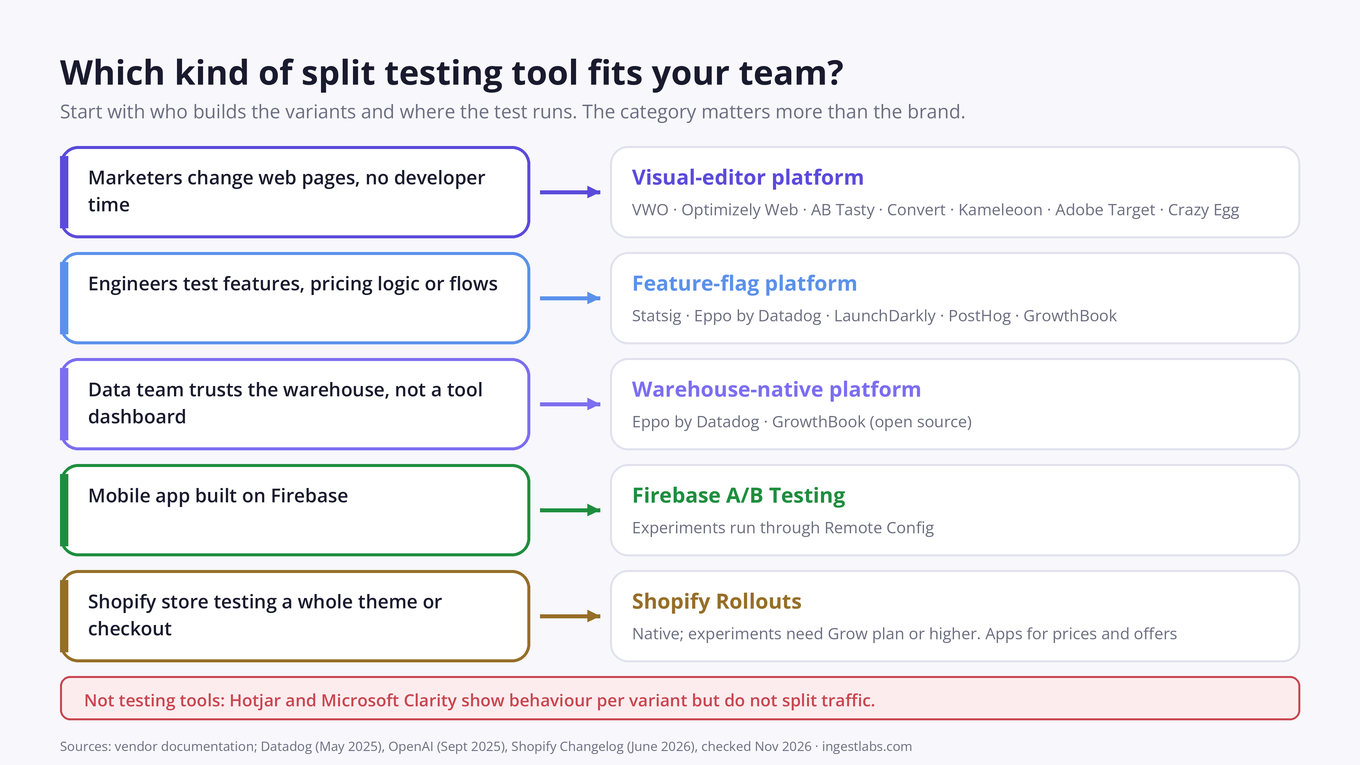
Who builds the variants? If marketers build them, you need a visual editor. If engineers build them, a feature-flag platform fits better and avoids page flicker.
-
Where does the test run? Browser-side tools are fastest to start but can slow pages or flash the original version before the variant loads. Server-side and SDK-based tools avoid that but need developer time.
-
Where will you analyze results? If your source of truth is a data warehouse such as BigQuery or Snowflake, warehouse-native tools such as Eppo and GrowthBook read metrics from it directly. Otherwise, the tool's own reporting or its GA4 integration will do.
-
How much traffic do you have? A store converting at 2.5% needs about 15,600 visitors per variant to detect a 20% lift, and about 62,400 to detect a 10% lift, at 95% significance and 80% power. With less traffic, the tool matters less than testing bolder changes.
| Your situation | Start with |
|---|---|
| Marketing team, website, no developers to spare | A visual-editor platform |
| Product team testing features and pricing logic | A feature-flag platform |
| Data team with a warehouse as the source of truth | A warehouse-native platform (Eppo or GrowthBook) |
| Mobile app on Firebase | Firebase A/B Testing |
| Shopify store testing a new theme or checkout | Shopify Rollouts |
| Low budget, technical team | An open-source tool (PostHog or GrowthBook) |
Six features to check in any demo
-
Statistics you can explain. Ask whether the tool uses frequentist, Bayesian or sequential methods, and how it handles checking results early.
-
Flicker control for browser-side tests, and server-side options for anything sensitive.
-
Sample ratio mismatch checks, which flag when the traffic split is off, a sign of a broken test.
-
Guardrail metrics such as page speed, average order value and refunds, alongside the main goal.
-
Integrations with GA4, your data warehouse and your ad platforms.
-
Mutually exclusive tests, so one visitor isn't in two experiments that affect each other.
The data behind the test matters as much as the tool
Every split testing tool judges winners on conversion data. If purchases are under-counted, because of ad blockers, short browser cookie lifetimes or broken tags, both variants lose data, and small lifts disappear into the noise. If the variant name never reaches GA4 or ad platforms, you can't check whether a winner also holds up on returns, repeat purchases or paid-media performance.
Two habits fix most of this: send conversion events from your server, and attach the experiment and variant name to every conversion.
How Ingest Labs fits
Ingest Labs is not a split testing tool. It keeps the conversion data your tests depend on complete and consistent. Ingest IQ sends events server-side, so each purchase, with its variant label, reaches GA4 and ad platforms. Ingest ID keeps a durable first-party identifier, so returning visitors stay in the same variant group in your reporting. Event IQ lets you compare variants on metrics a testing tool doesn't see. Read our complete guide to server-side tracking for the setup.
FAQ
What is the best split testing software?
There is no single best tool. Marketing teams testing websites usually choose a visual-editor platform such as VWO, Optimizely, AB Tasty, Convert or Kameleoon. Product teams testing features choose Statsig, Eppo, LaunchDarkly, PostHog or GrowthBook. Mobile teams often use Firebase A/B Testing, and Shopify stores can use Shopify Rollouts. Match the tool to who builds variants and where tests run.
Is there a free A/B testing tool now that Google Optimize is gone?
Google Optimize shut down on September 30, 2023, and Google has no direct replacement. Free options exist: GrowthBook and PostHog are open source and can be self-hosted, PostHog Cloud includes 1 million feature flag and experiment requests free each month, and Firebase A/B Testing covers app experiments. Self-hosting still costs engineering time.
Are Hotjar and Microsoft Clarity A/B testing tools?
No. Hotjar and Microsoft Clarity record heatmaps and sessions, but they do not split traffic or calculate which version won. They work alongside a testing tool to show why a variant performed better. Hotjar integrates with testing tools such as AB Tasty, Optimizely and Unbounce, so you can filter recordings and heatmaps by experiment and variant.
How much traffic do I need for split testing?
It depends on your conversion rate and the lift you want to detect. A rule of thumb is visitors per variant ≈ 16 × p × (1 − p) ÷ d², where p is the baseline conversion rate and d the absolute change. At a 2.5% conversion rate, detecting a 20% lift needs about 15,600 visitors per variant.
What's the difference between client-side and server-side split testing?
Client-side tools change the page in the visitor's browser with a script. They're quick to set up and suit marketers, but can cause flicker or slow pages. Server-side tools decide the variant on your server or in your code before the page loads. They need developers, but they avoid flicker and can test logic such as pricing or search results.
Sources
-
Google Optimize Help, "[Sunset September 2023] Google Optimize" (checked November 23, 2026)
-
Datadog press release, "Datadog Acquires Eppo to Expand Its AI, Product Analytics, Experimentation and Feature Flag Capabilities," May 5, 2025
-
OpenAI, "Vijaye Raji to become CTO of Applications with acquisition of Statsig," September 2, 2025; TechCrunch, September 2, 2025
-
Shopify Changelog, "Schedule, publish and A/B test new themes and checkout and customer account configurations," June 5, 2026
-
PostHog, "Experiments pricing" (checked November 23, 2026)
-
GrowthBook GitHub repository and documentation (checked November 23, 2026)
-
Firebase, "Firebase A/B Testing" product page and documentation (checked November 23, 2026)
-
Hotjar Help Center, "A/B Testing with Hotjar" (checked November 23, 2026)
-
Ron Kohavi, Diane Tang and Ya Xu, Trustworthy Online Controlled Experiments, Cambridge University Press, 2020 (sample-size rule of thumb)