Third-Party Cookies in 2026: What Changed for Advertisers
Updated November 23, 2026
Short answer: Third-party cookies have not disappeared, but advertising still can't rely on them. Google reversed its plan to remove them from Chrome. In April 2025 it dropped the planned opt-in prompt, and on October 17, 2025 it retired most Privacy Sandbox replacements, including Topics, Protected Audience and the Attribution Reporting API. Chrome, with about 69% of browser traffic (StatCounter, October 2026), still allows third-party cookies by default. Safari, about 17%, and Firefox already block them. So roughly one in five page views carries no third-party cookie, and consent rules, ad blockers and Chrome users who block cookies remove more. The impact shows up as smaller retargeting audiences, broken frequency caps and under-counted conversions, especially on iPhone. The durable response is first-party data: consented identifiers, server-side tracking and conversion APIs. Those work in every browser, whatever Google decides next.
What third-party cookies are and what advertisers used them for
A third-party cookie is set by a domain other than the site you're visiting. An ad network's script on a news site can set a cookie on the ad network's domain, then read the same cookie on a retailer's site. That shared ID is what made cross-site tracking work.
Advertisers relied on it for five jobs:
| Job | How third-party cookies helped |
|---|---|
| Retargeting | Recognising a visitor from your site when they browse elsewhere |
| Audience building | Grouping users by sites visited into interest segments |
| Frequency capping | Limiting how often one person sees the same ad across sites |
| View-through attribution | Linking an ad impression on one site to a purchase on another |
| Cross-site measurement | Following a user across publishers to build reach and conversion reports |
First-party cookies, which your own domain sets, are different. Browsers still allow them, although Safari can limit how long cookies set by scripts last. See our guide to cookie limits by browser and the difference between first- and third-party cookies.
What actually happened to third-party cookies in Chrome
Older articles, including the earlier version of this page, said Chrome was about to remove third-party cookies. That changed.
| Date | What Google did |
|---|---|
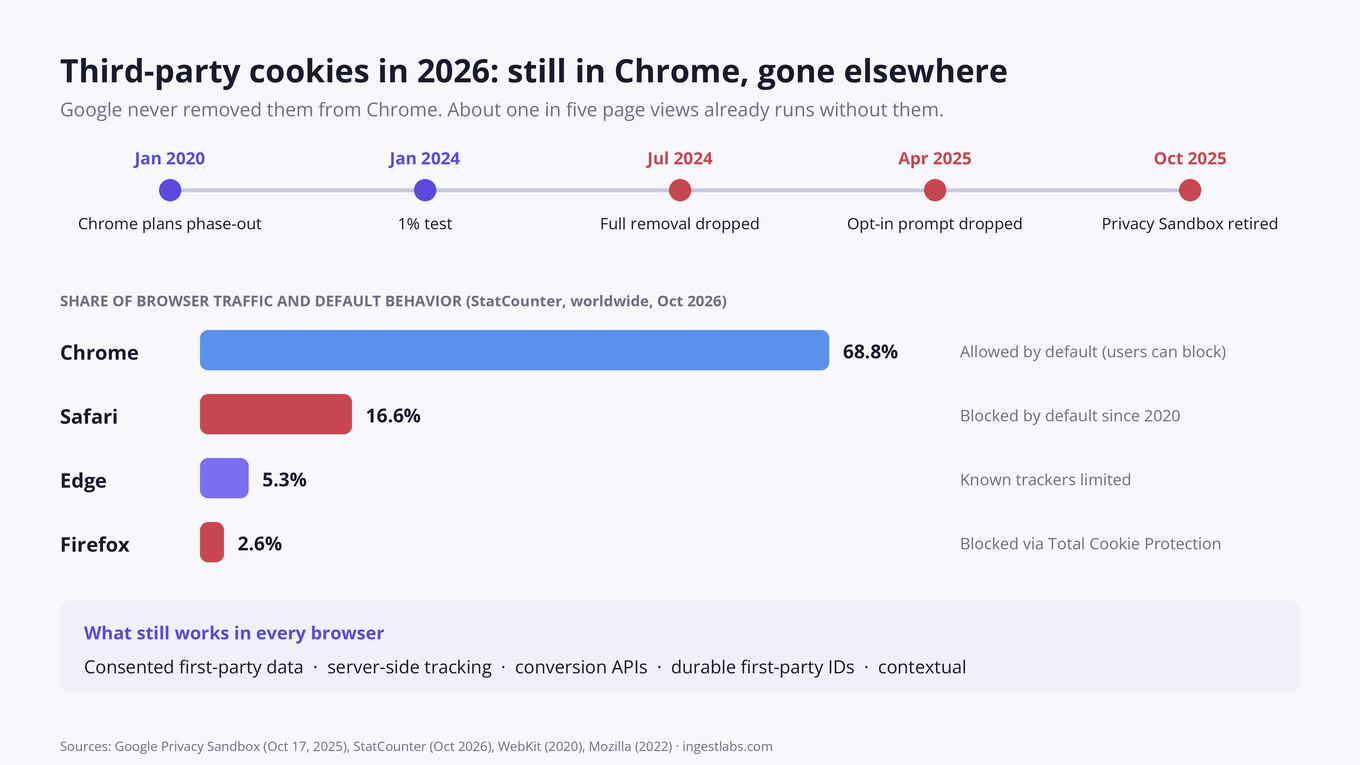
| January 2020 | Announced plans to phase out third-party cookies in Chrome within two years |
| 2021–2024 | Delayed the deadline several times while building Privacy Sandbox replacements |
| January 2024 | Restricted third-party cookies for 1% of Chrome users as a test |
| July 2024 | Dropped full deprecation; proposed a user-choice prompt instead |
| April 2025 | Dropped the standalone prompt; kept existing Chrome cookie settings |
| October 17, 2025 | Retired most Privacy Sandbox technologies, including Topics, Protected Audience, Attribution Reporting, IP Protection and Related Website Sets |
In its October 2025 update, Google said Chrome will maintain its current approach to offering users third-party cookie choice. It is keeping CHIPS (partitioned cookies), FedCM (federated sign-in) and Private State Tokens, and supporting work on an interoperable attribution standard.
What this means in practice: third-party cookies still work for most Chrome users by default, any Chrome user can block them in settings, and Incognito blocks them.
Where third-party cookies are blocked today
| Browser | Share of traffic (StatCounter, Oct 2026) | Default third-party cookie behavior |
|---|---|---|
| Chrome | 68.8% | Allowed by default; users can block them; blocked in Incognito |
| Safari | 16.6% | Blocked by default since March 2020 (Intelligent Tracking Prevention) |
| Edge | 5.3% | Tracking prevention limits known trackers |
| Firefox | 2.6% | Total Cookie Protection by default since June 2022, giving each site its own cookie jar |
Safari and Firefox together account for about 19% of browser traffic worldwide, and more in markets with high iPhone usage. In those browsers, third-party cookies are already gone. On top of that:
-
Consent rules. In the EU and UK, non-essential cookies need prior consent, so users who decline aren't tracked even in Chrome. In California, consumers can opt out of the sale or sharing of their data for cross-context behavioral advertising.
-
Apple's App Tracking Transparency (ATT). Since iOS 14.5, apps must ask permission before tracking users across other companies' apps and sites.
-
Ad blockers and privacy browsers block many tracking scripts outright.
How this affects advertising performance
| Area | What breaks without third-party cookies | Who feels it most |
|---|---|---|
| Retargeting reach | Safari, Firefox and opted-out users drop out of audiences | Brands with high iPhone or EU traffic |
| Frequency capping | The same person looks like several users, so they see ads too often | Display and video buyers |
| Attribution | View-through and cross-site conversions go missing; last click and direct get too much credit | Upper-funnel channels |
| Audience targeting | Third-party segments shrink and lose accuracy | Open-web programmatic |
| Measurement | Platform-reported conversions drift away from your own sales data | Every advertiser |
These losses rarely show up as an error. Reports just get quieter: fewer conversions on iPhone, more "direct" sales, and Smart Bidding learning from less data.
What to do instead: a first-party data plan
-
Collect consented first-party data. Logins, newsletter sign-ups and loyalty programs give you identifiers you own, with permission recorded.
-
Move tracking server-side. Send events from your own server, through a first-party subdomain, so measurement doesn't depend on third-party scripts running in the browser.
-
Use conversion APIs. Meta's Conversions API, Google Ads enhanced conversions and similar APIs match hashed first-party data to ad clicks and impressions.
-
Keep a durable first-party identifier. Join a visitor's sessions and devices with your own ID, not a third-party cookie.
-
Add contextual targeting. Target the page and content, not the person's history.
-
Use clean rooms for partner data. Match your data with publishers or retailers without sharing raw customer records.
-
Measure incrementality. Run holdout tests and marketing mix modeling to check what platform attribution can no longer see.
Because Google's plans have changed several times, build for the strictest browser, not the most permissive one. A setup that works in Safari will keep working if Chrome changes again.
How Ingest Labs fits
Ingest IQ moves event collection server-side, so conversions reach analytics and ad platforms without third-party cookies. Ingest ID keeps a durable first-party identifier and links it to consented, hashed customer data. Event IQ shows how journeys and conversions hold up across browsers and channels. Read our complete guide to server-side tracking and our cross-device attribution guide.
FAQ
Is Google still getting rid of third-party cookies in Chrome?
No. Google dropped its plan to deprecate third-party cookies in July 2024, dropped the planned opt-in prompt in April 2025, and on October 17, 2025 retired most Privacy Sandbox technologies. Chrome keeps third-party cookies on by default, and users can block them in settings. Safari and Firefox still block them by default.
Which browsers block third-party cookies?
Safari has blocked third-party cookies by default since March 2020 through Intelligent Tracking Prevention. Firefox has used Total Cookie Protection by default since June 2022, giving each site a separate cookie jar. Brave also blocks them. Chrome allows them by default but lets users block them, and blocks them in Incognito mode.
How do third-party cookie limits affect advertising?
They shrink retargeting audiences, weaken frequency caps and hide conversions that happen across sites or devices. Platforms then under-report results on Safari and for users who decline consent, so last-click and direct channels get too much credit. With about 19% of browser traffic on Safari and Firefox, the gap is large even with Chrome unchanged.
What are the alternatives to third-party cookies?
The main alternatives are consented first-party data, server-side tracking, and conversion APIs that send hashed customer data from your server. Others include durable first-party identifiers, contextual targeting, data clean rooms and incrementality testing. Google's Privacy Sandbox APIs, such as Topics and Protected Audience, were retired in October 2025 and are no longer an option.
How can I tell if a cookie is third-party?
Open your browser's developer tools, go to the Application or Storage tab, and look at the cookies for the page. A cookie whose domain differs from the site in the address bar is third-party. For example, a cookie set for an ad network's domain while you're on a retailer's site is a third-party cookie.
Sources
-
Google, "Update on Plans for Privacy Sandbox Technologies," Anthony Chavez, October 17, 2025
-
Google Privacy Sandbox blog updates on third-party cookie plans, July 2024 and April 2025; reported by The Register, April 22, 2025
-
StatCounter Global Stats, browser market share worldwide, October 2026
-
WebKit, "Full Third-Party Cookie Blocking and More," March 2020; "Tracking Prevention in WebKit" (checked November 23, 2026)
-
Mozilla, "Firefox rolls out Total Cookie Protection by default to all users worldwide," June 14, 2022
-
Apple, App Tracking Transparency (iOS 14.5 and later)