Significant Data Fiduciary Under DPDP: Who, What, When
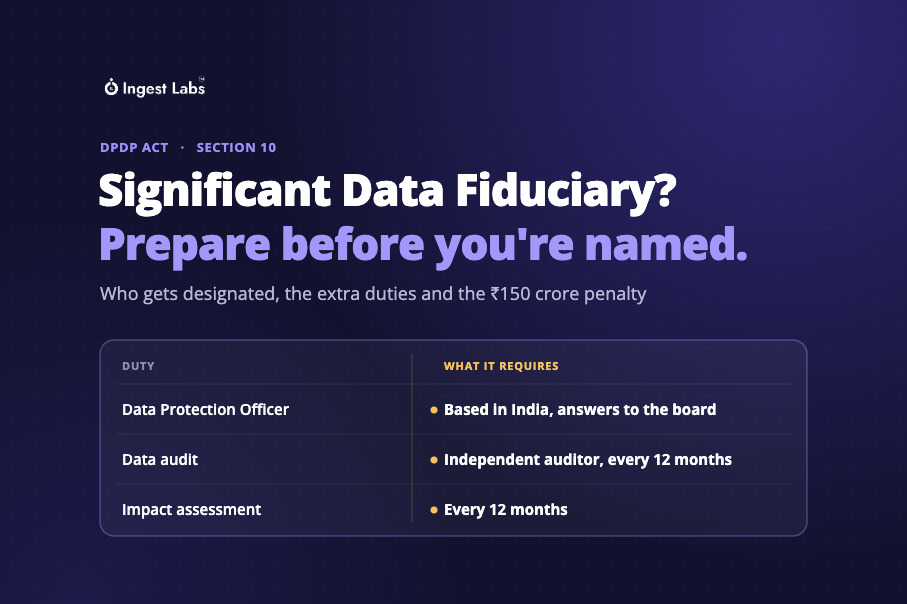
Short answer: A Significant Data Fiduciary (SDF) is an organisation, or class of organisations, that the Indian government notifies under section 10 of the DPDP Act because of the volume and sensitivity of the personal data it handles, the risk to people's rights, or wider concerns such as security of the State and public order. There is no size or user threshold that triggers it automatically, and as of 23 November 2026 no SDF has been notified. A notified SDF must appoint a Data Protection Officer based in India who answers to the board, appoint an independent data auditor, carry out a Data Protection Impact Assessment and a data audit every 12 months, and keep any personal data the government specifies inside India. Breaching these duties carries a penalty of up to ₹150 crore. They apply from 13 May 2027.
Every organisation that decides why and how digital personal data within the Act's scope is processed is a Data Fiduciary under the Digital Personal Data Protection Act, 2023. A smaller group will be notified by the government as Significant Data Fiduciaries and will carry heavier duties, a dedicated penalty of up to ₹150 crore and possibly data localisation requirements.
No organisation has been notified yet. That is not a reason to wait. The duties are organisational (an India-based DPO, an independent auditor, an annual impact assessment and audit) and they take longer to set up than most technical controls.
This article explains how designation works, what the duties require in practice, what the October 2026 Removal of Difficulties Order did and did not change, and what a 90-day readiness programme looks like for the marketing and data stack. For the full DPDP timeline, see our DPDP Act compliance guide.
What a Significant Data Fiduciary is
Section 10(1) lets the government notify any Data Fiduciary, or class of Data Fiduciaries, as significant, based on an assessment of relevant factors including:
-
the volume and sensitivity of personal data processed
-
risk to the rights of Data Principals
-
potential impact on the sovereignty and integrity of India
-
risk to electoral democracy
-
security of the State
-
public order
Designation is by notification, not self-assessment. No turnover figure or user count triggers it automatically, and the factors are qualitative. In our reading, they point towards scale combined with sensitive data, or a role in public life.
The user-count thresholds people sometimes quote (two crore registered users for large ecommerce and social media platforms, for example) come from the Third Schedule on data retention. They are not SDF thresholds.
When the duties apply
SDF duties apply from 13 May 2027, along with most of the Act's other obligations. In January 2026 the government consulted industry on shortening the timelines, including bringing SDF obligations forward. As of 23 November 2026, no instrument changing the dates has been issued, so that remains a proposal.
The sensible reading is that 13 May 2027 is the operative date, with some chance of an earlier one. An organisation that would struggle to appoint a DPO and an auditor in a short window should treat the proposal as a reason to start now.
Who should plan as if they will be designated
This is a planning judgement, not a prediction of whom the government will notify. But the factors make some profiles hard to ignore. Where an organisation combines large numbers of Indian customers with data whose misuse would cause real harm, the cost of being unprepared outweighs the cost of preparing.
| Profile | Why the section 10 factors are engaged |
|---|---|
| Banks, NBFCs, payment firms | Financial data at population scale; sectoral regulation already signals sensitivity |
| Insurers | Health, claims and financial data; underwriting decisions affect individuals directly |
| Large consumer platforms | Very high volume; behavioural and identity data; possible relevance to public order |
| Hospital chains and diagnostics networks | Health data, often including children and vulnerable patients |
| Large retailers and quick commerce | Volume, payment data, location data and detailed marketing profiles |
| Travel platforms and hotel groups holding ID documents | Passport and ID data combined with travel patterns |
The additional duties
SDFs carry every obligation of an ordinary Data Fiduciary, plus the following under section 10(2) and Rule 13.
| Duty | What it means in practice |
|---|---|
| Data Protection Officer | Represents the SDF under the Act, is based in India, is responsible to the board of directors or similar governing body, and is the point of contact for grievances |
| Independent data auditor | Carries out a data audit evaluating the SDF's compliance with the Act |
| Data Protection Impact Assessment | Describes people's rights and the purposes of processing, and assesses and manages risks to those rights; every 12 months under the Rules |
| Periodic audit | A data audit every 12 months under the Rules |
| Significant observations | Material findings of the assessment and audit are reported to the Data Protection Board |
| Algorithmic due diligence | Checking that algorithmic software used to process personal data does not pose risks to people's rights |
| Localisation under Rule 13(4) | Personal data the government specifies, on a committee's recommendation, together with its traffic data, must not be transferred outside India |
The DPO requirement deserves attention. "Responsible to the board" is a governance statement, not a job title. A DPO three levels below the CISO, with no reporting line to the board, is in our view hard to defend.
Rule 13(4) is the only localisation requirement in the DPDP framework itself, and it applies only to notified SDFs and only to data the government specifies. Ordinary cross-border transfers work on a negative-list basis under section 16: permitted except to countries the government restricts. No data has been specified under Rule 13(4) yet. Until it is, the useful preparation is knowing where each category of data flows, including the traffic data around it. Our DPDP vs GDPR comparison explains how this differs from European transfer rules.
What the October 2026 Order changed, and what it did not
On 5 October 2026 the government issued the Digital Personal Data Protection (Removal of Difficulties) Order, 2026 (S.O. 5458(E)) under section 43(1), published in the Gazette on 6 October 2026. It makes two wording changes.
-
Section 10(2)(c)(ii). The periodic audit an SDF must carry out is now expressly a "data audit". It is a wording fix, not a new duty, but it settles what kind of audit the provision means.
-
Section 9(1). The requirement for verifiable consent from a lawful guardian expressly covers persons with disabilities who have one, as well as children.
It adds no new duty, moves no date (SDF obligations still start on 13 May 2027), notifies no SDF and specifies no data under Rule 13(4). The practical effect is clarity: scope and select your auditor for a data audit.
The penalty position
Breaching the SDF obligations carries a penalty of up to ₹150 crore, imposed by the Data Protection Board after an inquiry. It is a separate category, so an SDF that suffers a breach could also face the security safeguards penalty (up to ₹250 crore) and the breach notification penalty (up to ₹200 crore).
The Board weighs the nature, gravity and duration of the breach, the type of data, repetition, gains made or losses avoided, mitigation and proportionality. There is no percentage-of-turnover model. One caveat: as of mid-November 2026, the Board has no Chairperson or Members, so there is no enforcement practice to learn from yet.
What an annual impact assessment needs from the marketing and data stack
Impact assessment templates tend to focus on core systems. In large consumer businesses, the marketing and analytics stack is often where personal data travels furthest and least visibly. A credible assessment needs four things from it.
1. A data flow inventory
Every event that carries personal data, from where it is collected to where it lands. A purchase that fires a browser pixel, a server-side call to Meta's Conversions API with a hashed email, a GA4 hit and a nightly sync to BigQuery is four flows, not one. Call-centre lead forms and CRM enrichments belong here too.
2. A destination register
A list of every third party and internal system that receives personal data, with the purpose each one serves, the fields sent and the processing region. This becomes the backbone of both the assessment and the data audit, and it feeds the processor contracts that section 8(2) requires.
3. Consent coverage evidence
For each flow that relies on consent, proof that the event was sent only when valid consent existed for that purpose, and that withdrawal stopped it. Attribution, retargeting and lookalike building are not legitimate uses under section 7, so they depend on consent. A consent platform log shows what the customer chose; it does not show what the tag manager actually sent. Our guide to DPDP consent and notice requirements covers the engineering.
4. Algorithmic profiling
In our reading, lookalike audiences, propensity models, next-best-offer engines and credit or underwriting scores built on behavioural signals are likely to fall within the algorithmic due diligence duty. The assessment should record what each model uses, what decisions it influences and how risks to people are tested.
A 90-day SDF readiness plan
Days 1 to 30: governance and scope
-
Assess whether your profile engages the section 10 factors, and record the board's decision to prepare.
-
Appoint or designate a DPO based in India, with a documented reporting line to the board.
-
Shortlist independent data auditors and scope the engagement as a data audit.
-
Draft the data flow inventory, starting with the highest-volume customer journeys.
Days 31 to 60: evidence
-
Complete the destination register: every destination, purpose, field set and processing region.
-
Map each flow to a legal ground: consent or a specific section 7 legitimate use.
-
Test consent enforcement event by event, including withdrawal, across at least your top ten destinations.
-
List the algorithmic systems that use personal data and the decisions they influence.
Days 61 to 90: assessment and dry run
-
Run a full impact assessment against the inventory and register, and record risks and mitigations.
-
Commission a pilot data audit and treat its findings as you would "significant observations" to the Board.
-
Identify data categories, and their traffic data, that would be hard to keep in India if specified under Rule 13(4), and assess options.
-
Brief the board on gaps, owners and a remediation plan to 13 May 2027.
Where Ingest Labs fits
Ingest Labs acts as a Data Processor. The SDF remains the Data Fiduciary and remains responsible for its processors under section 8(1). Within that, Ingest IQ addresses the evidence problem in the marketing stack.
-
An audit trail for the assessment and data audit. Ingest IQ records, per event and per destination, what was sent and under which consent state. That is the consent coverage evidence an auditor will ask for, produced as a by-product of routing rather than reconstructed afterwards.
-
A maintained destination register. Purpose mapping across more than 100 integrations gives you a current record of where personal data goes and why.
-
Enforcement, not just records. Your consent platform records consent; Ingest IQ enforces it before data reaches Meta, Google, Klaviyo or the warehouse, and propagates withdrawal and erasure to destinations that already received data.
-
Region-pinned processing. Processing for Indian customers can be pinned to a region with a documented sub-processor list. That records where Indian customers' event data is processed, which is useful input if data you hold is later specified under Rule 13(4).
Ingest Labs is architected for DPDP and holds SOC 2 Type II, and works alongside existing consent platforms such as OneTrust and Consentmo. Our DPDP resource page has more detail.
Frequently asked questions
What is a Significant Data Fiduciary under the DPDP Act?
A Data Fiduciary, or class of fiduciaries, that the government notifies under section 10 based on factors including the volume and sensitivity of data, risk to people's rights, and impact on sovereignty, electoral democracy, security of the State and public order. SDFs carry duties beyond those of ordinary fiduciaries.
Is there a user or revenue threshold for SDF designation?
No. Designation is by government notification and there is no automatic threshold. The user-count thresholds in the Third Schedule relate to data retention for certain ecommerce, gaming and social media businesses, not to SDF status. As of 23 November 2026, no SDF has been notified.
When do SDF obligations start?
On 13 May 2027. The government consulted in January 2026 on bringing SDF obligations forward, but as of 23 November 2026 no instrument changing the dates has been issued.
What did the October 2026 Removal of Difficulties Order change for SDFs?
It clarified that the periodic audit under section 10(2)(c)(ii) is a "data audit". Separately, it clarified that the guardian consent requirement in section 9(1) covers persons with disabilities who have a lawful guardian. It added no new duties and changed no dates.
Do SDFs have to store all data in India?
No. Under Rule 13(4), an SDF must ensure that personal data the government specifies, on a committee's recommendation, together with its traffic data, is not transferred outside India. No such data has been specified yet. Stricter sectoral rules, such as the RBI's payment data storage requirements, apply separately.
What is the penalty for breaching SDF obligations?
Up to ₹150 crore, imposed by the Data Protection Board after an inquiry. It is a separate category from the security safeguards and breach notification penalties, which can apply as well.
To prepare your marketing and data stack for SDF-level scrutiny, book a DPDP readiness call.
Sources
-
India Code, The Digital Personal Data Protection Act, 2023 (checked 2026-11-23): section 10 factors and duties; ₹150 crore penalty for breach of section 10 obligations; section 8(1) and 8(2) on processors
-
Cyril Amarchand Mangaldas, client alert on the DPDP Rules (checked 2026-11-02): annual impact assessment and audit for SDFs; Rule 13 duties
-
DSCI, FAQs on cross-border flow of data under the DPDP Act and Rules (checked 2026-11-02): no blanket localisation; SDF localisation only for specified data
-
India Data Law, weekly DPDP updates (checked 2026-11-23): the 6 October 2026 order on sections 9 and 10 changed wording, not dates; no SDF notified; no Board appointments
-
DPDP Rules tracker, What is in force in 2026 (checked 2026-11-02): commencement dates unchanged
This article is general information about the Digital Personal Data Protection Act, 2023 and the Digital Personal Data Protection Rules, 2025, current as of November 2026. It is not legal advice. Please take advice from qualified counsel on your specific position.