Server-Side Tracking Under DPDP: A Reference Architecture
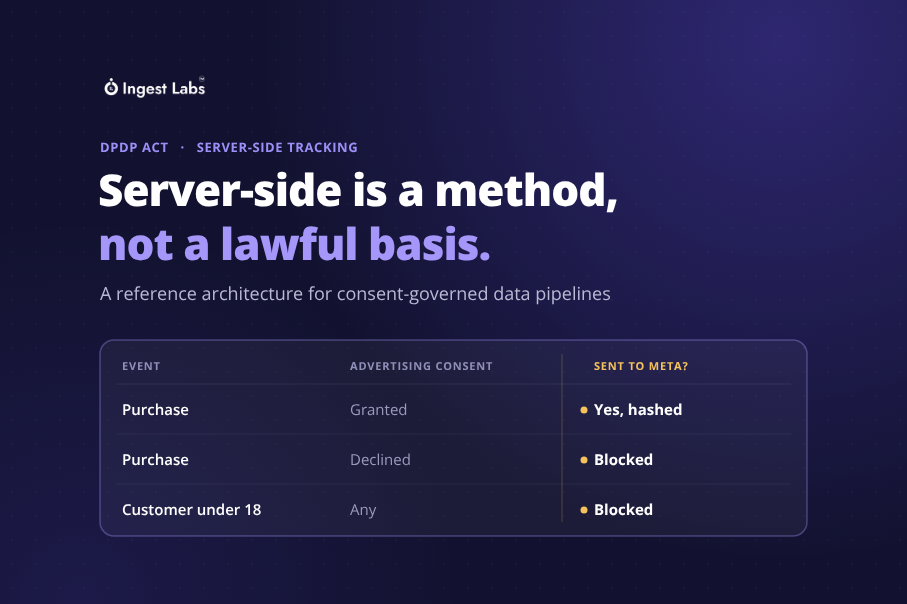
Short answer: Under India's DPDP Act, server-side tracking is a way of moving data, not a legal basis for moving it. Every event sent from your server to Meta, Google Ads, GA4, Klaviyo or a warehouse still needs consent under section 6 or a specific legitimate use under section 7, and attribution, retargeting and lookalike audiences are not legitimate uses. Built properly, though, a server-side pipeline is the best place to enforce DPDP: one gateway where every event passes, consent attached to every event, a policy deciding which destination may receive which fields, an audit log kept for at least a year, and a record of which destinations hold each person's data so that withdrawal, erasure and breach reporting can actually be carried out. Most of these obligations apply from 13 May 2027.
Server-side tracking is often sold to Indian marketing teams as the answer to signal loss. Move tags off the browser, send events from your own server to Meta, Google and the rest, and recover the conversions that ad blockers and browser restrictions were eating.
Under the Digital Personal Data Protection Act, 2023, that framing needs correcting before it reaches production. The law regulates the processing, not the network path. A purchase event sent through a server-to-server API needs exactly the same consent as one sent through a browser pixel.
This article sets out a reference architecture in eight layers for heads of data, martech architects and CISOs: what each event should carry, how policy is evaluated, how fields are minimised per destination, how withdrawal and erasure reach every destination, and how to test that the whole thing works. For the full DPDP timeline and obligations, see our DPDP Act compliance guide. If server-side tracking itself is new to your team, start with the complete guide to server-side tracking.
Server-side is a method, not a lawful basis
The DPDP Act gives two grounds for processing personal data: consent under section 6, or one of the legitimate uses listed in section 7. There is no "legitimate interests" ground of the GDPR kind.
The section 7 uses cover things like data a person voluntarily provides for a specified purpose (section 7(a), such as a phone number given to receive a receipt), disclosures a law requires you to make to the State (section 7(d)), compliance with court orders (section 7(e)) and medical emergencies (section 7(f)). Attribution, retargeting, audience building and lookalike modelling are not among them.
So a purchase event sent to Meta's Conversions API with a hashed email needs the same consent whether it leaves the browser through a pixel or your server through an API call. That consent must be free, specific, informed, unconditional and unambiguous, given by a clear affirmative action, and limited to the data necessary for the purpose (section 6(1)). Our guide to DPDP consent and notice requirements covers what valid consent and notice look like in practice.
The "recovery" trap
The specific risk with server-side tracking is a quiet one. A consent banner records that a shopper declined advertising. The browser pixel respects that and does not fire. But the server-side container, configured by a different team or a vendor, forwards the order event to Meta and Google Ads anyway, because "it's server-to-server, not a cookie".
In a performance review, that shows up as recovered conversions. Under DPDP, it is processing without a lawful basis, carried out by your processor on your instruction. Section 8(1) makes the Data Fiduciary responsible for processing by its processors regardless of any agreement to the contrary. Every event recovered from someone who said no is exposure, not performance.
Why client-side tags make DPDP enforcement hard
A typical Indian D2C or retail site runs a dozen or more client-side tags: Meta pixel, Google tag, GA4, TikTok, a session recorder, an affiliate tracker, a chat widget, a reviews platform. Each one reads the page, decides for itself whether consent exists, and sends what it chooses to its own servers.
That architecture has three structural problems under DPDP.
| Problem | What it looks like | Why it matters under DPDP |
|---|---|---|
| Decisions spread across tags | Each tag interprets the consent signal independently, with its own integration and its own bugs | Consent is purpose-specific (section 6(1)); one misconfigured tag breaks it for that purpose |
| No single audit point | Evidence of what was sent lives in a dozen vendor consoles, if anywhere | Rule 6 expects visibility through logs and monitoring, kept for at least a year |
| No field-level control | Tags collect what their vendor's script collects, often including URL parameters, form fields and device data | Consent covers only the data necessary for the specified purpose |
A server-side setup does not fix these automatically. A container that simply mirrors every client tag reproduces the same problems one hop later. What fixes them is a deliberate design in which consent travels with the data and is enforced in one place.
The reference architecture: eight layers
The architecture separates capture from enforcement. Your consent platform records what the person agreed to. The pipeline enforces it, per event and per destination, and keeps the evidence.
| Layer | What it does | DPDP hook |
|---|---|---|
| 1. Consent capture | Consent platform or Consent Manager signal becomes a versioned consent record | Section 5 and Rule 3 notice; section 6 consent |
| 2. Event envelope | Every event from web, app, store or call centre carries consent, notice version and an age flag | Proof of consent for each processing purpose |
| 3. Ingest gateway | Validates the envelope and evaluates policy; missing consent means deny | Single enforcement point |
| 4. Purpose-to-destination map | States which purposes each destination serves and which consent it needs | Purpose limitation under section 6(1) |
| 5. Per-destination routing | Sends each destination only its allowed fields, hashed or tokenised where needed | Data minimisation; Rule 6 safeguards |
| 6. Audit log | Append-only record of every decision and every field sent | Rule 6 logs kept for at least one year |
| 7. Withdrawal and erasure | Looks up where a person's data went and stops, suppresses or deletes downstream | Sections 6(6) and 8(7) |
| 8. Region and sub-processor register | Keeps processing locations and processor contracts documented | Sections 8(1), 8(2) and 16 |
Layer 1: Consent capture
The consent platform is where the person sees the notice and makes a choice. Under section 5 and Rule 3, the notice must be standalone, in clear and plain language, with an itemised description of the personal data and the specific purposes, how to withdraw, and how to exercise rights and complain to the Board. The person must be able to read it in English or any language in the Eighth Schedule.
For the pipeline, the output that matters is a machine-readable consent record: which purposes were granted, under which notice version, at what time. Since 13 November 2026, the Consent Manager framework under Rule 4 has been in force and the Board's registration portal is open. Once Consent Managers are registered, people will be able to give, review and withdraw consent through one. Your capture layer should be ready to accept consent state from either source and turn it into the same record.
Layer 2: Consent travels with every event
The most important design decision is that consent is not looked up once per session and forgotten. It is attached to every event, so every downstream decision can be made, and later proven, from the event itself.
A minimal envelope looks like this:
{
  "event_id": "evt_01JD8Q4K7M2X",
  "event_name": "purchase",
  "event_time": "2027-05-20T10:42:13+05:30",
  "source": "web",
  "principal": {
    "pseudonymous_id": "pid_7f3c9a1e",
    "identifiers": { "email": "asha@example.in", "phone": "+91XXXXXXXXXX" }
  },
  "consent": {
    "jurisdiction": "IN",
    "consent_record_id": "cr_55e01b",
    "consent_version": "2027-04-v3",
    "notice_version": "notice-en-2027-04",
    "notice_language": "en",
    "purposes_granted": ["analytics", "order_fulfilment"],
    "purposes_denied": ["advertising", "personalisation"],
    "captured_at": "2027-05-20T10:31:02+05:30",
    "source": "cmp"
  },
  "age_gate": { "is_child": false, "verifiable_parental_consent": null },
  "payload": {
    "order_id": "ORD-883201",
    "value": 2499.00,
    "currency": "INR",
    "items": [{ "sku": "TSH-BLK-M", "qty": 1 }]
  }
}
Each field earns its place:
-
Pseudonymous ID. Lets you route, deduplicate and later find every event for one person. Raw identifiers such as the email and phone in this example should be tokenised or dropped at the gateway (Layer 5) so they do not travel further.
-
Jurisdiction. The Act applies to processing in India and to processing outside India connected with offering goods or services to people in India (section 3). Global brands need to know which regime governs which event.
-
Consent and notice versions. When your notice changes, events captured under the old notice should be distinguishable. Consent given before the Act's obligations start also needs a fresh notice under section 5(2).
-
Purposes granted and denied. Explicit, not inferred. A missing purpose is treated as denied.
-
Age flag. Drives the hard block described in the children's section below.
Layer 3: The ingest gateway evaluates policy
Every event enters through one gateway. The gateway checks the envelope, rejects or holds events with missing or malformed consent state, and evaluates policy: given these purposes, this jurisdiction and this age flag, which destinations may receive this event, and with which fields?
Two principles matter. First, deny by default: an event with no consent state goes nowhere except, where a section 7 legitimate use genuinely applies, to the systems that need it, such as order fulfilment or a receipt. Second, version the policy. When legal or marketing changes a rule, the gateway records which policy version made each decision, so you can reconstruct why an event went where it went on any given day.
Layer 4: Map purposes to destinations
Destinations are not purposes. Meta's Conversions API can serve conversion measurement and audience building; a warehouse can serve analytics, finance and model training. The mapping layer forces the organisation to state, for each destination, which purposes it serves and therefore which consents it needs.
| Destination | Purpose served | Required consent | Allowed fields | Dropped or transformed |
|---|---|---|---|---|
| GA4 | Analytics | analytics | Pseudonymous ID, event name, page, value, currency, item SKUs | Email and phone dropped; IP truncated |
| Meta Conversions API | Advertising measurement and optimisation | advertising | Hashed email, hashed phone, event ID, value, currency | Raw identifiers never sent; address dropped |
| Google Ads Enhanced Conversions | Advertising measurement | advertising | Hashed email, hashed phone, order ID, value | Raw identifiers never sent |
| Klaviyo | Marketing messages, personalisation | personalisation plus marketing opt-in | Email, first name, products viewed, cart contents | Payment details dropped |
| Snowflake or BigQuery | Analytics, reporting | analytics | Pseudonymous ID, event payload | Email and phone tokenised |
| Order management | Order fulfilment (section 7(a) where it applies) | Fulfilment purpose | Name, phone, address, order lines | Marketing attributes dropped |
| Any ads or behavioural destination | Advertising, tracking | Never, if the person is a child | None | Event blocked |
Under this policy, the example envelope above (analytics granted, advertising denied) reaches GA4 and the warehouse in minimised form, and order management for fulfilment. It does not reach Meta, Google Ads or Klaviyo.
Layer 5: Route per destination, with field-level minimisation
Consent under section 6(1) covers only the data necessary for the specified purpose, and Rule 6 lists encryption, obfuscation, masking and tokenisation among reasonable safeguards. In pipeline terms, each destination gets its own transform, built from the allowed-fields column of the policy table.
When only analytics is granted, the email address is dropped or replaced with a token before the event reaches GA4 or the warehouse. When advertising is granted, Meta receives a normalised, hashed email, never the raw value. Free-text fields such as URL query strings, search terms and form inputs are stripped unless a destination needs them, because that is where personal data leaks most often. A call-centre lead form that writes a phone number into a UTM parameter is a classic example.
Minimisation should be an allow-list, not a block-list. New fields added by the product team should not flow anywhere until someone has mapped them.
Layer 6: Keep an append-only audit log
Rule 6 requires visibility on access and processing through logs and monitoring, and requires those logs to be kept for at least one year. In a consent-governed pipeline, the audit log is the evidence that enforcement happened.
For each event and each candidate destination, record the event ID, pseudonymous ID, consent record and version, policy version, decision (sent, blocked or transformed), fields actually sent, the destination's response and the time. Make the log append-only and access-controlled, and keep it lean: it records that an email was hashed and sent, not the email itself.
This log answers the question a DPO, an auditor or the Data Protection Board will ask: did this person's data go to Meta after they declined advertising, and can you show that it did not?
Layer 7: Propagate withdrawal and erasure
Withdrawal must be as easy as giving consent (section 6(4)). Once a person withdraws, the fiduciary and its processors must stop processing within a reasonable time (section 6(6)). Data must be erased once the purpose is no longer served or consent is withdrawn, unless a law requires it to be kept (section 8(7) and Rule 8). Grievances must be resolved within a reasonable period not exceeding 90 days (Rule 14).
The gateway handles the first half easily: the next event carries the updated consent state and is blocked. The hard part is data already sent. For that, the pipeline needs a ledger of which destinations received which person's data, and for which purposes, built from the audit log.
When a withdrawal or erasure request arrives, the pipeline looks the person up in the ledger and fans out the right actions: remove them from Meta and Google audiences, suppress them in Klaviyo, delete or anonymise rows in the warehouse, and notify any processor that cannot be reached by API. Each action is logged with its outcome. Once Consent Managers are registered, a withdrawal may also arrive through one rather than your own banner, so the pipeline should be ready to accept withdrawal signals from every channel.
Layer 8: Region-aware processing and a sub-processor register
Under section 16, transfers outside India are permitted except to countries the government restricts by notification. There is no general localisation requirement. Localisation applies only to notified Significant Data Fiduciaries, for data the government specifies, and stricter sectoral rules such as the RBI's payment data storage requirements continue to apply. As of November 2026, no Significant Data Fiduciary has been notified and no restricted-country list has been issued.
That still argues for region awareness. Pinning the processing of Indian customers' events to a defined region keeps sectoral obligations manageable and makes it simpler to respond if a restricted list is published. A documented sub-processor register, listing each processor, its role, its processing location and the contract it works under (section 8(2) requires a valid contract), is what the fiduciary needs to answer for its processors under section 8(1).
Children: the age flag is a hard block
Under the DPDP Act, a child is anyone under 18. Before processing a child's data, the fiduciary needs verifiable consent from a parent or lawful guardian (section 9). Separately, section 9(3) prohibits tracking or behavioural monitoring of children and targeted advertising directed at them. Breaching the children's data obligations carries a penalty of up to ₹200 crore.
In the architecture, the child flag is not just another purpose. When it is true, the gateway blocks every advertising and behavioural destination outright, whatever consent the event carries. Parental consent may permit the processing needed to provide the service; it does not unlock retargeting, lookalikes or behavioural profiling. The Fourth Schedule exemptions are narrow and should be built as explicit, reviewed exceptions, not general overrides.
How the flag gets set depends on your age-assurance approach. Whatever the method, a service likely to attract under-18s should treat an unknown age conservatively.
Breach readiness: knowing where data went
Section 8(6) and Rule 7 require the fiduciary to tell the Board without delay on becoming aware of a breach, followed by a detailed report within 72 hours (which the Board may extend), and to inform each affected person without delay, in plain language. There is no materiality threshold. Failing to notify carries a penalty of up to ₹200 crore; failing to take reasonable safeguards to prevent a breach carries up to ₹250 crore.
The detailed report needs facts: what data, which people, which systems. If a breach happens at a downstream destination or processor, the fiduciary has to work out quickly which of its customers' data that destination held, and which fields. A pipeline with a per-destination audit log and a person-to-destination ledger can answer that with a query. A stack of independent browser tags usually cannot.
Failure modes to design against
| Failure mode | How it happens | Control |
|---|---|---|
| Consent bypass | Server-side container forwards events regardless of consent state | Gateway enforcement; deny by default; no direct tag-to-vendor paths |
| Stale consent | Consent cached per session, so a withdrawal is not reflected until the next visit | Consent attached to each event; withdrawal pushes an update to the gateway |
| Shadow tags | Marketing adds a browser pixel outside the pipeline | Tag inventory, content security policy, periodic network scans |
| Field creep | A new form field or URL parameter flows to every destination | Allow-list transforms per destination |
| Identifier leakage | Email in a URL, page title or custom parameter | Pattern-based stripping at the gateway; destination payload checks |
| Child events reach ads | Age flag missing or defaulting to false | Required field; unknown treated conservatively on relevant services |
| Orphaned data | Erasure done in the warehouse but not in ad audiences | Person-to-destination ledger; logged fan-out with outcomes |
| Policy drift | A rule changed without a record | Versioned policy; version written to every audit entry |
How to test it
A consent-governed pipeline is only as credible as the evidence that it works. Build these tests into every release and into routine monitoring.
-
Test users for each consent state. Keep synthetic users for each combination: all denied, analytics only, advertising only, all granted, child with parental consent, child without. Run scripted journeys for each before every release.
-
Edge-case events at the gateway. Inject envelopes with a missing consent block, an unknown purpose, a malformed age flag and an unsupported jurisdiction. Check the decision for each destination.
-
Payload checks per destination. Capture what is actually sent to each destination for the test users and compare it with the allowed-fields column of the policy table. Any extra field is a failure.
-
Daily reconciliation. Compare event counts by consent state with counts received by each destination. If Meta reports more conversions than the gateway sent with advertising consent, something is bypassing the pipeline.
-
Withdrawal drills. Withdraw consent for a test user and confirm that events stop, audiences update and the warehouse is cleaned, with each step visible in the audit log.
-
Breach tabletop. Pick a destination, assume it has been compromised, and time how long it takes to produce the list of affected people and fields.
Measurement that survives DPDP
None of this means giving up measurement. It means building measurement on data you are entitled to use.
-
Modelled conversions on consented traffic. Send complete, high-quality events for people who granted advertising consent, and let platform modelling estimate the rest. Report modelled totals honestly rather than inflating them with events you should not have sent.
-
First-party identity on consented data only. Resolve identity across devices and sessions only for people whose consent covers that purpose, and keep identity graphs scoped by purpose so an analytics identity does not quietly become an advertising one.
-
Aggregate analytics where consent is narrower. Where only analytics is granted, minimised, pseudonymous events in GA4 and the warehouse still support funnel analysis, merchandising and forecasting.
-
Better consent rates, not workarounds. A clear, standalone notice in the customer's language and a fair choice is a more durable lever than any routing trick. Click-ID loss is a related problem with its own fixes, covered in why Google Ads conversions drop when click IDs go missing.
Where things stand
As of 23 November 2026, the DPDP dates have not moved. The Consent Manager framework came into force on 13 November 2026, and the consent, notice, security, breach, children's data, retention and rights obligations apply from 13 May 2027. The Data Protection Board exists in law but has no Chairperson or Members yet, and challenges to the Act before the Supreme Court are next listed for 9 December 2026 with no stay in place.
Where Ingest Labs fits
Most organisations already have a consent platform. What they usually lack is the layer between that platform and the destinations their data flows to. That layer is what Ingest IQ provides: server-side tracking with consent-governed routing that applies consent per event and per destination, with purpose mapping across more than 100 integrations including Meta, Google Ads, GA4, TikTok, Klaviyo, Snowflake, BigQuery and CRMs.
In terms of the architecture above, Ingest IQ provides consent-governed routing per event and per destination, purpose mapping, an audit trail for every event and destination, withdrawal and erasure propagation to the destinations that received the data, and region-pinned processing for Indian customers with a documented sub-processor list. It works with your existing consent platform, whether OneTrust, Consentmo or a custom build. It is an enforcement layer, not a consent platform.
Under DPDP, Ingest Labs acts as your Data Processor and you remain the Data Fiduciary. The platform is architected for DPDP and holds SOC 2 Type II. Our DPDP resource page sets out the architecture in more detail.
Frequently asked questions
Is server-side tracking allowed under the DPDP Act?
Yes. In our reading, the Act is technology-neutral: it regulates the processing, not the technical method of collecting or sending data. That processing needs consent under section 6 or a legitimate use under section 7. A server-side pipeline is allowed, and can be the best way to enforce consent, provided it sends only data the person has agreed to.
Can we send conversions to Meta's Conversions API for people who declined advertising consent?
No. Advertising measurement, retargeting and audience building are not legitimate uses under section 7, so they need consent. Sending those events server-side is still processing, and under section 8(1) the fiduciary is responsible for its processors' processing.
How long should we keep the pipeline's audit logs?
At least one year. Rule 6 requires logs to be kept for at least a year as part of reasonable security safeguards. Keep them append-only and access-controlled, and record decisions and fields sent without storing raw identifiers in the log.
What should happen to a child's events in the pipeline?
Under section 9(3), children (anyone under 18) may not be tracked, behaviourally monitored or targeted with advertising. The child flag should block every advertising and behavioural destination outright, whatever other consent the event carries. Processing needed to provide the service requires verifiable consent from a parent or guardian.
Does the DPDP Act require us to keep Indian customers' data in India?
Not generally. Section 16 permits transfers except to countries the government restricts by notification, and no such list had been issued as of November 2026. Localisation applies only to notified Significant Data Fiduciaries, for data the government specifies, and under stricter sectoral rules such as the RBI's payment data storage requirements.
When do these obligations apply?
The consent, notice, security, breach, children's data, retention and rights obligations apply from 13 May 2027. The Consent Manager framework came into force earlier, on 13 November 2026. As of 23 November 2026, no instrument has changed those dates.
To map your current tags and destinations against this architecture, book a DPDP readiness call.
Sources
-
DPDP Wiki, Section 6: Consent (checked 2026-10-27): requirements for valid consent, withdrawal as easy as giving consent, processors to stop processing after withdrawal
-
DPDP Wiki, Section 9: Processing of personal data of children (checked 2026-11-02): verifiable parental consent; ban on tracking, behavioural monitoring and targeted advertising directed at children
-
DPDP Wiki, Section 16: Processing of personal data outside India (checked 2026-11-02): restriction by notification; stricter laws continue to apply
-
DPDP Wiki, Section 3: Application of the Act (checked 2026-11-02): territorial and extra-territorial application
-
Cyril Amarchand Mangaldas, client alert on the DPDP Rules (checked 2026-11-02): security safeguards and one-year log retention; breach notices without delay and a detailed Board report within 72 hours; grievances resolved within 90 days
-
DSCI, FAQs on cross-border flow of data under the DPDP Act and Rules (checked 2026-11-02): no blanket localisation; SDF localisation only for specified data
-
India Data Law, weekly DPDP updates (checked 2026-11-23): Consent Manager provisions in force from 13 November 2026; no Board appointments; Supreme Court petitions listed for 9 December 2026
This article is general information about the Digital Personal Data Protection Act, 2023 and the Digital Personal Data Protection Rules, 2025, current as of November 2026. It is not legal advice. Please take advice from qualified counsel on your specific position.