OTT and CTV Attribution: How It Works and Where It Misleads
Updated November 23, 2026
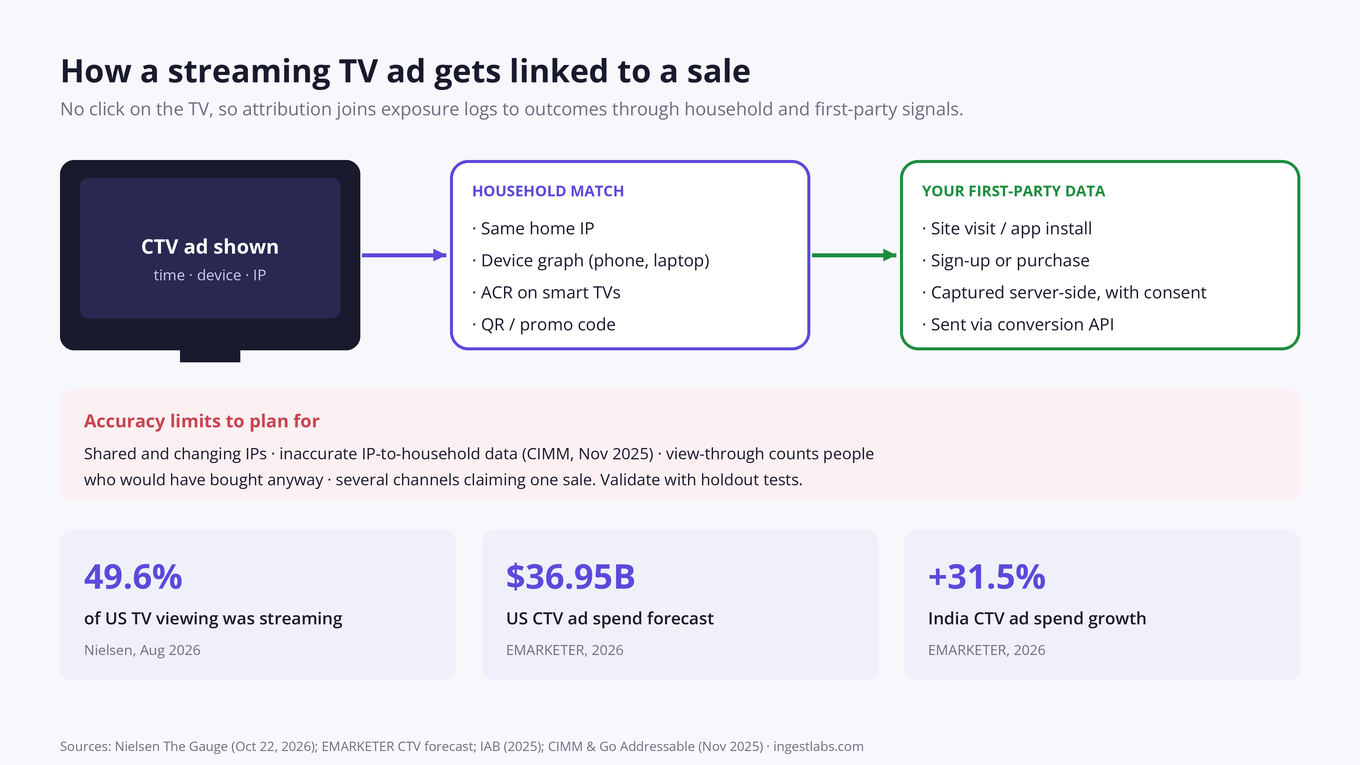
Short answer: OTT attribution links ads shown on streaming TV to actions people take afterwards, such as site visits, app installs or purchases, usually on a different device. A TV ad can't be clicked, so attribution relies on other signals. The main ones are household IP matching, device graphs, automatic content recognition (ACR) on smart TVs, QR and promo codes, retailer clean rooms and incrementality tests. Each has accuracy limits, so treat view-through numbers as estimates and confirm them with holdout tests. The stakes are large. Streaming took 49.6% of US TV viewing in August 2026 (Nielsen), and US connected TV (CTV) ad spend is forecast at about $37 billion for 2026 (EMARKETER). Strong OTT attribution starts on your own site, by capturing every visit and conversion with consent and server-side. That way the household and device signals have something reliable to match against.
OTT vs CTV: the terms
| Term | Meaning | Example |
|---|---|---|
| OTT (over-the-top) | Video delivered over the internet instead of cable or satellite, on any screen | Netflix, Prime Video, YouTube, JioHotstar |
| CTV (connected TV) | A TV screen connected to the internet: a smart TV, streaming stick or console | Roku, Fire TV, Samsung and LG smart TVs, Apple TV |
| Linear TV | Scheduled broadcast or cable channels | Network and cable channels |
| FAST | Free, ad-supported streaming TV channels | The Roku Channel, Samsung TV Plus, Pluto TV |
In practice, "OTT advertising" usually means ads in streaming video, and "CTV" means the big-screen subset of it. Attribution challenges are greatest on CTV, because the screen has no click, no browser cookie and is often shared by a household.
Why OTT attribution matters now
| Indicator | Figure | Source |
|---|---|---|
| Streaming share of US TV viewing | 49.6% (August 2026) | Nielsen, The Gauge |
| YouTube share of US TV viewing | 15.8% (August 2026) | Nielsen, The Gauge |
| US CTV ad spend forecast | $36.95 billion in 2026 | EMARKETER |
| US digital video ad spend forecast | $81.9 billion in 2026, up 11% | IAB |
| India CTV ad spend growth | 31.5% year on year in 2026, among the fastest of markets tracked | EMARKETER |
Money is moving into streaming faster than measurement is improving. Without attribution, CTV gets judged on reach and completion rates alone, or gets no credit at all in click-based reports.
How OTT attribution works
| Method | How it links an ad to an outcome | Strengths | Limits |
|---|---|---|---|
| Household IP matching | Matches the IP address of the TV that saw the ad to later visits or conversions from the same home network | Scalable; works for web conversions | IPs change and are shared; mobile and VPN traffic won't match; data provider accuracy varies |
| Device graphs | Links the TV to phones and laptops in the same household using IP, logins and other signals | Extends to cross-device conversions | Probabilistic links can be wrong; privacy restrictions |
| ACR (automatic content recognition) | Smart TVs recognise what is on screen, including ads, from opted-in sets | Measures exposure on linear and streaming alike | Only covers opted-in TVs from participating makers |
| QR codes, promo codes and vanity URLs | Viewer acts directly from the ad | Deterministic and simple | Captures only direct responders, a small share of impact |
| Clean rooms | Matches exposure logs with retailer or advertiser first-party data without sharing raw records | Can tie ads to actual sales, including in store | Needs data partnerships and match keys |
| Incrementality tests | Compares exposed and holdout groups or regions | Measures true lift, not just correlation | Needs scale and planning time |
| Marketing mix modeling (MMM) | Statistical model of spend vs sales over time | Covers all channels; no user-level data | Slow, aggregate, needs history |
The IAB notes that CTV typically relies on device-level data, such as IP address and household data, for targeting and measurement. That is why IP and household graphs sit at the centre of most CTV attribution products.
The accuracy problem with IP-based attribution
Household IP matching is the most common method, and its weaknesses are often underplayed:
-
IP-to-household data isn't always right. In November 2025, the Coalition for Innovative Media Measurement (CIMM) and Go Addressable published a study testing IP records from six data providers against ISP data. It found costly inaccuracies in IP-to-household links.
-
Shared and changing IPs. Mobile carriers and some broadband providers place many households behind one IP, and home IPs change over time.
-
View-through inflation. Many people in an exposed household would have visited anyway. IP matching counts them all as attributed unless a control group is used.
-
Double counting. The CTV platform, search and social may all claim the same conversion.
Treat IP-matched results as a directional signal. Calibrate them against incrementality tests before moving large budgets.
A practical OTT attribution setup
-
Set objectives per campaign. Use reach and frequency for awareness, and site visits, installs or sales for performance. Don't judge an awareness flight on last-click sales.
-
Fix your own data first. Capture every site visit, sign-up and purchase server-side, with consent and a first-party ID, so CTV partners have accurate outcomes to match against.
-
Share conversions through conversion APIs, not just pixels. Send outcomes server-to-server to your CTV platform or measurement partner, with hashed identifiers where consented.
-
Agree lookback windows up front. For example, 7 days for site visits and 14–30 days for purchases, depending on your sales cycle. Apply the same windows when comparing partners.
-
Run holdout tests. Use geographic or audience holdouts at least once a quarter to measure incremental lift.
-
Compare across channels. Check CTV-attributed conversions against your analytics and order data, and deduplicate against search and social claims.
-
Add direct-response signals. QR codes and promo codes give a clean floor of attributable activity.
Privacy and consent
CTV measurement uses IP addresses and device identifiers, which are personal data in many regions. Under GDPR they generally need a lawful basis, often consent for advertising uses. In California, consumers can opt out of the sale or sharing of their data for cross-context behavioral advertising. India's DPDP Act brings consent and notice rules for digital personal data, with core obligations from May 13, 2027. Use clean rooms and hashed, consented identifiers wherever possible. See our PII handling guide.
How Ingest Labs fits
CTV partners can only attribute outcomes that you measure well. Ingest IQ captures site visits and conversions server-side and can forward them, with consent, to measurement partners through conversion APIs. Ingest ID gives each visitor a durable first-party identifier, so post-exposure visits and later purchases join up. Event IQ lets you compare CTV-driven journeys with other channels using your own data. See also our cross-device attribution guide and conversion funnel guide.
FAQ
What is OTT attribution?
OTT attribution links ads shown in streaming video to actions viewers take later, such as visiting a website, installing an app or buying. Because TV ads can't be clicked, it relies on household IP matching, device graphs, automatic content recognition, QR or promo codes, clean rooms and incrementality tests to connect exposure to outcomes.
How is CTV attribution different from linear TV measurement?
Linear TV has traditionally been measured with panels and modelled reach, so results arrive as broad estimates. CTV ads are served digitally, so each impression can be logged with a time, device and IP address and matched to later actions. That allows household-level attribution, but the matching is probabilistic and needs validation.
How accurate is IP-based CTV attribution?
It is useful but imperfect. IP addresses can be shared by many homes or change over time. A November 2025 study by CIMM and Go Addressable found costly inaccuracies in IP-to-household data from major providers. IP matching also counts people who would have converted anyway, so confirm results with holdout or geographic incrementality tests.
Does OTT attribution work without third-party cookies?
Yes. CTV attribution doesn't rely on browser cookies. It uses IP addresses, device identifiers, ACR data, clean rooms and first-party conversion data. What it does need is accurate outcome data from your own website and app. Capturing conversions server-side with a first-party identifier gives partners something reliable to match against.
What lookback window should I use for CTV attribution?
Choose based on your sales cycle and keep it consistent across partners. Many advertisers use about 7 days for site visits and 14 to 30 days for purchases. Longer windows attribute more conversions, but they also credit more conversions that would have happened anyway, so pair them with incrementality tests.
Sources
-
Nielsen, "TV Viewing Cools Off in Nielsen's August Gauge Reports," October 22, 2026
-
EMARKETER, "Exclusive forecast: Global CTV ad spend accelerates as emerging markets scale" (2026 forecast)
-
EMARKETER, "Digital video ad spend pulls further ahead, pushing linear TV's share under 40%," June 2026 (citing IAB)
-
IAB, "Unified Media Planning Playbook Across CTV, OLV, Social Video, and FAST," July 2025
-
CIMM and Go Addressable, IP-to-household accuracy study, November 5, 2025
-
AdExchanger, "The Marketer's Guide to IP Addresses in Connected TV"