Offline Conversion Tracking in PPC: Costing Millions
Your paid media campaigns are optimizing blindly.
Not because your targeting is off. Not because your creative underperforms. But because the majority of the revenue your ads generate never makes it back to your ad platforms.
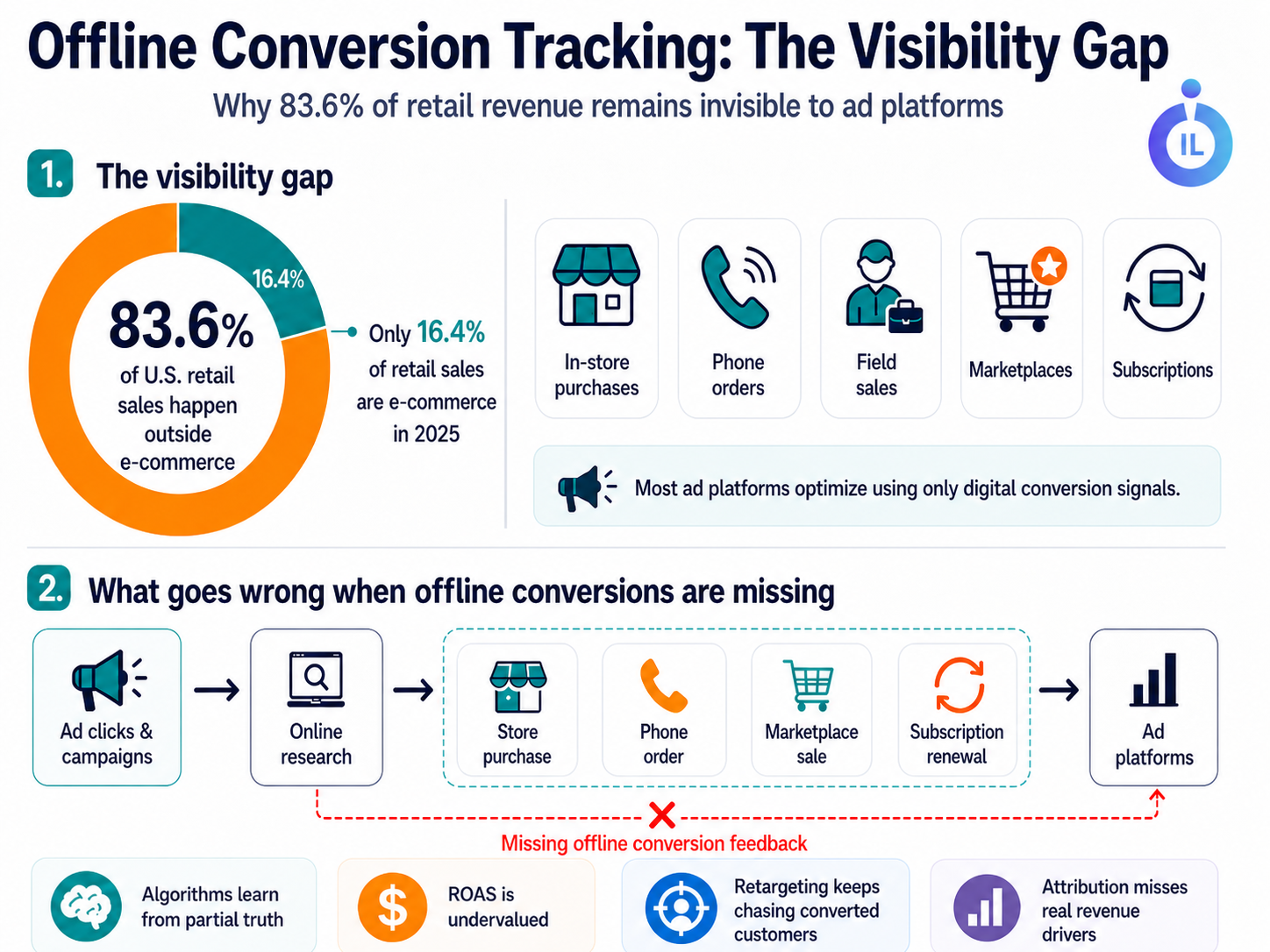
According to the latest U.S. Census data, e-commerce represents just 16.4% of total retail sales in 2025. That means 83.6% of retail transactions still occur outside digital channels—in stores, over the phone, through field sales, on marketplace platforms, and through subscription renewals.
Yet most marketing teams continue to optimize campaigns as if digital conversions tell the complete story. They don't. This gap in offline conversion tracking creates a fundamental flaw in your omnichannel marketing strategy—one that impacts marketing attribution, ROAS optimization, and ad spend optimization decisions every single day.
The result? Campaigns that train machine learning models on incomplete conversion data. ROAS calculations that undervalue high-performing channels. Retargeting that wastes budget on customers who have already converted offline. And marketing attribution models that miss the real drivers of business growth.
After nearly two decades leading marketing technology organizations at Fortune 50 companies and working with enterprise retail brands, I've seen this data blind spot cost companies millions in misallocated ad spend. The fix isn't another dashboard or analytics tool. It's a fundamental shift in how conversion data flows through your marketing infrastructure.
The Real Cost of Incomplete Conversion Data
When offline conversions remain invisible to your ad platforms, you're not just missing data points. You're actively damaging campaign performance and wasting ad spend.
Your Bidding Algorithms Learn From Partial Truth
Google Smart Bidding, Meta's Advantage+, and The Trade Desk's Koa all rely on conversion feedback to optimize in real-time. When store purchases, phone orders, or CRM conversions never reach these platforms, the algorithms optimize toward an incomplete picture of customer value.
McKinsey research shows that 60% to 70% of consumers research and shop across both online and in-store touchpoints. If your conversion pipeline only captures digital transactions, your ad platforms are training on less than half the customer journey.
Google has reported an average 15% lift in omnichannel ROAS when store conversion data gets integrated into Smart Bidding. That's not incremental improvement—that's the difference between profitable growth and wasted spend.
How Missing Offline Conversion Tracking Destroys ROAS Optimization
Without complete offline conversion tracking, your ROAS calculations systematically undervalue channels that drive in-store purchases. Display campaigns, Connected TV, and video ads often influence offline buying behavior more than digital conversions—but if those store purchases never feed back into your ad platforms, these channels appear to underperform.
Recent audits of retail ad accounts show misattribution rates of 10% to 20% when offline conversions aren't integrated. For a brand spending $10 million annually on paid media, that amounts to $1 million to $2 million flowing into the wrong channels each year.
The downstream impact on ad spend optimization is severe. Marketing teams shift budgets away from effective channels toward those that simply capture more digital conversions. This isn't strategic optimization—it's optimizing based on visibility bias.
Post-Conversion Retargeting Burns Budget
Without real-time visibility into offline conversions, your retargeting campaigns continue to serve ads to customers who already bought from you in-store, called your sales team, or purchased through a marketplace channel.
Industry data show that 20% to 30% of retargeting impressions reach already-converted customers when offline conversion suppression isn't in place. At scale, that's tens of thousands of dollars per month chasing customers who don't need convincing.
The issue compounds when you consider customer experience. Someone who just purchased from your store doesn't want to see ads for the same product category they already bought. It signals operational dysfunction and erodes brand trust.
Why Marketing Attribution Breaks Without Offline Conversion Data
Marketing attribution models depend on a complete view of the customer journey, from first touch to final conversion. When offline conversions remain trapped in your POS system or CRM and don't flow back to your ad platforms, you're measuring channel performance with systematically biased data.
Upper-funnel channels like Connected TV, podcast advertising, and display often influence offline purchases more than direct digital conversions. Without offline conversion-tracking integration, these channels appear less effective than they are, leading marketing teams to shift budget toward lower-funnel digital tactics.
One retail and apparel brand we worked with discovered that their Connected TV campaigns were driving 40% more revenue than previously measured after integrating offline store conversions through proper offline conversion tracking. That insight shifted their entire media strategy and unlocked a growth channel they had been systematically underinvesting in. The visuals in this blog give you a clear flow of why attribution breaks.
Why Most Teams Haven't Solved the Offline Conversion Tracking Challenge
The technical and organizational barriers to closing the offline conversion loop are real. But they're not insurmountable.
Data Lives (offline conversion details) in Disconnected Systems
Point-of-sale systems, call center platforms, CRM databases, and order management systems (all considered under Offline conversions) rarely communicate with each other—let alone with Google Ads, Meta, or your DSP. Most organizations lack the data infrastructure to unify online and offline customer identifiers in a privacy-compliant way.
Building this infrastructure requires investment in Customer Data Platforms (CDPs), server-side tag managers, data pipelines, and identity resolution capabilities. For organizations without a strong martech foundation, the complexity of implementation can be daunting.
Latency Kills Campaign Effectiveness
Even when offline conversion data eventually reaches marketing teams, it often arrives days or weeks after the initial ad interaction. By then, the campaign has already moved on—budgets reallocated, bids adjusted, audiences retargeted.
Real-time or near-real-time conversion pipelines are essential for modern algorithmic optimization. Google Ads accepts offline conversions for up to 90 days, but for Smart Bidding to use them effectively in ROAS optimization, they need to arrive within 24 to 48 hours.
Privacy and Identity Resolution Add Complexity
Connecting an online ad click to an offline purchase requires matching customer identifiers across systems—such as email addresses, phone numbers, loyalty IDs, or hashed customer keys. This matching must happen in a privacy-compliant way that respects GDPR, CCPA, and evolving privacy regulations.
First-party data strategies and server-side tracking infrastructure have become essential. Organizations that haven't invested in these capabilities struggle to close the offline conversion loop at all.
The Three Pillars of Effective Offline Conversion Tracking
After working with dozens of enterprise retail and omnichannel brands, I've found that the teams getting offline conversion tracking right focus on three core capabilities:
1. Unified Customer Timeline Across All Touchpoints
The foundation is a single customer record that captures both online and offline interactions. This requires:
-
Identity resolution that matches customers across devices, channels, and platforms using deterministic signals (email, phone, loyalty ID) and probabilistic modeling where needed
-
Real-time data integration that pushes offline conversions—store purchases, phone orders, subscription activations—into your marketing data layer within hours, not days
-
Privacy-compliant architecture built on first-party data foundations, typically using a CDP like Adobe Real-Time CDP, Segment, or mParticle to orchestrate data flows
When a customer sees an ad, clicks through, researches online, and purchases in-store, the complete journey should appear as a single timeline. Without this foundation, everything else fails.
2. Near-Real-Time Conversion Suppression for Ad Spend Optimization
Once you know someone has converted offline, you need to immediately remove them from retargeting audiences across all paid channels. This capability directly impacts ad spend optimization by eliminating wasted impressions:
-
Automated audience suppression that updates Google Ads, Meta, TikTok, and DSP exclusion lists within 24 hours of an offline conversion
-
Server-side tag management using Ingest IQ ( server-side tag manager) or similar tools to process conversion events without relying on browser-based tracking
-
CRM integration that triggers conversion events based on order status changes, fulfillment confirmations, or payment processing
The goal is to stop wasting impressions on customers who've already taken the desired action, freeing up budget to reach genuinely unconverted prospects.
3. Complete Conversion Feedback Loops to Ad Platforms
To unlock the full power of algorithmic optimization, offline conversion data must flow back into your ad platforms' native conversion tracking systems. This directly enables better ROAS optimization and marketing attribution:
-
Google Ads Offline Conversion Import using GCLID matching to tie store purchases back to specific ad clicks
-
Meta offline Conversions API (CAPI) with server-side event transmission for offline purchases and phone orders
-
TikTok Offline Conversion API (CAPI) with server-side event transmission. Offline conversions help you measure offline customer actions, in-store purchases, subscription orders, purchases, and more.
-
Enhanced conversions using hashed customer identifiers (email, phone) to improve match rates when click IDs aren't available
-
Cross-platform attribution feeds that push unified conversion data into The Trade Desk, Amazon DSP, or other programmatic platforms
When implemented correctly, your Smart Bidding algorithms optimize toward total customer value—not just digital conversions.
What Success Looks Like in Omnichannel Marketing
Organizations that close the offline conversion tracking loop see measurable impacts across multiple dimensions:
Campaign Performance: ROAS improvements of 10% to 20% as bidding algorithms optimize toward complete conversion data rather than partial signals. This is true ROAS optimization—based on total customer value, not just visible digital conversions.
Budget Efficiency: Retargeting waste reduction of 20% to 30% as already-converted customers get suppressed from remarketing audiences in near-real-time. This represents pure ad spend optimization—eliminating spend that could never drive incremental value.
Marketing Attribution Accuracy: Channel-level performance measurement that reflects true customer journeys across online and offline touchpoints, leading to better budget allocation decisions and more effective media mix optimization.
Customer Experience: Reduced ad fatigue and improved brand perception as customers stop seeing irrelevant ads post-purchase.
The brands succeeding in omnichannel marketing have made offline conversion tracking a core infrastructure priority, not an optional analytics enhancement.
Moving Forward: Start With Composable Infrastructure
The temptation is to focus on quick wins.
And uploading a CSV of offline conversions once a quarter or building a one-off integration between your POS and Google Ads. - Don't cut it. Inefficient or not worth the effort.
The right approach to offline conversion tracking starts with composable infrastructure:
There are tools and solutions that don't need heavy development efforts from your IT.
You can invest in a Customer Data Platform that can ingest, unify, and activate customer data across all your marketing tools. This is your data backbone for omnichannel marketing. (But this can be time-consuming and still not real-time and creates additional hops.)
Implement server-side tracking using Ingest Labs' IngestIQ or similar solutions. Browser-based tracking won't cut it in a privacy-first world. Data moves in real time, as these solutions can listen for offline conversion events and push the audience accordingly for Ad optimization.
Build real-time data pipelines that move conversion events (in real-time) from your CRM, POS, and order management systems into your marketing data layer and to Ad platforms within hours. Use Data Pipelines from Ingest Labs
Enable offline conversion imports for every major ad platform you use—Google Ads, Meta, The Trade Desk, Amazon DSP. Feed them complete conversion data at least daily for accurate marketing attribution. Event IQ from Ingest Labs all these pre-built
Create automated suppression workflows that update audience exclusions across all paid channels when offline conversions occur, driving immediate ad spend optimization. You should never waste an Ad impression on a converted customer.
This isn't a marketing project. It's a martech infrastructure initiative that requires engineering resources, data architecture expertise, and executive sponsorship. But the ROI justifies the investment.
The Bottom Line
If your omnichannel strategy can't explain offline impact or stop post-conversion retargeting, you're not measuring performance. You're guessing.
With 83.6% of retail sales still happening outside of e-commerce, the cost of missing offline conversion signals isn't theoretical. It's showing up in your underperforming ROAS, your wasted retargeting spend, and your misallocated media budgets.
The ad platforms aren't the problem. Your data infrastructure is.
The teams winning in omnichannel marketing have invested in the foundational capabilities to unify online and offline customer data, move conversion signals in near real time, and feed complete outcomes back into algorithmic optimization. They've made offline conversion tracking a strategic priority, enabling true ROAS optimization, accurate marketing attribution, and intelligent ad spend optimization.
CTA: How much of your revenue is still invisible to your ad platforms? Want to see how offline conversion tracking improves ROAS?
Act now, call us for a quick demo, review, and guidance.
About the Author: Mahesh Reddy led Marketing Technology organizations at Sprint and T-Mobile for nearly two decades, working with Adobe, Google, Facebook, and other MarTech leaders to solve complex data and attribution challenges for omnichannel retail brands.