Meta CAPI, Google Enhanced Conversions and the DPDP Act
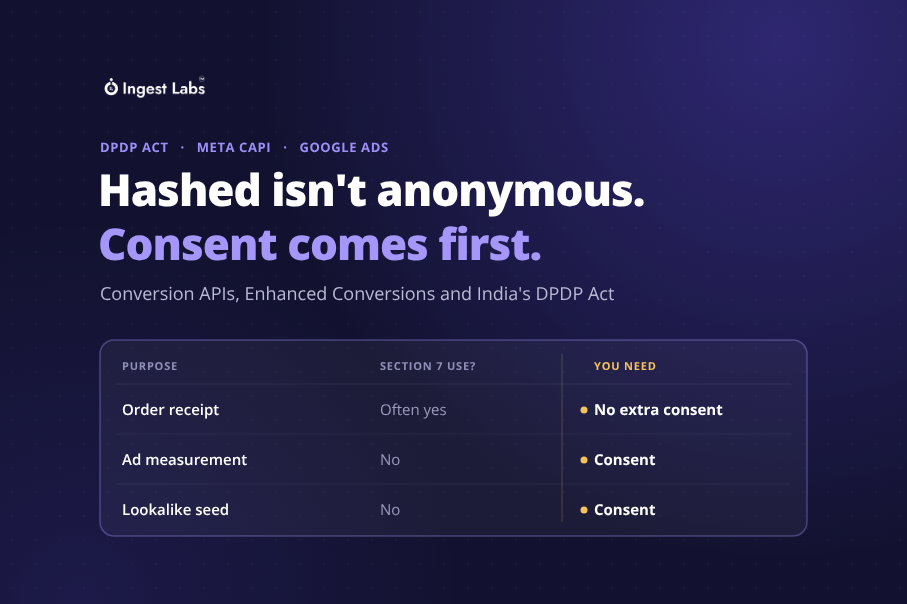
Short answer: Meta's Conversions API and Google's Enhanced Conversions both send identifiers about a specific customer to an ad platform, usually a hashed email or phone number plus the order details. Under India's DPDP Act, that is processing of personal data for advertising measurement, and advertising measurement is not one of the "legitimate uses" in section 7. It needs the customer's consent, for that purpose, given before the event is sent. Hashing protects the value in transit; it does not remove the need for consent, because the hash exists precisely so the platform can match it to a person. Google Consent Mode and similar flags carry the consent decision to the platform, but they are signals, not consent. The obligations apply from 13 May 2027.
Meta's Conversions API (CAPI) and Google Ads Enhanced Conversions have become standard equipment for Indian performance teams. Both recover measurement lost to ad blockers, browser restrictions and missing click IDs, and both improve bidding by giving the platform better signals about who converted.
Both also work by sending identifiers about a named customer to a third party. That is exactly the kind of processing the Digital Personal Data Protection Act, 2023 was written to govern.
This article explains what these tools actually send, which DPDP grounds apply, why hashing and consent flags do not settle the question on their own, and what a setup that holds up looks like for web, app, call-centre and offline conversions. For the full DPDP timeline, see our DPDP Act compliance guide.
What these tools actually send
It helps to be precise about the data, because the legal analysis follows the fields.
| Tool | Typical identifiers | Hashed before sending? | Other data |
|---|---|---|---|
| Meta Conversions API | Email, phone, first and last name, city, state, postcode, date of birth, external ID | Yes, SHA-256, for email, phone, names, gender, date of birth, city, state, postcode and country; recommended for external ID | IP address, user agent, Meta click and browser IDs (fbc, fbp), which are sent unhashed |
| Meta Pixel with Advanced Matching | Email, phone, name and similar fields read from the page | Hashed by the pixel in the browser | Cookies, page URL, event details |
| Google Ads Enhanced Conversions | Email, phone, name, home address | Yes, SHA-256, by the Google tag or your own code | Order ID, conversion value, click ID where present |
| Offline or call-centre conversion uploads | Email or phone captured by sales or support | Hashed in the upload | Lead or order outcome, value, timestamp |
Two points stand out. First, IP address, user agent and click identifiers are sent in the clear, and together they can identify a device and often a person. Second, every one of these tools exists to match the event to a specific account on the platform. Matching is the feature.
Hashing is protection, not anonymisation
Teams sometimes argue that a SHA-256 hash of an email is not personal data, so DPDP does not apply. That argument does not survive contact with how these tools work.
A hashed email is sent so that Meta or Google can hash its own users' emails the same way and find the match. If the platform can link the value back to an account, the person is identifiable. In our reading, a hashed identifier sent for matching is personal data under the Act, and treating it otherwise would be hard to defend before the Data Protection Board.
Hashing still matters. It is a reasonable security safeguard of the kind Rule 6 describes (encryption, obfuscation, masking, tokenisation), and it limits what a breach in transit could expose. Keep doing it. Just do not treat it as a substitute for a lawful basis.
Which DPDP ground applies?
The DPDP Act gives two grounds for processing: consent under section 6, or a legitimate use under section 7. There is no legitimate-interests balancing test.
| What the event is used for | Section 7 legitimate use? | What you need |
|---|---|---|
| Fulfilling the order, sending the receipt | Often yes, under section 7(a), for the data the customer gave for that purpose | Nothing further for that purpose |
| Measuring which ad led to the sale | No | Consent for advertising measurement |
| Optimising bids and delivery on the platform | No | Consent for advertising |
| Building or refreshing a retargeting audience | No | Consent for advertising or retargeting |
| Seeding a lookalike audience | No | Consent for that purpose |
Section 7(a) is the one teams reach for. It covers data a person voluntarily gives for a specified purpose where she has not said she does not consent, with a receipt as the standard example. A shopper gives her email to receive her order confirmation. Sending that email, hashed, to Meta so it can attribute and optimise ads is a different purpose that she did not give the data for. Our DPDP vs GDPR comparison explains why the EU habit of relying on legitimate interests for these flows has no equivalent in India.
Consent must be free, specific, informed, unconditional and unambiguous, given by a clear affirmative action, and limited to the data needed for the purpose (section 6(1)). In practice, that means a notice that names advertising measurement as a purpose, says which data is used, and gives the customer a real choice. Our guide to DPDP consent and notice requirements covers how to word and structure that.
Consent signals are not consent
Google Consent Mode
Google's Consent Mode includes four consent states that govern Google's advertising and analytics tags: ad_storage, analytics_storage, ad_user_data (permission to send user data to Google for advertising) and ad_personalization (permission to use data for personalised advertising). For Enhanced Conversions, ad_user_data is the state that matters.
Consent Mode carries a decision; it does not make one. Google's own documentation says that the site owner is responsible for obtaining consent. For Indian traffic, your notice and consent platform must collect the decision first, and your tags must then set those states from it.
Google offers two implementations. In basic mode, Google tags do not load until the visitor makes a choice, and nothing is sent if they decline. In advanced mode, tags load immediately, with consent defaulting to denied unless you set other defaults, and send measurements without cookies while consent is denied. Whether cookieless pings from people who declined are acceptable under DPDP is a question to settle with counsel; the cautious choice for Indian traffic is basic mode, or a server-side setup that sends nothing for denied purposes.
Meta
For Meta, the practical control is simple: if a customer has not consented to advertising, do not send the event to Meta. That decision has to be made on your side, before the API call, for both the browser pixel and the server event.
Where setups go wrong
The server event ignores the banner
The most common failure is a server-side container that forwards every purchase to Meta and Google regardless of what the consent banner recorded, on the theory that server-to-server traffic is not a cookie. Under DPDP it is still processing, and section 8(1) makes you responsible for what your processors do on your behalf. Our reference guide to server-side tracking explains how these containers are typically wired.
Pixel and server disagree
Many setups send the same event from both the pixel and the server, with a shared event ID so Meta can deduplicate them. Under DPDP, both paths must apply the same consent state. A pixel that respects a denial while the server event goes through anyway produces the worst of both: an unlawful event that also looks like a measurement gain.
Raw identifiers leak through other fields
Hashing the email field does nothing if the same email sits in a URL parameter, a custom data field or a page title that the pixel also sends. Strip identifiers from free-text fields before anything leaves your systems.
Old customer lists are re-uploaded
Customer Match lists, Custom Audiences and offline conversion uploads often reuse data collected years ago for other purposes. For consent given before the obligations started, section 5(2) requires a fresh notice as soon as reasonably practicable, and the customer can then withdraw. Data collected without any advertising consent should not go to the platforms at all.
Children's events reach ad platforms
Under the Act a child is anyone under 18, and section 9(3) prohibits tracking, behavioural monitoring and targeted advertising directed at children. Parental consent does not change that. If a customer is known or likely to be under 18, block the event from every advertising destination outright.
Withdrawal, erasure and the audiences you already built
When a customer withdraws consent, section 6(6) requires you to stop processing within a reasonable time and to cause your processors to stop too. Section 8(7) requires erasure once consent is withdrawn or the purpose is no longer served, unless a law requires retention, and requires you to cause your processors to erase data you made available to them.
For ad platforms, that means more than stopping future events. Remove the customer from Custom Audiences and Customer Match lists, exclude them from lookalike seeds on the next refresh, and record that you did it. The Consent Manager framework has been in force since 13 November 2026 and registration is open. Once Consent Managers are registered, a withdrawal may reach you through one rather than your own banner, so the process should be ready to accept signals from every channel.
A setup that holds up
-
Name the purposes. List advertising measurement, bid optimisation, retargeting and lookalike modelling as purposes in your notice, separately from analytics and order fulfilment.
-
Collect consent before the first event. For Indian traffic, default advertising to denied until the customer chooses.
-
Gate both paths. Apply the same consent check to the pixel and the server event, and send nothing to Meta or Google for customers who declined.
-
Map consent to platform flags. Set Google's
ad_user_dataandad_personalizationfrom the customer's actual choice, and prefer basic Consent Mode for Indian traffic unless counsel is comfortable with cookieless pings. -
Send the minimum. Hash email and phone as the platforms specify, send only the fields each platform needs, and strip identifiers from URLs and free-text fields.
-
Block children. Suppress every advertising event for customers known or likely to be under 18.
-
Handle withdrawal end to end. Stop events, remove the customer from audiences and lists, and log each step.
-
Keep the evidence. Log every event, the consent state it carried and what was sent to each platform, and keep the logs for at least a year as Rule 6 requires.
-
Report honestly. Expect lower match rates on Indian traffic and use the platforms' modelled conversions rather than "recovering" events from people who said no.
The same pattern applies to other conversion APIs. Our LinkedIn Conversions API setup guide covers that platform, and why Google Ads conversions drop when click IDs go missing explains the measurement side.
Where things stand
As of 23 November 2026, the DPDP dates have not moved. The Consent Manager framework came into force on 13 November 2026, and the consent, notice, security, breach and children's data obligations apply from 13 May 2027. The Data Protection Board has no Chairperson or Members yet, and challenges to the Act are next listed before the Supreme Court on 9 December 2026, with no stay in place.
Where Ingest Labs fits
The hard part of all this is not the policy. It is making sure that, on every purchase, lead and sign-up, the event only reaches Meta, Google and the rest when the customer agreed to that purpose. Ingest IQ does that in the pipeline: it applies consent per event and per destination, against the purposes you map to each destination, across more than 100 integrations including Meta CAPI and Google Ads.
Every event and destination decision is written to an audit trail, withdrawal and erasure propagate to the destinations that received the data, and processing for Indian customers can be region-pinned with a documented sub-processor list. It works with your existing consent platform, whether OneTrust, Consentmo or a custom build. Under DPDP, Ingest Labs acts as your Data Processor and you remain the Data Fiduciary; the platform is architected for DPDP and holds SOC 2 Type II. See our DPDP resource page for the architecture.
Frequently asked questions
Do we need consent to send purchases to Meta's Conversions API under DPDP?
Yes, if the event carries identifiers about the customer and is used for advertising measurement, optimisation or audiences. Those purposes are not legitimate uses under section 7, so they need consent under section 6. The fact that the event travels server-to-server does not change that.
Is a hashed email personal data under the DPDP Act?
In our reading, yes, when it is sent so that a platform can match it to an account. The hash exists to identify the person on the platform. Hashing is still a useful security safeguard, but it is not a reason to skip consent.
Does Google Consent Mode satisfy DPDP consent requirements?
No. Consent Mode passes your customer's choice to Google tags; it does not collect that choice. You still need a notice and consent that meet sections 5 and 6 of the Act, and your tags must set ad_user_data and ad_personalization from the customer's actual decision.
Can we upload offline conversions from our call centre?
Only for customers who consented to advertising measurement. A phone number given to a sales agent for a callback is data provided for that purpose. Uploading it to Google or Meta for attribution is a separate purpose that needs consent.
What happens to existing Custom Audiences and Customer Match lists?
Review them before 13 May 2027. Customers whose data was collected without advertising consent should not be in them, and anyone who withdraws must be removed. For consent given before the obligations started, send the fresh notice that section 5(2) requires.
Can we keep running retargeting for 16- and 17-year-olds?
No. Under the DPDP Act anyone under 18 is a child, and section 9(3) prohibits tracking, behavioural monitoring and targeted advertising directed at children, even with parental consent.
To review your Meta and Google setup against the India rules, book a DPDP readiness call.
Sources
-
Meta for Developers, Conversions API customer information parameters (checked 2026-11-23): which fields must be hashed with SHA-256 and which (IP address, user agent, fbc, fbp) must not; email and phone normalisation
-
Google Ads Help, About enhanced conversions (checked 2026-11-23): first-party data sent; SHA-256 hashing before sending
-
Google for Developers, Consent mode overview (checked 2026-11-23): consent types for ads and analytics; basic and advanced modes; site owner responsible for obtaining consent
-
India Code, The Digital Personal Data Protection Act, 2023 (checked 2026-11-23): sections 6(6), 8(1), 8(5) and 8(7) on processors, withdrawal and erasure
-
DPDP Wiki, Section 6: Consent (checked 2026-10-27): requirements for valid consent
-
DPDP Wiki, Section 9: Processing of personal data of children (checked 2026-11-02): ban on tracking, behavioural monitoring and targeted advertising directed at children
-
Cyril Amarchand Mangaldas, client alert on the DPDP Rules (checked 2026-11-02): reasonable security safeguards; one-year log retention
-
India Data Law, weekly DPDP updates (checked 2026-11-23): Consent Manager provisions in force from 13 November 2026; Supreme Court petitions listed for 9 December 2026
This article is general information about the Digital Personal Data Protection Act, 2023 and the Digital Personal Data Protection Rules, 2025, current as of November 2026. It is not legal advice. Please take advice from qualified counsel on your specific position.