DPDP vs GDPR: Why Your Privacy Stack Won't Port to India
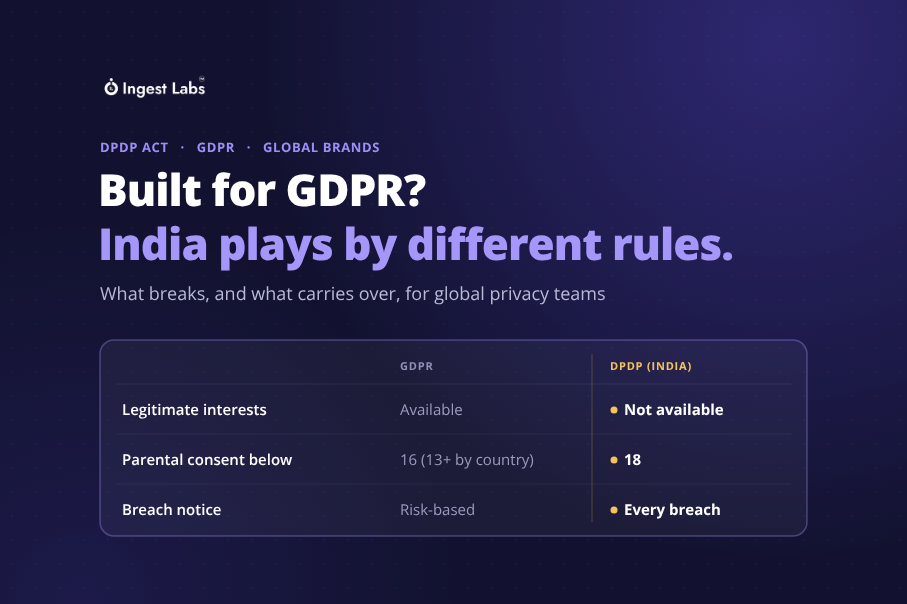
Short answer: India's DPDP Act looks like the GDPR but differs at the point that matters most to marketing and data teams: it has no "legitimate interests" ground. Processing needs consent or one of a short list of legitimate uses, and attribution, retargeting and lookalike audiences are not on that list. DPDP also treats everyone under 18 as a child and bans tracking and targeted advertising directed at them, requires every personal data breach to be reported to the regulator and to each affected person with no risk threshold, and controls cross-border transfers through a negative list rather than adequacy decisions and standard contractual clauses. Security programmes, data maps, access-request tooling and processor contracts carry over with adjustments. The legal grounding of marketing and measurement does not. Most of these obligations apply from 13 May 2027.
If your organisation built its privacy programme around the GDPR, India's Digital Personal Data Protection Act, 2023 will look familiar at first. It has controllers (called Data Fiduciaries), processors, consent, notices, rights, breach reporting and a regulator. The common assumption is that India needs a translated privacy notice and a few edits to the cookie banner.
That assumption fails at the most important point. Much of a modern marketing and measurement stack in Europe rests, for at least some flows, on legitimate interests. In India it has nothing to rest on.
This article sets out the differences that matter to global brands and multinational financial services groups with Indian customers: the legitimate-interests gap, a side-by-side comparison, what breaks when you copy an EU setup to India, what carries across, and a checklist your privacy team can work from. For the full DPDP timeline and obligations, see our DPDP Act compliance guide.
The central difference: India has no legitimate interests
How much of your EU stack rests on Article 6(1)(f)
Article 6(1) of the GDPR gives six lawful bases: consent, contract, legal obligation, vital interests, public task and legitimate interests. Legitimate interests, in Article 6(1)(f), covers processing "necessary for the purposes of the legitimate interests pursued by the controller or by a third party", subject to a balancing test.
In practice, many EU programmes use that balancing test for processing that feels expected but is awkward to put behind a consent prompt: first-party analytics, fraud scoring, product measurement, some attribution, CRM enrichment and service emails to existing customers.
What the DPDP Act offers instead
The DPDP Act provides two grounds and no balancing test:
-
Consent under section 6, which must be free, specific, informed, unconditional and unambiguous, given by a clear affirmative action, and limited to the data necessary for the specified purpose.
-
Certain legitimate uses under section 7, a closed list. It covers data a person voluntarily provides for a specified purpose where they have not indicated that they do not consent (section 7(a)), state functions and benefits, legal obligations, court orders, medical emergencies, epidemics and disasters, and employment purposes.
Marketing measurement is not on the list. Neither are attribution, retargeting, audience building or lookalike modelling. If a purpose does not fall within section 7, it needs consent.
Why section 7(a) does not rescue retargeting
Global teams often point to section 7(a) as India's version of legitimate interests. It is much narrower. The standard illustration is a customer who gives a phone number to get a receipt: the data was provided voluntarily, for a specified purpose, and can be used for that purpose.
Apply that to an ecommerce order. A shopper gives her email and address to complete a purchase. You can use them to fulfil and confirm the order. Hashing that email and sending it to Meta's Conversions API to retarget her, or to seed a lookalike audience, is a different purpose that she did not provide the data for. Pixel signals such as page views and add-to-cart events are a step further away, because they are collected from her behaviour rather than handed over for a stated purpose.
The practical result is that India needs a consent-first measurement architecture, even where your EU stack has relied on legitimate interests for some flows. Our guide to DPDP consent and notice requirements covers how to design notices and purposes so that consent is specific enough to hold up.
Fraud, risk and security processing
Financial services teams should look carefully at what currently sits on legitimate interests for fraud and risk. Some of it may fall under section 7 where a law requires the checks. Section 17 also exempts processing for the prevention and investigation of offences. How far that exemption reaches into routine commercial fraud scoring has not been tested, so take Indian advice purpose by purpose rather than assume the EU mapping carries over.
DPDP vs GDPR: the comparison
The GDPR column covers well-established provisions. The DPDP column reflects the Act and the DPDP Rules, 2025 as of early November 2026.
| Area | GDPR | DPDP Act 2023 and Rules 2025 |
|---|---|---|
| Territorial scope | Establishment in the EU, or targeting or monitoring people in the EU | Processing in India, plus processing outside India connected with offering goods or services to people in India (s.3) |
| Data covered | All personal data | Digital personal data, including data collected offline and later digitised (s.3) |
| Publicly available data | Still regulated | Excluded where the individual made it public, or where it was published under a legal obligation (s.3(c)) |
| Lawful bases | Six (Art 6), including legitimate interests | Consent (s.6) or listed legitimate uses (s.7); no legitimate interests |
| Children | For online services offered directly to children, parental consent below 16; member states may lower to 13 (Art 8) | Under 18; verifiable consent of a parent or lawful guardian; no tracking, behavioural monitoring or targeted advertising directed at children (s.9) |
| Sensitive data | Special categories with extra conditions (Art 9) | No separate category; sectoral rules add requirements |
| Breach: regulator | Within 72 hours where feasible, unless unlikely to result in a risk (Art 33) | Every breach: intimation without delay, then a detailed report within 72 hours (s.8(6), Rule 7) |
| Breach: individuals | Where likely to result in high risk (Art 34) | Every affected individual, without delay; no risk threshold |
| Rights | Access, rectification, erasure, portability, objection and others | Access, correction and erasure, grievance redressal, nomination; responses within 90 days |
| Officer and assessments | DPO in defined cases (Art 37); DPIA for high-risk processing (Art 35) | Contact details of a DPO or responsible person for all; India-based DPO, annual DPIA and audit only for notified Significant Data Fiduciaries (s.10) |
| Cross-border transfers | Adequacy, standard contractual clauses and other safeguards (Chapter V) | Permitted except to countries the government restricts by notification (s.16(1)); stricter sectoral laws still apply (s.16(2)) |
| Consent intermediaries | No equivalent | Registered Consent Managers, framework from 13 November 2026 |
| Regulator | Supervisory authority in each member state | Data Protection Board of India, with appeals to TDSAT; no members appointed as of early November 2026 |
| Fines | Up to €20 million or 4% of worldwide annual turnover, whichever is higher (Art 83) | Fixed caps per category, up to ₹250 crore |
In short, the DPDP Act is narrower than the GDPR in scope (digital data only, no special categories, public data excluded) but stricter on several points that matter most to marketing and data operations.
What breaks when you port your EU setup
1. Consent defaults by region
Many global tag configurations set consent defaults by region: denied for the EEA and the UK, granted elsewhere. In many containers India falls into "elsewhere". Once DPDP's consent obligations apply from 13 May 2027, that default would fire advertising tags and send hashed identifiers to ad platforms before any consent exists.
Copying the EEA default is not enough on its own. India's purposes, notice wording and withdrawal mechanics differ. Treat India as its own consent region with its own purpose list, and make sure server-side events follow the same consent state as the browser. A server-side pipeline that forwards every purchase event to Meta regardless of what the banner recorded is one of the most common gaps in practice.
2. Analytics and measurement on legitimate interests
Map every flow that your EU record of processing places under Article 6(1)(f), then ask one question of each: which section 7 legitimate use covers this in India? For most marketing analytics, attribution and audience flows, the answer is none, so they move behind consent.
Expect lower match rates and smaller retargeting pools for Indian traffic, and plan modelled or aggregate reporting for people who decline. Have that conversation with your performance marketing team now, not in May 2027.
3. "Strictly necessary" and everything else
EU banners usually divide trackers into "strictly necessary", which run without consent, and everything else. The DPDP Act has no cookie-category exemption of that kind. The question for every tag and event is the same as for any other processing: consent, or a specific section 7 legitimate use?
Some functional processing, such as keeping a cart or completing checkout, can reasonably be tied to data the customer provided for that purpose. Analytics, A/B testing, session recording and advertising pixels usually cannot. Review your "necessary" bucket line by line rather than inheriting the EU classification.
4. Audiences aged 13 to 17
For online services offered directly to children, a programme built on Article 8 treats 16, or 13 in some member states, as the age at which a person can consent alone. Under DPDP a child is anyone under 18. Processing a child's data needs verifiable consent from a parent or lawful guardian, and section 9(3) separately prohibits tracking, behavioural monitoring and targeted advertising directed at children. Parental consent does not unlock targeted advertising.
For brands in education, gaming, fashion, beauty, quick commerce and youth banking, this changes the funnel. Age signals need to suppress pixels and conversion API events, not just change the ad creative.
5. Breach playbooks built on risk thresholds
EU playbooks open with triage: is the breach likely to result in a risk (Article 33), and is that risk high (Article 34)? Many incidents end at that step with an internal record and no notification. DPDP removes that step for notification. Every personal data breach is intimated to the Board without delay, followed by a detailed report within 72 hours, and every affected person is told without delay.
Your playbook needs an India branch without risk triage for the notification decision, and your processors, including marketing vendors, need contracts that make them tell you quickly enough. In our reading, a misconfigured destination that sends Indian customers' data to the wrong ad account can amount to a personal data breach that needs notifying.
6. Transfer documentation built on SCCs
Under Chapter V, EU transfer documentation is built around adequacy decisions and standard contractual clauses. DPDP inverts the model: section 16(1) lets the government restrict transfers to countries it notifies, and transfers elsewhere are permitted. Section 16 applies from 13 May 2027, so the thing to track is any restricted-country notification. There is no blanket localisation requirement. Localisation applies only to notified Significant Data Fiduciaries, for categories of data the government specifies on a committee's recommendation.
The binding constraint for many groups is sectoral. Section 16(2) preserves Indian laws that give a higher degree of protection or restriction on transfers, so for regulated financial businesses, sectoral rules such as the RBI's payment data storage requirements still apply whatever the DPDP Act permits.
7. DPIA cadence and the DPO model
Under Article 35 you run a DPIA when processing is likely to be high risk, often at project launch. DPDP imposes an annual DPIA and audit, but only on Significant Data Fiduciaries notified by the government, and none had been notified as of 13 October 2026.
Large banks, insurers, marketplaces and platforms should still plan for it. A notified SDF needs a DPO based in India who is responsible to the board, an independent data auditor and the annual cycle. A DPO in Dublin covering India by email will not meet that.
What carries over, with adjustments
Security programmes
The DPDP Rules describe reasonable security safeguards in terms a mature ISO 27001 or SOC 2 programme will recognise: encryption or masking, access control, logging and monitoring, backups and continuity, and technical and organisational measures. The India-specific additions are keeping logs for at least one year and putting security clauses into processor contracts. Failing to take reasonable safeguards carries the highest DPDP penalty cap, up to ₹250 crore.
Data maps and records of processing
Your EU data map is the most valuable thing you bring to India. The DPDP notice must itemise the personal data and each purpose, which you cannot do without knowing what you collect and where it goes. Withdrawal and erasure also depend on knowing every destination that received the data. For Indian customers, add three fields: the section 6 or 7 ground for each purpose, the Eighth Schedule languages your notices are offered in, and any retention class that applies to you.
Access-request tooling
Access, correction and erasure workflows carry across, and a 90-day outer limit sits comfortably with most global service levels. Two additions: nomination under section 14, which lets a person name someone to exercise their rights on death or incapacity, and a visible grievance channel, which the Act requires every Data Fiduciary to provide.
Processor contracts
GDPR data processing agreements are a sound base, but the liability position differs. Under section 8(1), the Data Fiduciary is responsible for processing by its processors regardless of any agreement to the contrary. Add DPDP clauses on security safeguards, log retention, breach notice timing, withdrawal propagation and erasure.
Where things stand
As of early November 2026, the DPDP dates have not moved: the Consent Manager framework starts on 13 November 2026 and most obligations apply from 13 May 2027. The Data Protection Board exists in law but has no Chairperson or Members yet.
Several petitions challenging parts of the Act and Rules are before the Supreme Court. The Court declined to stay the Act without hearing the government and listed the matter for 17 November 2026. None of this changes the compliance dates today, but it is worth watching.
The India delta: a checklist for global privacy teams
-
Re-ground every purpose. For Indian customers, assign each purpose to consent or a named section 7 legitimate use. Anything that was legitimate interests in the EU and has no section 7 home moves to consent.
-
Make India its own consent region. Default to denied for marketing and analytics, with an India-specific purpose list rather than inherited cookie categories.
-
Enforce consent server-side. Make conversion APIs, warehouse syncs, CDP audiences and email platforms follow the same consent state as browser tags, per event and per destination.
-
Rewrite the notice. Standalone and itemised, in English and the Eighth Schedule languages your customers use, plus a notice programme for existing customers.
-
Engineer withdrawal and erasure. Withdrawal must be as easy as consent, and processing by you and your processors must stop within a reasonable time.
-
Reset the age gate to 18. Suppress tracking and targeted advertising for under-18s across pixels, SDKs and server-side events.
-
Add an India branch to the breach playbook. No risk triage for the notification decision; Board intimation without delay, a detailed report within 72 hours, and notices to every affected person.
-
Update processor contracts for security, one-year logs, breach notice timing, withdrawal and erasure.
-
Re-map transfers. Swap the SCC-centred analysis for a watch on any restricted-country notification, and record sectoral constraints such as RBI payment data storage.
-
Prepare for possible SDF designation. Identify an India-based DPO, an independent auditor and an annual DPIA and audit cycle.
-
Extend access-request tooling for nominees and a grievance-first workflow.
-
Decide your Consent Manager position before the framework starts on 13 November 2026.
Where Ingest Labs fits
The hardest part of the India delta is not the policy. It is enforcement in the data pipeline. Your consent platform records that an Indian shopper declined advertising, but your server-side container, CDP and warehouse syncs will keep sending her events to Meta, Google Ads and your email platform unless something in the path checks consent on every event.
Ingest IQ is that enforcement layer. It sits between consent capture and more than 100 integrations and applies consent per event and per destination, against the purposes mapped to each destination. Every event and destination decision goes into an audit trail, withdrawal and erasure propagate to the destinations that received the data, and processing for Indian customers can be region-pinned with a documented sub-processor list.
Ingest IQ works with your existing consent platform, whether OneTrust, Consentmo or a custom build. Under DPDP, Ingest Labs acts as your Data Processor and you remain the Data Fiduciary. The platform is architected for DPDP and holds SOC 2 Type II. Our DPDP resource page sets out the architecture.
Frequently asked questions
Is the DPDP Act the same as the GDPR?
No. They share concepts such as controllers (Data Fiduciaries), processors, consent, notice, rights and breach reporting, but they differ in important ways. The DPDP Act has no legitimate-interests ground, treats anyone under 18 as a child, requires notification of every breach without a risk threshold, has no special categories of data, uses a negative-list model for transfers, and covers only digital personal data.
Can we rely on legitimate interests for analytics in India?
No. The DPDP Act allows processing only with consent under section 6 or for a listed legitimate use under section 7. Marketing analytics, attribution, retargeting, audience building and lookalike modelling are not among the legitimate uses, so for people in India they need consent.
If we comply with the GDPR, how much carries over to DPDP?
A good deal of the infrastructure: security programmes, data maps, access-request tooling and processor contracts all transfer with adjustments. What does not carry over is the legal grounding of marketing and measurement, cookie classifications, the child age threshold, risk-based breach triage and SCC-based transfer documentation.
Does the DPDP Act require data to stay in India?
Not generally. Once section 16 applies from 13 May 2027, transfers are permitted except to countries the government restricts by notification. Localisation applies only to notified Significant Data Fiduciaries for data the government specifies, and stricter sectoral rules, such as the RBI's payment data storage requirements, continue to apply.
How do DPDP penalties compare with GDPR fines?
GDPR fines can reach €20 million or 4% of worldwide annual turnover, whichever is higher. DPDP penalties are fixed caps per category, imposed by the Data Protection Board after an inquiry, of up to ₹250 crore for failing to take reasonable security safeguards. They are not linked to turnover.
Does the Supreme Court challenge change the DPDP deadlines?
Not as of early November 2026. The Supreme Court declined to stay the Act without hearing the government and listed the petitions for 17 November 2026. The Consent Manager framework still starts on 13 November 2026 and most obligations still apply from 13 May 2027.
If you are running an EU-to-India gap analysis, book a DPDP readiness call.
Sources
-
GDPR Article 6, Lawfulness of processing (legislation.gov.uk) (checked 2026-11-02): the six lawful bases, including legitimate interests in Article 6(1)(f)
-
GDPR Article 8, Conditions applicable to child's consent (gdpr-text.com) (checked 2026-11-02): 16-year threshold; member states may lower it to no lower than 13
-
GDPR Article 33, Notification of a breach to the supervisory authority (gdpr-text.com) (checked 2026-11-02): 72 hours where feasible; not required where unlikely to result in a risk
-
GDPR Article 34, Communication of a breach to the data subject (gdpr-text.com) (checked 2026-11-02): individuals told where a breach is likely to result in a high risk
-
GDPR Article 83, Administrative fines (gdpr-text.com) (checked 2026-11-02): up to €20 million or 4% of worldwide annual turnover
-
DPDP Wiki, Section 3: Application of the Act (checked 2026-11-02): territorial and extra-territorial application; exclusion for publicly available data
-
DPDP Wiki, Section 6: Consent (checked 2026-10-27): requirements for valid consent and withdrawal
-
DPDP Wiki, Section 9: Processing of personal data of children (checked 2026-11-02): verifiable parental consent; ban on tracking, behavioural monitoring and targeted advertising directed at children
-
DPDP Wiki, Section 16: Processing of personal data outside India (checked 2026-11-02): restriction by notification; stricter laws continue to apply
-
DSCI, FAQs on cross-border flow of data under the DPDP Act and Rules (checked 2026-11-02): no blanket localisation; SDF localisation only for specified data
-
Cyril Amarchand Mangaldas, client alert on the DPDP Rules (checked 2026-11-02): breach notices without delay and a detailed Board report within 72 hours; one-year logs; annual SDF DPIA and audit; 90-day cap
-
India Data Law, Is the Data Protection Board of India operational? (checked 2026-11-02): no Chairperson or Members appointed
-
DPDP Rules tracker, What is in force in 2026 (checked 2026-11-02): commencement dates unchanged
-
MediaNama, DNPA challenge to the DPDP Act in the Supreme Court (checked 2026-11-02): no stay; listed for 17 November 2026
This article is general information about the Digital Personal Data Protection Act, 2023, the Digital Personal Data Protection Rules, 2025 and the EU General Data Protection Regulation, current as of November 2026. It is not legal advice. Please take advice from qualified counsel on your specific position.