DPDP Readiness Checklist: A 60-Step Roadmap to 13 May 2027
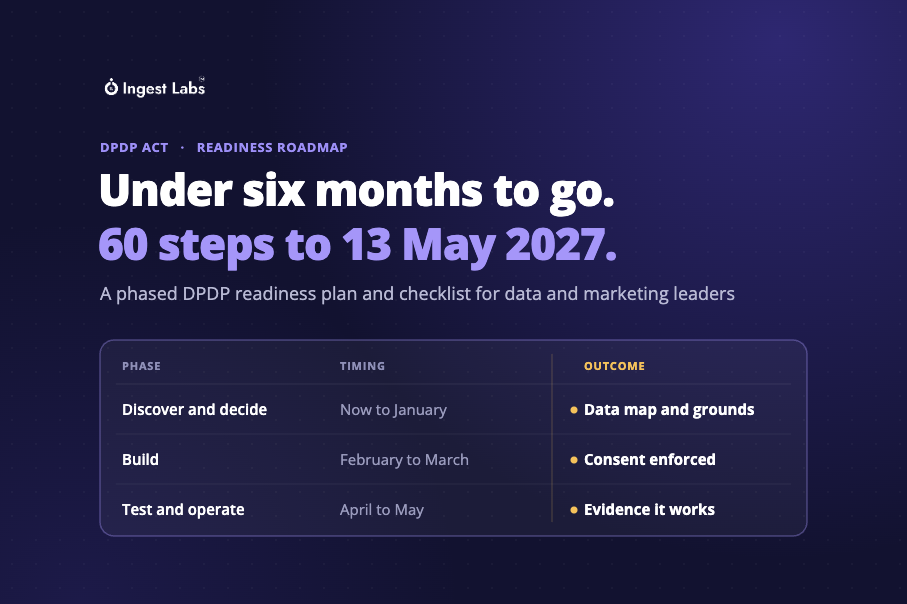
Short answer: Most of India's DPDP Act obligations apply from 13 May 2027, under six months away. A credible readiness programme has five phases: discover (map data, purposes and destinations), decide (assign a legal ground to every purpose and settle fiduciary and processor roles), build (notices, consent capture, enforcement in the data pipeline, withdrawal and erasure, children's controls, security and logs), test (consent states, withdrawal drills, breach tabletops) and operate (rights, grievances, breach reporting and evidence). The work that takes longest is not the privacy notice. It is making every event, tag and data feed respect consent, and being able to show it. This checklist sets out the 60 steps, by workstream, with the sections and rules behind each.
When the Digital Personal Data Protection Rules, 2025 were notified on 13 November 2025, organisations had 18 months before the main obligations apply. As of late November 2026, under six months remain.
The dates have not moved. The Consent Manager framework came into force on 13 November 2026, and the notice, consent, security, breach, children's data, retention, rights and cross-border obligations apply from 13 May 2027. The government consulted earlier in 2026 on shortening some timelines, but no instrument changing the dates has been issued.
This checklist is for the people who have to make it happen: DPOs, general counsel, CISOs, heads of data and marketing leaders. For the background, see our DPDP Act compliance guide.
The roadmap at a glance
| Phase | Timing | Outcome |
|---|---|---|
| 1. Discover | Now to mid-January 2027 | A data map of every collection point, purpose, system and destination |
| 2. Decide | By end of January 2027 | A legal ground for every purpose; roles settled with every vendor |
| 3. Build | February to March 2027 | Notices, consent, enforcement, withdrawal, erasure, children's controls, security, contracts |
| 4. Test | April 2027 | Evidence that consent, withdrawal, erasure and breach processes work |
| 5. Operate | From 13 May 2027 | Rights, grievances, breach reporting and ongoing monitoring |
Workstream 1: Governance
-
Name an accountable executive and a DPO or person who can answer for the organisation's processing, and publish their business contact details (section 8(9)).
-
Set up a steering group with legal, security, data, marketing, product and customer service.
-
Brief the board on obligations, penalties of up to ₹250 crore, and the plan.
-
Assess whether you could be notified as a Significant Data Fiduciary under section 10, and if so plan for an India-based DPO, an independent data auditor and annual assessments and audits.
Workstream 2: Discover the data
-
List every collection point: website, app, stores, call centre, forms, partners, events, Wi-Fi.
-
List every system that stores personal data: CRM, CDP, warehouse, marketing tools, support, finance.
-
List every destination that receives personal data: ad platforms, analytics, messaging, agencies, partners.
-
For each flow, record the fields, the purpose, the processing location and the vendor.
-
Identify children's data and data about persons with disabilities who have lawful guardians.
-
Identify data held only because "it might be useful".
Workstream 3: Decide the legal ground for every purpose
-
Assign each purpose to consent (section 6) or a specific legitimate use (section 7). There is no legitimate-interests ground.
-
Use section 7(a) only for data a person gave for that specific purpose, such as fulfilling an order.
-
Treat attribution, retargeting, lookalikes, audience building and most marketing analytics as needing consent.
-
Note any law that requires you to keep data, so erasure can respect it (section 8(7)).
-
Note disclosures a law requires you to make to authorities (section 7(d)).
-
Record the decision and the reasoning for each purpose.
Our DPDP vs GDPR comparison explains why EU legitimate-interests mappings do not carry over.
Workstream 4: Notices and consent
-
Write a standalone, itemised notice listing the personal data, each purpose and the service it enables (section 5, Rule 3).
-
Explain how to withdraw consent, exercise rights and complain to the Board.
-
Offer the notice in English and the Eighth Schedule languages your customers use.
-
Capture consent per purpose, by clear affirmative action, with no pre-ticked boxes and no bundling with the service.
-
Avoid the dark patterns prohibited by the Central Consumer Protection Authority's 2023 guidelines, such as forced action, confirm shaming and nagging.
-
Version notices and consent records, and keep them so you can prove consent if challenged (section 6(10)).
-
Plan notices for customers who consented before the obligations start (section 5(2)).
-
Be ready to accept consent and withdrawal signals from registered Consent Managers once they exist.
Our guide to DPDP consent and notice requirements covers notice design in detail, and our explainer on Consent Managers covers that framework.
Workstream 5: Enforce consent in the data stack
-
Default all non-essential tags and events to off for Indian users until they choose.
-
Gate every destination on the purposes it serves, per event, including server-side and conversion API traffic.
-
Send each destination only the fields its purpose needs; hash or tokenise identifiers where appropriate.
-
Strip personal data from URLs, page titles and free-text fields before anything is sent.
-
Find and remove "shadow" tags added outside your tag management.
-
Reconcile what destinations receive against what consent allows.
Our guide to server-side tracking explains where these controls sit. For a DPDP-specific design, see our server-side reference architecture for DPDP.
Workstream 6: Withdrawal and erasure
-
Make withdrawal as easy as giving consent (section 6(4)).
-
Stop processing within a reasonable time after withdrawal, and cause processors to stop (section 6(6)).
-
Keep a record of which destinations received each person's data, so withdrawal and erasure reach all of them.
-
Remove withdrawn users from ad audiences, customer match lists and lookalike seeds.
-
Erase data when the purpose is no longer served or consent is withdrawn, unless a law requires retention, and cause processors to erase (section 8(7)).
-
If you are an e-commerce, gaming or social media business above the Third Schedule thresholds, build the three-year inactivity erasure process with 48 hours' notice.
Workstream 7: Children and persons with disabilities
-
Identify where under-18s may use your services.
-
Obtain verifiable parental or guardian consent where you process their data (section 9(1), Rules 10 and 11).
-
Block tracking, behavioural monitoring and targeted advertising directed at children (section 9(3)).
-
Apply Fourth Schedule exemptions only where they genuinely fit, and document why.
Workstream 8: Security and logs
-
Review safeguards against Rule 6: encryption, masking or tokenisation, access control, monitoring, backups.
-
Keep logs of access and processing for at least one year.
-
Restrict exports and downloads of customer data, and control devices.
-
Align with sectoral and CERT-In requirements, such as CERT-In's 180-day log retention in India.
Workstream 9: Breach readiness
-
Define what counts as a breach, including misdirected data and vendor incidents (section 2(u)).
-
Pre-draft notices to the Board and to affected people with everything Rule 7 requires.
-
Be able to notify the Board without delay and file a detailed report within 72 hours.
-
Be able to identify every affected person and notify each one without delay.
-
Combine DPDP, CERT-In's six-hour reporting and sectoral reporting in one run-book.
-
Run at least one tabletop exercise before May 2027.
Workstream 10: Rights and grievances
-
Publish how people can make access, correction, erasure and grievance requests (Rule 14).
-
For data processed on consent or under section 7(a), be able to give a summary of the person's data and the identities of the fiduciaries and processors it was shared with (section 11).
-
Resolve grievances within a reasonable period not exceeding 90 days (Rule 14(3)).
-
Support nomination of someone to act on death or incapacity (section 14).
Workstream 11: Processors and partners
-
Settle who is fiduciary and who is processor for every vendor and partner.
-
Put valid contracts in place with every processor (section 8(2)), covering safeguards, logs, breach notice, withdrawal, erasure, sub-processors and locations.
-
Remember you are responsible for processors regardless of the contract (section 8(1)).
Workstream 12: Cross-border and sectoral rules
-
Record where each category of data is processed and stored.
-
Watch for any restricted-country notification under section 16, and apply stricter sectoral rules such as RBI, SEBI and IRDAI storage requirements.
Workstream 13: Evidence
- Keep evidence that the programme works: consent records, audit logs of what was sent where, withdrawal and erasure logs, breach drills, rights request metrics and board reports.
Where things stand
As of 23 November 2026, the DPDP dates have not moved. The Consent Manager framework came into force on 13 November 2026 and the Consent Manager registration portal has opened, though no Consent Manager has been registered yet. Most obligations apply from 13 May 2027. The Data Protection Board has no Chairperson or Members yet, no Significant Data Fiduciary has been notified, and challenges to the Act are next listed before the Supreme Court on 9 December 2026, with no stay in place.
Where Ingest Labs fits
Workstreams 5, 6 and 13 are where most programmes struggle, because they depend on the data pipeline rather than on policy. Ingest IQ applies consent per event and per destination across more than 100 integrations, keeps an audit trail per event and per destination, and propagates withdrawal and erasure to the destinations that received the data. Processing for Indian customers can be region-pinned with a documented sub-processor list.
It works with your existing consent platform, whether OneTrust, Consentmo or a custom build. Under DPDP, Ingest Labs acts as your Data Processor and you remain the Data Fiduciary. The platform is architected for DPDP and holds SOC 2 Type II. Our DPDP resource page has more detail.
Frequently asked questions
When do the DPDP obligations apply?
Most apply from 13 May 2027, including notice, consent, security, breach, children's data, retention, rights and cross-border rules. The Consent Manager framework came into force on 13 November 2026. As of 23 November 2026, no instrument has changed those dates.
Where should we start if we have done nothing yet?
Start with the data map and the legal ground for each purpose. Without knowing what you collect, why and where it goes, you cannot write an accurate notice, enforce consent or answer a rights request.
What takes longest?
Usually enforcement in the data stack: making every tag, event, API and sync respect consent, and building withdrawal and erasure that reach every destination. Notices and policies are faster.
Do we need a DPO?
Every fiduciary must publish the contact details of a DPO, if it has one, or of a person who can answer questions about its processing. A notified Significant Data Fiduciary must appoint a DPO based in India who answers to the board.
What are the penalties?
Up to ₹250 crore for failing to take reasonable security safeguards, ₹200 crore for failing to notify a breach or for breaching children's data obligations, ₹150 crore for breaching SDF obligations, and ₹50 crore for other breaches, imposed by the Data Protection Board after an inquiry.
Will the deadline move?
We cannot predict that. The government consulted on shortening some timelines in 2026, and challenges to the Act are before the Supreme Court with no stay. Plan for 13 May 2027.
To turn this checklist into a plan for your organisation, book a DPDP readiness call.
Sources
-
India Code, The Digital Personal Data Protection Act, 2023 (checked 2026-11-23): sections 2(u), 5 to 12, 14, 16 and the penalty schedule
-
Cyril Amarchand Mangaldas, client alert on the DPDP Rules (checked 2026-11-02): Rules 3, 6, 7 and 13; Third Schedule; one-year logs
-
DPDPA.com, Rule 7 of the DPDP Rules, 2025 (checked 2026-11-23): breach notice content and timing
-
DPDPA.com, Rule 14 of the DPDP Rules, 2025 (checked 2026-11-23): publishing rights channels; grievances within 90 days; nomination
-
Nishith Desai Associates, India revamps rules on mandatory incident reporting (checked 2026-11-23): CERT-In Directions of 28 April 2022; six-hour reporting; 180-day logs within India
-
Mondaq, CCPA Guidelines for Prevention and Regulation of Dark Patterns, 2023 (checked 2026-11-23): specified dark patterns
-
India Data Law, weekly DPDP updates (checked 2026-11-23): Consent Manager provisions in force from 13 November 2026; no Board appointments; no SDF notified; Supreme Court petitions listed for 9 December 2026
This article is general information about the Digital Personal Data Protection Act, 2023 and the Digital Personal Data Protection Rules, 2025, current as of November 2026. It is not legal advice. Please take advice from qualified counsel on your specific position.