DPDP for Retail, FMCG and Quick Commerce
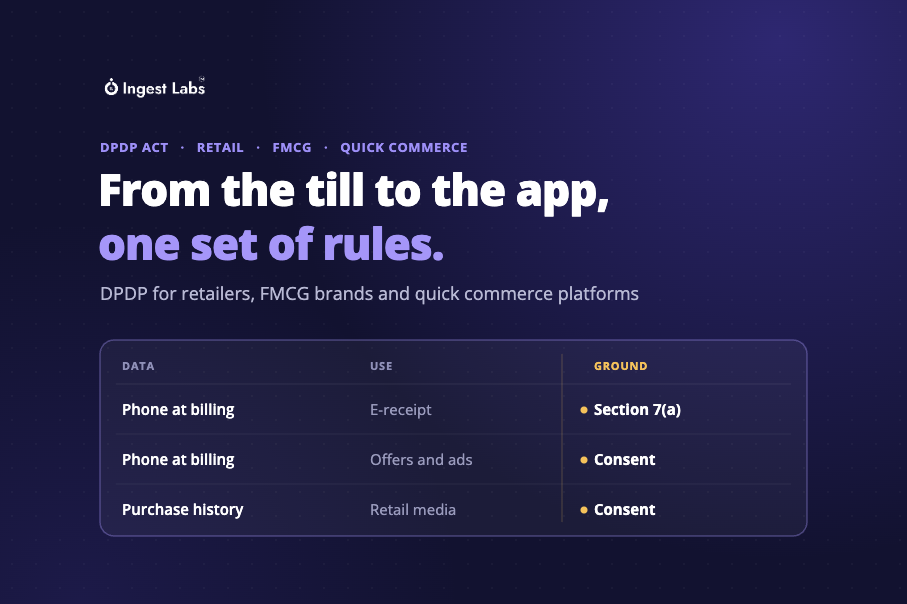
Short answer: India's DPDP Act reaches well beyond the website for retailers, FMCG brands and quick commerce platforms. Phone numbers taken at the till, loyalty sign-ups on paper forms and contest entries become covered as soon as they are digitised. Using them for anything beyond the purpose the customer gave them for, such as marketing, ad audiences or a retail media network, needs consent. Quick commerce adds precise location and frequent behavioural data; FMCG promotions often reach teenagers, who cannot be tracked or targeted. Sharing customer data with brand partners or retail media buyers makes them recipients you must be able to name if a customer asks, for data processed on consent. Most obligations apply from 13 May 2027.
Retail, FMCG and quick commerce businesses collect personal data in more places than almost any other sector: point-of-sale systems, loyalty programmes, apps, delivery partners, contests on packaging, sampling campaigns, WhatsApp communities and, increasingly, retail media networks that sell access to shopper audiences.
The Digital Personal Data Protection Act, 2023 applies to all of it once it is digital. This article looks at what that means for omnichannel retailers, FMCG brands and quick commerce platforms, and where their data practices most often fall short. For the full timeline, see our DPDP Act compliance guide.
Offline data is in scope once it is digitised
Section 3 applies the Act to digital personal data, including personal data collected in non-digital form and digitised later. A phone number written on a paper loyalty form and typed into the CRM, or a contest entry scanned from a coupon, is covered from the moment it is digitised.
The till is where this matters most. The standard illustration of a section 7(a) legitimate use is a customer giving her phone number to receive a receipt: data voluntarily provided for a specified purpose. That covers sending the receipt. It does not cover adding her to a promotional SMS list, a WhatsApp community or a Meta custom audience. Those need consent.
Where the sector's data flows, and what each needs
| Data flow | Common practice | Ground in our reading |
|---|---|---|
| Phone number at billing | Used for e-receipts and later for offers | Section 7(a) for the receipt; consent for offers |
| Loyalty programme | Points, tiers, purchase history, personalised offers | Consent for the programme's marketing purposes, captured with a proper notice |
| Quick commerce app | Location, order history, browsing, push notifications | Section 7(a) for delivery; consent for marketing, profiling and ads |
| FMCG contests and promotions | Entries via QR codes, WhatsApp or microsites | Consent for any use beyond running the contest; no targeting of under-18s |
| Retail media network | Shopper segments made available to brands for ads | Consent for that purpose; brands receiving data must be nameable recipients |
| Store Wi-Fi and footfall | Device and location data | Consent where it identifies people |
| Delivery partner | Name, address, phone shared for delivery | Section 7(a); the partner acts on your behalf or as its own fiduciary depending on the arrangement |
Retail media networks need particular care
Retail media is one of the sector's fastest-growing revenue lines, and one of the most exposed under DPDP. When a retailer or quick commerce platform uses shopper purchase data to build audiences that brands buy against, three questions arise.
-
Is there consent for that purpose? Using purchase history to target ads on behalf of third-party brands is not order fulfilment. It needs consent, specific to that purpose, with a notice that says so.
-
Who receives what? If brands, agencies or ad platforms receive personal data, even hashed, they are recipients the customer is entitled to know about. Where processing rests on consent or section 7(a), section 11(1)(b) gives people the right to the identities of all other Data Fiduciaries and Data Processors their data was shared with, with a description of the data shared.
-
Can withdrawal and erasure reach them? When a customer withdraws consent, in our reading you must stop sharing and make your processors stop, and you should contractually require recipient brands to stop too.
In our reading, clean-room and aggregate-only models that never hand brands identifiable data reduce these risks, but the retailer's own processing to build segments still needs a lawful basis.
Quick commerce: location and frequency
Quick commerce platforms see customers far more often than a typical retailer, and they hold precise delivery locations. That makes their data valuable for marketing and risky to mishandle.
-
Location for delivery is section 7(a); location for ad targeting or footfall analytics is not.
-
Order frequency and basket data used for personalisation and push campaigns need consent for those purposes.
-
Dark-store and rider systems hold names, addresses and phone numbers; access controls and logs under Rule 6 apply, and logs must be kept for at least one year.
-
Retention: a quick commerce platform that is an e-commerce entity with two crore or more registered users in India is subject to the Third Schedule's three-year inactivity erasure rule, with 48 hours' notice before erasure.
FMCG: promotions, sampling and teenagers
FMCG brands increasingly hold first-party data from QR-code promotions, WhatsApp chatbots, sampling programmes and their own D2C sites. Three issues recur.
-
Purpose creep. Data collected to run a contest or send a sample is often added to marketing lists by default. That needs consent for the marketing purpose.
-
Agency-run campaigns. Promotions are often run by agencies on separate platforms. The brand remains responsible for its processors under section 8(1), and the agency's database is part of the brand's data map.
-
Teenagers. Snacks, beverages, personal care and cosmetics promotions reach many under-18s. Under the Act a child is anyone under 18; processing a child's data needs verifiable parental consent, and section 9(3) prohibits tracking, behavioural monitoring and targeted advertising directed at children. Age checks at entry, and keeping under-18 entrants out of ad audiences, are essential.
Consent screens and dark patterns
Retail and quick commerce apps are platforms offering goods in India, so the Central Consumer Protection Authority's Guidelines for Prevention and Regulation of Dark Patterns, 2023 apply to them. Forced action (making marketing consent a condition of ordering), interface interference (hiding the decline option) and nagging (repeatedly re-asking) are among the 13 specified patterns. DPDP independently requires consent to be free, specific, informed, unconditional and unambiguous. Our guide to DPDP consent and notice requirements covers notice wording and the Eighth Schedule language options, which matter for retailers serving customers across states.
A plan to 13 May 2027
-
Map every collection point: POS, loyalty, app, website, contests, sampling, Wi-Fi, delivery and agency-run campaigns.
-
Separate service from marketing: section 7(a) for receipts, delivery and the account; consent for offers, personalisation, ads and retail media.
-
Rebuild notices as standalone and itemised, in the languages your customers use, at the till as well as online.
-
Gate every destination on consent, including server-side feeds to ad platforms and retail media partners.
-
Document retail media recipients and make sure withdrawal and erasure reach them.
-
Add age checks to promotions and apps likely to attract teenagers, and keep under-18s out of ad audiences.
-
Fix processor contracts with agencies, delivery partners, POS and loyalty vendors.
-
Check the two-crore threshold for e-commerce operations, and build the inactivity erasure workflow if it applies.
-
Keep logs for at least a year and an audit trail of what was shared with whom.
Where things stand
As of 23 November 2026, the DPDP dates have not moved. The Consent Manager framework came into force on 13 November 2026 and the Consent Manager registration portal has opened, though no Consent Manager has been registered yet. Most obligations apply from 13 May 2027. The Data Protection Board has no Chairperson or Members yet, and challenges to the Act are next listed before the Supreme Court on 9 December 2026, with no stay in place.
Where Ingest Labs fits
Omnichannel retailers and quick commerce platforms send shopper data to more destinations than most businesses: ad platforms, messaging tools, CDPs, warehouses and retail media partners. Ingest IQ applies consent per event and per destination across more than 100 integrations, so each destination receives only the data its purpose allows.
Ingest IQ keeps an audit trail per event and per destination, which can support your records of who received what, and withdrawal and erasure propagate to the destinations that received the data. Processing for Indian customers can be region-pinned with a documented sub-processor list. It works with your existing consent platform. Under DPDP, Ingest Labs acts as your Data Processor and you remain the Data Fiduciary. The platform is architected for DPDP and holds SOC 2 Type II. Our DPDP resource page has more detail.
Frequently asked questions
Does the DPDP Act apply to phone numbers collected at the till?
Yes, once they are digitised. Section 3 covers personal data collected in non-digital form and digitised later. Using the number to send the receipt is a section 7(a) legitimate use; using it for promotional messages or ad audiences needs consent.
Do loyalty programmes need consent?
For their marketing purposes, yes. Points and tiers that the customer signs up for can be run on the data she gives for that purpose, but personalised offers, profiling and sharing with partners need consent with a clear notice.
Is a retail media network allowed under DPDP?
In our reading, yes, with consent for that purpose. Using shopper data to target ads for third-party brands is not order fulfilment. Any brand or platform that receives personal data is a recipient the customer can ask about under section 11, and in our reading you should contractually require it to stop when she withdraws.
Can FMCG brands run contests aimed at teenagers?
They can run contests, but anyone under 18 is a child under the Act. Processing their data needs verifiable parental consent, and section 9(3) prohibits tracking, behavioural monitoring and targeted advertising directed at them.
Does the two-crore retention rule apply to quick commerce?
If the platform is an e-commerce entity with two crore or more registered users in India, the Third Schedule requires erasure three years after the customer's last interaction or exercise of rights, or after the Rules commenced, whichever is latest, with 48 hours' notice.
When do these obligations apply?
Most apply from 13 May 2027. The Consent Manager framework came into force on 13 November 2026, and the dark patterns guidelines already apply.
To map your retail, FMCG or quick commerce data flows, book a DPDP readiness call.
Sources
-
India Code, The Digital Personal Data Protection Act, 2023 (checked 2026-11-23): sections 3, 6, 7, 8, 9 and 11
-
DPDP Wiki, Section 3: Application of the Act (checked 2026-11-02): data collected offline and later digitised
-
Cyril Amarchand Mangaldas, client alert on the DPDP Rules (checked 2026-11-02): Third Schedule retention classes; security safeguards and one-year logs
-
Mondaq, CCPA issues Guidelines for Prevention and Regulation of Dark Patterns, 2023 (checked 2026-11-23): specified dark patterns and applicability
-
India Data Law, weekly DPDP updates (checked 2026-11-23): Consent Manager provisions in force from 13 November 2026; Supreme Court petitions listed for 9 December 2026
This article is general information about the Digital Personal Data Protection Act, 2023 and the Digital Personal Data Protection Rules, 2025, current as of November 2026. It is not legal advice. Please take advice from qualified counsel on your specific position.