DPDP for Pharma: HCPs, Patients and Awareness Campaigns
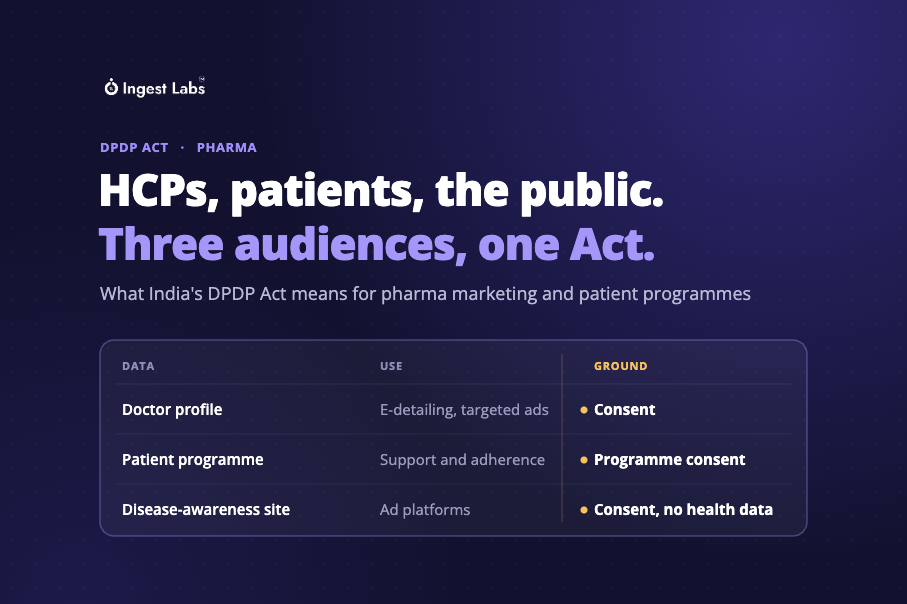
Short answer: Pharmaceutical companies in India process personal data about three groups: healthcare professionals (HCPs), patients and caregivers in support programmes, and the public through disease-awareness campaigns. India's DPDP Act applies to all three. HCP databases used for detailing, CME invitations and digital engagement need a clear basis, usually consent for marketing. Patient support programmes collect health data that must never reach ad platforms. In our reading, adverse event reports and other mandated disclosures can rest on section 7(d), and research can fall under a limited exemption if data is not used to make decisions about individuals. The Uniform Code for Pharmaceutical Marketing Practices, 2024 continues to govern how HCPs are engaged. Most DPDP obligations apply from 13 May 2027.
Indian pharma marketing has moved quickly from medical representatives with printed detailing aids to omnichannel engagement: HCP portals, webinars, WhatsApp groups, e-detailing, CRM-driven call planning, programmatic campaigns aimed at doctors, patient apps and disease-awareness websites.
Each of those channels runs on personal data. The Digital Personal Data Protection Act, 2023 sets the rules for collecting and using it, alongside the Department of Pharmaceuticals' Uniform Code for Pharmaceutical Marketing Practices, 2024 (UCPMP) for how companies engage HCPs.
This article covers what DPDP means for HCP engagement, patient programmes, disease-awareness marketing and research, and a plan to 13 May 2027. For the full DPDP timeline, see our DPDP Act compliance guide.
HCP data is personal data
A doctor's name, registration number, specialty, clinic address, phone number, prescribing interests and engagement history are personal data under the Act. Section 2(t) defines personal data as any data about an individual who is identifiable by or in relation to it.
Some HCP data is public. Section 3(c)(ii) excludes from the Act personal data that the person has made public, or that someone is legally required to publish. In our reading, that may cover a doctor's name and registration details on a statutory register, but not the profiles, call notes, engagement scores and preferences your CRM builds on top of them.
| HCP data use | Ground in our reading |
|---|---|
| Recording samples given, as UCPMP requires (name and address of each recipient) | Section 7(a) where the HCP gave the details to receive samples; retention required by the code is a compliance question for counsel |
| Inviting an HCP to a CME programme she signed up for | Section 7(a) for that purpose |
| Ongoing e-detailing, newsletters and WhatsApp engagement | Consent |
| Programmatic and social ads targeted at named HCPs | Consent |
| Building engagement or prescribing-potential scores | Consent, with a notice that names the purpose |
| Sharing HCP data with agencies and data vendors | Processor contracts; consent where the vendor uses data for its own purposes |
Buying HCP lists from data vendors deserves care. If the vendor cannot show that doctors agreed to their data being shared with you for marketing, the list is a liability.
UCPMP alongside DPDP
The UCPMP 2024 governs how pharmaceutical companies engage HCPs. Among other things, it prohibits gifts for the personal benefit of HCPs and their families and cash or monetary grants to them, prohibits travel and hospitality for HCPs attending conferences as delegates (speakers at CME programmes excepted), limits free samples to twelve packs per drug per HCP per year with the name and address of each recipient recorded, and requires CME programme details and expenditure to be published on company websites. Complaints go to an ethics committee, and CEOs file an annual self-declaration of compliance.
UCPMP is a code, not a data protection law, but it shapes what HCP data you keep and why. Map each UCPMP record-keeping requirement to the data it needs, and keep only that.
Patient support programmes and apps
Patient support programmes, adherence apps, helplines and diagnostic partnerships collect health information about patients and, often, caregivers and children. The DPDP Act has no separate sensitive-data category, but every obligation applies in full, and the type of data is a factor the Board weighs in setting penalties.
-
Consent for the programme, separately from marketing. Enrolment in a support programme is a specified purpose. Using programme data for brand marketing, ad audiences or HCP targeting is a different purpose that needs separate consent.
-
No health data in ad platforms. Pixels and conversion APIs on patient apps and programme sites must never carry condition, medicine or treatment information. Programme sites should not run retargeting at all.
-
Children. Under the Act a child is anyone under 18. Paediatric programmes need verifiable consent from a parent or lawful guardian, and section 9(3) prohibits tracking, behavioural monitoring and targeted advertising directed at children.
-
Vendors. Programmes are usually run by agencies, hub providers and call centres acting as your processors. Under section 8(1) you are responsible for them.
Adverse events and other mandated reporting
Pharmacovigilance requires companies to collect and report adverse event information, which often includes patient and reporter details. Section 7(d) covers disclosures a law requires you to make to the State or its instrumentalities, and section 8(7) allows you to keep data where a law requires retention. Collect only what the reporting requires, keep it separate from marketing systems, and confirm the legal basis for each step with counsel.
Research and real-world evidence
Section 17(2)(b) disapplies the Act for processing necessary for research, archiving or statistical purposes, if the personal data is not used to take any decision specific to the person and the processing follows the standards in the Rules. In our reading, that may help with genuinely statistical real-world evidence work. It does not cover using research data to target HCPs or patients, and it does not replace ethics approvals or clinical trial rules.
Disease-awareness and consumer campaigns
Disease-awareness websites, symptom checkers and social campaigns attract people looking for information about specific conditions. A page view on a site about a particular condition, sent to an ad platform with an identifier, can reveal health information about a person.
-
Gate every advertising tag and conversion event on consent.
-
Do not send condition-specific page paths, search terms or quiz answers to ad platforms.
-
Treat symptom checkers and quizzes as health data collection, with a notice and consent for each purpose.
Our guide to server-side tracking explains how page events usually reach ad platforms, and our guide to DPDP consent and notice requirements covers notice design. For a DPDP-specific design, see our server-side reference architecture for DPDP.
A plan to 13 May 2027
-
Map HCP data across CRM, field force tools, events, digital channels and vendors, and assign a ground to each purpose.
-
Refresh HCP consent for digital engagement, with a notice and an easy way to withdraw.
-
Audit bought HCP lists for evidence of consent to share.
-
Separate patient programme data from marketing, and keep health data out of ad platforms.
-
Lock down disease-awareness sites: consent-gated tags, no condition data in events.
-
Protect children's data in paediatric programmes.
-
Fix processor contracts with agencies, hub providers, call centres and data vendors.
-
Join up incident reporting for DPDP and CERT-In.
Where things stand
As of 23 November 2026, the DPDP dates have not moved. The Consent Manager framework came into force on 13 November 2026 and the Consent Manager registration portal has opened, though no Consent Manager has been registered yet. Most obligations apply from 13 May 2027. The Data Protection Board has no Chairperson or Members yet, and challenges to the Act are next listed before the Supreme Court on 9 December 2026, with no stay in place.
Where Ingest Labs fits
Pharma marketing teams need to run HCP and consumer campaigns without health information leaking into ad platforms. Ingest IQ applies consent per event and per destination across more than 100 integrations, so each destination receives only the data its purpose allows, and keeps an audit trail per event and per destination.
Withdrawal and erasure propagate to the destinations that received the data, and processing for Indian users can be region-pinned with a documented sub-processor list. It works with your existing consent platform. Under DPDP, Ingest Labs acts as your Data Processor and you remain the Data Fiduciary. The platform is architected for DPDP and holds SOC 2 Type II. Our DPDP resource page has more detail.
Frequently asked questions
Is a doctor's data personal data under the DPDP Act?
Yes. Any data about an identifiable individual is personal data, including a doctor's contact details, specialty and engagement history. Data the doctor has made public, or that a law requires to be published, is excluded, but the profiles and scores built on top of it are not.
Do we need consent to send HCPs digital marketing?
In our reading, yes, for ongoing e-detailing, newsletters, WhatsApp engagement and targeted ads. Data a doctor gave for a specific purpose, such as registering for a CME programme, can be used for that purpose under section 7(a).
Does UCPMP 2024 override DPDP?
No. UCPMP governs how pharmaceutical companies engage HCPs; DPDP governs how personal data is processed. Both apply. UCPMP's record-keeping requirements, such as recording sample recipients, should be mapped to the minimum data needed.
Can patient support programme data be used for marketing?
Not without separate consent for that purpose. Enrolment in a programme is its own purpose, and health information from it must never be sent to ad platforms.
Is research exempt from DPDP?
Partly. Section 17(2)(b) disapplies the Act for research, archiving or statistical processing if the data is not used for decisions about specific people and follows the prescribed standards. It does not cover marketing use of research data.
When do these obligations apply?
Most DPDP obligations apply from 13 May 2027. UCPMP 2024 already applies.
To review your HCP and patient data flows, book a DPDP readiness call.
Sources
-
India Code, The Digital Personal Data Protection Act, 2023 (checked 2026-11-23): sections 2(t), 3(c), 7, 8, 9 and 17(2)(b)
-
Nishith Desai Associates, Code for Pharmaceutical Marketing Practices refurbished (checked 2026-11-23): UCPMP 2024 provisions on gifts, samples, CME and enforcement
-
Cyril Amarchand Mangaldas, client alert on the DPDP Rules (checked 2026-11-02): security safeguards; breach notices
-
India Data Law, weekly DPDP updates (checked 2026-11-23): no Board appointments; Supreme Court petitions listed for 9 December 2026
This article is general information about the Digital Personal Data Protection Act, 2023 and the Digital Personal Data Protection Rules, 2025, current as of November 2026. It is not legal advice. Please take advice from qualified counsel on your specific position.