DPDP for Investment Banking, Wealth and Broking
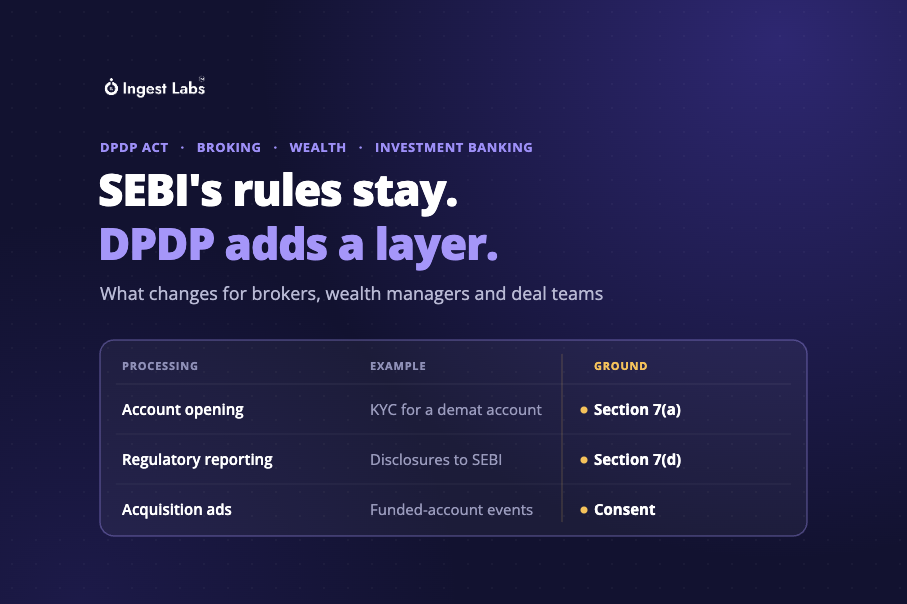
Short answer: Brokers, wealth managers, asset managers and investment banks handle identity documents, bank details, portfolios, income and, in deal work, personal data about other companies' employees and customers. India's DPDP Act applies to all of it, on top of SEBI's rules. In our reading, opening and servicing an account can rest on section 7(a), the data the client gives for that purpose, and disclosures a law requires you to make to SEBI or other authorities can rest on section 7(d). Marketing, retargeting on account-opening journeys, cross-sell and sharing leads need consent. SEBI's Cybersecurity and Cyber Resilience Framework already requires "Regulatory Data" to be stored in India and incidents to be reported within six hours; DPDP adds breach notices to the Data Protection Board and every affected client. Due diligence data rooms raise their own questions. Most DPDP obligations apply from 13 May 2027.
Capital markets firms sit at an unusual junction. Retail broking and wealth platforms run consumer-scale digital acquisition, with app installs, account-opening funnels and performance marketing. Private banks and wealth managers hold deep, sensitive relationships with a small number of high-net-worth clients. Investment banks handle other companies' personal data in deals. All of them fall under SEBI's rules for their securities and advisory businesses, and banks are also regulated by the RBI.
The Digital Personal Data Protection Act, 2023 applies across these models. This article explains where it adds to SEBI's rules, what changes for marketing and client data, and how deal teams should think about personal data in transactions. For the full DPDP timeline, see our DPDP Act compliance guide.
Two layers: SEBI and DPDP
SEBI's Cybersecurity and Cyber Resilience Framework (CSCRF) applies to SEBI-regulated entities, including stock brokers, depositories and depository participants, mutual funds and asset management companies, portfolio managers, investment advisers, research analysts, merchant bankers and KYC registration agencies. Among other things, it requires:
-
cyber attacks, cybersecurity incidents and breaches to be reported to SEBI and CERT-In within six hours of noticing them; and
-
"Regulatory Data" to be stored within the legal boundaries of India, with a limited exception for IT and cybersecurity data sent to international security operations centres or security SaaS tools.
The DPDP Act sits alongside this. Section 16(2) preserves stricter Indian rules on transfers outside India, so SEBI's storage requirement is not displaced. DPDP adds consent and notice standards, client rights, breach notices to the Data Protection Board and to each affected client, and penalties of up to ₹250 crore.
| Topic | SEBI layer | DPDP layer |
|---|---|---|
| Incident reporting | SEBI and CERT-In within six hours | Board without delay, detailed report within 72 hours, and each affected client without delay |
| Data location | Regulatory Data within India | No general localisation; SEBI rule preserved by section 16(2) |
| KYC | KYC and KRA processes | Section 7(a) for data given to open the account; legally required retention preserved |
| Marketing | Advertising and conduct rules | Consent for each marketing purpose; withdrawal as easy as consent |
What rests on section 7, and what needs consent
The Act has no legitimate-interests ground and no general "legal obligation" ground. The relevant legitimate uses are section 7(a), data a client voluntarily gives for a specified purpose; section 7(d), disclosures a law requires you to make to the State or its instrumentalities; and section 7(e), compliance with a judgment, decree or order. Section 8(7) lets you keep data where a law requires retention.
| Processing | Ground in our reading |
|---|---|
| Account opening, KYC and running the account | Section 7(a); retention required by law preserved |
| Statutory reporting to SEBI, exchanges and authorities | Section 7(d) |
| Trade confirmations and contract notes | Section 7(a) |
| Retargeting on account-opening journeys | Consent |
| Conversion APIs on app installs and funded accounts | Consent |
| Cross-sell of new products to existing clients | Consent |
| Sharing leads with partners or distributors | Consent for sharing |
| Relationship-manager outreach to prospects | Consent, unless the prospect gave her details for that purpose |
Retail broking and wealth apps
Retail platforms run some of India's largest performance marketing programmes. Three issues stand out.
Funnel events reveal financial behaviour. An event that says a named user opened a demat account, funded it or placed a first trade, sent to Meta or Google, discloses financial activity. Send such events only with advertising consent, carry the minimum fields, and never include account numbers, holdings or values. Our guide to server-side tracking explains how these events usually reach ad platforms. For a DPDP-specific design, see our server-side reference architecture for DPDP.
Teenagers and minor accounts. Under the Act a child is anyone under 18. Minor accounts operated by guardians, and young users drawn in by market content, must be kept out of tracking and targeted advertising; section 9(3) prohibits both, even with parental consent.
Withdrawal must reach every channel. Clients who withdraw marketing consent must stop receiving campaigns across email, SMS, WhatsApp, push notifications, calls and ad audiences, and your processors must stop too.
Private wealth and relationship managers
Wealth relationships often run on relationship managers' phones, messaging apps and personal spreadsheets. Under DPDP, that is processing by the fiduciary, which must take reasonable security safeguards (section 8(5), Rule 6), keep logs of access and processing for at least a year, and report every breach.
In practice, that means bringing client communications and records into managed systems, restricting exports, controlling devices, and making sure a departing relationship manager does not leave with client data. Client data taken by a departing employee is, in our reading, a personal data breach that must be reported.
Investment banking: personal data in deals
Deal work routinely involves other companies' personal data: employee lists, payroll, customer databases and management information in virtual data rooms.
-
Section 17(1)(e) exempts processing necessary for a scheme of compromise or arrangement, or a merger or amalgamation of companies, approved by a court or tribunal or other competent authority. In our reading, due diligence before any such approval, and transactions that do not need one, are unlikely to be covered automatically.
-
Minimise what goes into the data room. Anonymise or aggregate employee and customer data wherever the analysis allows, and release identifiable data only to the people who need it.
-
Settle roles. The seller and buyer are usually each fiduciaries for their own processing; advisers, data room providers and processors act for them. Write those roles into engagement letters and NDAs.
-
Plan for breach. A misdirected data room invitation that exposes employee data is a personal data breach under the Act's broad definition.
Significant Data Fiduciary readiness
No Significant Data Fiduciary had been notified as of 23 November 2026, and there is no automatic threshold. Large brokers, depositories and asset managers holding identity and financial data for millions of investors fit section 10's factors and should prepare: a Data Protection Officer based in India who answers to the board, an independent data auditor, and an impact assessment and data audit every 12 months. Breaching those duties carries a penalty of up to ₹150 crore.
A plan to 13 May 2027
-
Map every purpose to a ground and note any legal retention requirement.
-
Reconcile with SEBI's CSCRF: data location, incident reporting and logs, in one control set.
-
Clean acquisition funnels: consent for every advertising event, and no financial details in events.
-
Rebuild notices and consent flows in apps and onboarding, in the Eighth Schedule languages your clients use.
-
Bring relationship-manager data into managed systems with access controls and logs.
-
Set deal protocols for personal data in data rooms.
-
Join up incident reporting: SEBI, CERT-In and the Data Protection Board in one run-book.
-
Prepare for SDF designation.
Where things stand
As of 23 November 2026, the DPDP dates have not moved. The Consent Manager framework came into force on 13 November 2026 and the Consent Manager registration portal has opened, though no Consent Manager has been registered yet. Most obligations apply from 13 May 2027. The Data Protection Board has no Chairperson or Members yet, and challenges to the Act are next listed before the Supreme Court on 9 December 2026, with no stay in place.
Where Ingest Labs fits
Broking and wealth platforms need acquisition signal without leaking financial activity into ad platforms. Ingest IQ applies consent per event and per destination across more than 100 integrations, so each destination receives only the data its purpose allows, and keeps an audit trail per event and per destination.
Withdrawal and erasure propagate to the destinations that received the data, and processing for Indian clients can be region-pinned with a documented sub-processor list. It works with your existing consent platform. Under DPDP, Ingest Labs acts as your Data Processor and you remain the Data Fiduciary. The platform is architected for DPDP and holds SOC 2 Type II. Our DPDP resource page has more detail.
Frequently asked questions
Does DPDP replace SEBI's cybersecurity framework?
No. SEBI's CSCRF continues to apply to regulated entities, including its six-hour incident reporting and its requirement to keep Regulatory Data in India. DPDP adds consent, rights, and breach notices to the Data Protection Board and affected clients.
Do we need consent for KYC?
Collecting KYC data for an account the client opens can rest on section 7(a), and disclosures a law requires you to make to authorities on section 7(d). Records a law requires you to keep need not be erased on request, but they cannot be reused for marketing without consent.
Can we send account-opening events to Meta and Google?
Only with the client's consent for advertising, and only with minimal fields. Events should never include account numbers, holdings, trade values or other financial details.
Are due diligence data rooms exempt from DPDP?
Not automatically. Section 17(1)(e) exempts processing necessary for schemes of compromise, arrangement, merger or amalgamation approved by a court, tribunal or other competent authority. In our reading, due diligence before approval, or deals that need no approval, should follow DPDP's rules, with data minimised.
Is data taken by a departing relationship manager a breach?
In our reading, yes. The Act defines a personal data breach to include unauthorised acquisition and use of personal data, and every breach must be reported to the Board and to affected clients.
When do these obligations apply?
Most DPDP obligations apply from 13 May 2027. SEBI's CSCRF already applies.
To review your client acquisition and data flows, book a DPDP readiness call.
Sources
-
India Code, The Digital Personal Data Protection Act, 2023 (checked 2026-11-23): sections 2(u), 7, 8, 9, 10, 16 and 17
-
Cyril Amarchand Mangaldas, client alert on SEBI's Cybersecurity and Cyber Resilience Framework (checked 2026-11-23): regulated entities covered; six-hour reporting to SEBI and CERT-In; Regulatory Data stored in India
-
Cyril Amarchand Mangaldas, client alert on the DPDP Rules (checked 2026-11-02): security safeguards; one-year logs; breach notices; SDF duties
-
India Data Law, weekly DPDP updates (checked 2026-11-23): no SDF notified; no Board appointments; Supreme Court petitions listed for 9 December 2026
This article is general information about the Digital Personal Data Protection Act, 2023 and the Digital Personal Data Protection Rules, 2025, current as of November 2026. It is not legal advice. Please take advice from qualified counsel on your specific position.