DPDP for Insurers: Health Data, Quote Journeys and Partners
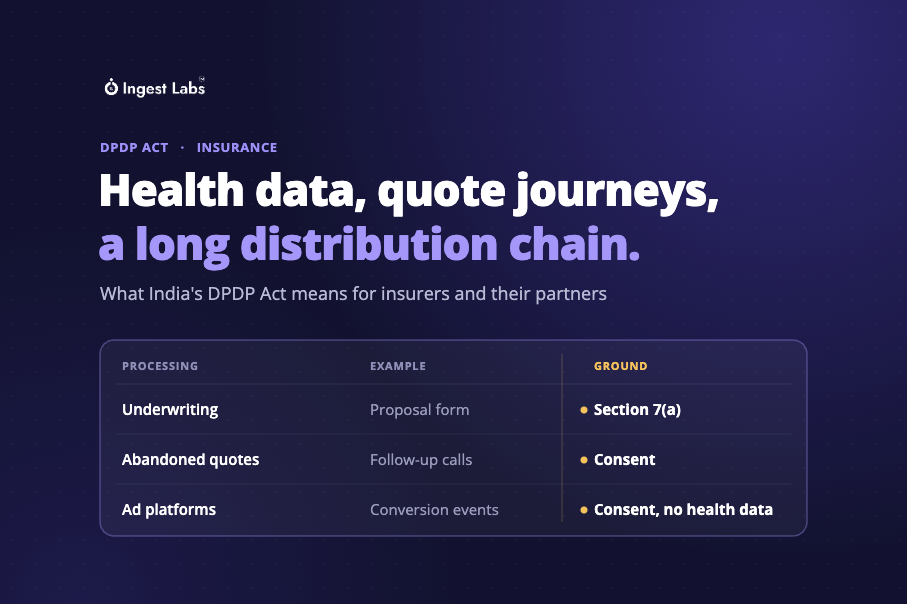
Short answer: Insurers hold some of the most sensitive personal data in any consumer business: health records, claims histories, financial details and information about family members, including children. India's DPDP Act does not create a separate "sensitive data" category, but its rules apply in full. Issuing and servicing a policy the customer applied for can rest on the data she gave for that purpose, while marketing, retargeting, lead sharing and cross-sell need consent. Health and claims details must never reach ad platforms. In our reading, TPAs and agents that act on your behalf are your processors, and you answer for them; brokers and web aggregators are often fiduciaries for their own customers. IRDAI's cyber security guidelines continue alongside DPDP. Large insurers should plan for possible Significant Data Fiduciary designation. Most DPDP obligations apply from 13 May 2027.
Insurance in India is sold and serviced through a long chain: the insurer, brokers and corporate agents, web aggregators, point-of-sale persons, third-party administrators, hospitals, wellness partners and the martech stack behind every quote journey. Personal data moves along all of it.
The Digital Personal Data Protection Act, 2023 does not change who is in that chain. It changes the rules for every link: what needs consent, what customers can demand, who reports a breach, and who answers to the Data Protection Board when something goes wrong.
This article covers what DPDP means for life, health and general insurers and their distribution partners, and a plan to 13 May 2027. For the full DPDP timeline, see our DPDP Act compliance guide.
No special category, but no shortcuts
Unlike the GDPR, the DPDP Act does not treat health data as a special category with extra conditions. Our DPDP vs GDPR comparison covers that difference. In practice this gives insurers no relief: health data is still personal data, every DPDP obligation applies to it, and a breach involving it is likely to weigh heavily when the Board considers the type of data involved in setting a penalty.
What rests on section 7, and what needs consent
The Act has no legitimate-interests ground. Processing rests on consent or a legitimate use under section 7. For insurers the relevant ones are data a person voluntarily provides for a specified purpose (section 7(a)), disclosures a law requires you to make to the State or its instrumentalities (section 7(d)), and medical emergencies (section 7(f)). There is no general "legal obligation" ground, but section 8(7) lets you keep data where a law requires retention.
| Processing | Ground in our reading |
|---|---|
| Underwriting and issuing a policy the customer applied for | Section 7(a) for the data she gave for that purpose |
| Servicing, renewal notices and claims | Section 7(a) |
| KYC for a policy the customer buys | Section 7(a); retention required by law preserved |
| Reporting to regulators and authorities | Section 7(d) |
| Quote-journey analytics and abandoned-quote follow-up | Consent |
| Retargeting, lookalikes and conversion APIs | Consent |
| Cross-sell to existing policyholders | Consent |
| Sharing leads with or buying leads from aggregators | Consent for sharing for that purpose |
| Wellness programmes using wearable or app data | Consent, specific to that purpose |
Quote journeys and ad platforms
Online quote and proposal forms ask about age, health conditions, smoking, income and family members. Those same pages often carry advertising pixels and server-side conversion events.
Three rules follow.
-
Never send health, financial or family details to ad platforms. Conversion events should carry the minimum needed for measurement, and only with advertising consent.
-
Strip identifiers from URLs and form fields before any tag can read them. A health condition in a URL parameter that reaches a pixel is a breach waiting to happen.
-
Abandoned-quote follow-up needs consent. A phone number typed into a quote form and then abandoned was given to get a quote, not to receive repeated calls and ads.
Our guide to server-side tracking explains how quote-journey events typically reach ad platforms.
The distribution chain: who is fiduciary, who is processor
| Party | Usual role in our reading | What to check |
|---|---|---|
| Insurer | Data Fiduciary for policy and claims data | Responsible for its processors under section 8(1) |
| TPA handling claims for the insurer | Processor | Contract, safeguards, breach notice, erasure |
| Corporate agent or broker selling on the insurer's journey | Processor for that journey, or a fiduciary for its own customer relationships | Who decides the purposes; consent for sharing |
| Web aggregator or comparison site | Often a fiduciary for its own users, sharing leads with insurers | Consent for sharing with each insurer |
| Point-of-sale persons and agents | Act for the insurer or intermediary | Training, device controls, data minimisation |
| Hospitals in the network | Fiduciaries for their own patient data | Data sharing agreements for claims |
The practical risk sits with leads. Leads that arrive from an aggregator or partner without evidence of consent for sharing with your company are a liability under DPDP.
Policyholders, nominees and children
Two features of insurance need care.
Insurance nominees are not DPDP nominees. A policy nominee receives benefits under insurance law. A nominee under section 14 of the DPDP Act exercises the person's data rights on death or incapacity. They may be the same person, but they are recorded and verified for different purposes. Do not assume one covers the other.
Child plans and family floaters include children's data. Under the Act a child is anyone under 18. Processing a child's personal data needs verifiable consent from a parent or lawful guardian, and section 9(3) prohibits tracking, behavioural monitoring and targeted advertising directed at children. Children covered under a family policy must be kept out of every marketing and advertising flow.
IRDAI cyber security guidelines
IRDAI's Information and Cyber Security Guidelines, 2023, notified on 24 April 2023, apply to insurers and to intermediaries such as brokers, corporate agents, web aggregators, TPAs and insurance repositories. Among other things, they require regulated entities other than insurers to store ICT infrastructure logs and critical and business data in India; insurers are covered by other IRDAI rules on storing data in India.
Individual agents and point-of-sale persons are not covered directly; insurers must apply their own security framework to them. These obligations continue alongside DPDP. In our reading, section 16(2) preserves IRDAI's storage rules, so DPDP's negative-list approach to transfers does not displace them.
Significant Data Fiduciary readiness
Health, claims and financial data at scale is exactly what section 10's factors describe: volume, sensitivity and risk to people's rights. No SDF had been notified as of 23 November 2026, and there is no automatic threshold, but large insurers should plan for designation: a Data Protection Officer based in India who answers to the board, an independent data auditor, and an impact assessment and data audit every 12 months. Breaching these duties carries a penalty of up to ₹150 crore.
A plan to 13 May 2027
-
Map every purpose to a ground: section 7(a) for underwriting and servicing, section 7(d) for mandated disclosures, consent for marketing and cross-sell, plus a note of any legal retention requirement.
-
Clean the quote journey: no health, financial or family data in pixels, URLs or conversion events; advertising only with consent.
-
Audit the distribution chain: settle fiduciary and processor roles with every intermediary, TPA and aggregator, and fix contracts.
-
Verify lead consent: require evidence of consent for sharing for every bought or partner lead.
-
Separate DPDP nominees from policy nominees in systems and processes.
-
Protect children's data under family and child plans from all marketing use.
-
Join up incident reporting: DPDP, CERT-In and IRDAI in one run-book.
-
Prepare for SDF designation.
Where things stand
As of 23 November 2026, the DPDP dates have not moved. The Consent Manager framework came into force on 13 November 2026 and the Consent Manager registration portal has opened, though no Consent Manager has been registered yet. Most obligations apply from 13 May 2027. The Data Protection Board has no Chairperson or Members yet, and challenges to the Act are next listed before the Supreme Court on 9 December 2026, with no stay in place.
Where Ingest Labs fits
Insurers need acquisition signal from quote journeys without letting health or financial details reach ad platforms. Ingest IQ applies consent per event and per destination across more than 100 integrations, so each destination receives only the data its purpose allows, and keeps an audit trail per event and per destination.
Withdrawal and erasure propagate to the destinations that received the data, and processing for Indian customers can be region-pinned with a documented sub-processor list. It works with your existing consent platform. Under DPDP, Ingest Labs acts as your Data Processor and you remain the Data Fiduciary. The platform is architected for DPDP and holds SOC 2 Type II. Our DPDP resource page has more detail.
Frequently asked questions
Is health data a special category under the DPDP Act?
No. The Act has no separate category for sensitive data. Health data is personal data subject to every DPDP obligation, and the type of data is one of the factors the Board weighs when setting a penalty.
Do insurers need consent to underwrite a policy?
Processing the data a customer gives to apply for a policy, for that purpose, can rest on section 7(a). Using that data for marketing, cross-sell or advertising is a different purpose that needs consent.
Can we follow up on abandoned quotes?
Only with consent for that purpose. A phone number entered to get a quote was given for the quote, not for repeated calls, messages or retargeting.
Are TPAs our processors?
Usually, when they handle claims on the insurer's behalf. Under section 8(1) the insurer is responsible for their processing, so contracts must cover safeguards, breach notice, withdrawal and erasure.
Is a policy nominee the same as a DPDP nominee?
No. A policy nominee receives benefits under insurance law. A DPDP nominee under section 14 exercises the person's data rights on her death or incapacity. They need to be recorded and verified separately.
Do IRDAI's cyber security guidelines still apply?
Yes. They continue alongside the DPDP Act, and in our reading section 16(2) preserves their rules on keeping data in India.
To review your quote journeys and distribution data flows, book a DPDP readiness call.
Sources
-
India Code, The Digital Personal Data Protection Act, 2023 (checked 2026-11-23): sections 7, 8, 9, 10, 14 and 16
-
Cyril Amarchand Mangaldas, Primer on IRDAI Information and Cyber Security Guidelines, 2023 (checked 2026-11-23): applicability to insurers and intermediaries; storage of logs and data in India
-
Cyril Amarchand Mangaldas, client alert on the DPDP Rules (checked 2026-11-02): security safeguards; breach notices; SDF duties
-
India Data Law, weekly DPDP updates (checked 2026-11-23): no SDF notified; no Board appointments; Supreme Court petitions listed for 9 December 2026
This article is general information about the Digital Personal Data Protection Act, 2023 and the Digital Personal Data Protection Rules, 2025, current as of November 2026. It is not legal advice. Please take advice from qualified counsel on your specific position.