DPDP for Hotels and OTAs: Bookings, IDs and Loyalty
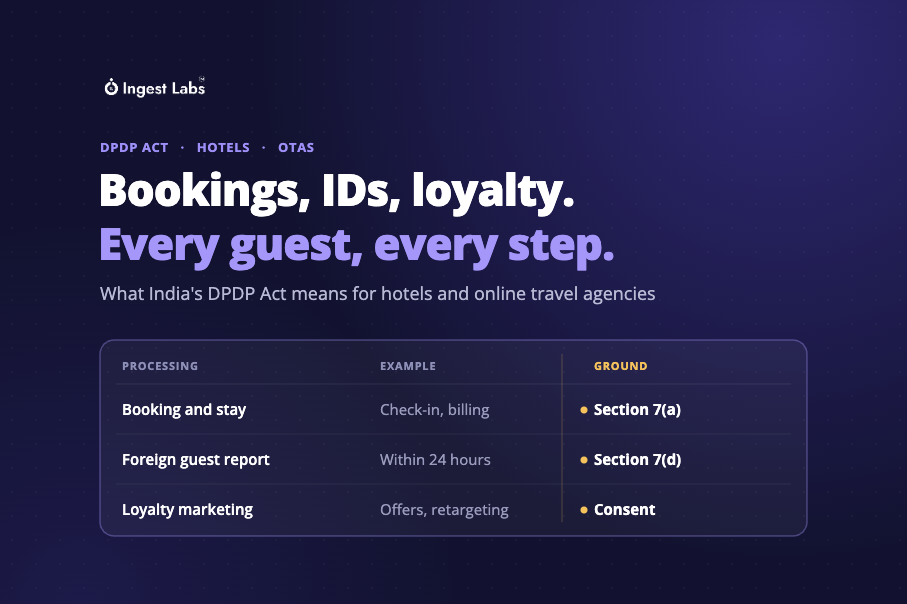
Short answer: Hotels, hotel groups and online travel agencies (OTAs) collect identity documents, travel plans, payment details and data about every guest in a booking, including children. India's DPDP Act applies to all of it. Taking a booking and checking a guest in can rest on the data the guest gives for that purpose under section 7(a). Reporting foreign guests' arrival and departure details to the authorities, which the Immigration and Foreigners Act, 2025 requires (police directives set a 24-hour online deadline), can rest on section 7(d). Loyalty marketing, retargeting, abandoned-booking follow-ups and lookalike audiences need consent. OTAs and hotels each decide purposes for their own processing, so the data they share needs clear roles. Copies of Aadhaar and passports kept "just in case" are a breach risk. Most DPDP obligations apply from 13 May 2027.
Few consumer businesses handle as much identity data as hospitality and travel. A single stay can involve an OTA booking, a hotel's own booking engine, a channel manager, a property management system, ID scans at the front desk, loyalty enrolment, Wi-Fi sign-in, spa and restaurant bills, and a post-stay review request.
The Digital Personal Data Protection Act, 2023 applies at every step. This article covers what it means for hotels, hotel groups and OTAs, where marketing stacks create risk, and a plan to 13 May 2027. For the full DPDP timeline, see our DPDP Act compliance guide.
What rests on section 7, and what needs consent
The Act has no legitimate-interests ground. Processing rests on consent or a legitimate use under section 7, including data a guest voluntarily provides for a specified purpose (7(a)) and disclosures a law requires you to make to the State or its instrumentalities (7(d)). Section 8(7) lets you keep data where a law requires retention.
| Processing | Ground in our reading |
|---|---|
| Taking and managing a booking | Section 7(a) for the data the guest gave for that purpose |
| Check-in, identity verification and billing | Section 7(a); retention where a law requires it |
| Reporting foreign guests to the authorities | Section 7(d) |
| Pre-arrival and stay messages | Section 7(a) |
| Loyalty programme marketing and personalised offers | Consent |
| Abandoned-booking emails and retargeting | Consent |
| Conversion APIs and lookalike audiences | Consent |
| Review requests after the stay | Consent, in our reading, unless clearly part of the service the guest asked for |
Foreign guest reporting
Under the Immigration and Foreigners Act, 2025, accommodation providers must report foreign guests' arrival and departure details to the authorities. Police directives issued in November 2026, for example in Visakhapatnam, require the reports to be filed online within 24 hours of each event, with penalties for non-compliance.
This is a disclosure required by law, which can rest on section 7(d). It does not make the data available for other purposes. Passport and visa details collected for reporting should not flow into marketing systems.
Identity documents at the front desk
Hotels routinely photograph or photocopy guests' ID documents and keep them indefinitely. Under DPDP that is a growing liability.
-
Collect what the purpose needs. Record the details a law or your verification process requires, not every page of every document.
-
Do not keep copies "just in case". Data must be erased when the purpose is no longer served, unless a law requires retention (section 8(7)).
-
Secure what you keep. Rule 6 requires reasonable safeguards, including access controls, encryption or masking, and logs kept for at least one year.
-
Front-desk devices and email inboxes that hold ID scans are a common breach source. A personal data breach must be reported to the Board and to every affected guest.
OTAs, hotels and shared guest data
An OTA takes a booking from a traveller and passes guest details to the hotel. The OTA decides its own purposes, such as marketing to its customers, and the hotel decides its own, such as running the stay. In our reading, each is usually a Data Fiduciary for its own processing, and the data they exchange needs a clear basis on both sides.
| Situation | What to settle |
|---|---|
| OTA passes guest details to the hotel for the stay | In our reading, the hotel can use them for the stay under section 7(a), as the guest gave them to make that booking; marketing to that guest needs the hotel's own consent |
| Hotel adds OTA guests to its loyalty or marketing lists | Needs consent from the guest; an OTA booking alone is not enough |
| Channel managers, PMS and booking engine vendors | Usually processors for the hotel, under section 8(1) and a valid contract |
| Global distribution systems and international hotel groups | Cross-border transfers are permitted under section 16 unless restricted, but every DPDP obligation still applies |
Our guide to DPDP consent and notice requirements covers how to capture marketing consent at booking without bundling it into the booking itself.
Booking engines and ad platforms
Hotel and OTA booking engines carry Meta, Google and metasearch pixels and send server-side conversion events. Three rules follow.
-
Consent before advertising tags fire for Indian travellers.
-
No passport, ID, payment or companion details in events sent to ad platforms.
-
Abandoned-booking retargeting needs consent. An email typed into a booking form that was then abandoned was given to make a booking, not to be retargeted.
Our guide to server-side tracking explains where these events come from. For a DPDP-specific design, see our server-side reference architecture for DPDP.
Families and children
Bookings often include children. Under the Act a child is anyone under 18. Processing a child's personal data needs verifiable consent from a parent or lawful guardian, and section 9(3) prohibits tracking, behavioural monitoring and targeted advertising directed at children. Children's details captured for a booking or check-in must stay out of marketing and advertising flows, and family-holiday campaigns should target the adult who consented, not the child.
A plan to 13 May 2027
-
Map every collection point: OTA feeds, booking engine, front desk, Wi-Fi, F&B, spa, loyalty, call centre and review platforms.
-
Assign a ground to each purpose: section 7(a) for bookings and stays, section 7(d) for foreign guest reporting, consent for marketing.
-
Minimise and secure ID documents, and set retention periods.
-
Separate booking and marketing consent on every channel.
-
Clean booking engines of personal and identity data in ad events.
-
Settle roles with OTAs, channel managers and vendors in contracts.
-
Protect children's data in bookings.
-
Rehearse breach response: Board and every affected guest, plus CERT-In.
Where things stand
As of 23 November 2026, the DPDP dates have not moved. The Consent Manager framework came into force on 13 November 2026 and the Consent Manager registration portal has opened, though no Consent Manager has been registered yet. Most obligations apply from 13 May 2027. The Data Protection Board has no Chairperson or Members yet, and challenges to the Act are next listed before the Supreme Court on 9 December 2026, with no stay in place.
Where Ingest Labs fits
Hotels and OTAs need booking conversion data for metasearch and paid media without leaking identity or companion details. Ingest IQ applies consent per event and per destination across more than 100 integrations, so each destination receives only the data its purpose allows, and keeps an audit trail per event and per destination.
Withdrawal and erasure propagate to the destinations that received the data, and processing for Indian guests can be region-pinned with a documented sub-processor list. It works with your existing consent platform. Under DPDP, Ingest Labs acts as your Data Processor and you remain the Data Fiduciary. The platform is architected for DPDP and holds SOC 2 Type II. Our DPDP resource page has more detail.
Frequently asked questions
Do hotels need consent to check guests in?
Processing the data a guest gives to make a booking and stay, for that purpose, can rest on section 7(a). Reporting foreign guests to the authorities, as immigration law requires, can rest on section 7(d). Marketing needs consent.
Can we keep copies of guests' ID documents?
Only what a law or your verification process requires, for as long as it requires. Section 8(7) requires erasure once the purpose is no longer served, unless a law requires retention, and Rule 6 requires reasonable safeguards for whatever you keep.
Can hotels market to guests who booked through an OTA?
Not on the basis of the OTA booking alone. The hotel can use the guest's details for the stay, but adding the guest to its own marketing lists needs the guest's consent.
Can we retarget abandoned bookings?
Only with consent for that purpose. Details entered into an abandoned booking form were given to make a booking, not for advertising.
Does DPDP stop international hotel groups moving data abroad?
No. From 13 May 2027, section 16 permits transfers outside India except to countries the government restricts, and none had been restricted as of 23 November 2026. Stricter sectoral rules, such as the RBI's payment data storage rule, still apply, and so does every other DPDP obligation.
When do these obligations apply?
Most DPDP obligations apply from 13 May 2027. Foreign guest reporting under immigration law already applies.
To review your booking and guest data flows, book a DPDP readiness call.
Sources
-
India Code, The Digital Personal Data Protection Act, 2023 (checked 2026-11-23): sections 7, 8, 9 and 16
-
Deccan Chronicle, Vizag hotels told to report foreign guests' details within 24 hours (checked 2026-11-23): reporting under the Immigration and Foreigners Act, 2025; online filing within 24 hours
-
Cyril Amarchand Mangaldas, client alert on the DPDP Rules (checked 2026-11-02): security safeguards; one-year logs; breach notices
-
India Data Law, weekly DPDP updates (checked 2026-11-23): Consent Manager provisions in force from 13 November 2026; Supreme Court petitions listed for 9 December 2026
This article is general information about the Digital Personal Data Protection Act, 2023 and the Digital Personal Data Protection Rules, 2025, current as of November 2026. It is not legal advice. Please take advice from qualified counsel on your specific position.