DPDP for Hospitals, Diagnostics and Healthtech
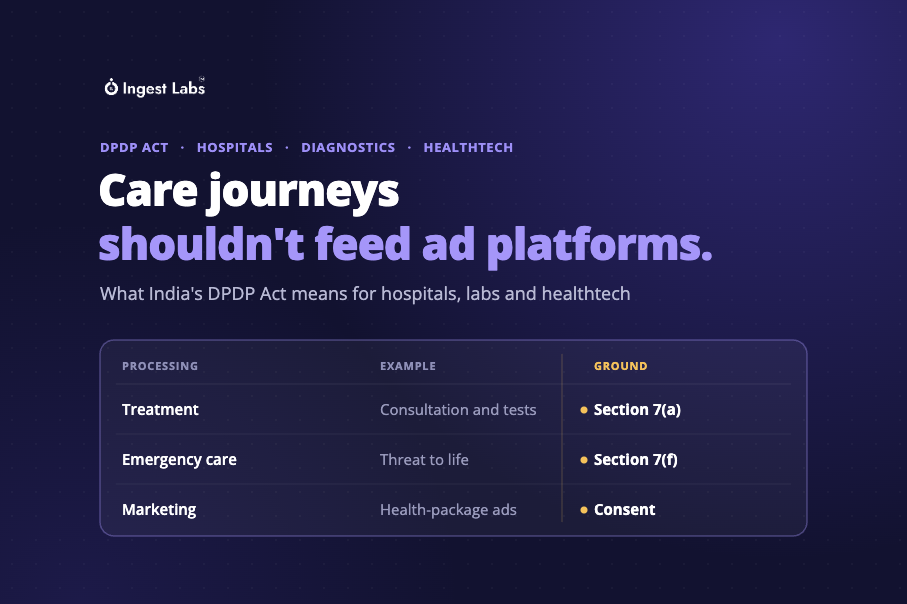
Short answer: Hospitals, diagnostic chains and healthtech platforms process health information about patients, including children, every day. India's DPDP Act applies to all of it. There is no special health-data category, but every obligation applies in full. In our reading, treating a patient who asked for care can rest on section 7(a), the data she gave for that purpose. Medical emergencies and epidemic response have their own legitimate uses. Marketing, retargeting, review requests and health-package promotions need consent. The biggest marketing-stack risk is pixels and conversion events on appointment, test-booking and symptom pages that tell ad platforms who is seeking which care. Healthcare providers are exempt from some children's data rules, but only for providing health services. Most DPDP obligations apply from 13 May 2027.
Indian healthcare has gone digital fast. Patients book appointments and tests online, receive lab reports on WhatsApp, consult doctors by video, pay through apps and get health-package offers by SMS. Hospitals and diagnostic chains now run performance marketing programmes as sophisticated as any consumer brand's.
That makes the Digital Personal Data Protection Act, 2023 a marketing question for healthcare as much as a clinical one. This article covers what the Act means for hospitals, diagnostics and healthtech, where marketing stacks create the most risk, and a plan to 13 May 2027. For the full DPDP timeline, see our DPDP Act compliance guide.
Health data under the DPDP Act
The DPDP Act does not create a special category for health data, unlike the GDPR. Our DPDP vs GDPR comparison covers that difference. Health data is personal data like any other, and every obligation applies: notice, consent or a legitimate use, security safeguards, breach notification, retention and rights. When the Data Protection Board sets a penalty, the type of data involved is one of the factors it weighs.
What rests on section 7, and what needs consent
Section 7 includes several legitimate uses that matter in healthcare: data a person voluntarily provides for a specified purpose (7(a)); responding to a medical emergency involving a threat to life or an immediate threat to health (7(f)); providing medical treatment or health services during an epidemic, outbreak or other threat to public health (7(g)); and disclosures a law requires you to make to the State or its instrumentalities (7(d)).
| Processing | Ground in our reading |
|---|---|
| Consultation, diagnosis, treatment and billing the patient asked for | Section 7(a) for the data she gave for that purpose |
| Emergency care where consent cannot be obtained | Section 7(f) |
| Care during an epidemic or outbreak | Section 7(g) |
| Mandatory reporting to health authorities | Section 7(d) |
| Sending lab reports and appointment reminders | Section 7(a) |
| Health-package promotions and wellness campaigns | Consent |
| Review and rating requests | Consent, in our reading, unless clearly part of the service the patient asked for |
| Retargeting, lookalikes and conversion APIs | Consent |
| Sharing data with insurers or TPAs for cashless claims | Section 7(a) where the patient asked for a cashless claim; confirm with counsel |
The biggest risk: pixels on care journeys
Appointment, test-booking, doctor-search and symptom-checker pages often carry Meta, Google and analytics tags, and server-side conversion events. A page view on an oncology appointment page, or a purchase event for a specific diagnostic test, sent to an ad platform with an identifier, can tell that platform that a named person is seeking a specific kind of care.
In our reading, that is processing of health information for advertising, which needs consent, and a careless implementation can amount to a personal data breach.
-
Consent before any advertising tag fires on care journeys.
-
No condition, specialty, doctor or test names in events, page paths or parameters sent to ad platforms.
-
Generic conversion events only, such as "appointment booked", with no clinical detail.
-
No retargeting audiences built from clinical pages.
-
Strip identifiers from URLs such as report links and booking confirmations.
Our guide to server-side tracking explains how page events reach ad platforms and where to control them. For a DPDP-specific design, see our server-side reference architecture for DPDP.
Children and persons with disabilities
Under the Act a child is anyone under 18, and processing a child's data normally needs verifiable consent from a parent or lawful guardian. Section 9(3) prohibits tracking, behavioural monitoring and targeted advertising directed at children.
The Fourth Schedule, through Rule 12, exempts clinical establishments, mental health establishments and healthcare professionals from sections 9(1) and 9(3), but only for processing limited to providing health services to the extent needed to protect the child's health. In our reading, that exemption covers treatment. It does not cover marketing, paediatric health-package promotions or retargeting parents based on their child's visit.
The October 2026 Removal of Difficulties Order clarified that the guardian consent requirement in section 9(1) also covers persons with disabilities who have a lawful guardian, which matters for mental health and disability care.
Records, retention and erasure
Patients can ask for erasure under section 12, and data must be erased once the purpose is no longer served or consent is withdrawn, unless a law requires it to be kept (section 8(7)). Medical records are often subject to retention rules under other laws and professional standards, so the practical approach is a retention schedule by record type: keep clinical records as required, and erase marketing data, leads and analytics profiles when their purpose ends.
Healthtech platforms
Teleconsultation apps, online pharmacies, diagnostic marketplaces and health-record apps face all of the above, plus two platform-specific issues.
-
Roles. A platform connecting patients with independent doctors and labs needs to settle who is the fiduciary for which processing. The platform, the doctor and the lab may each decide purposes for different parts of the journey.
-
Scale and SDF risk. Platforms holding health data for millions of users fit section 10's factors. No Significant Data Fiduciary had been notified as of 23 November 2026, but large platforms should prepare for designation.
A plan to 13 May 2027
-
Map every collection point: front desk, website, app, call centre, lab, pharmacy, WhatsApp and partners.
-
Assign a ground to each purpose: section 7(a), 7(f), 7(g) or 7(d) for care and mandated reporting; consent for marketing.
-
Clean every care journey of advertising leakage: consent-gated tags, no clinical details in events, no audiences from clinical pages.
-
Separate clinical and marketing data in systems and access controls.
-
Protect children's data and confine the healthcare exemption to treatment.
-
Build a retention schedule by record type.
-
Fix processor contracts with labs, platforms, agencies, call centres and IT vendors.
-
Rehearse breach response: Board and every affected patient, without delay, plus CERT-In.
Where things stand
As of 23 November 2026, the DPDP dates have not moved. The Consent Manager framework came into force on 13 November 2026 and the Consent Manager registration portal has opened, though no Consent Manager has been registered yet. Most obligations apply from 13 May 2027. The Data Protection Board has no Chairperson or Members yet, and challenges to the Act are next listed before the Supreme Court on 9 December 2026, with no stay in place.
Where Ingest Labs fits
Healthcare marketing teams need to measure campaigns without telling ad platforms who is seeking which care. Ingest IQ applies consent per event and per destination across more than 100 integrations, so each destination receives only the data its purpose allows, and keeps an audit trail per event and per destination.
Withdrawal and erasure propagate to the destinations that received the data, and processing for Indian patients can be region-pinned with a documented sub-processor list. It works with your existing consent platform. Under DPDP, Ingest Labs acts as your Data Processor and you remain the Data Fiduciary. The platform is architected for DPDP and holds SOC 2 Type II. Our DPDP resource page has more detail.
Frequently asked questions
Do hospitals need consent to treat patients under DPDP?
Processing the data a patient gives to receive care, for that purpose, can rest on section 7(a). Medical emergencies and care during an epidemic have their own legitimate uses under sections 7(f) and 7(g). Consent is needed for purposes beyond care, such as marketing.
Can we use Meta and Google pixels on appointment pages?
Only with the patient's consent for advertising, and only with generic events. Never send condition, specialty, doctor or test details to ad platforms, and do not build retargeting audiences from clinical pages.
Are hospitals exempt from the children's data rules?
Partly. Clinical establishments, mental health establishments and healthcare professionals are exempt from sections 9(1) and 9(3) for processing limited to providing health services to protect the child's health. The exemption does not cover marketing or advertising.
Can patients ask us to erase their medical records?
They can ask, and data must be erased once its purpose is no longer served, unless a law requires it to be kept. Medical records are often subject to retention rules under other laws, so keep what is required and erase the rest, including marketing data.
Is health data a special category under the DPDP Act?
No. The Act has no separate sensitive-data category, but every obligation applies to health data, and the type of data is one of the factors the Board weighs in setting penalties.
When do these obligations apply?
Most DPDP obligations apply from 13 May 2027.
To review your care journeys for advertising leakage, book a DPDP readiness call.
Sources
-
India Code, The Digital Personal Data Protection Act, 2023 (checked 2026-11-23): sections 7, 8, 9, 10 and 12
-
DPDPA.com, Rule 12 of the DPDP Rules, 2025 (checked 2026-11-23): sections 9(1) and 9(3) disapplied for Fourth Schedule classes and purposes
-
DSCI, FAQs on children's and persons with disabilities' personal data (checked 2026-11-23): healthcare exemption limited to health services needed to protect the child's health
-
Cyril Amarchand Mangaldas, client alert on the DPDP Rules (checked 2026-11-02): security safeguards; breach notices
-
India Data Law, weekly DPDP updates (checked 2026-11-23): October 2026 order on section 9(1); no SDF notified; Supreme Court petitions listed for 9 December 2026
This article is general information about the Digital Personal Data Protection Act, 2023 and the Digital Personal Data Protection Rules, 2025, current as of November 2026. It is not legal advice. Please take advice from qualified counsel on your specific position.