DPDP for D2C and Ecommerce Brands: Growth Stack on Consent
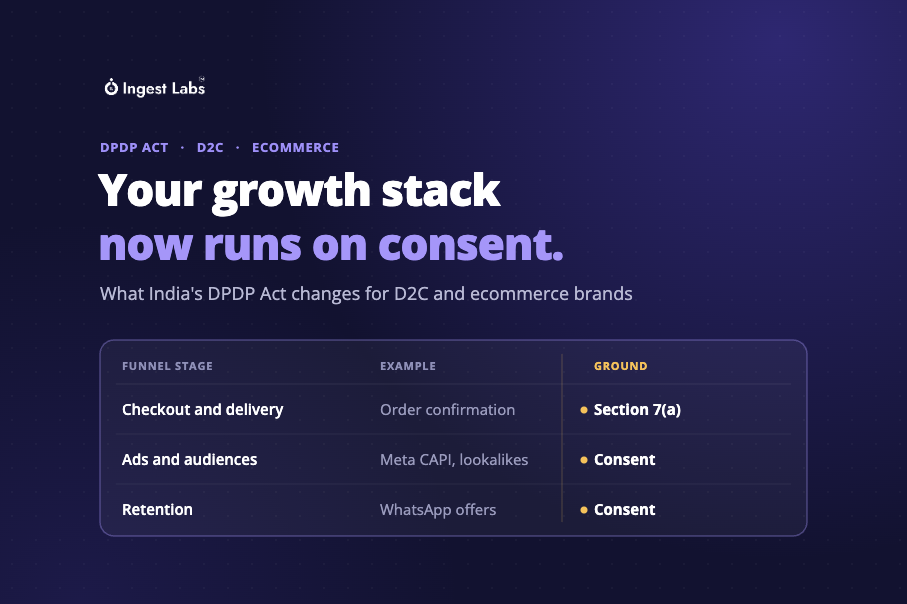
Short answer: For D2C and ecommerce brands, India's DPDP Act changes three things in the growth stack. First, attribution, retargeting, lookalike audiences and most marketing analytics need the shopper's consent, because the Act has no legitimate-interests ground; an email given to receive an order confirmation cannot be reused to target ads. Second, every shopper must be able to withdraw that consent as easily as she gave it, and, in our reading, the withdrawal has to reach every destination that received her data, including ad platforms, messaging tools and your warehouse. Third, anyone under 18 cannot be tracked, behaviourally monitored or targeted with ads, subject to narrow exemptions in the Rules. E-commerce entities with two crore or more registered users in India also face a three-year inactivity erasure rule. Consent screens must avoid the dark patterns already banned by consumer law. Most obligations apply from 13 May 2027.
Indian D2C and ecommerce brands run some of the most data-intensive marketing stacks in the world. A single order can fire a Meta pixel and Conversions API event, a Google Ads conversion with Enhanced Conversions, a GA4 purchase, a Klaviyo or WebEngage flow, a WhatsApp confirmation, a CDP update, a warehouse sync and an affiliate postback.
Under the Digital Personal Data Protection Act, 2023, each of those is processing of personal data that needs a lawful basis, and most of them depend on consent. That makes the DPDP Act a growth question as much as a legal one.
This article sets out what the Act means for the D2C and ecommerce funnel, where most brands' current setups fall short, and a practical plan to 13 May 2027. For the full timeline, see our DPDP Act compliance guide.
The funnel, purpose by purpose
The Act gives two grounds for processing: consent under section 6, or a legitimate use under section 7. The section 7(a) use covers data a shopper voluntarily gives for a specified purpose where she has not indicated she does not consent, such as a phone number for a delivery update.
| Funnel stage | Typical processing | Ground in our reading |
|---|---|---|
| Browse | Analytics events, session recording, product recommendations | Consent |
| Ads | Meta and Google pixels, conversion APIs, TikTok, affiliate tracking | Consent |
| Sign-up | Account creation with email or phone | Section 7(a) for running the account; consent for marketing |
| Checkout | Name, address, phone, payment | Section 7(a) for fulfilling the order |
| Post-purchase | Order and delivery messages | Section 7(a) |
| Retention | Marketing emails, WhatsApp campaigns, win-back flows, loyalty offers | Consent |
| Audiences | Custom audiences, customer match, lookalikes, suppression lists | Consent |
The pattern is consistent. Everything needed to sell and deliver the product can usually rest on section 7(a). Everything used to market, measure or target needs consent.
Five places D2C stacks fall short
1. Server-side "recovery" of declined shoppers
Many brands moved to server-side tracking to recover conversions lost to ad blockers. If the server container forwards every purchase to Meta and Google regardless of what the shopper chose, it is processing without consent. The fiduciary is responsible for its processors under section 8(1), so this cannot be pushed onto the agency or the tag vendor. Our guide to server-side tracking explains how these containers are usually wired.
2. Checkout data reused for ads
Sending the checkout email and phone, hashed, through Meta's Conversions API or Google's Enhanced Conversions is advertising measurement, not order fulfilment. Section 7(a) does not cover it. It needs consent for that purpose.
3. WhatsApp and SMS marketing on a delivery opt-in
A phone number given for delivery updates is data provided for that purpose. Using it for promotional WhatsApp campaigns is a different purpose that needs its own consent. Keep transactional and promotional messaging on separate consents and separate lists.
4. Withdrawal that stops at the banner
Withdrawal must be as easy as giving consent (section 6(4)), and once a shopper withdraws, you and your processors must stop processing within a reasonable time (section 6(6)). An unsubscribe link that removes her from one email list, while she stays in Meta audiences, a WhatsApp segment and a lookalike seed, does not meet that standard.
5. Teenage shoppers in fashion, beauty and gaming
Under the Act, anyone under 18 is a child. Section 9(3) prohibits tracking, behavioural monitoring and targeted advertising directed at children, and parental consent does not lift that ban. Brands with large teenage audiences need an age signal at sign-up and must keep under-18 shoppers out of every advertising destination and audience.
Consent design: what consumer law already forbids
Ecommerce consent screens are also subject to the Central Consumer Protection Authority's Guidelines for Prevention and Regulation of Dark Patterns, 2023, notified on 30 November 2023 under the Consumer Protection Act, 2019. They apply to platforms systematically offering goods or services in India, advertisers and sellers.
Several of the 13 specified dark patterns map directly onto consent design:
| Dark pattern | How it shows up in consent |
|---|---|
| Forced action | Making marketing consent a condition of placing an order |
| Interface interference | A bright "Accept all" button next to a faint "Manage choices" link |
| Confirm shaming | "No thanks, I don't like saving money" as the decline option |
| Trick question | Double negatives such as "Untick if you do not want to not receive offers" |
| Nagging | Re-asking for consent on every page after a shopper declines |
DPDP independently requires consent to be free, specific, informed, unconditional and unambiguous (section 6(1)). A consent screen built on any of these patterns is unlikely to meet that test either. Our guide to DPDP consent and notice requirements covers notice wording, languages and purpose design.
Retention: the two-crore rule
The Third Schedule to the Rules sets a specific retention rule for e-commerce entities with two crore or more registered users in India. Personal data must be erased three years after the person last approached the fiduciary or exercised her rights, or after the Rules' commencement, whichever is latest, unless a law requires it to be kept. The person must be given 48 hours' notice before erasure.
For large marketplaces and D2C platforms at that scale, that means:
-
tracking the last meaningful interaction per customer
-
an automated notice-then-erase workflow
-
erasure that reaches processors, including ad audiences and the warehouse
Every fiduciary, whatever its size, must also erase data once consent is withdrawn or the purpose is no longer served (section 8(7)), and keep processing logs for at least one year.
Measurement that survives
Lower consent rates on Indian traffic are likely. The answer is better measurement on consented data, not workarounds.
-
Send complete events for consented shoppers. Server-side delivery with full, deduplicated events improves match quality where you are allowed to send.
-
Use platform modelling honestly. Let Meta and Google model the conversions you cannot send, and report modelled figures as modelled.
-
Lean on first-party analytics. Minimised, pseudonymous events in GA4 and the warehouse still support funnel, merchandising and cohort analysis where only analytics is granted.
-
Earn consent. A clear, honest notice in the shopper's language, with a real choice, tends to outperform aggressive banners over time. Missing click IDs are a separate measurement problem; see why Google Ads conversions drop when click IDs go missing.
A plan to 13 May 2027
-
Inventory every tag, pixel, API and sync that touches shopper data, web, app and server-side.
-
Assign a ground to every purpose: section 7(a) for fulfilment and service, consent for everything else.
-
Rewrite the notice and consent screens as standalone, itemised and free of dark patterns, in English and the Eighth Schedule languages your shoppers use.
-
Gate every destination on consent, per event, including server-side and conversion API traffic.
-
Split transactional and promotional messaging across email, SMS and WhatsApp.
-
Add an age signal and block under-18s from all advertising destinations and audiences.
-
Build withdrawal and erasure fan-out to ad platforms, messaging tools, CDP and warehouse.
-
Check the two-crore threshold and, if it applies, build the three-year inactivity workflow.
-
Update processor contracts with agencies, tag vendors and platforms for safeguards, logs, breach notice and erasure.
-
Keep the evidence: an audit trail of what went where, under which consent.
Where things stand
As of 23 November 2026, the DPDP dates have not moved. The Consent Manager framework came into force on 13 November 2026 and the Consent Manager registration portal has opened, though no Consent Manager has been registered yet. Most obligations apply from 13 May 2027. The Data Protection Board has no Chairperson or Members yet, and challenges to the Act are next listed before the Supreme Court on 9 December 2026, with no stay in place.
Where Ingest Labs fits
D2C growth teams need two things at once: the conversion signal that keeps ads efficient, and the assurance that no shopper's data goes where she did not agree. Ingest IQ provides server-side tracking with consent-governed routing, applying consent per event and per destination across more than 100 integrations.
Ingest IQ keeps an audit trail per event and per destination, withdrawal and erasure propagate to the destinations that received the data, and processing for Indian shoppers can be region-pinned with a documented sub-processor list. It works with your existing consent platform, including Consentmo for Shopify brands, OneTrust or a custom build. Under DPDP, Ingest Labs acts as your Data Processor and you remain the Data Fiduciary. The platform is architected for DPDP and holds SOC 2 Type II. Our DPDP resource page has more detail.
Frequently asked questions
Do D2C brands need consent for Meta and Google conversion tracking?
Yes. Advertising measurement, retargeting and audience building are not legitimate uses under section 7, so they need the shopper's consent under section 6. That applies to browser pixels and to server-side conversion APIs alike.
Can we use the checkout email for marketing?
Not on the basis of the order alone. Section 7(a) covers using the email for the purpose it was given, such as order confirmation. Marketing emails, WhatsApp campaigns and ad audiences are different purposes that need consent.
Does the DPDP Act ban dark patterns in consent banners?
The DPDP Act requires consent to be free, specific, informed, unconditional and unambiguous. Separately, the CCPA's Guidelines for Prevention and Regulation of Dark Patterns, 2023 already prohibit 13 specified dark patterns, including forced action, interface interference, confirm shaming and nagging. Consent screens should avoid all of them.
What is the two-crore retention rule?
Under the Third Schedule, e-commerce entities with two crore or more registered users in India must erase personal data three years after the person last interacted or exercised her rights, or after the Rules commenced, whichever is latest, with 48 hours' notice before erasure, unless a law requires retention.
Can we target 16- and 17-year-old shoppers?
No. Anyone under 18 is a child under the Act, and section 9(3) prohibits tracking, behavioural monitoring and targeted advertising directed at children, even with parental consent.
When do these rules apply?
Most obligations, including consent, notice, children's data, retention and rights, apply from 13 May 2027. The Consent Manager framework came into force on 13 November 2026. The dark patterns guidelines already apply.
To map your D2C stack against these rules, book a DPDP readiness call.
Sources
-
India Code, The Digital Personal Data Protection Act, 2023 (checked 2026-11-23): sections 6, 7, 8 and 9
-
DPDP Wiki, Section 6: Consent (checked 2026-10-27): requirements for valid consent and withdrawal
-
Cyril Amarchand Mangaldas, client alert on the DPDP Rules (checked 2026-11-02): Third Schedule retention classes; one-year processing logs
-
Mondaq, CCPA issues Guidelines for Prevention and Regulation of Dark Patterns, 2023 (checked 2026-11-23): the 13 specified dark patterns; applicability; notified 30 November 2023
-
India Data Law, weekly DPDP updates (checked 2026-11-23): Consent Manager provisions in force from 13 November 2026; Supreme Court petitions listed for 9 December 2026
This article is general information about the Digital Personal Data Protection Act, 2023 and the Digital Personal Data Protection Rules, 2025, current as of November 2026. It is not legal advice. Please take advice from qualified counsel on your specific position.