DPDP for Banks, NBFCs and Fintech: What Changes
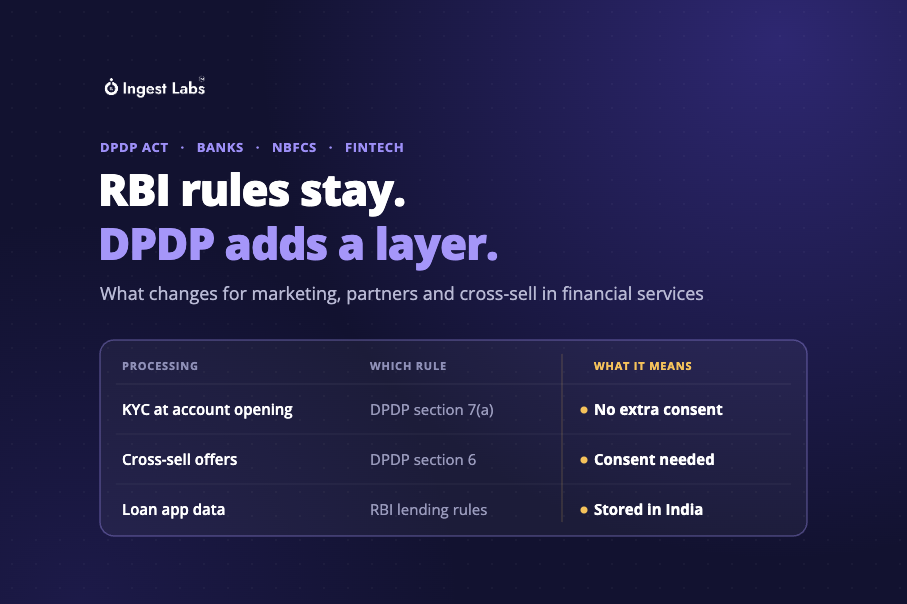
Short answer: Banks, NBFCs and fintechs already work under some of India's strictest data rules, and the DPDP Act adds to them rather than replacing them. Account opening and KYC can rest on the data the customer gives for that purpose under section 7(a), records that a law requires you to keep are exempt from erasure, and reporting to authorities can rest on section 7(d). Cross-selling, pre-approved offer campaigns, lead generation through partners, retargeting and lookalike audiences need the customer's consent. Section 16(2) preserves stricter Indian rules on transferring data outside India, such as the RBI's payment data storage requirement and the India-only storage rule in the RBI's digital lending directions. Their other requirements, including explicit consent, continue to apply alongside the Act. Lending service providers, fintech partners and agencies are usually your processors, and you answer for them. Large banks and NBFCs should also plan for possible Significant Data Fiduciary designation. Most DPDP obligations apply from 13 May 2027.
Financial services firms have lived with data regulation longer than almost anyone in India. RBI directions on payment data, digital lending, outsourcing and cyber security already shape how banks, NBFCs and fintechs collect, store and share customer data.
The Digital Personal Data Protection Act, 2023 adds a general layer across all of it: consent and notice standards for every purpose, rights for every customer, breach notices to a new regulator, and penalties of up to ₹250 crore. For marketing and growth teams in particular, it changes how customer data can be used for acquisition and cross-sell.
This article sets out where DPDP and the RBI's rules meet, what changes for marketing and partnerships, and a plan to 13 May 2027. For the full DPDP timeline, see our DPDP Act compliance guide.
Two layers: DPDP and sectoral rules
Section 16(2) of the Act preserves any Indian law that provides a higher degree of protection for, or restriction on, transfers of personal data outside India. More broadly, section 38 makes the Act additional to other laws, although the Act prevails if the two conflict. In practice, a regulated entity has to meet both.
| Area | Sectoral rule (examples) | DPDP layer |
|---|---|---|
| Payment data | RBI circular of 6 April 2018 requires payment system operators to store the entire data relating to payment systems in India | Section 16(2) preserves it; no general DPDP localisation |
| Digital lending | RBI digital lending directions, 2025: need-based collection with prior, explicit consent and an audit trail; data stored only on servers in India; lending service providers may keep only basic minimal data | Consent and notice under sections 5 and 6; processor controls under section 8 |
| KYC and AML | Legal duties to collect, verify and retain customer records | Section 7(a) for data given to open the account; legally required retention preserved by sections 8(7) and 12(3); disclosures to authorities under section 7(d) |
| Marketing and cross-sell | Fair practice and conduct rules | Consent for each marketing purpose; withdrawal as easy as consent |
| Breaches | Sectoral and CERT-In incident reporting | Every personal data breach to the Data Protection Board and each affected customer |
What legitimately rests on section 7, and what needs consent
The DPDP Act has no legitimate-interests ground. Processing rests on consent under section 6 or on one of the legitimate uses in section 7. For financial services the relevant ones are data a customer voluntarily provides for a specified purpose (section 7(a)), disclosures that a law requires you to make to the State or its instrumentalities (section 7(d)), and compliance with court orders (section 7(e)). There is no general "legal obligation" ground, but section 8(7) lets you keep data where a law requires retention.
| Processing | Ground in our reading |
|---|---|
| KYC collection for an account the customer opens | Section 7(a); retention required by law preserved |
| Statutory reporting to regulators and authorities | Section 7(d) |
| Servicing an account or loan the customer applied for | Section 7(a) for the data she gave for that purpose |
| Credit bureau checks for an application | Typically covered by the application and applicable credit information law; confirm with counsel |
| Fraud detection | Section 17 exemption for offences may apply in part; routine commercial fraud scoring needs advice purpose by purpose |
| Cross-sell and pre-approved offers | Consent |
| Retargeting, lookalikes and conversion APIs | Consent |
| Sharing leads with partners or co-lenders for their marketing | Consent |
| Product analytics in apps | Consent, unless strictly needed to provide the service |
Section 17 exempts processing for the prevention, detection and investigation of offences. How far that reaches into routine commercial fraud scoring has not been tested. Our DPDP vs GDPR comparison explains why global groups cannot rely on the EU's legitimate-interests approach for these flows in India.
The Digital Lending Directions already set a high bar
For lenders, the RBI's digital lending rules, issued as the Reserve Bank of India (Digital Lending) Directions, 2025 on 8 May 2025, already require much of what DPDP will:
-
data collection must be need-based, with the borrower's prior and explicit consent and an audit trail;
-
digital lending apps must not access mobile resources such as files and media, contact lists, call logs or telephony functions, with one-time access to the camera, microphone or location allowed for onboarding or KYC with explicit consent;
-
all data must be stored only on servers located in India;
-
lending service providers must not store borrowers' personal information beyond basic minimal data, such as name, address and contact details, needed for their role, and the regulated entity remains responsible for the data.
DPDP builds on this with standalone itemised notices, withdrawal as easy as consent, erasure at processors, rights requests, grievance timelines and breach notices to the Data Protection Board. A lender that meets the Directions has a head start, but not a finished programme.
Marketing and acquisition: where most gaps are
Acquisition through partners
Banks and NBFCs acquire customers through direct selling agents, aggregators, comparison sites, fintech partners and co-branded programmes. Each partner that collects leads for you is either your processor, acting on your instructions, or a fiduciary in its own right that needs its own basis to share data with you. The contract and the consent flow must match which it is. Leads bought from a partner who cannot show consent for sharing are a liability.
Pixels and conversion APIs on application journeys
Loan, card and account application pages often carry Meta, Google and affiliate pixels, plus server-side conversion events. Those events can reveal that a named person applied for credit. They need consent for advertising, should never carry application or financial details, and must be blocked for anyone under 18. Our guide to server-side tracking explains how these events are usually sent.
Cross-sell from existing customers
Using a savings customer's data to market a credit card is a new purpose. It needs consent. Where a customer consented before 13 May 2027, section 5(2) requires a notice as soon as reasonably practicable, and you may continue that processing until she withdraws. A new cross-sell purpose still needs fresh consent.
Withdrawal across channels
A customer who withdraws marketing consent must stop receiving campaigns across email, SMS, WhatsApp, outbound calls and ad audiences, and processors must stop too. Section 6(6) requires that within a reasonable time.
Partners, LSPs and the fiduciary question
In most bank and NBFC partnerships, the regulated entity decides why and how borrower or customer data is processed, which makes it the Data Fiduciary. Lending service providers, collection agencies, call centres, cloud providers and martech vendors are then its processors. Under section 8(1), the fiduciary is responsible for their processing regardless of any agreement to the contrary.
Where a fintech uses customer data for its own purposes, such as building its own marketing audiences, it is likely acting as a fiduciary for that processing and needs its own basis. Map each partnership and settle the roles in the contract.
Significant Data Fiduciary readiness
No Significant Data Fiduciary had been notified as of 23 November 2026, and there is no automatic threshold. But section 10 points to the volume and sensitivity of data and the risk to people's rights, which makes large banks, NBFCs and payment firms obvious candidates. A notified SDF must appoint a Data Protection Officer based in India who answers to the board, appoint an independent data auditor, carry out an impact assessment and a data audit every 12 months, and keep any data the government specifies in India. Breaching those duties carries a penalty of up to ₹150 crore.
A plan to 13 May 2027
-
Map every purpose to a ground: section 7(a) for the account or loan, section 7(d) for mandated disclosures, consent for everything else, plus a note of any legal retention requirement.
-
Reconcile with RBI rules: payment data, digital lending, outsourcing and KYC retention, purpose by purpose.
-
Rewrite notices and consent flows for applications, apps and branches, in the Eighth Schedule languages your customers use.
-
Strip financial details from marketing events and gate pixels and conversion APIs on consent.
-
Audit partner and LSP data flows, settle fiduciary and processor roles, and fix contracts.
-
Build withdrawal and erasure fan-out across messaging, audiences, CRM and processors, respecting legal retention.
-
Join up incident reporting: DPDP, CERT-In and RBI in one run-book.
-
Prepare for SDF designation: DPO, auditor, annual assessment and audit.
Where things stand
As of 23 November 2026, the DPDP dates have not moved. The Consent Manager framework came into force on 13 November 2026 and the Consent Manager registration portal has opened, though no Consent Manager has been registered yet. Most obligations apply from 13 May 2027. The Data Protection Board has no Chairperson or Members yet, and challenges to the Act are next listed before the Supreme Court on 9 December 2026, with no stay in place.
Where Ingest Labs fits
Financial services marketing teams need conversion signal for acquisition without letting application or account data leak into ad platforms. Ingest IQ applies consent per event and per destination across more than 100 integrations, so each destination receives only the data its purpose allows, and keeps an audit trail per event and per destination.
Withdrawal and erasure propagate to the destinations that received the data, and processing for Indian customers can be region-pinned with a documented sub-processor list. It works with your existing consent platform, whether OneTrust or a custom build. Under DPDP, Ingest Labs acts as your Data Processor and you remain the Data Fiduciary. The platform is architected for DPDP and holds SOC 2 Type II. Our DPDP resource page has more detail.
Frequently asked questions
Does DPDP replace RBI data rules?
No. Sectoral rules continue to apply alongside the DPDP Act, and section 16(2) expressly preserves stricter Indian laws on transfers, such as the RBI's payment data storage requirement. Regulated entities have to meet both.
Can banks rely on legitimate interests for cross-sell?
No. The DPDP Act has no legitimate-interests ground. Cross-sell and pre-approved offer campaigns are new marketing purposes that need consent, with a notice that names them and withdrawal as easy as consent.
Does KYC data need consent under DPDP?
Collecting KYC data for an account the customer opens can rest on section 7(a), and disclosures a law requires you to make to authorities on section 7(d). Records that a law requires you to keep do not have to be erased on request, but they must not be reused for marketing without consent.
Are lending service providers our processors?
Usually, where the regulated entity decides why and how borrower data is processed. Under section 8(1) you are responsible for their processing. The RBI's Digital Lending Directions separately limit what LSPs may store.
Will banks be Significant Data Fiduciaries?
Possibly. No SDF had been notified as of 23 November 2026 and there is no automatic threshold, but large banks and NBFCs fit the section 10 factors and should prepare.
When do these obligations apply?
Most DPDP obligations apply from 13 May 2027. The RBI's payment data and digital lending rules already apply.
To review your acquisition and cross-sell flows against DPDP and RBI rules, book a DPDP readiness call.
Sources
-
India Code, The Digital Personal Data Protection Act, 2023 (checked 2026-11-23): sections 6, 7, 8, 10, 16 and 17
-
Reserve Bank of India, Storage of Payment System Data, 6 April 2018 (checked 2026-11-23): entire payment system data to be stored only in India
-
Reserve Bank of India, Digital Lending Directions, 2025 (checked 2026-11-23): need-based collection with explicit consent and audit trail; limits on device access; storage only in India; LSP minimal data
-
Cyril Amarchand Mangaldas, client alert on the DPDP Rules (checked 2026-11-02): security safeguards; breach notices; SDF duties
-
India Data Law, weekly DPDP updates (checked 2026-11-23): no SDF notified; no Board appointments; Supreme Court petitions listed for 9 December 2026
This article is general information about the Digital Personal Data Protection Act, 2023 and the Digital Personal Data Protection Rules, 2025, current as of November 2026. It is not legal advice. Please take advice from qualified counsel on your specific position.