DPDP Breach Notices: Every Breach, Two Notices, 72 Hours
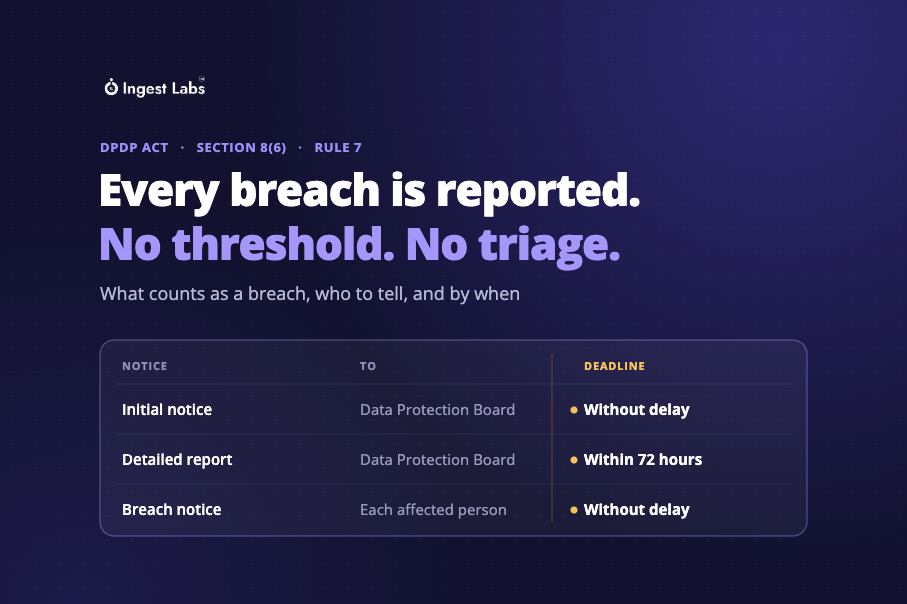
Short answer: Under India's DPDP Act, every personal data breach must be reported, with no materiality or risk threshold. On becoming aware of a breach, the Data Fiduciary must tell the Data Protection Board without delay, file a detailed report within 72 hours, and inform each affected person without delay, in plain language, through their account or registered contact details. A "personal data breach" is defined broadly to include any unauthorised processing, so a marketing misconfiguration that sends customer data to the wrong place can qualify, not just a cyberattack. Failing to notify carries a penalty of up to ₹200 crore, and failing to take reasonable safeguards up to ₹250 crore. CERT-In's separate six-hour reporting rule for cyber incidents continues to apply. The DPDP breach obligations apply from 13 May 2027.
Most Indian companies already have an incident response plan. Few have one that matches the DPDP Act, because the Act changes three assumptions at once: there is no threshold below which a breach goes unreported, the regulator and every affected person must both be told, and "breach" covers far more than hacking.
For marketing and data teams, the last point matters most. A server-side tag that sends customer emails to the wrong ad account, a CRM export left in a shared folder, or an agency uploading the wrong list to Meta can each be a reportable breach.
This article explains what counts as a breach, what each notice must contain and when, how DPDP sits alongside CERT-In's rules, and how to build a playbook your marketing and data stack can actually execute. For the full DPDP timeline, see our DPDP Act compliance guide.
What counts as a personal data breach
Section 2(u) of the Act defines a personal data breach as "any unauthorised processing of personal data or accidental disclosure, acquisition, sharing, use, alteration, destruction or loss of access to personal data, that compromises the confidentiality, integrity or availability of personal data".
Two parts of that definition reach well beyond cyberattacks.
-
"Any unauthorised processing." In our reading, processing not authorised by consent, a legitimate use or the fiduciary's own instructions falls within the definition if it compromises confidentiality, integrity or availability.
-
"Accidental disclosure ... sharing, use." Human error counts. Sending data to the wrong recipient is a breach even if nobody meant harm.
In our reading, the following marketing and data incidents are likely to be personal data breaches under the Act:
| Incident | Why it may qualify |
|---|---|
| Server-side container sends hashed emails to another brand's Meta pixel | Accidental disclosure and sharing |
| Customer list uploaded to the wrong ad account by an agency | Accidental sharing by a processor |
| CRM or warehouse export left in a publicly accessible storage bucket | Loss of confidentiality |
| Session-recording tool captures payment or OTP fields | Unauthorised processing |
| Email campaign sent with other customers' details in the body | Accidental disclosure |
| Ransomware encrypts the customer database | Loss of access and availability |
| Ex-employee downloads customer data before leaving | Unauthorised acquisition and use |
Not every one of these will cause harm. Under the DPDP Act, that does not decide whether to notify.
No threshold: every breach is reported
This is the biggest change for teams used to the GDPR. Under the GDPR, a breach is reported to the regulator unless it is unlikely to result in a risk, and to individuals only where the risk is high. Our DPDP vs GDPR comparison covers the difference in detail.
The DPDP Act has no such triage. Section 8(6) requires the fiduciary to inform the Board and each affected person of a breach, and Rule 7 sets out how. There is no exception for small breaches, encrypted data or low risk. Severity still shapes your response; it does not decide whether you notify.
The two notices and their clocks
Rule 7 sets out two sets of notices, and the Board notice has two stages.
| Notice | When | What it must contain |
|---|---|---|
| To each affected person | Without delay, on becoming aware | A description of the breach, including its nature, extent and timing; the consequences likely to arise for her; the mitigation measures taken or being taken; the safety measures she can take; contact details of a person who can respond for the fiduciary |
| Initial notice to the Board | Without delay | A description of the breach, including its nature, extent, timing and location, and its likely impact |
| Detailed report to the Board | Within 72 hours of becoming aware, or longer if the Board allows on written request | Updated and detailed information; the broad facts on the events, circumstances and reasons; mitigation measures; any findings about who caused it; remedial measures to prevent recurrence; a report on the notices given to affected people |
Three practical points follow.
The notice to people goes through their account or registered contact details. Rule 7 requires the notice to be given in plain language through the person's user account or a mode of communication she registered. Your notification capability therefore depends on having current, usable contact details, and on knowing exactly which people were affected.
"Without delay" is not 72 hours. The 72 hours applies to the detailed Board report. The initial Board notice and the notices to people are due without delay. Do not tell your board or your customers that you have 72 hours to notify individuals.
The detailed report needs facts you may not have. Root cause, the person responsible and remedial measures within 72 hours is demanding. Plan for an initial report that is honest about what is not yet known, and use the extension process where the investigation genuinely needs it.
How DPDP sits alongside CERT-In
The DPDP Act does not replace India's existing cyber-incident reporting regime. Under Directions issued on 28 April 2022 under section 70B(6) of the Information Technology Act, 2000, CERT-In requires service providers, intermediaries, data centres, body corporates and government organisations to report specified cyber incidents, including data breaches and data leaks, within six hours of noticing them or being told of them. The same Directions require logs of ICT systems to be kept for a rolling 180 days within Indian jurisdiction.
| CERT-In Directions | DPDP Act and Rules | |
|---|---|---|
| Who reports | Covered entities, including body corporates | Data Fiduciaries |
| What | Specified cyber incidents, including data breaches and leaks | Every personal data breach |
| To whom | CERT-In | Data Protection Board and each affected person |
| When | Within six hours of noticing | Without delay; detailed Board report within 72 hours |
| Log retention | 180 days, within India | At least one year under Rule 6 |
In our reading, a cyberattack that exposes customer data will usually trigger both regimes, while a misdirected list upload may trigger only DPDP. Sectoral regulators such as the RBI, SEBI and IRDAI have their own reporting rules for regulated entities, which also continue to apply. Build one incident process with several reporting outputs, not several processes.
Breaches at your processors
Most marketing breaches happen at a vendor: an agency, an email platform, a CDP, an ad platform integration. Under section 8(5), the fiduciary must protect personal data in its possession or under its control, including processing by its processors, and section 8(6) puts the notification duty on the fiduciary. A breach at your processor is therefore, in practice, yours to report.
That has two consequences.
-
Your contracts must make processors tell you fast. Hours, not days, with the facts you need for the Board notice. Review breach clauses with counsel against the content Rule 7 requires.
-
You must know what each processor held. To tell the Board the extent of a breach, and to notify each affected person, you need to know which people's data, and which fields, the processor had. That is a data-mapping question before it is a legal one.
Penalties
The Schedule to the Act sets two relevant penalties, imposed by the Board after an inquiry:
-
up to ₹200 crore for failing to notify the Board or affected people of a breach, and
-
up to ₹250 crore for failing to take reasonable security safeguards to prevent a breach.
They are separate categories. In our reading, a breach caused by weak safeguards and then not reported could attract both. The Board weighs the nature, gravity and duration of the breach, the type of data, repetition, mitigation and proportionality. As of 23 November 2026 the Board has no Chairperson or Members, so there is no enforcement practice yet.
A breach playbook for the marketing and data stack
-
Define what triggers the playbook. Include misdirected data, wrong-audience uploads, tag misconfigurations and vendor incidents, not just security alerts. Tell marketing, analytics and agency teams how to raise one.
-
Name an owner and a deputy. One person accountable for the Board notice, with authority to send it out of hours.
-
Pre-draft the notices. Templates for the initial Board notice, the detailed report and the notice to people, covering every item Rule 7 requires, in English and the other languages your customers use.
-
Know where data went. Keep a record of which destinations and processors received which people's data, and which fields. This is what lets you state the extent of a breach and list affected people quickly.
-
Keep logs you can use. Logs of access and processing kept for at least one year under Rule 6, and for 180 days within India under the CERT-In Directions, searchable by person, destination and time.
-
Fix processor contracts. Notice to you within hours, with the facts Rule 7 needs, plus cooperation with the investigation.
-
Map the other regimes. CERT-In's six hours, and any RBI, SEBI or IRDAI reporting that applies to you, in the same run-book.
-
Rehearse. Run a tabletop on a marketing scenario, such as an agency uploading the wrong customer list to Meta, and time how long it takes to produce the affected-person list and the initial Board notice.
Where things stand
As of 23 November 2026, the DPDP dates have not moved. The breach obligations in section 8(6) and Rule 7 apply from 13 May 2027. CERT-In's six-hour rule already applies. The Data Protection Board exists in law but has no Chairperson or Members, and challenges to the Act are next listed before the Supreme Court on 9 December 2026, with no stay in place.
Where Ingest Labs fits
The hardest part of a DPDP breach notice is answering, quickly and accurately, what data went where and whose it was. Ingest IQ keeps an audit trail per event and per destination. When a destination or processor reports an incident, that trail is the starting point for listing affected people and fields.
Ingest IQ also reduces how much can go wrong. It applies consent per event and per destination across more than 100 integrations, so each destination receives only the data its purpose allows, and it propagates withdrawal and erasure to the destinations that received the data. Under DPDP, Ingest Labs acts as your Data Processor and you remain the Data Fiduciary. The platform is architected for DPDP and holds SOC 2 Type II. Our DPDP resource page has more detail.
Frequently asked questions
Is there a minimum threshold for reporting a breach under the DPDP Act?
No. Section 8(6) and Rule 7 require every personal data breach to be reported to the Data Protection Board and to each affected person. There is no exception for small, low-risk or encrypted-data breaches.
Do we have 72 hours to notify affected customers?
No. Affected people must be told without delay. The 72-hour period applies only to the detailed report to the Board, which follows an initial Board notice that is also due without delay.
Is sending customer data to the wrong ad account a breach?
In our reading, it is likely to be. The Act defines a personal data breach to include any unauthorised processing and any accidental disclosure or sharing of personal data that compromises its confidentiality. Sending customer data to the wrong account fits that description.
Who notifies when the breach happens at our vendor?
You do, as the Data Fiduciary. Section 8(5) covers data processed on your behalf by your processors, and section 8(6) places the duty to notify on the fiduciary. Your contracts should require processors to tell you quickly, with the facts you need.
Does the DPDP Act replace CERT-In reporting?
No. CERT-In's Directions require specified cyber incidents, including data breaches and leaks, to be reported within six hours of noticing them. That continues alongside the DPDP notices, as do sectoral rules for regulated entities.
What are the penalties?
Up to ₹200 crore for failing to notify the Board or affected people, and up to ₹250 crore for failing to take reasonable security safeguards to prevent a breach. They are separate categories and can both apply.
To test your breach playbook against a marketing-stack scenario, book a DPDP readiness call.
Sources
-
India Code, The Digital Personal Data Protection Act, 2023 (checked 2026-11-23): definition of personal data breach in section 2(u); sections 8(5) and 8(6); penalty schedule
-
DPDPA.com, Rule 7 of the DPDP Rules, 2025 (checked 2026-11-23): content and timing of notices to affected people and to the Board; 72-hour detailed report
-
Cyril Amarchand Mangaldas, client alert on the DPDP Rules (checked 2026-11-02): breach notices; one-year log retention under Rule 6
-
Nishith Desai Associates, India revamps rules on mandatory incident reporting (checked 2026-11-23): CERT-In Directions of 28 April 2022; six-hour reporting; covered entities; 180-day logs within India
-
India Data Law, weekly DPDP updates (checked 2026-11-23): no Board appointments; Supreme Court petitions listed for 9 December 2026
This article is general information about the Digital Personal Data Protection Act, 2023 and the Digital Personal Data Protection Rules, 2025, current as of November 2026. It is not legal advice. Please take advice from qualified counsel on your specific position.