Data Principal Rights Under DPDP: Running Them at Scale
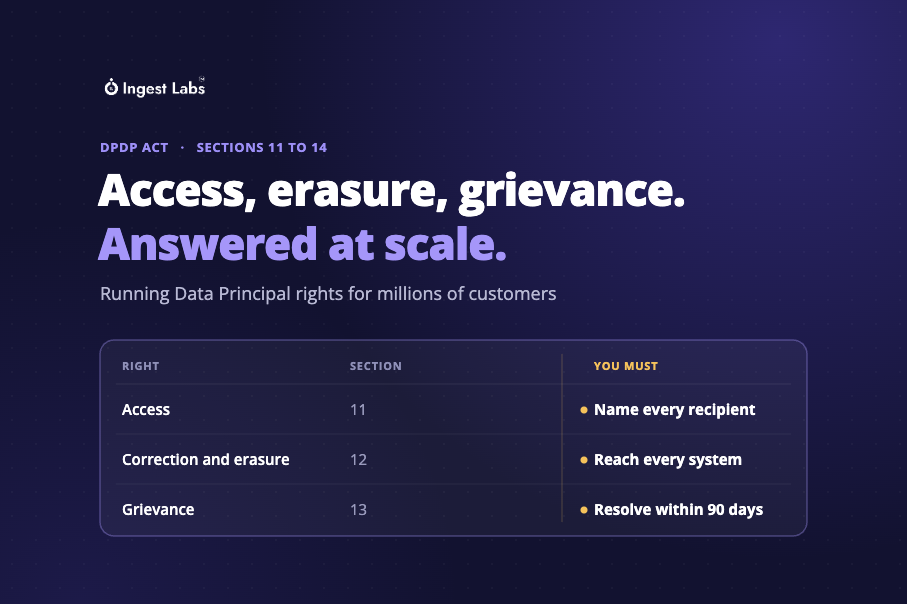
Short answer: India's DPDP Act gives people four rights over their personal data: to obtain a summary of what a business holds and who it was shared with (section 11), to have it corrected, completed, updated or erased (section 12), to have a readily available way to raise grievances (section 13), and to nominate someone to act for them on death or incapacity (section 14). Businesses must publish how to make these requests on their website or app, and must resolve grievances within a reasonable period not exceeding 90 days. The access right includes naming every other fiduciary and processor the data was shared with, which most marketing stacks cannot do today. People must take a grievance to the business first before going to the Data Protection Board. These rights apply from 13 May 2027.
Most large Indian consumer businesses already answer some privacy requests: an unsubscribe here, an account deletion there, the occasional email to a DPO. From 13 May 2027, the Digital Personal Data Protection Act, 2023 turns that into a formal set of rights with defined content, published channels and a grievance deadline.
At scale, the hard part is not the request form. It is answering accurately: a summary of every piece of personal data you hold about a person, every processing activity, and the identity of every other business you shared it with, then correcting or erasing it everywhere it went.
This article explains what each right requires, where marketing and data stacks typically fall short, and how to build a rights process that works for millions of customers. For the full DPDP timeline, see our DPDP Act compliance guide.
The four rights at a glance
| Right | Section | What the person can ask for | What it means for you |
|---|---|---|---|
| Access to information | 11 | A summary of the personal data processed and the processing activities; the identities of all other fiduciaries and processors it was shared with, with a description of what was shared | A data inventory per person, including every destination |
| Correction and erasure | 12 | Correction, completion, updating and erasure of personal data processed on consent (including section 7(a)) | Changes and deletions that reach every system holding the data |
| Grievance redressal | 13 | A readily available means of raising grievances about your obligations or her rights | A published process with a response within 90 days |
| Nomination | 14 | Nominate another individual to exercise her rights on death or incapacity | A way to record nominees and verify them when they act |
The access and correction rights apply to data processed on the basis of consent, including processing under section 7(a), where a person voluntarily gave data for a specified purpose.
Section 11: the access right is a data-mapping test
Section 11(1) gives a person the right to obtain:
-
a summary of the personal data being processed and the processing activities undertaken with it;
-
the identities of all other Data Fiduciaries and Data Processors with whom the data has been shared, along with a description of the data shared; and
-
any other information the Rules prescribe.
The second item is the difficult one. For a typical consumer brand, a single customer's data may have gone to Meta and Google through conversion APIs, to an email platform, a CRM, a customer data platform, a warehouse, an agency, a call-centre partner, a logistics partner and a payment provider. Answering accurately means knowing, per person, which of those received data and which fields.
Section 11(2) carves out sharing with fiduciaries authorised by law to obtain data, at their written request, for the prevention, detection or investigation of offences or cyber incidents, or for prosecution. You do not have to disclose those.
What a good access response contains
-
The categories of personal data held, such as contact details, order history, browsing events, preferences and support tickets.
-
The processing activities, linked to the purposes in your notice.
-
Each other fiduciary and processor the data went to, with what was shared.
-
How to correct, erase, withdraw consent or raise a grievance.
Section 12: correction and erasure have to travel
Section 12(2) requires the fiduciary to correct inaccurate or misleading data, complete incomplete data and update it on request. Section 12(3) requires erasure on request unless retention is necessary for the specified purpose or for compliance with a law.
Two practical points.
Erasure is not just your database. Under section 8(7), you must also cause your processors to erase data you made available to them. A request that deletes the customer from your CRM but leaves her in a Meta custom audience, a Klaviyo list and the warehouse is not complete.
Some data must be kept. Tax, accounting, KYC and sectoral rules often require records to be retained. The right answer is to erase what is not required, restrict what is, and tell the person which is which.
Withdrawal of consent under section 6 is closely related but separate. A person can withdraw consent at any time, as easily as she gave it, and you and your processors must then stop processing within a reasonable time. Our guide to DPDP consent and notice requirements covers withdrawal design.
Section 13: grievances and the 90-day limit
Section 13 gives every person the right to a readily available means of grievance redressal from the fiduciary, or from a Consent Manager, about its obligations or her rights. Rule 14(3) requires fiduciaries to publish their grievance redressal system and to respond within a reasonable period not exceeding 90 days.
Section 13(3) requires the person to exhaust this process before approaching the Data Protection Board. In other words, your grievance desk is the first line of enforcement. A complaint that reaches the Board will arrive with your response, or lack of one, attached.
Ninety days is a ceiling, not a target. If a rights request goes unanswered and becomes a grievance, the 90-day limit for grievances starts to matter, and a request that sits in a shared inbox for weeks leaves little room.
Section 14: nomination
Section 14 lets a person nominate another individual to exercise her rights in the event of her death or incapacity. Rule 14(4) allows nomination of one or more individuals, subject to your terms of service and applicable law. You need a way to record nominees, and a way to verify both the nominee's identity and the death or incapacity before acting on their request.
Publishing how to exercise rights
Rule 14(1) requires fiduciaries to prominently publish on their website, app or both the means by which people can make rights requests, and any identifiers, such as a username, needed to verify who is asking. Your notice under section 5 must also tell people how to exercise their rights and how to complain to the Board.
Rule 14 also expects Consent Managers, where applicable, to publish how people can make requests and raise grievances through them. The Consent Manager framework has been in force since 13 November 2026 and the Board's registration portal is open. Once Consent Managers are registered, in our reading some requests may reach you through one.
Where rights processes break at scale
| Failure | What it looks like | Fix |
|---|---|---|
| No per-person data map | Access responses list systems, not what was actually shared | Record which destinations received each person's data, and which fields |
| Identity mismatch | The same customer appears under different emails and phone numbers | Resolve identity across systems before searching or deleting |
| Partial erasure | Deleted from the CRM, still in ad audiences and the warehouse | Fan erasure out to every destination that received the data, and log it |
| Manual queue | Requests handled by email and spreadsheets | Ticketed workflow with deadlines and automated lookups |
| Unverified requester | Data sent to someone impersonating the customer | Verify against identifiers you already hold, as Rule 14 permits |
| Retention conflicts | Legal hold data deleted, or deletable data kept "just in case" | Retention schedule per data category, applied consistently |
A rights operating model
-
Publish the channels. Web form, in-app option and a monitored email, with the identifiers you need, as Rule 14(1) requires.
-
Verify, proportionately. Use identifiers you already hold, such as a logged-in session or a one-time code to the registered phone or email.
-
Search one index, not twenty systems. Maintain a per-person record of data categories, purposes and destinations, so an access request is a lookup, not a project.
-
Act everywhere. Correction, erasure and withdrawal fan out to every system and processor that holds the data, with each action logged.
-
Track the clock. Grievances resolved within 90 days, and rights requests answered well inside it.
-
Respect retention. Apply your retention schedule, and explain what you cannot erase and why.
-
Report. Volumes, response times and outcomes to the DPO and, for larger organisations, the board.
Where things stand
As of 23 November 2026, the DPDP dates have not moved. The rights in sections 11 to 14 and Rule 14 apply from 13 May 2027. The Data Protection Board has no Chairperson or Members yet, and challenges to the Act are next listed before the Supreme Court on 9 December 2026, with no stay in place.
Where Ingest Labs fits
The access right's demand to name every fiduciary and processor a person's data was shared with, and the erasure right's need to reach every destination, both depend on knowing where each person's data went. Ingest IQ keeps an audit trail per event and per destination across more than 100 integrations. That gives your rights team a reliable starting point for access responses.
Ingest IQ also propagates withdrawal and erasure to the destinations that received the data, and Ingest ID provides first-party identity resolution. Under DPDP, Ingest Labs acts as your Data Processor and you remain the Data Fiduciary. The platform is architected for DPDP and holds SOC 2 Type II. Our DPDP resource page has more detail.
Frequently asked questions
What rights do people have under the DPDP Act?
Four: access to a summary of their personal data and who it was shared with (section 11), correction, completion, updating and erasure (section 12), grievance redressal (section 13), and nomination of someone to act for them on death or incapacity (section 14).
How long do we have to respond?
Rule 14(3) requires grievances to be resolved within a reasonable period not exceeding 90 days. The Rules do not set a separate deadline for access or correction requests. In our reading, answering them well within 90 days is prudent.
Do we have to tell customers which vendors received their data?
Yes, if they ask, for data processed on the basis of consent (including under section 7(a)). Section 11(1)(b) gives people the right to the identities of all other Data Fiduciaries and Data Processors with whom their data has been shared, with a description of what was shared. The exception in section 11(2) covers only sharing with authorities for offences and cyber incidents.
Can we refuse an erasure request?
You can keep data where retention is necessary for the specified purpose or required by law, such as tax or KYC records. Other data processed on consent must be erased on request, including at the processors you shared it with, and you should explain to the person what you kept and why.
Can a customer go straight to the Data Protection Board?
No. Section 13(3) requires the person to exhaust your grievance redressal process first. That makes your own grievance handling the first test of your compliance.
What is a nominee?
Someone a person names under section 14 to exercise her rights if she dies or becomes incapacitated. You need a way to record nominees and to verify them, and the death or incapacity, before acting on their requests.
To test how your stack would answer an access or erasure request today, book a DPDP readiness call.
Sources
-
India Code, The Digital Personal Data Protection Act, 2023 (checked 2026-11-23): sections 11, 12, 13, 14 and 15 in full; section 8(7) on erasure by processors
-
DPDPA.com, Rule 14 of the DPDP Rules, 2025 (checked 2026-11-23): publishing the means to make requests; grievances resolved within a reasonable period not exceeding 90 days; nomination of one or more individuals
-
DPDP Wiki, Section 6: Consent (checked 2026-10-27): withdrawal of consent and processors stopping processing
-
India Data Law, weekly DPDP updates (checked 2026-11-23): Consent Manager provisions in force from 13 November 2026; no Board appointments; Supreme Court petitions listed for 9 December 2026
This article is general information about the Digital Personal Data Protection Act, 2023 and the Digital Personal Data Protection Rules, 2025, current as of November 2026. It is not legal advice. Please take advice from qualified counsel on your specific position.