CDP Pricing 2026: What Customer Data Platforms Really Cost
Updated November 23, 2026
Short answer: Most customer data platforms (CDPs) are sold on custom quotes, so the price depends on what the vendor meters: monthly tracked users (MTUs), events, profiles, activated records or rows synced. Self-serve entry plans exist for testing, but production contracts are negotiated on your data volume, so two companies on the same platform can pay very different amounts. The licence is only part of the bill. Budget also for implementation services, data-volume growth, warehouse compute, compliance work and overages during seasonal peaks. CDP spend usually comes out of the martech line, which Gartner's 2025 CMO Spend Survey put at 22.4% of marketing budgets, so it competes directly with every other tool in the stack. The most reliable way to estimate a CDP budget is to model next year's tracked users or events against each shortlisted vendor's metering unit, then add services and a buffer for overages and bot-inflated traffic.
What drives CDP cost: the pricing unit
The biggest pricing decision is not the vendor's list price. It is the unit the vendor charges for, because that unit decides what makes your bill grow.
| Pricing unit | Where you usually see it | What makes the bill grow | Watch out for |
|---|---|---|---|
| Monthly tracked users (MTUs) | Packaged CDPs and event pipelines | More unique visitors or users each month | Anonymous visitors and bots count as users |
| Events | Event pipelines and analytics-led CDPs | More page views, clicks and purchases tracked | Chatty tracking plans and duplicate events |
| Activated records | Audience activation and reverse ETL tools | More people sent to more audiences and destinations | Each person can be billed per audience, per destination |
| Monthly active rows (MAR) | Data integration (ELT) platforms | More rows inserted or updated in synced tables | High-churn tables such as ad metrics |
| Usage-based (syncs, actions, consumption) | Composable and enterprise CDPs | Volume of syncs, actions or data processed | No public rates; ask for a written volume model |
Read the definition of the unit closely. Where activated records are billed per person, per audience and per destination, a single customer sent to three audiences in two ad platforms can count six times.
What to ask for in a CDP quote
Because most production pricing is negotiated, the quote is where the real cost is decided. Ask every shortlisted vendor for the same five things, in writing:
| Ask for | Why it matters |
|---|---|
| The exact metering unit and how it is counted | Decides whether bots, anonymous visitors and duplicate events add to the bill |
| Your projected bill at today's volume and at 1.5 times today's volume | Shows how cost grows as traffic grows |
| Overage rates and how peaks are handled | Seasonal spikes can push you above your committed tier |
| Implementation services, priced separately | Setup is often a separate statement of work |
| Renewal terms and any annual price increase | Year-two cost can differ from year one |
Self-serve entry plans are built for testing, not production. A mid-market brand with 400,000 monthly users will be well beyond any free or starter tier, so compare negotiated quotes, not list prices.
CDP pricing vs data integration platform pricing
Teams often compare CDP quotes with data integration (ELT) tools, but they meter different things:
-
CDPs and event pipelines charge on people (MTUs, profiles) or behaviour (events). They collect data from websites and apps and send it to marketing tools.
-
Data integration platforms move tables between systems. They commonly price on monthly active rows (MAR): rows inserted or updated in a month, usually excluding unchanged rows and the initial sync.
-
Reverse ETL and composable CDPs sit on your data warehouse and charge on syncs, activated records or actions, so you also pay warehouse compute.
If your data team already runs a warehouse and an ELT tool, a composable CDP can reuse that spend. If not, a packaged CDP bundles collection, storage and activation into one bill.
Hidden costs that change the total
-
Implementation and services. Setting up sources, identity rules, tracking plans and audiences is usually a separate statement of work. Ask for it in writing alongside the licence quote.
-
Bot and junk traffic. Under MTU pricing, every unique visitor counts, including bots and invalid traffic. Filtering that traffic before it reaches the CDP lowers the bill and cleans the data.
-
Overages. Usage-based contracts charge for volume above the committed tier. Seasonal peaks such as Black Friday can push you over in a single month.
-
Warehouse compute. Composable CDPs run queries on your warehouse, so audience refreshes appear on your Snowflake, BigQuery or Databricks bill rather than the CDP invoice.
-
Compliance work. Consent capture, deletion requests and audit trails take engineering time. Under the CCPA, California's regulator set 2025 penalties of up to $2,663 per violation and $7,988 per intentional violation or violation involving minors under 16, counted per violation.
-
Data quality. Duplicate events and broken identity rules inflate MTU and event counts, and they make the platform's output harder to trust.
How to estimate your CDP budget: a worked example
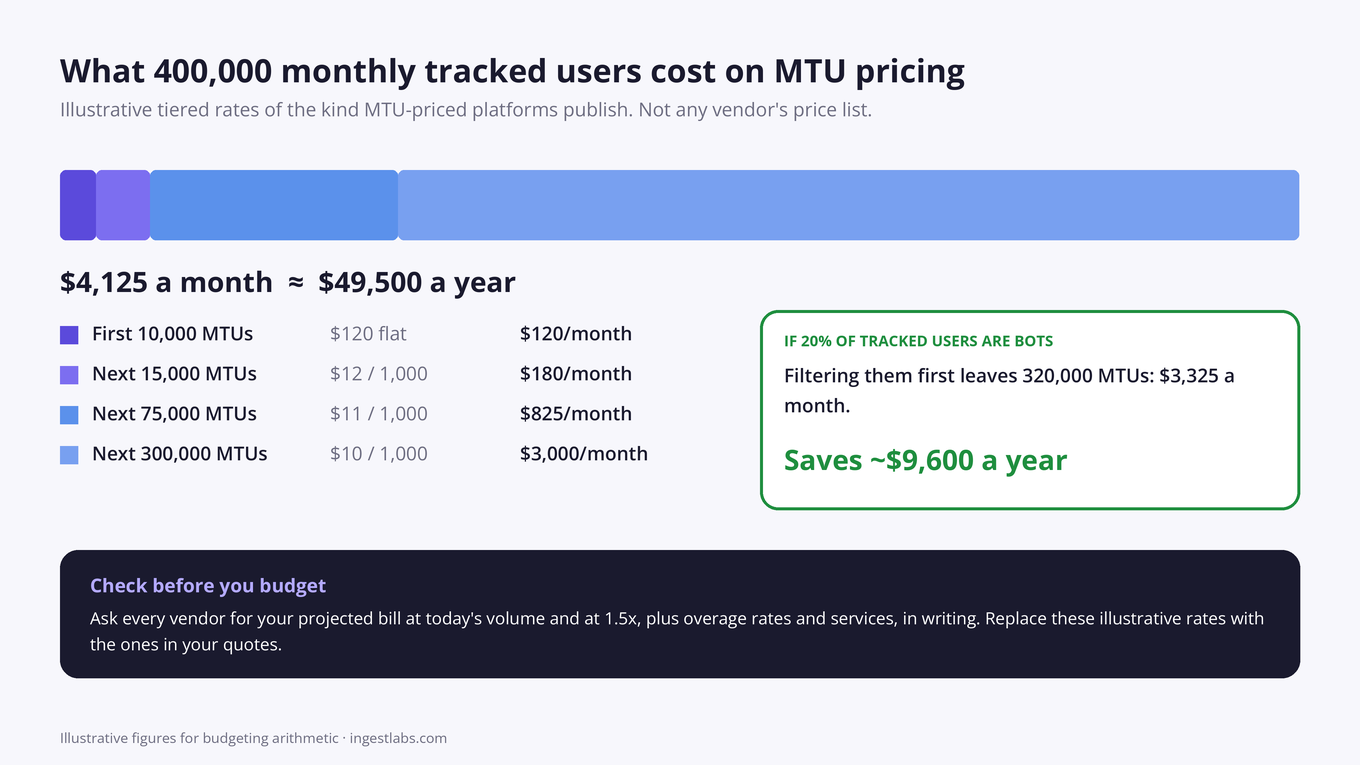
This uses illustrative tiered rates of the kind MTU-priced platforms publish, to show the arithmetic. It is not any vendor's price list, so replace the rates with the ones in your quotes.
| Line | Monthly tracked users | Rate | Monthly cost |
|---|---|---|---|
| Base plan | First 10,000 | $120 flat | $120 |
| Tier 1 | Next 15,000 (to 25,000) | $12 per 1,000 | $180 |
| Tier 2 | Next 75,000 (to 100,000) | $11 per 1,000 | $825 |
| Tier 3 | Next 300,000 (to 400,000) | $10 per 1,000 | $3,000 |
| Total for 400,000 MTUs | $4,125 a month, about $49,500 a year |
Now suppose 20% of those 400,000 tracked users are bots or invalid traffic. Removing them takes the count to 320,000, which cuts $800 a month, or about $9,600 a year, from this illustrative bill. The same logic applies to event-based pricing: every duplicate or junk event you stop collecting is volume you do not pay for.
To build your own estimate:
-
Pull 12 months of unique users and events from your analytics, and forecast growth for the contract term.
-
Map that volume to each shortlisted vendor's pricing unit.
-
Add implementation services, internal engineering time and warehouse compute.
-
Add a 15–20% buffer for seasonal peaks, or negotiate a higher committed tier.
-
Ask each vendor to show your projected bill, including overages, in writing.
What the CDP market looks like in 2026
Market-size figures vary widely, so use them with care. A 2026 review by CDP.com found published estimates for the CDP market ranging from $4 billion to $10 billion, depending on what each research firm counts. The CDP Institute's January 2026 industry update counts about $2.9 billion of revenue across the vendors it tracks. MarketsandMarkets' current forecast projects growth from $7.34 billion in 2026 to $14.04 billion by 2031. This is lower than the $28.2 billion by 2028 it projected in 2024, which older articles, including the earlier version of this page, still quote.
For budgeting, the market figure matters less than one fact: pricing is concentrated in a few metering models, and most vendors negotiate.
How Ingest Labs fits
Most CDP bills are driven by the volume and quality of the data you send them. Ingest IQ collects events server-side, so you control which events reach each tool and duplicates are dropped before they are counted. Ad Shield scores traffic quality, so bot and invalid visits can be filtered before they inflate MTU-based bills. Ingest ID resolves returning visitors to one first-party identifier, so one person is not counted as several users. Event IQ unifies event and marketing data for analysis. Ingest Labs pricing is quoted on data volume rather than per order. For a related comparison, see our guide to unified customer profiles.
FAQ
How much does a customer data platform cost?
Most CDPs are quote-based, so cost depends on your data volume and the vendor's metering unit. Self-serve entry plans exist for testing, but production contracts are negotiated. As an illustration, 400,000 monthly tracked users at tiered rates of $10 to $12 per 1,000 comes to about $49,500 a year before services, compute and overages.
What is MTU pricing?
MTU pricing charges for monthly tracked users, the number of unique users or visitors a platform collects data on each month. Plans usually include a base number of MTUs and charge tiered rates for each additional 1,000 users. Because anonymous visitors and bots can count, filtering invalid traffic and resolving duplicate identities lowers MTU-based bills.
How is data integration platform pricing calculated?
Data integration (ELT) platforms usually charge on the volume of data they move, not on users. Many price on monthly active rows, counting rows inserted or updated in a month, usually excluding unchanged rows and the initial sync. Bills grow with how often your source tables change, not with how many customers you have. CDPs, by contrast, usually charge on tracked users, events or profiles.
What hidden costs come with a CDP?
The main ones are implementation services, overage charges above your committed volume, warehouse compute for composable CDPs, and engineering time for consent and deletion requests. Bot traffic and duplicate events also add cost when pricing is based on users or events. Ask each vendor for a written volume model that includes overages before you sign.
How do I budget for a CDP?
Forecast next year's unique users and events from your analytics, map them to each vendor's pricing unit, and ask each vendor to show your projected bill in writing. Add implementation services, internal engineering time and warehouse compute, then keep a 15–20% buffer for seasonal peaks or negotiate a higher committed tier.
Sources
-
CMSWire, "With Stagnant Budgets, What's the CMO's Lifeline?" (reporting the Gartner 2025 CMO Spend Survey martech share of 22.4%), checked November 23, 2026
-
CDP.com, CDP Industry Statistics 2026, checked November 23, 2026
-
MarketsandMarkets, Customer Data Platform Market forecast to 2031, checked November 23, 2026