Cross-Border Data Transfers Under the DPDP Act
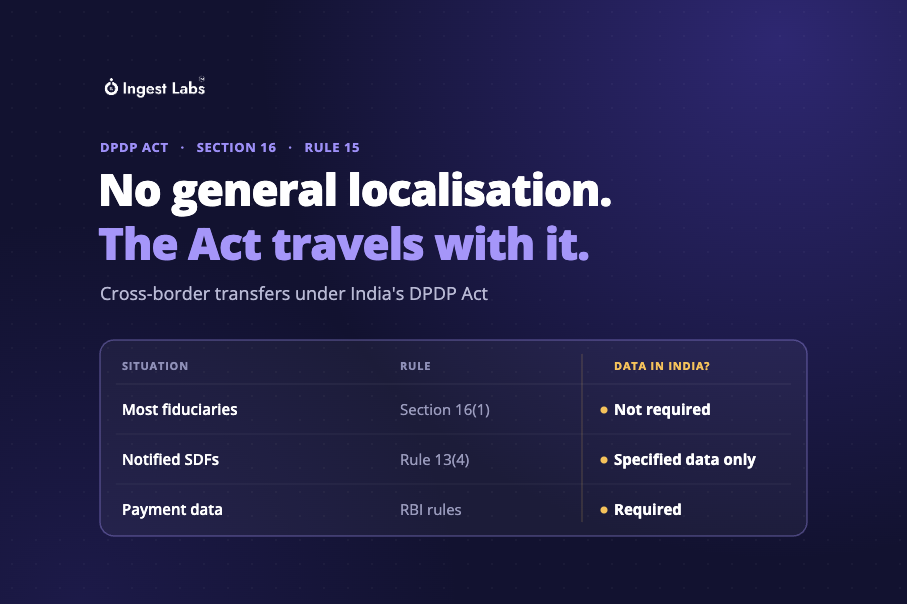
Short answer: India's DPDP Act does not require personal data to stay in India. Section 16 lets the government restrict transfers to specific countries by notification, and transfers everywhere else are permitted; as of 23 November 2026, no country has been restricted. Rule 15 adds that fiduciaries must meet any requirements the government sets by order about making data available to a foreign state or its agencies. Under the Act and Rules as they stand, localisation applies in two situations: for notified Significant Data Fiduciaries, for data the government specifies, and under stricter sectoral laws such as the RBI's payment data storage requirements, which section 16(2) preserves. Every other DPDP obligation still applies to data processed abroad, and the fiduciary stays responsible for its overseas processors. Section 16 applies from 13 May 2027.
For global brands and Indian companies running their marketing stack on US and European cloud services, the first DPDP question is often: do we have to move our data to India?
For most organisations, the answer under the Digital Personal Data Protection Act, 2023 is no. But that is not the same as "nothing changes". A restricted-country list could be published at any time, sectoral regulators already impose their own rules, and every obligation in the Act follows the data wherever it is processed.
This article explains how section 16 and Rule 15 work, where localisation does apply, how this differs from the GDPR, and what to put in place now so that a future notification is a configuration change rather than a migration. For the full DPDP timeline, see our DPDP Act compliance guide.
What section 16 says
Section 16 has two parts.
-
Section 16(1): the Central Government may, by notification, restrict the transfer of personal data by a Data Fiduciary for processing to any country or territory outside India it notifies.
-
Section 16(2): nothing in section 16 restricts any other Indian law that provides a higher degree of protection for, or restriction on, transfers of personal data outside India.
This is a negative-list model. Transfers are allowed unless the destination is restricted. As of 23 November 2026, no restricted-country notification has been issued.
What Rule 15 adds
Rule 15 says personal data processed under the Act may be transferred outside India, subject to the fiduciary meeting any requirements the Central Government specifies, by general or special order, about making that data available to a foreign state, or to any person or entity under the control of or any agency of such a state.
In plain terms, the concern is foreign government access. We are not aware of any such order as of 23 November 2026. If one is issued, it may affect transfers to vendors who can be compelled to give data to their home governments, which is a question to keep on your vendor review list.
Where localisation does apply
Significant Data Fiduciaries
Under Rule 13(4), a notified Significant Data Fiduciary must ensure that personal data the government specifies, on a committee's recommendation, together with the traffic data relating to its flow, is not transferred outside India. No SDF has been notified as of November 2026, and we are not aware of any data having been specified.
Sectoral rules
Section 16(2) keeps stricter sectoral rules in force. The best known is the RBI's requirement that payment system data be stored in India. Banks, NBFCs, insurers, securities firms and healthcare providers should map their own regulator's data rules alongside DPDP, because for them the sectoral rule will often be the binding constraint.
How this differs from the GDPR
| GDPR | DPDP Act | |
|---|---|---|
| Default | Transfers outside the EEA need a legal mechanism | Transfers permitted unless the destination is restricted |
| Mechanisms | Adequacy decisions, standard contractual clauses, binding corporate rules and others | None required; watch for restricted-country notifications and Rule 15 orders |
| Localisation | None in the GDPR itself | Only for notified SDFs, for specified data, and under sectoral laws |
| Documentation | Transfer impact assessments are common | Not required by the Act, but a record of where data goes is needed for other duties |
Our DPDP vs GDPR comparison covers the wider differences.
Every other obligation still travels with the data
Permission to transfer is not exemption from the Act. Section 3 applies the Act to processing within India and to processing outside India connected with offering goods or services to people in India. Data sent to a US analytics vendor or a European CDP is still subject to consent, notice, security safeguards, breach notification, retention and rights.
Section 8(1) makes the fiduciary responsible for processing done on its behalf by its processors, wherever they are. Rule 6 requires reasonable security safeguards and logs kept for at least a year, and section 8(6) requires every breach to be reported, including one at an overseas processor. In practice, cross-border risk under DPDP is mostly about whether your overseas vendors meet the same standards as your Indian ones.
What to put in place now
-
Map where Indian customers' data is processed and stored. Every destination, processor and sub-processor, with its processing location. Include ad platforms, analytics tools, CDPs, email and messaging platforms and support tools.
-
Record sectoral constraints. Note which data categories are subject to RBI, SEBI, IRDAI or health-sector storage rules, and where they are held.
-
Prefer configurable regions. Where a vendor offers regional processing, know how to switch it, so a restricted-country notification becomes a configuration change.
-
Put locations in contracts. Require processors to disclose processing locations and sub-processors, and to tell you before changing them.
-
Watch for government access orders. Track any Rule 15 order and assess which vendors could be affected.
-
Plan for possible SDF designation. If you could be notified, identify which data categories and traffic data would be hardest to keep in India.
-
Keep the evidence. A record of what data went to which destination, and where, supports breach reporting, access requests and any future transfer review.
Where things stand
As of 23 November 2026, the DPDP dates have not moved. Section 16 and Rule 15 apply from 13 May 2027, along with most other obligations. No restricted-country notification has been issued, we are not aware of any Rule 15 order, and no SDF has been notified. The Data Protection Board has no Chairperson or Members yet, and challenges to the Act are next listed before the Supreme Court on 9 December 2026, with no stay in place.
Where Ingest Labs fits
Cross-border readiness under DPDP is mostly about knowing where data goes and being able to change it. Ingest IQ offers region-pinned processing for Indian customers with a documented sub-processor list, and keeps an audit trail per event and per destination across more than 100 integrations, so you can show which destinations received which data.
It applies consent per event and per destination, so overseas destinations receive only the data their purpose allows, and it propagates withdrawal and erasure to the destinations that received the data. Under DPDP, Ingest Labs acts as your Data Processor and you remain the Data Fiduciary. The platform is architected for DPDP and holds SOC 2 Type II. Our DPDP resource page has more detail.
Frequently asked questions
Does the DPDP Act require data localisation?
Not generally. Section 16 permits transfers outside India except to countries the government restricts by notification. Localisation applies only to notified Significant Data Fiduciaries for data the government specifies, and under stricter sectoral laws.
Has the government published a list of restricted countries?
Not as of 23 November 2026. Section 16 allows the government to restrict transfers to specific countries by notification, but no such notification has been issued.
Do we need standard contractual clauses for transfers from India?
The DPDP Act does not require them. Your processor contracts should still cover security safeguards, breach notice, withdrawal, erasure and processing locations, because you remain responsible for your processors under section 8(1).
Do RBI payment data rules still apply?
Yes. Section 16(2) preserves Indian laws that provide a higher degree of protection or restriction on transfers, so the RBI's payment data storage requirements and other sectoral rules continue to apply.
What does Rule 15 require?
That fiduciaries meet any requirements the government specifies by order about making personal data available to a foreign state or entities under its control. We are not aware of any such order as of 23 November 2026.
Does the Act still apply to data we process abroad?
Yes. The Act covers processing outside India connected with offering goods or services to people in India, and the fiduciary remains responsible for overseas processors under section 8(1).
To map where your Indian customers' data is processed, book a DPDP readiness call.
Sources
-
India Code, The Digital Personal Data Protection Act, 2023 (checked 2026-11-23): section 16(1) and 16(2) in full; sections 3 and 8(1)
-
DPDPA.com, Rule 15 of the DPDP Rules, 2025 (checked 2026-11-23): transfers permitted subject to requirements on making data available to a foreign state
-
DSCI, FAQs on cross-border flow of data under the DPDP Act and Rules (checked 2026-11-02): no blanket localisation; SDF localisation only for specified data
-
DPDP Wiki, Section 3: Application of the Act (checked 2026-11-02): extra-territorial application
-
India Data Law, weekly DPDP updates (checked 2026-11-23): no SDF notified; no Board appointments; Supreme Court petitions listed for 9 December 2026
This article is general information about the Digital Personal Data Protection Act, 2023 and the Digital Personal Data Protection Rules, 2025, current as of November 2026. It is not legal advice. Please take advice from qualified counsel on your specific position.