DPDP Children's Data: Under 18, No Tracking or Targeting
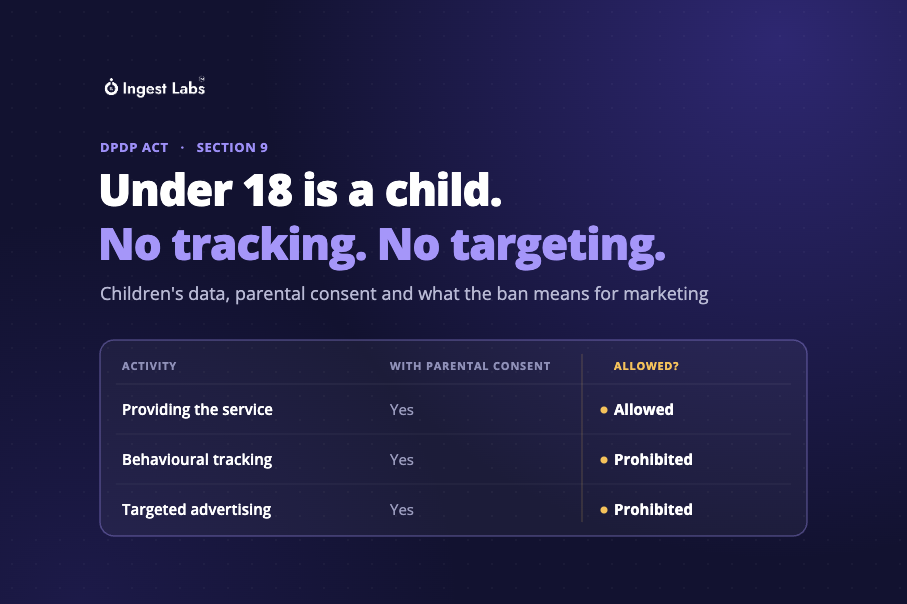
Short answer: Under India's DPDP Act, a child is anyone under 18. Before processing a child's personal data, a business must obtain verifiable consent from a parent or lawful guardian, and Rule 10 requires it to check that the person giving consent is an identifiable adult. Separately, section 9(3) prohibits tracking or behavioural monitoring of children and targeted advertising directed at them, and parental consent does not lift that ban. Processing likely to harm a child's well-being is also prohibited. A narrow set of exemptions covers healthcare providers, schools, school transport and a few purposes such as safety and age checks. Breaching the children's data obligations carries a penalty of up to ₹200 crore. The obligations apply from 13 May 2027.
Most global privacy programmes treat 13 or 16 as the age at which a person can consent online. India's Digital Personal Data Protection Act, 2023 sets it at 18, and it goes further: it bans tracking, behavioural monitoring and targeted advertising directed at children outright.
For brands in education, gaming, fashion, beauty, quick commerce, entertainment and youth banking, that changes the marketing funnel. It also raises a practical question every brand has to answer: how do you know who is under 18?
This article explains what section 9 and Rules 10 to 12 require, how verifiable parental consent works, what the exemptions cover, and how to make the ban on tracking and targeted advertising work in a real marketing and data stack. For the full DPDP timeline, see our DPDP Act compliance guide.
What section 9 says
Section 9 has five parts.
| Provision | What it requires |
|---|---|
| Section 9(1) | Before processing any personal data of a child, or of a person with disability who has a lawful guardian, obtain the verifiable consent of the parent or lawful guardian |
| Section 9(2) | Do not process personal data in a way likely to cause any detrimental effect on a child's well-being |
| Section 9(3) | Do not undertake tracking or behavioural monitoring of children, or targeted advertising directed at children |
| Section 9(4) | Sub-sections (1) and (3) do not apply to classes of fiduciaries or purposes prescribed in the Rules, subject to conditions |
| Section 9(5) | The government may notify an age above which a fiduciary whose processing of children's data is verifiably safe is exempt from some or all of sub-sections (1) and (3) |
Section 2 of the Act defines a child as an individual who has not completed 18 years. The October 2026 Removal of Difficulties Order clarified the wording of section 9(1) so that it expressly covers persons with disabilities who have a lawful guardian. We are not aware of any notification under section 9(5) as of November 2026.
Parental consent does not unlock advertising
The most common misreading of section 9 is that parental consent makes everything permissible. It does not.
Section 9(1) and section 9(3) are separate duties. Parental consent satisfies section 9(1), allowing you to process a child's data to provide your service. Section 9(3) is a standalone prohibition on tracking, behavioural monitoring and targeted advertising directed at children. It contains no consent exception. Only the exemptions in the Rules, or a government notification under section 9(5), can lift it. None of the Rule exemptions is about marketing.
In practice, for anyone you know or reasonably believe is under 18:
-
no retargeting pixels or conversion API events used for advertising
-
no inclusion in custom audiences, customer match lists or lookalike seeds
-
no behavioural profiling for personalised recommendations used to target advertising
-
no interest-based ads directed at them on your own properties
In our reading, contextual content on your own site, not driven by tracking or a behavioural profile, is a different matter. The ban is on tracking, behavioural monitoring and targeting, not on a child seeing your products.
How verifiable parental consent works under Rule 10
Rule 10 requires fiduciaries to adopt appropriate technical and organisational measures to ensure verifiable parental consent is obtained before a child's data is processed. It also requires due diligence to check that the person identifying as the parent is an identifiable adult.
That check can rely on:
-
reliable details of identity and age the fiduciary already holds, for example where the parent is already a registered, verified customer; or
-
identity and age details voluntarily provided, or a virtual token mapped to them, issued by an authorised entity, which includes details made available through a Digital Locker service provider such as DigiLocker.
The Rules illustrate four cases: a child signs up and names a parent who is already a registered user, or who is not; or the parent opens the account for the child, again as an existing user or a new one. In each case, the fiduciary must check it is dealing with an identifiable adult before processing the child's personal data.
In our reading, Rule 10 does not require every user's age to be verified. The due diligence it describes is about the parent. How you identify that a user is a child in the first place is left to your own age-assurance approach.
The exemptions in the Fourth Schedule
Rule 12 disapplies sections 9(1) and 9(3), subject to conditions, for the classes of fiduciaries in Part A of the Fourth Schedule and the purposes in Part B.
| Part A: classes of fiduciaries | Condition |
|---|---|
| Clinical establishments, mental health establishments and healthcare professionals | Processing limited to providing health services to the extent needed to protect the child's health |
| Educational institutions | Tracking and behavioural monitoring limited to educational activities or the safety of enrolled children |
| Transport providers engaged by educational or childcare institutions | Location tracking limited to the children's safety during travel |
| Part B: purposes |
|---|
| Determining a child's real-time location for her safety, protection or security |
| Due diligence to confirm that a user is not a child |
| Providing subsidies, benefits, services, certificates, licences or permits under law or policy, in the child's interests |
| Ensuring that information, services or advertisements likely to harm the child's well-being are not accessible to her |
None of these exemptions covers advertising, retargeting or behavioural marketing. Schools and edtech businesses should read the educational-institution exemption narrowly: it covers educational activities and safety, not marketing to students or their families.
The age question
The Act requires verifiable parental consent for children's data and bans tracking them, but it does not prescribe how a business must find out a user's age. In our reading, the practical standard is what a careful business would do given its audience.
| Audience | Sensible approach |
|---|---|
| Service clearly aimed at adults (credit cards, insurance, alcohol, B2B) | Collect date of birth where you need it anyway; treat declared under-18s as children |
| General audience likely to include teenagers (fashion, beauty, gaming, quick commerce, OTT) | Ask for age or date of birth at sign-up; default unknown-age users to non-advertising treatment until age is established |
| Service aimed at children or students (edtech, kids' content, youth banking) | Assume users are children unless shown otherwise; obtain verifiable parental consent; no advertising tracking |
Part B allows processing needed for due diligence to confirm a user is not a child, so, in our reading, collecting the minimum data needed for an age check is permitted.
Making it work in the marketing and data stack
The ban in section 9(3) has to be enforced where the data flows, not just in a policy. In practice that means an age signal travelling with every event.
-
Carry an age flag on every event. A simple field, such as is_child true, false or unknown, set from your account data or age check and attached to every web, app and server event.
-
Block advertising destinations outright for children. When the flag is true, no event goes to Meta, Google Ads, TikTok or any other advertising or behavioural destination, whatever other consent the event carries.
-
Decide how to treat unknown age. For general-audience services likely to attract teenagers, treat unknown age conservatively until it is established.
-
Keep children out of audiences. Exclude under-18 customers from custom audiences, customer match lists and lookalike seeds, and recheck on every refresh.
-
Separate service data from marketing data. Processing needed to provide the service with parental consent is allowed. Keep it apart from marketing analytics so that a child's service data does not leak into advertising.
-
Review personalisation. Recommendation engines that build a behavioural profile of a child are likely to be behavioural monitoring. Use contextual or non-profiled approaches for under-18s.
-
Log the decisions. Record that a child's event was blocked from each advertising destination. If the Board asks, the audit trail is your evidence.
Our reference guide to server-side tracking explains where these controls sit in a typical setup, and our guide to DPDP consent and notice requirements covers notices, including those addressed to parents.
Where things stand
As of 23 November 2026, the DPDP dates have not moved. The children's data obligations in section 9 and Rules 10 to 12 apply from 13 May 2027. The Data Protection Board has no Chairperson or Members yet, and challenges to the Act are next listed before the Supreme Court on 9 December 2026, with no stay in place.
Where Ingest Labs fits
The ban on tracking and targeted advertising directed at children has to be enforced on every event, at every destination. Ingest IQ applies consent per event and per destination across more than 100 integrations. In our reading, that is the kind of control needed to keep a child's data away from advertising destinations, and the audit trail per event and destination records what was sent where.
Ingest IQ works with your existing consent platform, whether OneTrust, Consentmo or a custom build, and propagates withdrawal and erasure to the destinations that received the data. Under DPDP, Ingest Labs acts as your Data Processor and you remain the Data Fiduciary. The platform is architected for DPDP and holds SOC 2 Type II. Our DPDP resource page has more detail.
Frequently asked questions
What age is a child under the DPDP Act?
Anyone under 18. Section 2 defines a child as an individual who has not completed 18 years, which is higher than the 13 or 16 used under many other privacy laws.
Can we run targeted ads to 16- and 17-year-olds with parental consent?
No. Section 9(3) prohibits tracking, behavioural monitoring and targeted advertising directed at children, and it has no consent exception. Parental consent satisfies section 9(1) for providing your service; it does not lift the ban in section 9(3).
How do we verify parental consent?
Rule 10 requires due diligence that the person giving consent is an identifiable adult, using reliable identity and age details you already hold, or details or a virtual token from an authorised entity, including through a Digital Locker service provider. The Rules include worked examples for existing and new users.
Do we have to verify the age of every user?
The Act and Rules do not impose a general duty to verify every user's age. But you must obtain parental consent for children and must not track or target them, so you need a reasonable way of knowing who is under 18. Processing needed to confirm a user is not a child is itself an exempt purpose.
Which organisations are exempt?
Under Rule 12 and the Fourth Schedule, healthcare providers, educational institutions and transport providers engaged by schools or childcare institutions are exempt from sections 9(1) and 9(3) for specified, limited processing, and a few purposes such as real-time safety tracking and age checks are exempt. None of the exemptions covers advertising.
What is the penalty?
Breaching the children's data obligations in section 9 carries a penalty of up to ₹200 crore, imposed by the Data Protection Board after an inquiry.
To review how your stack handles under-18 users, book a DPDP readiness call.
Sources
-
India Code, The Digital Personal Data Protection Act, 2023 (checked 2026-11-23): section 9 in full; ₹200 crore penalty for breach of section 9 obligations
-
DPDPA.com, Rule 10 of the DPDP Rules, 2025 (checked 2026-11-23): verifiable parental consent; checking the parent is an identifiable adult; virtual tokens and Digital Locker; worked examples
-
DPDPA.com, Rule 12 of the DPDP Rules, 2025 (checked 2026-11-23): sections 9(1) and 9(3) disapplied for Fourth Schedule classes and purposes
-
DSCI, FAQs on children's and persons with disabilities' personal data (checked 2026-11-23): Fourth Schedule Part A classes and Part B purposes with conditions
-
India Data Law, weekly DPDP updates (checked 2026-11-23): October 2026 order clarified section 9(1) wording; no Board appointments; Supreme Court petitions listed for 9 December 2026
This article is general information about the Digital Personal Data Protection Act, 2023 and the Digital Personal Data Protection Rules, 2025, current as of November 2026. It is not legal advice. Please take advice from qualified counsel on your specific position.