PII Handling Best Practices for Marketing Teams (2026)
Updated November 23, 2026
This guide explains common practice and what regulators and platforms publish. It is not legal advice; confirm your obligations with qualified counsel.
Short answer: Handling PII well comes down to a few habits. Collect only the personal data you need. Know where every field flows. Block it from places it shouldn't go, and protect it everywhere else. For marketing teams the riskiest flows are tags and pixels. Emails and phone numbers leak into page URLs, analytics and ad platforms, and Google's policies prohibit sending Google Analytics any data it could recognize as PII. When ad platforms need customer data for matching, send it normalized and SHA-256 hashed from your server, and only with consent. Hashing is pseudonymisation, not anonymisation, so hashed data is still personal data under GDPR. The stakes are rising. IBM put the global average cost of a breach at a record $4.99 million in July 2026. India's DPDP Act allows penalties of up to ₹250 crore, with its core obligations taking effect on May 13, 2027.
What counts as PII
Personally identifiable information (PII) is any information that can identify a person, on its own or combined with other data. Laws use different terms and draw the lines differently, which matters when you operate across the US, EU and India.
| Term | Where it's used | What it covers |
|---|---|---|
| PII | US guidance and industry usage | Information that can identify a person directly (name, email, SSN) or indirectly when combined with other data |
| Personal data | GDPR (EU), UK GDPR | Any information relating to an identified or identifiable person, including online identifiers such as cookie IDs and IP addresses |
| Special categories of personal data | GDPR Article 9 | Health, biometric, genetic, racial or ethnic origin, religion, political opinions, sex life or orientation, trade union membership |
| Sensitive personal information | California (CCPA as amended by CPRA) | Includes government IDs, account log-ins, precise geolocation, health and biometric data, and contents of private communications |
| Digital personal data | India's DPDP Act, 2023 | Personal data in digital form, or collected offline and later digitised |
Two practical points follow. First, under GDPR, a cookie ID or device ID can be personal data even without a name attached. Second, "non-sensitive" PII, such as a work email, still needs protection, because it can be combined with other data.
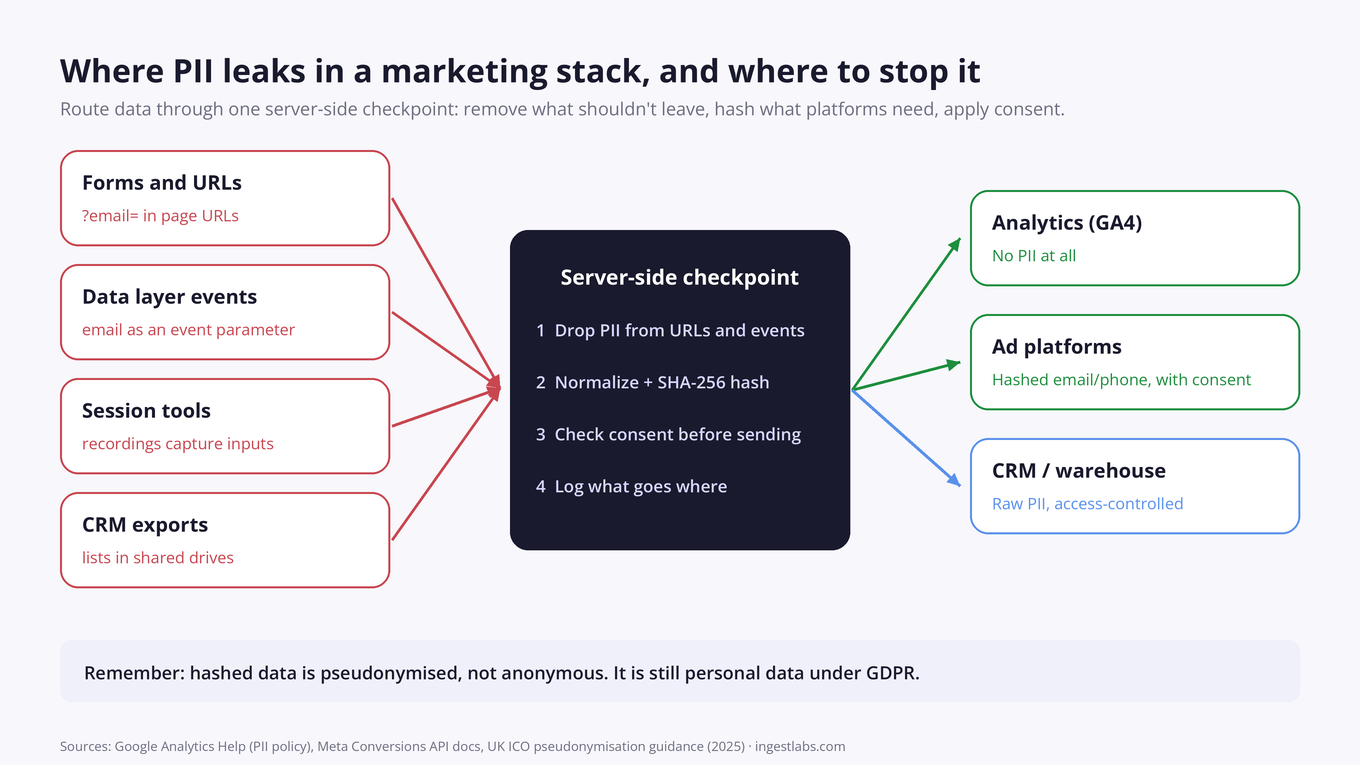
Where PII leaks in a marketing stack
Most marketing PII incidents are configuration mistakes, not hacks.
| Leak point | How it happens | Fix |
|---|---|---|
| Page URLs and titles | Forms that submit with GET put ?email= in the URL, which every tag on the next page then collects |
Submit forms with POST; strip PII parameters before tags fire; use GA4 data redaction for web streams |
| Analytics events | Developers send email or phone as an event parameter or user property | Review the data layer; send a non-PII internal ID instead |
| Ad pixels | Pixels capture form fields automatically, or advanced matching sends unhashed data | Hash user data before it leaves your systems; limit automatic form capture |
| Third-party scripts | Chat, heatmap and A/B testing tools record form inputs | Mask input fields in every session-recording tool |
| Spreadsheets and exports | CRM exports shared by email or left in shared drives | Restrict exports; set expiry on shared links; delete working files |
| AI tools | Staff paste customer lists into unapproved AI tools | Publish an approved-tools policy; block uploads of customer data |
Google's rule is explicit: its policies mandate that no data be passed to Google that Google could use or recognize as PII. Both the URL path and its parameters must be free of PII.
Best practices for handling PII
1. Map every PII field and where it goes
List each field you collect (email, phone, address, date of birth, IDs), the system that stores it, and every tool it reaches: analytics, ad platforms, CRM, email, data warehouse. You can't protect a flow you haven't documented. Under GDPR, high-risk processing also needs a data protection impact assessment (DPIA).
2. Collect less
Ask whether each field is needed for the stated purpose. Every field you skip is one you never have to secure, disclose or delete. DPDP and GDPR both require purpose limitation: use data only for the purpose you told people about.
3. Get consent before tags fire, and enforce it
Use a consent management platform, and make sure tags actually respect the choice. Under Google consent mode, when ad_storage is denied, no new advertising cookies are written and existing ones are not read. Test that this happens in practice, not just in the banner.
4. Hash correctly before sharing for ad matching
Meta's Conversions API is designed to reject unhashed contact information such as names, emails and phone numbers. Google's enhanced conversions work the same way. Normalize first, for example by trimming spaces and lowercasing emails, then apply SHA-256, and hash once only. Send hashed data from your server rather than exposing it in browser code.
5. Don't confuse hashing with anonymisation
The UK ICO is clear: pseudonymisation reduces risk, but it does not transform personal data to the extent that the law no longer applies. A hashed email can be matched back to a person by anyone who has the original list, which is exactly how ad platforms use it. Treat hashed data as personal data, with the same consent and retention rules.
| Technique | What it does | Still personal data? |
|---|---|---|
| Hashing (SHA-256) | Converts a value to a fixed string; the same input always gives the same output | Yes, it's pseudonymisation |
| Tokenisation | Replaces a value with a random token; the mapping is stored separately | Yes, for whoever holds the mapping |
| Encryption | Scrambles data; reversible with the key | Yes |
| Masking | Hides part of a value on screen, e.g. j***@example.com |
Yes, in the underlying record |
| Aggregation and true anonymisation | Removes the link to individuals so re-identification is not reasonably likely | No, if done effectively |
6. Restrict access and log it
Give access by role, require multi-factor authentication, and review access every quarter. Separate the systems that hold raw PII from the ones marketers use for reporting.
7. Set retention periods and delete on schedule
Define how long each data type is kept, then automate deletion. Old leads and abandoned-cart records are a common source of exposed data. For physical media and devices, follow a recognised sanitisation standard such as NIST SP 800-88. Simple overwriting is unreliable on SSDs and some cloud storage.
8. Vet every vendor that touches PII
Sign data processing agreements, check where data is stored and transferred, and confirm each vendor's own sub-processors. Every pixel on your site is effectively a vendor.
9. Have a breach plan with real deadlines
| Law | Who you notify | Deadline |
|---|---|---|
| GDPR (EU) / UK GDPR | Supervisory authority | Within 72 hours of becoming aware, unless the breach is unlikely to result in a risk to people |
| DPDP Act (India) | Data Protection Board and affected users | Users without delay; a detailed report to the Board within 72 hours |
| US state laws | Affected residents, sometimes the state attorney general | Varies by state |
10. Train the people who build tags
Most PII leaks in marketing come from tag setups, form builds and exports. Train marketers, developers and agencies on what counts as PII and how to check a release for leaks.
What's at stake
| Measure | Figure | Source |
|---|---|---|
| Global average cost of a data breach | $4.99 million, a record, up 12% | IBM Cost of a Data Breach Report, July 2026 |
| Maximum GDPR fine (most serious breaches) | €20 million or 4% of worldwide annual turnover, whichever is higher | GDPR Article 83 |
| Maximum DPDP penalty | Up to ₹250 crore, for failing to keep reasonable security safeguards | DPDP Act, 2023 |
| DPDP core obligations take effect | May 13, 2027, 18 months after the Rules were notified on November 13, 2025 | DPDP Rules, 2025 |
PII handling checklist for marketing teams
-
PII inventory and data-flow map up to date
-
No PII in URLs, page titles or analytics events
-
Consent captured and enforced by every tag
-
Customer data hashed once, server-side, before sharing with ad platforms
-
Session-recording tools mask all form inputs
-
Role-based access and MFA on CRM, CDP and warehouse
-
Retention periods defined and deletion automated
-
Data processing agreements with all vendors
-
Breach response plan tested against the 72-hour deadlines
-
DPDP readiness plan in place before May 13, 2027
How Ingest Labs fits
Routing tags through your own server gives you one place to control what leaves your systems. Ingest IQ collects events server-side, where PII can be removed or hashed, and consent applied, before data is forwarded to analytics and ad platforms. Ingest ID uses a first-party identifier, so reporting can join events without passing raw emails around. Event IQ helps you check which events and parameters reach each destination. For India, see our page on DPDP compliance for server-side tracking, and our guide to building a unified customer profile.
FAQ
How should PII be handled?
Collect only what you need, document where each field flows, and get consent before tags fire. Keep PII out of URLs and analytics, and hash customer data with SHA-256 on your server before sharing it with ad platforms. Limit access by role, delete data on a schedule, and keep a breach plan that meets 72-hour notification deadlines.
What are examples of PII?
Direct identifiers include full name, email address, phone number, home address, passport or national ID number and bank account details. Indirect identifiers, such as date of birth, postcode, IP address, cookie IDs and device IDs, can identify someone when combined. Under GDPR, online identifiers like cookie IDs count as personal data even without a name.
Is hashed data still PII?
Yes, in most cases. Hashing is pseudonymisation: the same email always produces the same hash, so anyone holding the original list can match it back. The UK ICO says pseudonymisation reduces risk but doesn't take data outside data protection law. Treat hashed emails and phone numbers as personal data, with consent, access and retention controls.
Can I send PII to Google Analytics?
No. Google's policies prohibit passing any data to Google Analytics that Google could use or recognize as PII, including email addresses, phone numbers and social security numbers. Check page URLs, page titles, event parameters and user properties. GA4 offers data redaction for web streams, but the safest fix is never sending PII in the first place.
How can businesses use PII for marketing and stay compliant?
Use PII only for purposes people agreed to, with consent recorded and enforced by your tags. Share customer data with ad platforms only as normalized, hashed values sent server-side. Sign data processing agreements with every vendor, honour deletion and opt-out requests, and prepare for India's DPDP Act, whose core obligations apply from May 13, 2027.
Sources
-
Google Analytics Help, "Best practices to avoid sending Personally Identifiable Information (PII)" (checked November 23, 2026)
-
Google, "Set up and manage consent" (checked November 23, 2026)
-
Meta for Developers, "Customer Information Parameters," Conversions API (updated January 9, 2026)
-
UK Information Commissioner's Office, "Pseudonymisation" guidance, March 2025
-
IBM and Ponemon Institute, Cost of a Data Breach Report 2026, July 29, 2026
-
Regulation (EU) 2016/679 (GDPR), Articles 4, 9, 33 and 83
-
Press Information Bureau, Government of India, "DPDP Rules, 2025 Notified," November 17, 2025; LexCounsel via Mondaq, "Notification of the Digital Personal Data Protection Rules, 2025," December 3, 2025
-
NIST Special Publication 800-88, Guidelines for Media Sanitization