




Are your clients questioning why their conversion numbers don't match reality? You're not alone. Ad blockers, browser restrictions, and privacy updates are erasing critical insights that clients depend on for business decisions. Browser restrictions, ad blockers affect over 40% of internet users.
An agency tracking server-side solves these data-accuracy problems by moving measurement from unreliable browsers to a secure infrastructure you control. This guide shows you exactly how server-side tracking works, how to implement it across major platforms like Google Analytics 4 and Meta, and how to position server-side tracking capabilities to grow your agency revenue.
At a glance
- Server-side tracking recovers more conversions: by bypassing ad blockers and browser restrictions that limit client-side data collection.
- Implementation involves five steps: audit existing tracking, set up server infrastructure with custom domains, deploy Meta and Google tags, validate data flow, and optimize continuously.
- Privacy compliance remains mandatory. Server-side tracking improves control over data handling but does not remove GDPR or CCPA obligations.
- Platform choice affects cost and scale. Managed tools like Ingest Labs reduce complexity for agencies, while DIY setups on GCP offer flexibility with higher operational effort.
What Is Server-Side Tracking?
Server-side tracking moves data collection from the user's browser to a dedicated server you control. Your website routes data through your own server infrastructure instead of relying solely on JavaScript tags that send data directly from the browser to third-party platforms.
How Server-Side Tracking Works
The data flow follows a specific sequence.
- A visitor takes an action like adding a product to the cart.
- The browser's dataLayer captures this event with relevant parameters like product ID, price, and user identifier.
- A client-side tag sends this information to your server container via HTTP request.
- The server validates the data format and enriches it with additional context.
- Finally, server-side tags forward the processed data to platforms like Google Analytics 4 or Meta's Conversions API.
Throughout this process, you maintain control. You decide which user identifiers to include and what personal information gets hashed for privacy. This governance layer is limited in traditional client-side implementations, where vendor pixels operate largely independently.
The technical foundation typically uses Google Tag Manager Server-Side or specialized platforms. These tools provide the server container, tag templates, and debugging interfaces you need.
Now let's explore why this architecture delivers concrete benefits for agency operations.
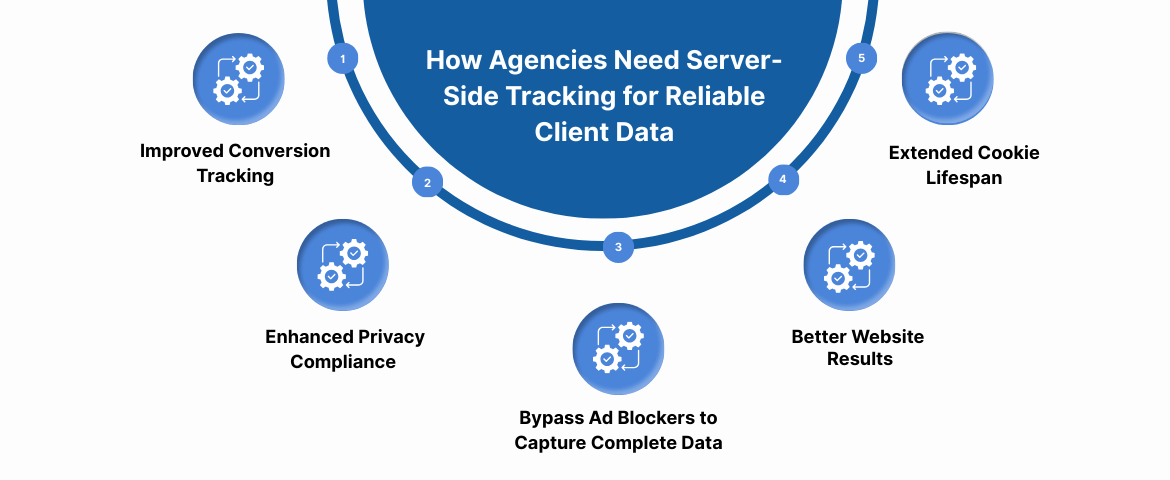
Why Agencies Need Server-Side Tracking for Reliable Client Data
Agency tracking server-side transforms how you deliver value to clients. The technology addresses fundamental problems: incomplete data, privacy compliance uncertainty, and performance trade-offs between tracking and user experience.
Here’s why you need it:
1. Improved Conversion Tracking Accuracy Across Client Accounts
Your reporting becomes more reliable when tracking moves server-side. The accuracy boost comes from bypassing browser-level interference. Ad blockers can't see or block requests between your server and advertising platforms.
Browser privacy settings don't limit server-to-server communication. iOS 14+ restrictions don't apply to Conversions API data.
2. Enhanced Privacy Compliance (GDPR, CCPA) for Client Websites
Privacy regulations make ROI tracking challenging. Server-side tracking simplifies GDPR and CCPA compliance by giving agencies full control over data handling.
You can filter or modify data before it reaches ad platforms, hash emails, truncate IPs, or remove sensitive fields based on consent. With data flow controlled at the server level, compliance is easier to document and enforce, reducing risk for both agencies and clients.
3. Bypass Ad Blockers to Capture Complete Data
Ad blockers specifically target common tracking domains and JavaScript patterns. Every blocked tracking request means lost conversion data and inaccurate campaign attribution.
The agency tracking server-side operates from your client's first-party domain. Ad blockers see these requests as essential site functionality rather than third-party advertising tracking.
4. Better Website Performance Equals Better Client Results
Page speed directly impacts conversion rates. Traditional client-side tracking loads multiple third-party scripts that compete for browser resources.
Server-side implementations reduce the JavaScript footprint on your client's pages. Instead of 8-12 separate tracking tags loading in the browser, you deploy one lightweight tag. This architectural change improves Core Web Vitals scores, which affect both user experience and SEO.
5. Extended Cookie Lifetime & First-Party Data Ownership
Browser restrictions have dramatically shortened cookie lifespans. For example, Safari’s Intelligent Tracking Prevention (ITP) limits client-side cookies to seven days maximum. This creates attribution problems when the customer journey spans multiple weeks in B2B and high-consideration purchases.
First-party cookies set from a tracking server can persist longer than standard client-side cookies, depending on browser policies and configuration. This extended lifetime maintains user identity across longer purchase cycles and improves attribution accuracy. Your clients get complete customer journey visibility instead of fragmented session data.
These benefits compound when implemented across your client portfolio. But the question becomes how to implement server-side tracking for the platforms your clients actually use.
Also Read: Guide to Effective Ads Tracking
Platform-Specific Server-Side Tracking for Agency Clients
Each advertising and analytics platform requires a specific configuration for server-side tracking. Major platforms now provide dedicated APIs and server-side endpoints designed for this architecture. Your implementation approach depends on which platforms deliver the most value.
1. Facebook Conversions API (Meta CAPI)
Meta CAPI is the most important server-side integration for agencies. It sends events directly from your server, bypassing pixel limitations. Events like PageView, AddToCart, and Purchase are matched using the fbp cookie and external_id parameters to prevent duplicates. The payoff is higher Event Match Quality, leading to better optimization and lower CPA.
2. Google Analytics 4 Server-Side Tracking
GA4 supports server-side tracking via the Measurement Protocol. Events are sent from your server, improving data reliability and cookie lifespan. Setup involves mapping dataLayer events to GA4 parameters. Since GA4 doesn’t auto-deduplicate client and server events, many agencies choose server-side only for cleaner data.
3. Google Ads Enhanced Conversions
Enhanced Conversions sends hashed first-party data (email, phone, address) with conversion events. Server-side implementation ensures consistent hashing and better control, improving attribution accuracy and automated bidding performance.
4. TikTok Events API & Snapchat CAPI
TikTok and Snapchat offer server-side APIs similar to Meta. TikTok Events API and Snapchat CAPI send conversion events from your server with improved reliability, with matching logic to deduplicate pixel data. These integrations improve reliability for campaigns targeting younger audiences.
5. E-commerce Tracking (Shopify, WooCommerce)
E-commerce clients need transaction-level tracking across all platforms. Server-side tracking ensures full purchase data even with ad blockers. Shopify typically uses middleware or apps, while WooCommerce relies on plugins or custom functions. These backend integrations guarantee you capture every transaction regardless of browser restrictions.
Your platform choices should match client goals and marketing mix. Ingest IQ provides pre-built server-side integrations and managed infrastructure for major advertising and analytics platforms. Your team focuses on strategy while the platform handles data collection and routing.
Also Read: Shopify GA4 Tracking Setup and Integration Guide
How to Implement Server-Side Tracking for Agency Clients
Successful implementation requires a structured approach. Skipping planning leads to technical debt and poor data quality. This five-step framework takes agencies from audit to optimization, with most implementations often completed in 2–4 weeks, depending on site complexity and platform mix.
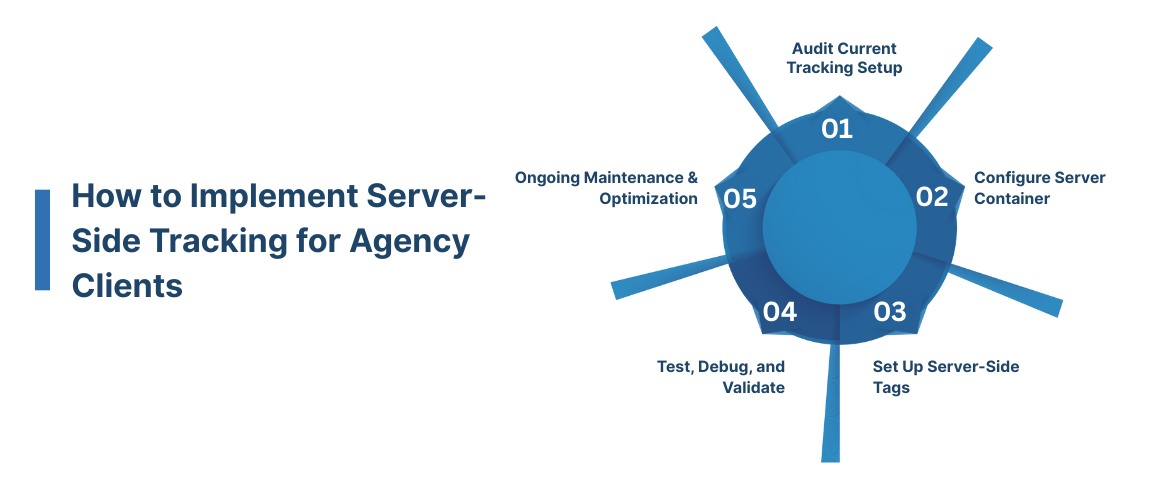
Step 1: Audit Current Tracking Setup
Document all existing tracking on the client’s site using developer tools and tag inspectors. List each pixel, event, and platform dependency in a single spreadsheet.
Focus on conversion tracking, note every conversion, destination platform, and captured parameters. Review the dataLayer and standardize event names and parameters, as a clean dataLayer simplifies server-side migration.
Step 2: Configure Server Container & Custom Domain
Set up a server-side GTM container or alternative platform and choose a hosting option based on cost and maintenance needs.
Create a custom tracking subdomain (e.g., track.clientdomain.com) with SSL to enable first-party data collection. Connect the client-side container to the server container via the transport_url and test to confirm events flow correctly.
Step 3: Set Up Server-Side Tags
Create server-side tags for audited platforms, starting with GA4 and Meta CAPI. Use native templates where possible to ensure correct formatting.
Apply transformation and governance rules at the server level, hash PII, enrich events, and filter unwanted traffic. Configure user ID and cookie matching between client and server to maintain accurate attribution.
Step 4: Test, Debug, and Validate
Use GTM preview mode to test events end-to-end and confirm they appear correctly in each platform with proper parameters and IDs.
Review server logs for errors like missing fields or auth failures. Compare client-side and server-side event counts. Minor differences are normal, but large gaps signal configuration issues.
Step 5: Ongoing Maintenance & Optimization
The agency tracking server-side needs regular upkeep. Monitor logs and alerts for errors, failed requests, or traffic drops.
Stay updated on platform API changes and optimize event routing and user matching based on performance data to maximize tracking accuracy and ROI.
The implementation process takes most agencies 2-4 weeks for a typical client website. Complex e-commerce sites might take longer. But once configured properly, server-side tracking requires less ongoing maintenance than juggling multiple client-side pixels. Now let's address the challenges you'll face during implementation.
5 Common Challenges with Agency Tracking Server-Side
Server-side tracking introduces predictable challenges. Addressing them early helps agencies set realistic timelines and avoid delivery issues.
- Managing Technical Complexity & Developer Resources: Server-side tracking often requires skills beyond standard marketing operations, including APIs and data governance. Most agencies scale effectively by training one senior developer or working with specialists instead of outsourcing every build.
- Privacy Compliance & Consent Management: Server-side does not remove consent requirements. Agencies must document data flows and apply consent-aware logic to filter events or strip identifiers when users opt out.
- Debugging Server-Side Tracking Limitations: Server-side behavior isn’t visible in browser tools, making troubleshooting harder. Reliable implementations depend on detailed server logs, error monitoring, and alerting for failed requests or data drops.
- Server Costs & Maintenance Across Multiple Clients: Server costs increase with event volume and client count. Many agencies reduce overhead by running shared infrastructure with strict data isolation and security controls.
- Client Expectation Gaps: Server-side tracking improves first-party data accuracy and extends cookie lifespan, but it does not replace third-party tracking. Clear client education prevents overpromising and trust issues.
With proper planning, these challenges are manageable. Treat server-side tracking as a long-term infrastructure investment, not a quick implementation. Now let's look at how successful agencies position and deliver these services.
Best Practices for Agency Tracking Server-Side Services
Delivering server-side tracking value requires more than technical setup. You need clear positioning, internal expertise, documentation standards, and pricing strategies. These elements transform server-side tracking from a technical project into a profitable service offering.
- How to Position Server-Side Tracking to Clients: Present server-side tracking as data accuracy protection, not a technical upgrade. Focus on outcomes, more reliable conversions, better attribution, and stronger campaign performance. Use simple before-and-after examples to show improvement.
- Building Internal Agency Expertise: Train 2–3 team members as server-side specialists. They handle complex setups and guide the rest of the team. Use internal checklists and templates to speed up delivery and reduce errors.
- Documenting Implementation for Client Handoffs: Create clear documentation for each client: setup details, data flow, rules, and platform connections. This helps with team handoffs, builds client trust, and protects long-term value.
- Pricing Server-Side Tracking Services: Charge based on impact, not hours. Use a one-time setup fee plus monthly management for monitoring and maintenance. Pricing typically reflects platform count, data volume, and ongoing infrastructure and monitoring costs.
Ingest IQ provides enterprise-grade server-side tracking infrastructure without managing Google Cloud Platform complexity. One platform handles all your client implementations with built-in monitoring and debugging tools.
With clear positioning, trained teams, strong documentation, and value-based pricing, server-side tracking becomes a repeatable, profitable agency service. For most agencies, managed solutions offer the best mix, especially when scaling across multiple clients.
Also Read: Setting up TikTok Events API for Conversion Tracking
Turn Server-Side Tracking into a Scalable Advantage with Ingest Labs
An agency tracking server-side addresses the fundamental data accuracy challenges that undermine agency performance. Browser restrictions, ad blockers, and privacy updates continue erasing critical conversion data. These problems won't reverse but will intensify as privacy regulations expand.
Your agency needs infrastructure that delivers reliable data regardless of these external pressures. Server-side tracking provides that foundation by moving data collection to an environment you control. The result is more accurate reporting, better campaign optimization, and confident client relationships.
Ingest Labs provides the complete server-side tracking solution your agency needs. Our platform handles the technical complexity while you focus on client strategy and growth:
- Ingest IQ manages server-side data collection across all major platforms with pre-built integrations for Meta CAPI, Google Analytics 4, and TikTok Events API.
- Ingest ID provides first-party identity resolution that improves attribution accuracy and extends customer journey visibility beyond browser limitations.
- Event IQ unifies data from multiple sources into actionable intelligence that drives campaign optimization and delivers measurable client results.
The infrastructure is designed to scale across agency client portfolios without requiring deep cloud infrastructure management.
Conclusion
Server-side tracking has moved from experimental technology to essential infrastructure for data-driven agencies. The benefits are measurable, including improved conversion-tracking accuracy and an extended cookie lifetime for better attribution. Page speed improvements directly increase client conversion rates.
The agencies that implement server-side tracking now build competitive advantages that compound over time. Better data enables better optimization, which delivers better results. This justifies higher fees and attracts better clients. This virtuous cycle starts with committing to implementation.
Start your agency tracking server-side journey with Ingest Labs.Contact us to see how our platform simplifies implementation and delivers reliable tracking. Transform data accuracy from a persistent problem into a competitive advantage.
FAQs
1. Do I need to be a developer to implement server-side tracking?
Technical knowledge helps significantly, but you don't need to be a developer. Many agencies successfully implement server-side tracking with one technical team member handling configuration. Account managers focus on client strategy, while managed platforms reduce technical requirements further.
2. Is server-side tracking GDPR compliant?
Server-side tracking is a tool that can support compliance, but doesn't guarantee it. You still need proper consent management and must document data processing activities. Server-side tracking gives better control over data handling, which makes implementing compliant practices easier.
3. Can server-side tracking replace third-party cookies?
No. Server-side tracking improves first-party data collection and extends first-party cookie lifetime. It doesn't restore third-party cross-site tracking capabilities. It helps you maximize value from first-party data as third-party cookies disappear.
4. What's the ROI of server-side tracking for clients?
Most agencies see 20-40% improvement in tracked conversions, which directly improves campaign optimization and ROI. Better data quality enables more effective audience targeting and automated bidding. The exact ROI varies by client industry and tracking setup.