



Have you ever wondered if your marketing campaigns are effectively and efficiently reaching the right audience?
Revenue in the U.S. fixed data market is projected to grow at 3.08% annually through 2029, highlighting opportunities. For digital marketers, e-commerce teams, and agencies, understanding marketing data is essential for driving measurable business results. Accurate, privacy-compliant data helps optimize campaigns, reduce wasted spend, and enhance customer journeys across multiple channels. Learning how to collect, analyze, and utilize marketing data ensures better targeting, higher conversions, and long-term customer loyalty.
Quick Overview
- Marketing data includes insights from customer interactions, such as clicks, purchases, and engagement, helping businesses understand behaviors.
- It enables precise targeting, increases ROI, offers personalized experiences, and supports data-driven decision-making for better campaign performance.
- Key types include demographic, behavioral, psychographic, transactional, and engagement data, each offering unique insights into customer preferences and actions.
- It improves customer understanding, boosts conversions, increases ROI, and helps predict future trends to optimize marketing strategies.
What is Marketing Data?
Marketing data is all the information collected from how people interact with your website, ads, and campaigns. It shows what your audience clicks, watches, buys, or ignores, helping you understand their behavior clearly. When you look at this data carefully, you can see patterns and figure out what works best. Using these insights, you can make smarter decisions that improve campaigns, save money, and boost results.
But what makes marketing data so essential? Let’s unpack its importance next.
Why Is Marketing Data Important?
Marketing data is important because it helps you make decisions based on facts rather than guesswork. Here are the key ways it can impact your marketing efforts:
- Better Targeting: You can reach the right audience with the right message at the right time.
- Segment audiences based on demographics, behavior, or engagement patterns.
- Identify high-value customers who are more likely to convert.
- Improved ROI: Data shows which campaigns work, helping you spend money more efficiently.
- Track ad performance across channels to allocate budgets wisely.
- Monitor conversion rates to see which campaigns generate real revenue.
- Personalized Experiences: Understanding customer behavior allows you to tailor messages and offers to individual needs.
- Recommend products based on browsing or purchase history.
- Send targeted emails or notifications aligned with customer interests.
- Informed Strategy: Patterns and trends in data guide smarter planning and long-term marketing decisions.
- Analyze seasonal or campaign trends to plan future strategies.
- Use insights to test new ideas or approaches before large-scale rollout.
- Reduced Wasted Effort: Marketing data helps identify what doesn’t work, so you can focus on high-impact actions.
- Pause underperforming campaigns quickly to save resources.
- Refine messaging based on feedback and engagement metrics.
But how exactly can different types of marketing data shape your approach? Let’s break down the key categories to better understand what each type can reveal.
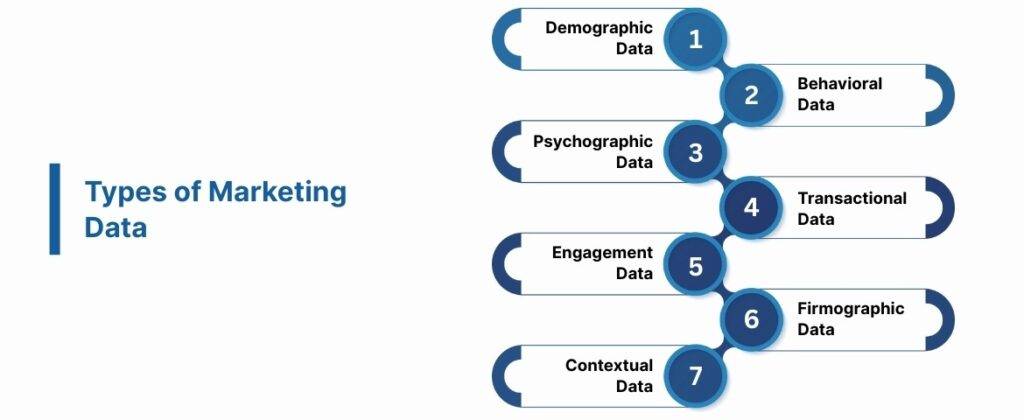
Types of Marketing Data
Marketing data comes in different forms, each offering unique insights into customer behavior and campaign performance. Here are the key types you should know and use effectively.
1. Demographic Data
Demographic data explains who your customers are, covering age, gender, income, location, and education. It helps you segment audiences and target the right groups with relevant campaigns. For example, an e-commerce brand can use income brackets to design tiered product offerings. When used well, demographic insights make your messaging more relatable and precise.
2. Behavioral Data
Behavioral data focuses on the actions people take, such as clicks, searches, purchases, or abandoned carts. It gives you a clear view of customer intent beyond surface-level details. For instance, repeat visits to a pricing page without purchase can signal the need for a discount offer. With these insights, you can guide customers toward conversion and build long-term loyalty.
3. Psychographic Data
Psychographic data looks at customer interests, lifestyles, values, and motivations. This information goes beyond “who” your customer is and reveals “why” they make decisions. For example, a fitness brand can target audiences motivated by wellness rather than just physical appearance. Using psychographics lets you craft messages that emotionally connect and inspire action.
4. Transactional Data
Transactional data records past purchases, order frequency, and spending patterns. It helps you understand what products are popular, how often customers buy, and how much they spend. For example, a subscription business can track renewal patterns to predict churn. With this knowledge, you can refine pricing models and encourage repeat purchases.
5. Engagement Data
Engagement data measures how customers interact with your marketing channels, from email open rates to social media comments. It highlights what content resonates and what fails to spark interest. For instance, tracking video completion rates can show whether your message holds attention. Strong engagement data guides you in producing campaigns that feel relevant and timely.
6. Firmographic Data
Firmographic data applies to B2B marketing, describing businesses by size, industry, revenue, and location. It’s essential for agencies and SaaS companies targeting specific sectors. For example, knowing a company’s headcount can help you pitch solutions scaled to their needs. Firmographics ensure you focus resources on high-value accounts rather than chasing mismatched leads.
7.Contextual Data
Contextual data captures real-time conditions around customer behavior, such as device type, time of day, or location. It shows the “when” and “where” of interactions. For example, a coffee chain can promote breakfast deals to mobile users near their store in the morning. This data makes your campaigns timely, relevant, and more likely to convert.
Now that we have a grasp on what data can do, let’s see where it all comes from and how it’s collected.
Also Read: Exploring Future Trends in Data Collection and AI Automation
Where Is Marketing Data Collected From?
Marketing data doesn’t come from a single source — it’s built from different touchpoints that shape customer interactions. Here are the main sources that businesses rely on to capture valuable insights.
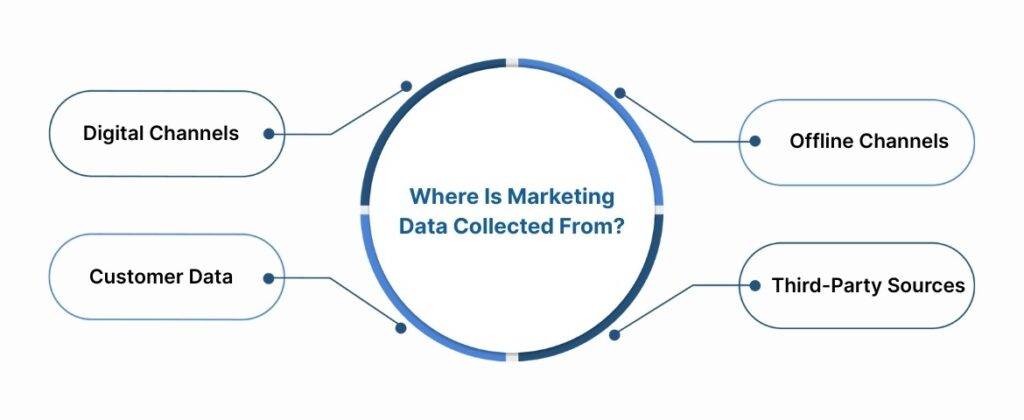
1. Digital Channels
Digital channels provide the largest share of marketing data, capturing how customers engage online. Here’s where that data comes from:
- Website Analytics
- Tracks user behavior such as page visits, bounce rates, and time on site.
- Shows conversion paths, abandoned carts, and repeat visits for better funnel optimization.
- Helps identify top-performing pages and areas that need improvement.
- Social Media Insights
- Measures likes, comments, shares, and follower growth across platforms.
- Provides audience sentiment and engagement trends in real time.
- Helps tailor content strategies for each platform.
- Email Campaigns
- Tracks open rates, click-through rates, and unsubscribes.
- Measures how subject lines and content influence engagement.
- Provides insights into customer retention and re-engagement strategies.
With Ingest Labs’ server-side tagging, businesses ensure that data from digital channels is privacy-compliant while maintaining speed and accuracy.
2. Offline Channels
Offline sources may seem old-fashioned, but they still deliver critical insights into customer behavior. Here’s how businesses capture them:
- Point-of-Sale (POS) Systems
- Collects transaction data directly from retail purchases.
- Tracks average order value and product preferences.
- Links in-store sales with online behaviors for a unified view.
- Events and Trade Shows
- Gathers attendee information, session participation, and post-event surveys.
- Tracks interest in specific product demos or discussions.
- Offers lead generation opportunities tied to offline engagement.
- Customer Surveys
- Provides direct feedback about product satisfaction and brand perception.
- Captures customer expectations and preferences in detail.
- Helps validate assumptions that digital data alone may not reveal.
Ingest Labs enables businesses to merge offline data with digital channels, building a single, consistent data source across environments.
3. Customer Data
Customer-owned systems are a goldmine of long-term, reliable insights. Here are the key tools that collect this data:
- CRM Systems
- Store customer profiles, purchase history, and communication records.
- Help track deal stages and customer lifecycle journeys.
- Provide data for segmentation and personalized outreach.
- Loyalty Programs
- Capture repeat purchase patterns and reward redemptions.
- Track frequency of engagement and preferred products.
- Help design targeted offers to encourage retention.
Ingest ID, part of Ingest Labs, unifies CRM and loyalty data across devices and platforms while protecting customer privacy.
4. Third-Party Sources
Third-party data expands the picture by adding market-level insights, though it requires careful use. These are the most common:
- Public Data Sets
- Offer demographic, economic, or regional statistics from government sources.
- Useful for benchmarking campaigns and understanding broader trends.
- Can supplement first-party insights with reliable, large-scale context.
- Market Research Reports
- Provide detailed industry insights, competitive benchmarks, and trend analysis.
- Help identify new opportunities and customer demands.
- Offer insights that internal data alone cannot provide.
Always ensure compliance with GDPR, CCPA, and other privacy laws when using external data sources.
Ingest IQ ensures businesses collect, store, and orchestrate third-party data securely while maintaining global compliance standards.
Next, we’ll look into the tangible benefits marketing data can bring to your business, offering a clearer view of why investing in it pays off.
Also Read: Understanding the Role of Ingest Labs in GDPR Compliance
Benefits of Marketing Data
Marketing data is more than numbers on a dashboard; it’s the foundation of smarter strategies and stronger outcomes. Here are the key benefits it brings to your business.
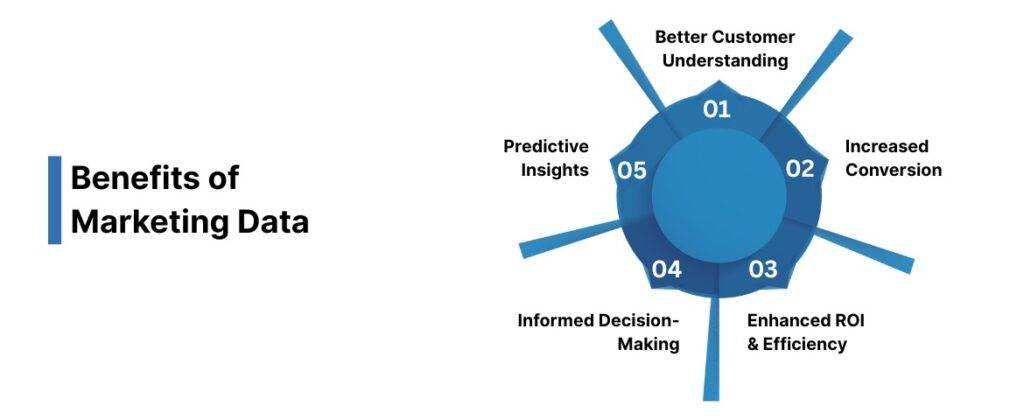
1. Better Customer Understanding
Marketing data helps you truly see how customers behave across different touchpoints. With it, you can identify what motivates them, what frustrates them, and what keeps them engaged. When businesses understand these patterns, they can create experiences that feel personalized and relevant at every stage.
2. Increased Conversion and Retention
Data shows you the exact points where customers drop off or complete a purchase. This clarity allows you to fine-tune landing pages, streamline checkout processes, and build campaigns that encourage repeat visits. Over time, these improvements not only drive more conversions but also build loyalty that reduces churn.
3. Enhanced ROI and Efficiency
By analyzing performance data, you can spot which channels deliver the best returns and which drain resources. This helps businesses reallocate budgets more effectively, reducing wasted spend and improving efficiency. As a result, every dollar invested works harder, producing measurable growth without unnecessary overhead.
4. Informed Decision-Making
Gut instincts can only go so far, but data provides proof to guide decisions. With access to accurate insights, teams can prioritize strategies that have clear evidence of success. This reduces risk, builds confidence in campaigns, and creates alignment across departments.
5. Predictive Insights for Future Campaigns
Marketing data doesn’t just explain what happened, it shows what’s likely to happen next. Predictive analytics uses past trends to anticipate customer needs, seasonal shifts, or campaign outcomes. This foresight allows businesses to plan proactively, creating campaigns that hit the mark before competitors react.
Integrate Ingest Labs to centralize privacy-first, server-side tracking and stream clean, real-time events to your CDP for accurate measurement.
Once you see its potential, how can you best apply it to build a smarter, more effective strategy? Let’s walk through how to turn these insights into actionable plans.
Also Read: Tips to Optimize Your Marketing ROI
Using Marketing Data to Build a Winning Strategy
Marketing data only becomes powerful when you actively use it to guide campaigns and optimize outcomes. Leveraging the right data enables precise targeting, better customer experiences, and measurable growth. Each step below explains how to turn insights into actionable marketing strategies.
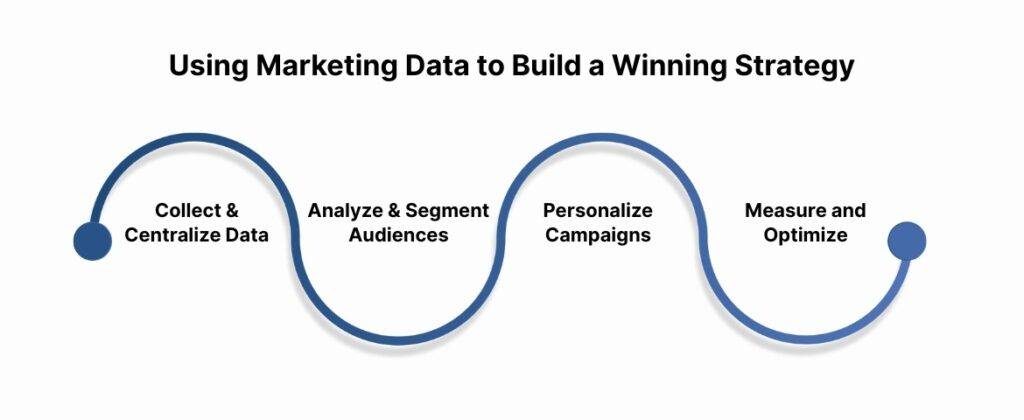
1. Collect and Centralize Data
Before you can make sense of your marketing efforts, you need to gather data from all touchpoints into one central location. Centralization reduces errors, avoids data silos, and provides a complete picture of your audience’s journey. This foundation ensures that every subsequent decision is based on accurate and comprehensive information.
To effectively centralize your data, focus on the following:
- Integrate all channels into one system
- Pull customer data from websites, apps, email campaigns, and offline sources.
- Ensure data is stored in consistent formats to avoid mismatched records.
- Use customer platforms for cross-channel visibility
- Combine CRM, e-commerce, and ad data into unified profiles.
- Eliminate silos between teams by making data available company-wide.
Ingest ID centralizes customer data for unified profiles from multiple sources, enabling real-time segmentation and personalization.
2. Analyze and Segment Audiences
Once your data is centralized, the next step is to examine it for patterns and identify high-value audience segments. Segmentation helps you understand customer preferences, behavior, and lifecycle stages. With clear segments, campaigns can be tailored to maximize engagement and conversion.
To make segmentation actionable:
- Identify patterns in behavior
- Spot high-engagement actions like repeat purchases or newsletter subscriptions.
- Map customer paths from awareness to conversion.
- Create actionable audience segments
- Group customers by location, purchase frequency, or browsing interests.
- Build high-value customer clusters for premium targeting.
Event IQ unifies data from multiple sources, enabling personalized experiences at scale and supporting cross-device tracking.
3. Personalize Campaigns
Data-driven personalization is key to making marketing messages feel relevant and timely. When you tailor communications to each audience segment, engagement increases and customer loyalty strengthens. Personalization also helps reduce wasted spend by delivering content only to those who are most likely to act.
To implement effective personalization:
- Tailor messages to behaviors
- Use browsing history to suggest relevant products.
- Deliver dynamic emails with personalized offers.
- Build contextual experiences
- Adjust website content in real time based on visitor profile.
- Target ads based on customer lifecycle stage.
Ingest ID provides a first-party identifier, enabling accurate attribution and personalized experiences that maximize return on ad spend (ROAS).
4. Measure and Optimize
Finally, tracking performance and optimizing campaigns is critical for sustained growth. Monitoring KPIs and analyzing outcomes allows you to refine strategies, reallocate resources, and continuously improve ROI. Optimization ensures marketing remains efficient, relevant, and impactful.
To optimize effectively:
- Monitor KPIs across campaigns
- Track metrics like cost per acquisition (CPA), return on ad spend (ROAS), and retention rates.
- Identify underperforming ads or landing pages.
- Adjust strategies in real time
- Reallocate budgets to the best-performing channels.
- Test variations of creatives and calls-to-action.
Ingest IQ provides actionable insights from customer journey analysis and real-time tag monitoring, helping measure campaign effectiveness with precision.
Final Thoughts
Marketing data is essential for businesses to understand their customers, improve campaigns, and achieve better results. Collecting and analyzing data helps increase conversions, maximize ROI, and guide more effective decisions. A clear data strategy ensures marketing efforts are targeted, relevant, and impactful, supporting long-term business growth.
Ingest Labs offers practical tools to make marketing data work for you. Ingest IQ tracks customer interactions accurately across web and mobile, while Ingest ID unifies customer profiles for personalized engagement. Event IQ helps measure campaign performance and optimize messaging across channels, all while maintaining privacy compliance. Together, these solutions simplify data management and help businesses deliver better results.
Book a demo with Ingest Labs today and see how data can power smarter marketing decisions
Frequently Asked Questions (FAQs)
1. What is the definition of marketing data?
Marketing data refers to the collection of information about customer behaviors, preferences, demographics, and market trends. This data helps businesses understand their target audience, optimize campaigns, and improve decision-making to boost overall marketing effectiveness.
2. What is data marketing?
Data marketing is the use of data analysis to drive marketing strategies and decisions. It involves collecting, analyzing, and applying data insights to create personalized and targeted marketing efforts that resonate with specific customer segments.
3. What is an example of market data?
An example of market data includes customer purchasing patterns, website traffic analytics, social media engagement metrics, or sales figures over a particular time. This information helps businesses understand customer behavior and market trends.
4. What does marketing data show?
Marketing data provides insights into customer preferences, campaign performance, and overall market trends. It shows how effectively marketing efforts are reaching and engaging target audiences, as well as identifying areas for improvement.
5. Why is marketing data important?
Marketing data is essential because it enables businesses to make informed decisions, improve strategies, and measure the success of campaigns. It helps companies understand their customers better, leading to more effective marketing, higher ROI, and sustained growth.
6. What are five examples of data?
Five examples of data include customer demographic information, website traffic analytics, email campaign open rates, social media engagement metrics, and product sales data. These types of data help businesses track performance and understand consumer behavior.