



Nearly half of today’s marketers are feeling the pressure to fix their funnel performance. According to recent data, 48% of marketers say improving their sales funnel is a top priority in 2025, which shows how critical it has become to understand where prospects drop off and why. Teams that take funnel optimization seriously now are the ones unlocking stronger conversions and better ROI.
For many digital marketers and e-commerce businesses, the real struggle isn’t generating traffic. It’s identifying what happens between the first touch and the final conversion. Without clear visibility into the funnel, budgets get wasted, engagement drops, and revenue opportunities disappear.
Let’s start by highlighting the key insights and takeaways you’ll gain from this guide.
Quick Overview
- Understand what a conversion funnel is, its stages, and how users move from discovery to conversion.
- Learn why conversion funnel analysis is critical for improving ROI, reducing acquisition costs, and enabling data-driven marketing decisions.
- Explore a step-by-step process to conduct conversion funnel analysis like a pro, including mapping user journeys, tracking first-party data, and identifying drop-offs.
- Discover best practices for funnel optimization to turn insights into measurable results across marketing, e-commerce, and agency operations.
- See real-world examples and how Ingest Labs tools provide privacy-compliant tracking, unified customer data, and actionable insights for smarter marketing.
What Is a Conversion Funnel?
A conversion funnel is the structured path your audience takes from discovering your brand to completing a desired action. It helps marketers and e-commerce teams understand how users move across different intent stages and where drop-offs happen. Conversion funnel analysis supports this process by examining user behavior at every step to identify friction, improve engagement, and increase conversions.
Common Stages of a Conversion Funnel
- Awareness: This is where users first discover your brand through channels like search, paid campaigns, or social media. They are not ready to buy yet, but they start recognizing your value.
- Consideration: At this stage, users explore your website, compare solutions, read content, and evaluate how you solve their problem. They show deeper interest and engage more actively.
- Decision: Users assess the final details that influence their choice. They review pricing, features, and social proof to decide if your product or service fits their needs.
- Conversion: This is the point where users take action such as making a purchase, signing up for a trial, or requesting a demo. It is the ultimate goal of the funnel and reflects how well your acquisition and engagement efforts are working.
These stages help businesses visualize user intent, spot friction points, and optimize experiences across the entire journey.
Why Conversion Funnel Analysis Matters
Conversion funnel analysis gives you a clear, data-backed view of how users move through each stage of the buying journey. It helps you pinpoint revenue leaks and identify the actions that improve performance. With privacy rules tightening, it has become a strategic necessity for marketing and e-commerce teams.
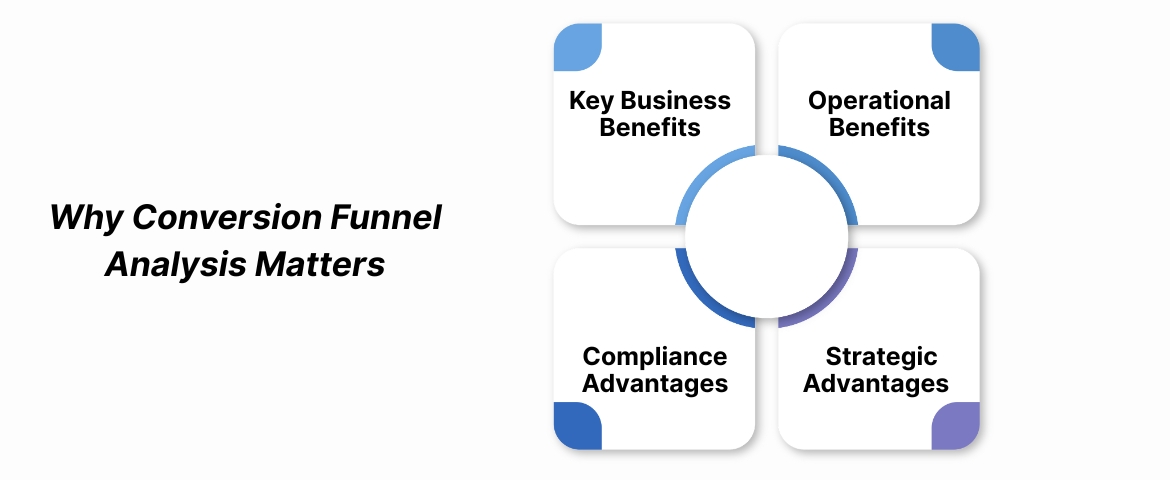
1. Key Business Benefits
- Improved ROI Across Channels: Funnel insights reveal which touchpoints drive conversions, helping you shift spend toward high-performing channels and eliminate wasted budget.
- Lower Customer Acquisition Costs: By exposing friction early, teams refine messaging, reduce bounce rates, and improve paths that lower CAC without increasing ad spend.
- More Accurate Revenue Attribution: Clear visibility into impactful interactions strengthens forecasting and prevents reliance on misleading last-click attribution.
2. Operational Benefits
- Smarter Decision-Making: Funnel analysis uncovers performance patterns across the full journey, allowing teams to act on real behavior instead of assumptions.
- Faster Detection of Performance Issues: Sudden drops become easier to diagnose, reducing troubleshooting time across landing pages, ads, and checkout flows.
- Better Alignment Across Teams: Shared funnel insights allow marketing, product, and analytics teams to collaborate using a single, unified data model.
3. Privacy and Compliance Advantages
- Built for a Cookieless Future: Funnel analysis powered by first-party data ensures accurate, stable tracking as third-party cookies disappear across major browsers.
- Supports Regulatory Compliance: Clear data flows help businesses stay compliant with CPRA, PIPEDA, and other US and Canadian privacy requirements.
4. Strategic Advantages for Marketing Leaders
- Clearer Growth Opportunities: Leaders see which funnel stages drive the biggest impact and can prioritize initiatives based on measurable business value.
- Better Budget Rationalization: When each stage is measurable, CMOs justify spending confidently and connect marketing activity to commercial outcomes.
- Stronger Customer Insights: Intent signals from the funnel help deliver contextual experiences and personalization without compromising privacy.
When executed consistently, funnel analysis becomes a core driver of smarter decisions, stronger attribution, and sustainable revenue growth.
Also read: Understanding the Importance and Benefits of Using First-Party Data in Marketing - Ingest Labs
How to Conduct Conversion Funnel Analysis
High-performing teams do not treat conversion funnel analysis as a linear checklist. This approach depends on accurate first-party data, durable identity, and server-side event capture, areas where traditional client-side analytics often fall short.
They treat it as an ongoing measurement framework that blends user intent, behavioral signals, attribution modeling, and privacy-first data to create a reliable foundation for growth.
Here is how to conduct funnel analysis at an expert level that supports long-term optimization and decision-making.
1. Define Funnel Stages With Precision, Not Assumptions
Your funnel should reflect your actual revenue engine, not a generic model used by others. Clearly mapping stages based on user intent and key touchpoints ensures you measure what truly drives conversions.
Map stages based on:
- The depth of intent your users display
- The touchpoints that influence decisions
- The micro-behaviors that predict conversion
For example, “Product Page → Add to Cart → Checkout → Purchase” is too broad for modern e-commerce. A winning funnel breaks this into micro-events like variant selection, offer view, checkout step interaction, payment method intent, and more.
Pro Tip: Use historical behavioral data to refine these stages instead of defining them from internal assumptions.
2. Build a First-Party, Server-Side Data Foundation
Accurate funnel analysis depends on clean, reliable, first-party data collected server-side across all user touchpoints. This ensures your insights are not affected by browser restrictions or fragmented tracking.
- Browsers block client-side cookies
- Attribution breaks across devices
- Ad platforms restrict user-level visibility
Ensure you track:
- Authenticated and unauthenticated users
- Event timestamps
- Cross-device identity
- Campaign metadata
- Consent preferences
Pro Tip: Data loss of even 10 percent can distort funnel drop-off percentages by 30 to 40 percent. Perform regular audits to validate data completeness.
Also Read: Understanding How server side Tracking Works
3. Map Real User Journeys, Not Idealized Paths
Users rarely move in a straight line from discovery to conversion. Mapping real journeys allows you to uncover actual behavior, deviations, and friction that impact results.
A professional funnel analysis includes:
- Multi-path journey mapping
- Segment-level flows for new vs returning users
- Friction clusters across different traffic sources
- Behavioral sequences leading to conversion or abandonment
Pro Tip: Build journey cohorts (ex: “Mobile visitors from paid social who reached checkout”) to isolate high-revenue friction patterns.
4. Identify Drop-Off Points With Quantitative and Qualitative Evidence
Drop-offs highlight where users abandon the funnel, but understanding why requires combining multiple data sources. Accurate identification lets you fix leaks that cost real revenue.
Professional teams combine: event analytics and other behavioral analytics tools (e.g., session replays or heatmaps).
This reveals intent blockers such as form hesitation, price anxiety, low perceived value, poor load speed, or misaligned landing page messaging.
Pro Tip: When analyzing drop-offs, compare absolute numbers and percentage falloffs. Both matter when diagnosing high-value leaks.
5. Analyze Channel Contribution With Conversion Depth, Not Clicks
Not all traffic sources are equal. Evaluating channels based on the depth of user engagement rather than just clicks reveals which campaigns truly drive conversions.
- Depth of engagement (how far users progress)
- Quality of micro-actions
- Repeat visit rate
- Conversion velocity
- Incremental contribution across stages
Pro Tip: Channels with strong “top-funnel activity” but weak “mid-funnel progression” usually reflect messaging mismatch or intent misalignment.
6. Evaluate Behavioral Signals That Predict Conversion Probability
Some user actions indicate higher likelihood to convert than others. Identifying these leading indicators allows you to intervene and optimize paths before drop-offs occur.
Track signals like:
- Interaction with high-intent pages
- Scroll depth thresholds
- CTA interaction patterns
- Repeat session frequency
- Cart modification actions
- Hesitation moments
Pro Tip: Create a behavioral scoring model using rule-based logic or your analytics tools, with clean first-party event data as the foundation.
7. Run Experiments Based on Evidence, Not Guesswork
Testing changes without data is costly. Funnel-driven experiments prioritize fixes with the highest impact, reducing risk and accelerating optimization.
Use your funnel insights to define:
- Where friction occurs
- Which behaviors predict success
- What messaging gaps cause confusion
- What layout or UI elements fail under real conditions
Pro Tip: Prioritize tests based on the “Impact × Urgency × Effort” model, focusing first on high-drop-off, low-effort changes.
8. Monitor, Measure, and Iterate With a Continuous Optimization Loop
A funnel is never “done.” Continuous monitoring ensures it adapts to changing user behavior, channel performance, and privacy requirements.
Review regularly:
- Shifting behavioral trends
- New drop-off clusters
- Seasonal intent changes
- Channel quality fluctuations
- Technical tracking issues
- Privacy updates that impact data flow
Pro Tip: Set quarterly funnel audits to revalidate your stages, data accuracy, and attribution paths. Most funnel failures happen because teams optimize outdated models.
Key Metrics Used in Conversion Funnel Analysis
Tracking specific metrics at every funnel stage is essential for uncovering friction points, understanding user behavior, and making informed decisions that improve conversions:
- Stage-to-stage conversion rate: Measures the percentage of users moving from one stage to the next. This reveals which stages need immediate improvement.
- Drop-off rate per stage: Shows where users abandon the funnel. Pinpointing these points helps address friction and recover lost conversions.
- Time to conversion: Tracks the duration for users to complete desired actions. Shorter times indicate a smoother, more efficient funnel.
- Funnel velocity: Measures how quickly users progress through each stage. Faster progression reflects better engagement and effective touchpoints.
- Assisted conversions: Captures interactions that indirectly contribute to final conversions. This helps identify high-impact channels beyond last-click attribution.
- Micro-conversion completion rate: Tracks intermediate actions like add-to-cart or form submissions. Monitoring these helps optimize paths before major drop-offs occur.
By monitoring these metrics, teams gain clear insights to refine strategies and improve overall funnel performance.
Best Practices for Funnel Optimization
Once you have conducted a detailed conversion funnel analysis, the next step is to apply strategic best practices that turn insights into measurable results. Optimizing the funnel ensures each stage drives higher engagement, reduces friction, and improves ROI.
- Identify KPIs for each funnel stage: Define key performance indicators that directly measure user engagement and progression through each stage, ensuring focus on metrics that impact revenue.
- Set clear and measurable goals: Establish precise targets for every funnel stage to align teams and quantify success, enabling proactive optimization rather than reactive adjustments.
- Use real-time data to refine marketing strategies: Continuously analyze user behavior and campaign performance to make informed, timely decisions that improve conversion rates.
- Review analytics tools for ongoing performance monitoring: Regularly audit dashboards and reports to detect bottlenecks, friction points, or anomalies before they affect results.
- Re-analyze and iterate based on updated data: Treat optimization as a continuous process by revisiting funnel performance, validating strategies, and implementing improvements consistently.
Applying these best practices ensures your conversion funnel remains efficient, measurable, and capable of driving higher revenue at every stage.
3 Examples of Conversion Funnel Analysis
Understanding the theory behind conversion funnel analysis is valuable, but seeing it applied in real-world scenarios makes the insights actionable. Here are three detailed examples across different industries, showing how funnel analysis identifies friction, improves conversions, and drives revenue growth.
E-Commerce Funnel Example
An online retailer selling clothing tracks the funnel from landing page visits → product page views → add to cart → checkout → purchase.
Funnel analysis reveals a 45% drop-off at the checkout stage, with users abandoning due to long forms and limited payment options.
By simplifying the checkout process, reducing form fields, and adding faster payment options such as PayPal and digital wallets, the retailer improves the completion rate. After optimization:
- Purchase completions increase by 20%
- Overall funnel conversion improves
- ROI on ad spend rises due to fewer wasted clicks
This example highlights the importance of first-party data for accurately tracking each stage, especially when browsers limit third-party cookies.
SaaS Funnel Example
A SaaS company offering project management software maps the funnel from free trial sign-ups → onboarding → feature usage → paid subscription.
Analysis shows 60% of users drop off during onboarding, even though trial sign-ups are strong. The friction stems from unclear instructions and lack of guidance in key workflows.
By implementing interactive tutorials, tooltips, and targeted onboarding emails:
- Onboarding completion rises by 25%
- More trial users convert to paid subscriptions
- Churn during early engagement decreases
This demonstrates how funnel analysis allows data-driven optimization of user experience, improving lifetime value and ROI for SaaS businesses.
B2B Marketing Funnel Example
A B2B digital marketing agency tracks the funnel from webinar sign-ups → webinar attendance → consultation requests → contracts.
Funnel insights show 35% of attendees leave without requesting a consultation, indicating a lack of personalized follow-up or resources to push leads forward.
The agency implements a follow-up campaign with:
- Targeted emails containing case studies
- Personalized consultation invitations
- Retargeting campaigns for webinar attendees
Resulting outcomes:
- Consultation requests increase by 18%
- Higher-quality leads enter the sales pipeline
- Marketing ROI improves with better attribution
This example illustrates how conversion funnel analysis enables agencies to optimize lead nurturing, align messaging across channels, and improve campaign performance.
These examples demonstrate that conversion funnel analysis is not theoretical, it provides actionable insights that can dramatically improve conversions, optimize marketing spend, and boost ROI across industries.
How Ingest Labs Helps Improve Funnel Visibility
Achieving clear visibility into your conversion funnel requires durable identity, server-side measurement, and unified event data. Ingest Labs provides a suite of privacy-first tools designed to capture accurate user behavior and optimize conversion measurement across platforms.
- Ingest ID: Assigns a first-party identifier to each unique visitor, consolidating interactions across devices and channels. This enables precise tracking of user journeys, accurate attribution, and compliance with privacy regulations in the US and Canada.
- Ingest IQ: Captures events server-side, bypassing limitations like ad blockers and cookie restrictions. This ensures reliable tracking across web and mobile applications and supports accurate measurement of micro-conversions and overall funnel progression.
- Event IQ: Unifies event data from multiple sources in near real time, supporting analytics workflows that provide insights into user behavior and performance. Teams can quickly identify high-intent users and support privacy-compliant measurement and analytics that teams can use to inform optimizations.
Together, these tools provide complete funnel visibility, accurate first-party data, and real-time insights, enabling data-driven decisions that improve conversion measurement and performance.
Conclusion
Conversion funnel analysis is no longer optional, it is a critical capability for marketers, e-commerce teams, and agencies seeking to maximize conversions, reduce wasted spend, and make data-driven decisions. By understanding user behavior at each stage, identifying drop-offs, and continuously optimizing your funnel, businesses can unlock measurable growth and stronger ROI.
Ingest Labs strengthens this process by giving teams a clearer, more accurate view of the customer journey. Instead of relying on fragmented or cookie-dependent tracking, marketers get stable first-party data and reliable funnel insights they can trust for decision-making.
Take control of your funnel performance today. Book a demo with Ingest Labs and see how precise conversion funnel analysis can transform your marketing outcomes.
FAQs
1. How often should I review my conversion funnel?
Regular reviews help you catch issues before they grow. For most teams, a monthly review of key funnel metrics is ideal, with weekly checks on high‑traffic funnels and quarterly deep dives for strategic analysis.
2. What common issues can cause low funnel conversion rates?
Low funnel conversions often stem from poor user experience such as slow page load times, unclear calls to action, mismatched messaging, and complicated checkout flows.
3. Can funnel analysis be applied outside e-commerce?
Yes. Any business with a defined goal, such as form submissions, demo sign‑ups, or trial activations, can use funnel analysis to improve engagement and conversions. It’s useful across B2B, SaaS, and digital services.
4. What is the difference between micro‑conversion and macro‑conversion analysis?
Macro conversions are the final, goal actions like a purchase or signup, while micro conversions are intermediate steps like product views or add‑to‑cart events. Tracking both helps you identify friction earlier in the funnel.
5. How do segmentation and funnel analysis work together?
Segmenting by device, source, or customer intent reveals deeper insights into which audiences perform well at each stage, helping you tailor optimizations and improve overall funnel efficiency.
6. What are the most important metrics to track within a conversion funnel?
Key metrics include stage‑by‑stage conversion rate, drop‑off rate, time to conversion, and overall funnel conversion rate. These metrics pinpoint where users lose interest and where optimization brings the most impact.