




Do visitors trust how you handle their data, or do they leave with unanswered questions? Many companies publish privacy policies, but still struggle to clearly explain how GDPR compliance works in day-to-day operations. That gap can quietly create doubt for users, partners, and internal teams managing data responsibilities.
GDPR enforcement has shown that unsupported or unclear data practices carry real consequences. Since GDPR took effect, regulators have issued multiple fines, including a €1.2 billion penalty against Meta for unlawful data transfers. While most businesses will never face penalties at that scale, regulators increasingly expect clarity, intent, and accountability.
This is where a GDPR Statement becomes useful. In this blog, we break down what it is, who needs one, and what to include in it. Read till the end to learn common mistakes that often weaken these statements and how to avoid them.
At A Glance:
- A GDPR Compliance Statement explains your commitment to protecting personal data and supporting user rights transparently.
- A strong statement reflects real data practices, not generic claims or legal-heavy language.
- Include key elements like company info, GDPR commitment, safeguarding measures, data subject rights, and third-party processing.
- Avoid common mistakes such as vague language, outdated practices, missing links, or unsupported claims.
- Privacy-first data tools make it easier to keep compliance statements accurate and defensible.
What Is A GDPR Compliance Statement?
A GDPR Statement is a public document that explains how your company commits to protecting personal data under GDPR rules. It shows customers, partners, and regulators that privacy is taken seriously across your marketing and data practices.
Unlike a full Privacy Policy, this statement works as a clear summary of your ongoing compliance efforts. You use it to explain how you respect user rights and manage personal data responsibly.
Most GDPR Compliance Statements cover topics such as:
- How your company protects personal data through technical and organizational controls
- How users can exercise their GDPR rights
- How you manage data processors and third-party vendors
- How privacy practices are reviewed and improved over time
While not legally required, this document plays an important role in how others perceive your data practices.
Once you understand what a GDPR Compliance Statement is, the next question becomes whether your company actually needs one.
Also Read: CCPA vs GDPR: Key Privacy Law Differences Explained
Does Your Company Need A GDPR Compliance Statement?
A GDPR compliance statement is optional, but it becomes valuable in several common business situations. If your company collects, shares, or analyzes personal data, transparency often works in your favor.
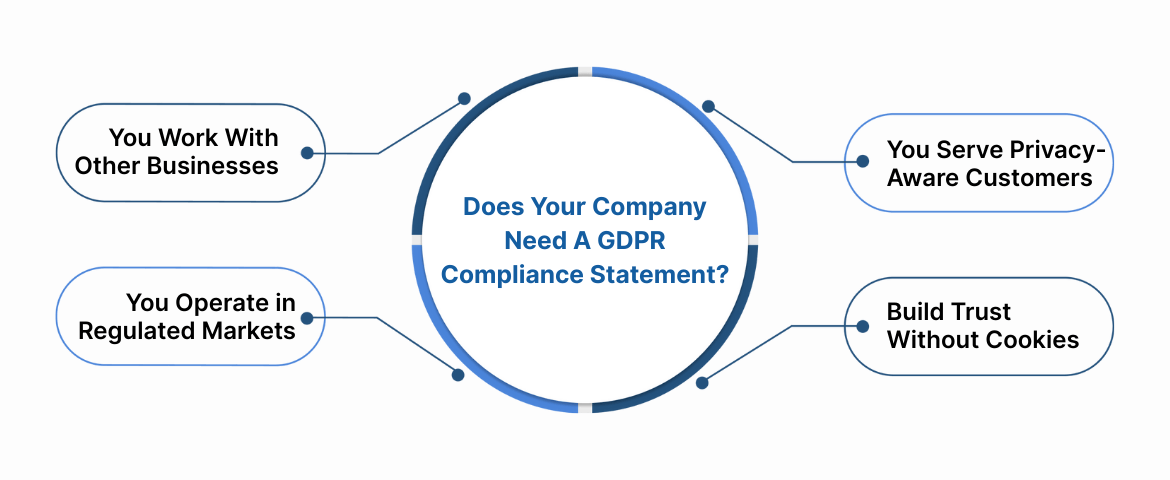
Below are scenarios where having one makes practical sense:
You Work With Other Businesses
- Partners and vendors often review your privacy standards before signing contracts or sharing data.
- A public statement helps show due diligence without requiring back-and-forth explanations.
- It signals that your processes are documented and actively maintained.
You Serve Privacy-Aware Customers
- Many users care about data protection, but rarely read full Privacy Policies.
- A GDPR statement gives them a clear, readable summary of your privacy approach.
- This is especially important after high-profile data misuse incidents increased public awareness.
You Operate in Regulated or High-Risk Markets
- Companies in ecommerce, advertising, and SaaS face higher scrutiny around data usage.
- Regulators may ask you to demonstrate intent and effort toward compliance during reviews.
- A statement helps show that privacy is built into your operations, not treated as an afterthought.
You Want to Build Trust in a Cookieless Environment
- First-party data strategies depend on user trust and consent-driven data collection.
- Clear communication supports ethical data practices and long-term customer relationships.
- Transparent compliance messaging reassures users that data is collected and managed responsibly.
Now that you know whether your business should have one, the next step is knowing exactly what to include and how to structure it clearly.
Also Read: GDPR vs HIPAA: Key Compliance Differences Explained
What Should A GDPR Compliance Statement Include?
A strong GDPR Compliance Statement reflects how your company handles personal data in real marketing operations. It should stay clear, honest, and aligned with how your systems actually work.
Here are the core sections most businesses include:
Company Identity and Contact Details
This section explains who you are and how you operate under GDPR. You should clarify whether you act as a data controller, processor, or both.
Include clear contact details so users know where to send privacy-related questions or requests. This builds confidence and reduces confusion during audits or partner reviews.
Commitment to GDPR Compliance
Here, you state your company’s commitment to GDPR principles and responsible data handling. Keep the language direct and focused on accountability.
You can briefly mention values like transparency, data minimization, and user control. This section sets the tone for the rest of the statement.
Data Protection Officer or Privacy Contact
If your company has a Data Protection Officer, mention their role and how they can be contacted. If not, identify a privacy contact or team.
This shows that privacy oversight exists within your organization. It also gives users a clear escalation path for concerns.
GDPR Compliance Approach
This section outlines how you work toward ongoing compliance. You can mention reviews, audits, internal policies, or staff training.
Focus on effort and process rather than legal detail. Readers want reassurance that compliance is maintained, not treated as a one-time task.
Security and Safeguards
Explain how you protect personal data using technical and organizational measures. Avoid listing sensitive technical details that could create risk.
You can reference access controls, encryption practices, or secure infrastructure at a high level. This balances transparency with security awareness.
Data Subject Rights
Acknowledge that users have rights under GDPR and explain how they can exercise them. You do not need to list every legal definition.
Keep this section practical by explaining request handling and response timelines. Clarity matters more than completeness here.
Third-Party Data Processing
If you share data with vendors or service providers, state that clearly. Confirm that these partners follow GDPR-aligned data protection standards.
You do not need to name vendors, but you should confirm oversight and contractual protections.
International Data Transfers
If personal data moves outside the EU, explain how it remains protected. Reference approved safeguards without legal citations.
This reassures users that data protection does not stop at borders. It also supports trust for global marketing operations.
After understanding what goes into the GDPR statement, let’s see how everything fits together in practice.
Not sure if your compliance claims match how your data actually flows? Ingest Labs supports privacy-first tracking and data visibility, helping teams document GDPR practices with confidence.
GDPR Compliance Statement Template
A template gives you structure while leaving room to reflect your real data practices. You should always customize it to match how your systems operate.
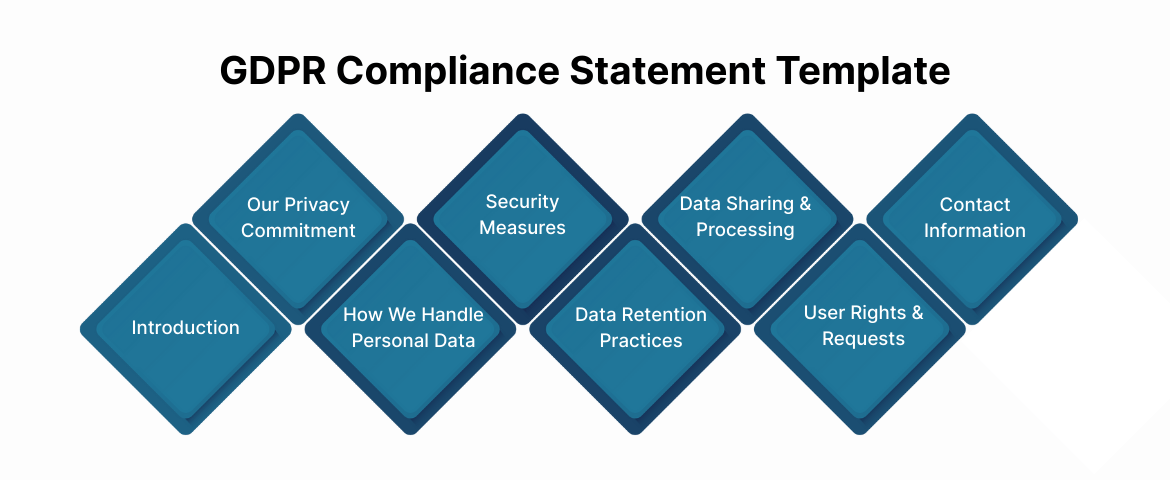
Below is a flexible template you can adapt for your organization.
This template is for informational purposes only and does not constitute legal advice.
1. Introduction
- Briefly explain what GDPR is and why privacy matters to your company. Keep this section simple and free from legal language.
- State who the statement is for and what it covers. This helps readers understand its purpose immediately.
2. Our Privacy Commitment
- Describe your commitment to protecting personal data and respecting user rights. Focus on responsibility, transparency, and accountability.
- You can mention that privacy is built into your marketing and analytics processes. This shows intent without technical depth.
3. How We Handle Personal Data
Explain how personal data is collected and used at a high level. Avoid listing every data point or system. You can summarize key principles, as shown below:
| Principle | How It Is Applied |
| Lawful Processing | Data is collected for clear and valid purposes |
| Data Minimization | Only the necessary data is collected |
| Accuracy | Data is reviewed and updated when needed |
| Storage Limits | Data is retained only when required |
4. Security Measures
- State that appropriate safeguards protect personal data from unauthorized access or misuse. Mention access controls and internal policies.
- Reassure readers that only authorized personnel can access sensitive data. This supports trust without revealing operational details.
5. Data Retention Practices
- Explain that personal data is not kept longer than needed. You can mention secure deletion or anonymization when data is no longer required.
- This section supports GDPR storage limitation requirements in a clear way.
6. Data Sharing and Processing
- Confirm that personal data may be shared with trusted service providers when necessary. State that data protection agreements are in place.
- Clarify that personal data is not sold. This addresses a common concern directly.
7. User Rights and Requests
List user rights in a clear and readable format, such as:
- Access to personal data
- Correction of inaccurate data
- Deletion requests
- Objections to certain processing
Explain how users can submit requests and what to expect next.
8. Contact Information
- End the statement with a clear privacy contact. Include an email address or form link for data-related questions.
- This gives the statement a clear and responsible closing.
With these sections in place, your GDPR Compliance Statement becomes both practical and credible.
Common Mistakes To Avoid In A GDPR Compliance Statement
A GDPR Statement works best when it reflects real practices, not generic promises. Below are common mistakes that can weaken trust or create confusion:
| Mistake | Why It Causes Problems |
| Treating it like a Privacy Policy | Overloading the statement with legal detail makes it harder to read and less effective |
| Using vague or generic language | Broad claims without a clear context raise questions about actual data practices |
| Making promises you cannot support | Statements must align with how data is collected, stored, and processed |
| Ignoring consent and user rights | Failing to explain how rights requests are handled creates uncertainty |
| Overlooking third-party data sharing | Omitting vendor involvement can suggest incomplete transparency |
| Leaving the statement outdated | Changes in tracking or tools can quickly make statements inaccurate |
Avoiding these issues keeps your statement clear, credible, and aligned with your marketing operations. A well-maintained document shows that privacy is handled with care, not treated as a checkbox.
Also Read: How to Respond to a GDPR or APPs Data Breach?
How Ingest Labs Supports Privacy-First GDPR Readiness
Writing a GDPR Compliance Statement is one step. Supporting it with the right systems is where many marketing teams struggle. Ingest Labs helps you align real data practices with the commitments you publicly share.
When your tracking, consent, and data flows are clean, your compliance messaging becomes easier to maintain and defend.
Here’s how Ingest Labs supports that process:
- Ingest IQ gives you greater control over how marketing data is collected through server-side tracking, helping you support claims around lawful, secure, and consent-based processing.
- Ingest ID enables first-party identity management, allowing you to reduce reliance on third-party cookies while supporting statements around data minimization and ethical personalization.
- Event IQ unifies consented data across channels, making it easier to respond to user rights requests and explain how personal data flows across your marketing stack.
Together, these tools help ensure your GDPR Compliance Statement reflects real, defensible data practices rather than broad promises.
Bottom Line
A GDPR Statement helps you explain how your business protects personal data without overwhelming readers with legal detail. When written clearly and supported by real processes, it builds trust with customers, partners, and regulators.
The strongest statements stay accurate because they reflect how data is actually collected, tracked, and governed. Making sure your statement matches reality is especially important in a cookieless, privacy-first environment.
Ingest Labs helps teams maintain visibility into consent, tracking, and first-party data flows, keeping compliance documentation accurate and up to date. Contact us to see how Ingest Labs supports compliant, data-driven marketing with confidence.
FAQs
1. What is an example of a GDPR statement?
An example of the GDPR statement could be- [Company Name] protects personal data per GDPR. Users can access, correct, or delete their data, and all information is securely stored.
2. How to write a GDPR disclaimer?
Write a GDPR disclaimer using clear, plain language that explains why data is collected, how it is used, and the legal basis for processing. Keep it specific, honest, and aligned with your actual data handling practices.
3. What documentation do we need to prove GDPR compliance?
You need records of processing activities, privacy and data protection policies, consent records, data processing agreements, and documented security measures. These help demonstrate accountability if regulators or partners request evidence.
4. How do you make sure you are following GDPR properly in practice?
You ensure compliance by mapping data flows, limiting collection to what is necessary, managing consent properly, and reviewing practices regularly. Ongoing monitoring and updates are essential as tools, vendors, and regulations change.