



Are you collecting plenty of customer data but still unsure what it actually tells you? Most businesses track website activity, campaigns, and conversions, yet struggle to understand customer intent and behavior clearly.
Customer data analytics helps close that gap. It gives teams a structured way to study customer actions, preferences, and feedback, then turn them into informed decisions. The rapid growth of the U.S. data analytics market, from USD 14.7 billion in 2024 to USD 43.5 billion by 2030, reflects this shift.
This guide breaks down what customer data analytics means, the types that matter most, and how to apply them responsibly. Read along to learn how to turn insights into actions that improve engagement, retention, and growth.
Key Highlights:
- Customer data analytics helps you understand customer behavior, preferences, and intent to improve decisions and experiences.
- Different customer data types and analytics models work together to improve acquisition, engagement, retention, and lifetime value.
- Effective customer analytics depends on clean data collection, proper organization, and turning insights into timely business actions.
- Privacy-compliant, first-party data strategies are essential as cookies decline and regulations continue to tighten.
- Structured processes and best practices help transform customer data into consistent, actionable business outcomes.
What Is Customer Data Analytics and Why Does It Matter?
Customer data analytics means collecting and analyzing customer data to understand behavior, preferences, and expectations across every interaction with your brand. You use this insight to make better marketing, product, and experience decisions based on real customer signals.
When customer data analytics is done right, it supports smarter growth decisions across teams, channels, and customer touchpoints.
Customer data analytics matters because it helps you:
- Stronger customer experiences: You can map the full customer journey, spot friction points, and improve interactions from acquisition to retention.
- Smarter marketing decisions: Instead of chasing vanity metrics, you understand which campaigns drive high-value customers and long-term revenue.
- Better product direction: Customer behavior and feedback show which features users adopt, ignore, or abandon over time.
- Improved ROI visibility: You see how marketing spend connects to conversions, lifetime value, and retention, not just traffic.
When you understand who buys, who churns, and why, your messaging becomes more relevant and timely. This clarity sets the stage for understanding the data itself, starting with the different types of customer data you collect.
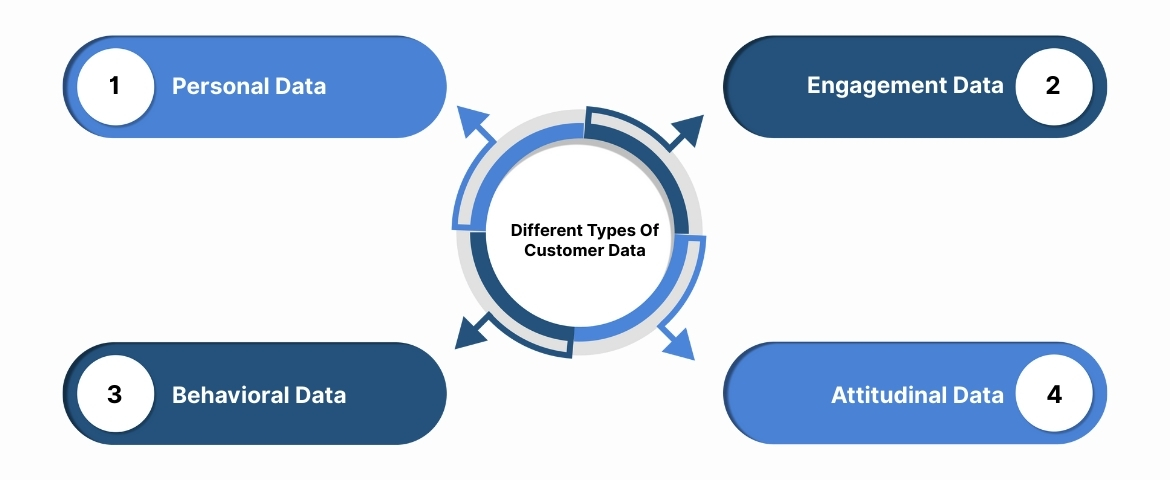
Different Types Of Customer Data
Every interaction your customer has with your brand creates data. Some data explains who they are, while other data shows what they do and how they feel. Understanding these differences helps you avoid treating all customer data the same:
Personal Data
Personal data includes the basic details that identify an individual customer and support personalized interactions. This data forms the foundation of customer profiles across systems.
- Example: Name, email address, location, birth date, and payment-related details used for account creation and transactions.
Engagement Data
- Engagement data tracks how customers interact with your content and campaigns across platforms. It helps you understand where attention is strongest and where interest drops.
- Example: Email open rates, click-through rates, social media likes, comments, and content shares.
Behavioral Data
Behavioral data captures what customers do as they interact with your brand over time. This data reveals intent and patterns that help predict future actions.
- Example: Website visits, browsing behavior, app usage, purchase history, and device preferences.
Attitudinal Data
Attitudinal data reflects how customers feel about your brand, products, or experience. It adds emotional context that numbers alone cannot explain.
- Example: Survey responses, reviews, satisfaction scores, sentiment feedback, and stated purchase criteria.
Together, these data types create a complete picture of your customers. The next step is understanding how to analyze this data in meaningful ways.
Key Types Of Customer Data Analytics
Customer data analytics uses different analytical approaches depending on the question you want to answer. Each type builds on the previous one and supports better decisions:
Descriptive Customer Analytics
Descriptive analytics looks at historical customer data to summarize what has already happened. It provides a clear snapshot of customer activity and performance trends.
It is commonly used for:
- Review sales reports, traffic trends, and conversion rates
- Analyze customer demographics and satisfaction ratings
- Monitor campaign performance across channels
Diagnostic Customer Analytics
Diagnostic analytics examines data to understand why certain outcomes occurred. It focuses on relationships, comparisons, and behavioral changes across touchpoints.
This helps you:
- Identify causes behind churn or conversion drops
- Compare performance between segments or channels
- Pinpoint friction within customer journeys
Predictive Customer Analytics
Predictive analytics uses historical data, statistical models, and machine learning to forecast customer behavior. It helps you anticipate needs instead of reacting late.
Common applications include:
- Estimating repurchase likelihood
- Identifying customers at risk of churn
- Predicting demand or engagement trends
Prescriptive Customer Analytics
Prescriptive analytics recommends specific actions based on predicted outcomes and business goals. It connects insight directly to execution.
Teams often use it to:
- Suggest personalized offers or messaging
- Optimize pricing or product bundles
- Improve response strategies for recurring customer issues
Key Metrics Commonly Used In Customer Data Analytics:
| Metric | What It Measures | Why It Matters |
| Customer Acquisition Cost (CAC) | Cost to acquire one customer | Reveals marketing and sales efficiency |
| Conversion Rate | Visitors who become customers | Shows how well campaigns and journeys perform |
| Customer Churn Rate | Customers who leave in a period | Signals retention and experience issues |
| Retention Rate | Customers who stay over time | Indicates loyalty and revenue stability |
| Customer Lifetime Value (LTV) | Total revenue per customer | Helps prioritize high-value segments |
| Net Promoter Score (NPS) | Likelihood to recommend | Reflects brand trust and satisfaction |
| Customer Satisfaction (CSAT) | Satisfaction after interactions | Identifies service or product gaps |
| Average Order Value (AOV) | Revenue per purchase | Tracks purchase behavior quality |
| Average Revenue per User (ARPU) | Revenue per customer | Measures upsell and pricing effectiveness |
By tracking the right metrics and applying the right analytics type, customer data becomes easier to act on. And that ease comes from a defined process that guides customer data from collection through decision-making.
How Does Customer Data Analytics Work?
Customer data analytics works through a clear sequence that turns scattered customer signals into insights your teams can actually use. While tools may differ, the underlying process stays consistent.
- Identify Relevant Customer Data: Define which geographic, behavioral, transactional, and feedback data directly support your marketing, product, and revenue goals.
- Collect Data Across Touchpoints: Capture customer data through consent-based forms, analytics tools, and interactions across web, app, email, and campaigns.
- Organize Data in a Central System: Standardize and centralize data from multiple sources to reduce duplication and maintain a consistent view of each customer.
- Analyze Patterns and Trends: Use dashboards, models, and visual reports to uncover behaviors, risks, and opportunities within customer journeys.
- Act on Insights and Measure Results: Apply insights to campaigns, products, and experiences while tracking performance changes over time.
Understanding the process makes it easier to see why customer data analytics creates value across teams.
Struggling to connect scattered customer data into one clear story? Ingest Labs helps standardize events, unify sources, and turn raw interactions into insights teams can actually act on.
Key Benefits Of Customer Data Analytics
Customer data analytics supports growth by improving how teams understand customers and respond to their needs. Its value extends well beyond reporting.
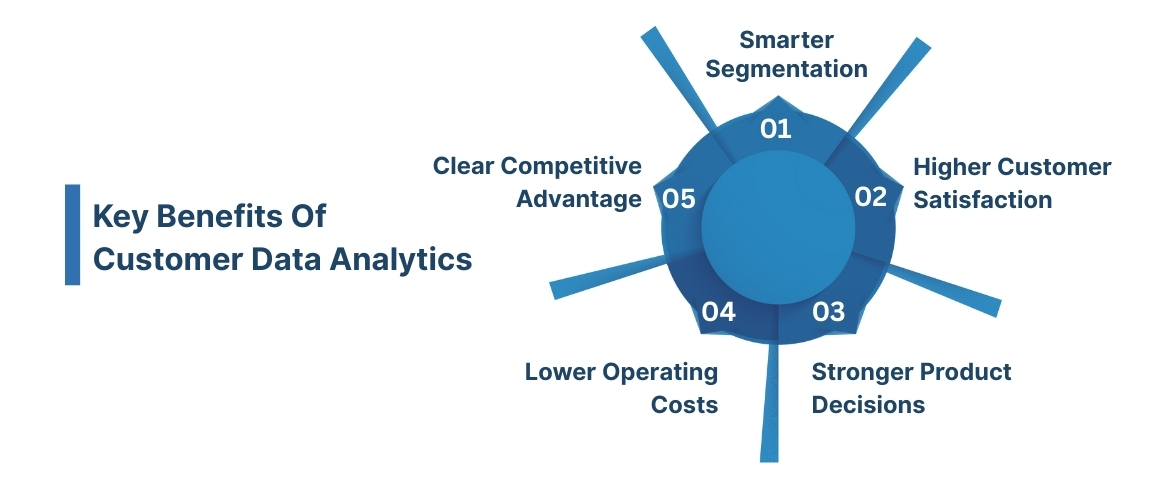
Here are the benefits that matter most to growing businesses:
Smarter Segmentation and Personalization
Analytics helps you group customers based on real behavior and preferences. This leads to messaging that feels relevant instead of generic.
- Build segments using actions and intent
- Personalize journeys by stage and interest
- Reduce spend on low-fit audiences
Higher Customer Satisfaction
When you act on feedback and behavior, experiences become smoother and more predictable. Customers notice when interactions feel intentional.
- Identify pain points across journeys
- Improve onboarding and support experiences
- Address issues before they drive churn
Stronger Product Decisions
Customer data analytics shows how users respond to features and updates over time. This shortens feedback loops and reduces guesswork.
- Track adoption after releases
- Learn which features deliver value
- Prioritize updates with clearer impact
Lower Operating Costs
Analytics helps teams spot inefficiencies early and adjust before costs increase. This supports better resource planning.
- Reduce spend on underperforming campaigns
- Identify churn risk sooner
- Improve pricing and packaging decisions
Clear Competitive Advantage
Companies that understand customers better respond faster and build stronger relationships. That creates long-term differentiation.
- Turn satisfied customers into advocates
- Improve sales effectiveness
- Stay efficient while scaling
These benefits depend on having reliable data, which makes responsible collection a critical next step.
How To Collect Customer Data and Stay Privacy-Compliant?
Collecting customer data today requires trust, transparency, and control. Privacy compliance should be built into your analytics setup, not added later.
Below are the essential steps to collect data responsibly:
Be Transparent and Obtain Consent
- Clearly explain what customer data you collect and why it supports specific experiences or services.
- Use consent banners and preference controls to meet privacy requirements in regulated regions.
- Respect consent choices consistently across all tracking and analytics tools.
Prioritize First-Party Data Collection
- Configure analytics tools to use cookies set on your own domain rather than third-party cookies.
- Reduce reliance on external identifiers that are impacted by browser restrictions and policy changes.
- Build customer profiles using direct interactions like sign-ups, purchases, and on-site behavior.
Implement Server-Side Tracking
- Route customer data through a secure server before sending it to analytics or advertising platforms.
- Filter or mask sensitive information to maintain control over what data is shared externally.
- Improve data reliability by reducing the impact of ad blockers and browser tracking limits.
Maintain Session Continuity Using First-Party Identifiers
- Use first-party identifiers to maintain session continuity under browser cookie limitations.
- Restore essential marketing cookies when they expire without creating new identifiers.
- Preserve attribution accuracy while staying within privacy guidelines.
Apply Consent-Based Conversion Tracking
- Adjust tracking behavior based on user consent using privacy and consent modes.
- Send limited data when full consent is not granted, while maintaining basic measurement.
- Use server-based conversion APIs to connect events without relying on third-party cookies.
With a compliant data foundation in place, customer data analytics can now be put to work across key business functions.
Worried about losing customer data to cookie limits or consent rules? Ingest Labs enables server-side, first-party tracking that keeps data accurate while staying privacy-compliant.
Common Applications Of Customer Data Analytics
Customer data analytics doesn’t live in dashboards alone. It shows up in everyday business decisions, often quietly shaping how customers experience your brand.
1. Customer acquisition: Analytics helps identify high-intent customer segments, optimize conversion paths, and improve targeting across paid and organic channels.
2. Customer retention: By analyzing behavior patterns and churn signals, businesses can intervene early with relevant offers, support, or engagement strategies.
3. Customer engagement: Data reveals what content, features, or touchpoints keep customers active, helping teams design experiences people actually return to.
4. Customer journey mapping: Analytics connects interactions across touchpoints, showing where users drop off, get stuck, or convert faster than expected.
5. Customer service optimization: Support data highlights recurring issues, response gaps, and opportunities for proactive resolution before problems escalate.
6. Business growth and forecasting: Predictive analytics supports decisions around pricing, expansion, and product investments by estimating lifetime value and demand trends.
That said, applying customer analytics at scale isn’t always smooth sailing.
What Challenges Do Businesses Face in Customer Analytics?
As customer data analytics expands across business functions, it also brings a set of challenges that organizations must navigate carefully. Here are the common ones to know:
Rising Data Storage and Infrastructure Costs
- As customer data grows across multiple channels, storage and processing costs increase rapidly. Businesses must balance performance needs with scalable infrastructure investments.
- Without proper planning, analytics systems can become expensive to maintain, limiting accessibility for smaller teams or growing organizations.
Customer Trust and Data Discomfort
- Customers are increasingly aware of how their data is tracked and used. Overly aggressive tracking or unclear practices can lead to discomfort and reduced trust.
- With the decline of third-party cookies, businesses must adapt by relying more on first-party data and transparent engagement strategies.
Risk of Data Breaches and Security Threats
- Customer data is a prime target for cyberattacks, and breaches can lead to financial losses and reputational damage. Protecting data requires continuous investment in security tools and internal controls.
- Even well-intentioned analytics efforts can backfire if security and access management are not prioritized.
Regulatory and Compliance Complexity
- Privacy regulations vary across regions and continue to evolve. Staying compliant requires businesses to understand applicable laws and adapt analytics processes accordingly.
- Failure to comply can result in fines, legal action, and loss of customer confidence.
Overcoming these challenges requires not just better tools, but smarter ways of working with customer data.
Best Practices to Turn Customer Data Into Insights
To get real value from customer analytics, data needs direction, structure, and context. These best practices help turn analytics into insights that teams can actually act on:
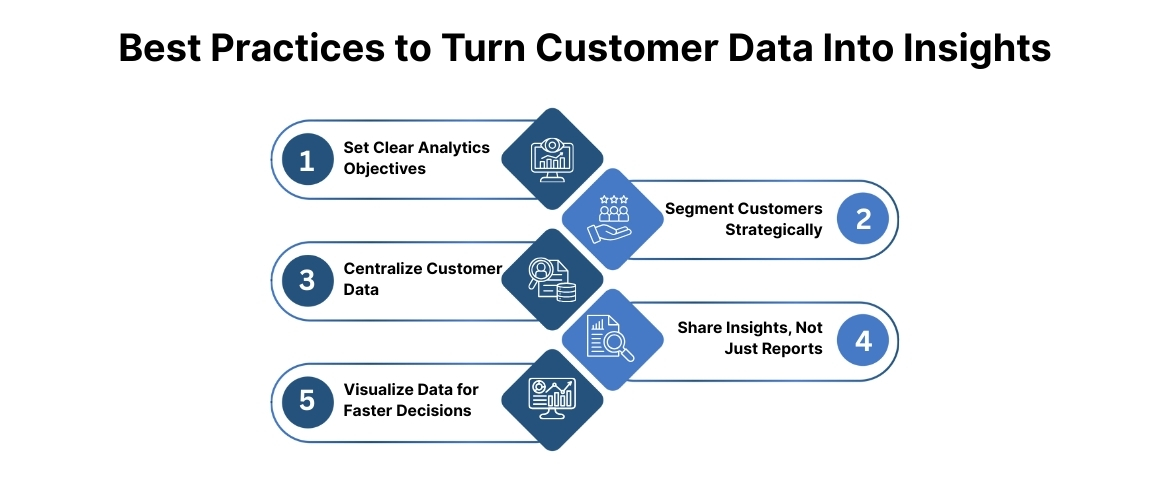
Set Clear Analytics Objectives
Defining what you want to achieve ensures that analytics efforts stay focused and actionable.
- Align data collection with specific business goals like retention, growth, or engagement.
- Identify which data types are essential before expanding tracking efforts.
Segment Customers Strategically
Segmentation helps turn raw data into meaningful insights without overwhelming teams.
- Group customers by behavior, preferences, or lifecycle stage.
- Prioritize segments that have the highest impact on business outcomes.
Centralize Customer Data
A unified data source reduces inconsistencies and improves collaboration across teams.
- Store customer data in a centralized platform accessible to relevant stakeholders.
- Ensure standardized naming and tracking conventions across tools.
Share Insights, Not Just Reports
Insights create value only when they’re understood and acted upon.
- Share concise summaries that highlight trends, risks, and opportunities.
- Encourage feedback to refine analysis and uncover new questions.
Visualize Data for Faster Decisions
Well-designed dashboards make patterns easier to spot and explain.
- Use clear visualizations to communicate insights across technical and non-technical teams.
- Focus on metrics that directly connect to business goals.
When customer data is handled responsibly and analyzed with intent, it stops being “just data” and starts guiding smarter decisions across the business.
How Ingest Labs Supports Privacy-First Customer Data Analytics
Customer data analytics only delivers value when the data behind it is accurate, privacy-compliant, and resilient to tracking limitations. Ingest Labs helps teams maintain that balance by simplifying how customer data is collected, processed, and activated.
Instead of patching together tools and workarounds, you get a cleaner way to collect and manage customer data in a cookieless world.
With Ingest Labs, you get:
- Accurate data collection: Using server-side tracking through Ingest IQ, you capture web and mobile interactions without data loss from ad blockers or browser restrictions.
- Clear customer journeys: Ingest ID assigns a persistent first-party identifier, helping you connect sessions, channels, and devices into one continuous customer view.
- Unified customer intelligence: With Event IQ, behavioral, engagement, and conversion data flows from multiple platforms into a single system for deeper analysis.
- Privacy-first analytics: Event IQ supports consent-aware data handling, keeping analytics aligned with GDPR, CCPA, and changing privacy requirements.
- Cross-channel visibility: By combining signals from ads, websites, and apps, Ingest Labs helps you spot where engagement drops across the journey.
- From insights to action: Analytics powered by Ingest IQ turn customer behavior into signals you can use to improve conversions, retention, and performance.
Ingest Labs helps customer data analytics stay reliable, compliant, and insight-ready.
Summing Up
Customer data analytics gives you a clear view of how customers interact with your brand across channels and touchpoints. It helps you move beyond assumptions and make decisions based on real behavior, intent, and feedback.
By collecting the right data, applying the right analytics types, and tracking meaningful metrics, you can improve overall customer experience. However, insights are only as strong as the data behind them. Privacy rules, cookie limits, and fragmented tracking disrupt customer journeys, making clean, consent-aware first-party data essential for trusted analytics.
Ingest Labs helps you keep customer data accurate, connected, and compliant so insights lead to real outcomes. If you’re ready to turn customer behavior into action, contact us and get the right support for your customer data analytics strategy.
FAQs
1. What is an example of customer analytics?
A common example is analyzing website behavior and purchase history to identify which campaigns bring repeat customers and higher lifetime value.
2. How to analyze customer data?
You analyze customer data by collecting it from key touchpoints, organizing it in one system, and reviewing patterns in behavior, engagement, and feedback.
3. What are the business benefits of analyzing customer purchase data and constructing behavioral profiles?
Analyzing purchase data and behavioral profiles helps you understand what customers buy, when they buy, and why. These insights support personalized marketing, stronger retention, improved product decisions, and more efficient use of marketing budgets.
4. What skills are needed for data analytics?
You need analytical thinking, comfort with data tools, and basic statistical knowledge. Clear communication skills help turn insights into actions.