



Every digital interaction, a click, a purchase, an email open, tells part of a customer’s story. But when those interactions are scattered across CRMs, ad platforms, analytics dashboards, and spreadsheets, marketers only see fragments.
The result? Disconnected insights, inconsistent messaging, and wasted ad spend.
Unified customer data solves this problem by connecting all those fragments into one consistent view of each customer, accessible to marketing, sales, product, and analytics teams alike.
In this article, we’ll explore what unified customer data really means, why it matters for every customer-facing team, how to start building it, and how platforms like Ingest Labs simplify unification through privacy-first, server-side data infrastructure.
Key Takeaways
- Unified customer data brings all customer information into one accurate, privacy-safe profile shared across teams.
- It helps marketing, sales, and product teams deliver consistent, personalized, and data-driven experiences.
- Strong data governance and compliance practices build customer trust and ensure regulatory safety.
- Ingest Labs simplifies data unification with secure, server-side tools for tracking, identity, and analytics.
What “Unified Customer Data” Actually Means
Unified customer data is the process of collecting, cleaning, and consolidating information about each customer from multiple systems into a single, consistent profile.
It ensures that every department, from marketing to customer success, is working with the same up-to-date record.
Definition and Core Concept
At its core, unified customer data brings together:
- Behavioral data (website visits, app usage, clicks).
- Transactional data (purchases, renewals, refunds).
- CRM data (contact details, account history).
- Support data (tickets, reviews, chat logs).
This unified profile enables better decisions, whether it’s personalizing campaigns, prioritizing leads, or predicting churn.
Think of it as building a single source of truth for every customer, a foundation for both marketing precision and customer trust.
How It Differs from Raw or Siloed Data
Siloed data lives in separate systems, often formatted differently and updated at different times. Unified data, in contrast, creates one accurate and continuously updated record that all teams can use.
| Type | Description | Challenge | Outcome |
| Siloed Data | Stored separately in different tools | Hard to connect and analyze | Fragmented insights |
| Raw Data | Unprocessed and inconsistent | Prone to errors and duplication | Misleading metrics |
| Unified Data | Standardized and connected | Provides cross-channel visibility | Informed, real-time actions |
Identity Resolution: The Glue That Holds It Together
When the same customer logs in from a phone, clicks an ad from a laptop, and visits the store in person, identity resolution connects those interactions under one profile.
This process uses identifiers (email, device ID, customer ID) to recognize the same user across channels, ensuring accurate tracking and personalization.
Ingest Labs’ Ingest ID enables identity resolution securely using first-party identifiers, helping marketers unify customer interactions without depending on third-party cookies.
Also Read: Understanding What is Data Integration: Process, Tools, and Examples
The Mess You’re Solving: Data Silos and Fragmentation
Before unification, most organizations face a data mess, disconnected systems, duplicate records, and inconsistent reporting. These silos not only limit insights but also degrade customer experience.
What Data Silos Look Like
Common silos appear across:
- CRM systems (customer names and emails).
- E-commerce platforms (transactions, cart data).
- Advertising platforms (clicks and impressions).
- Analytics tools (behavioral and funnel data).
- Support systems (complaints, satisfaction scores).
Each tool knows one piece of the customer story, but none sees the full picture.
The Real Cost of Fragmentation
Data fragmentation affects more than just marketing. It impacts efficiency, accuracy, and experience across departments.
Consequences include:
- Inconsistent messaging across campaigns.
- Misattributed conversions and poor budget allocation.
- Duplicate outreach to the same customer by different teams.
- Inability to measure full customer lifetime value (CLV).
Why Solving This Matters
When data is unified, companies can:
- Deliver consistent brand experiences.
- Accurately attribute conversions across touchpoints.
- Improve operational collaboration between marketing, sales, and support.
Ingest Labs’ Event IQ helps unify multi-channel data streams in real time — eliminating silos and giving organizations a live, accurate picture of the customer journey.
Also Read: Understanding Real-Time Data Streaming: Benefits and Use Cases for Marketing
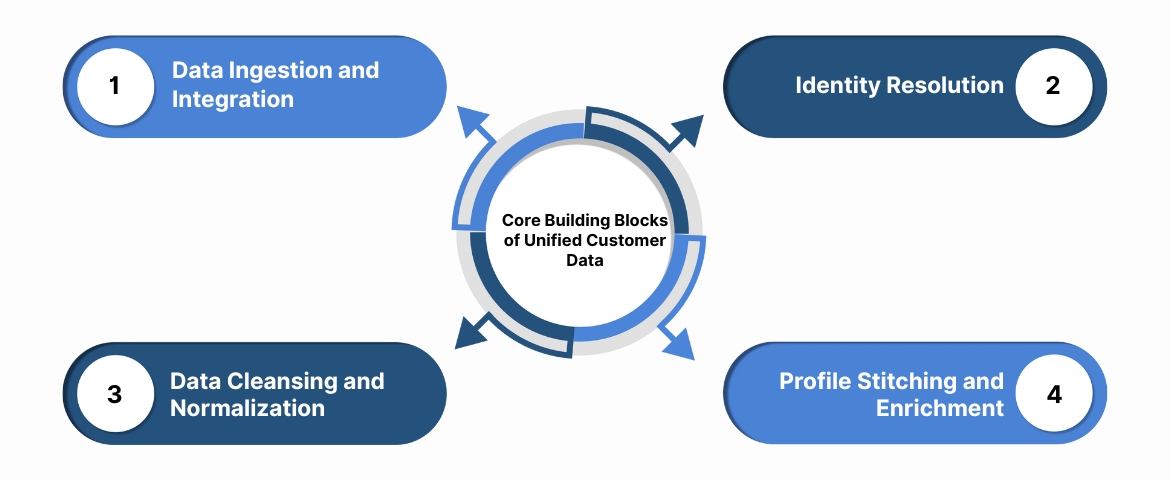
Core Building Blocks of Unified Customer Data
Unified customer data doesn’t happen automatically; it’s built on a foundation of processes and technologies that collect, clean, and connect information into one accurate profile. Let’s break down the essential components.
Data Ingestion and Integration
The first step is bringing all customer data together from every system that touches the customer journey. This includes:
- Online sources: websites, mobile apps, social media, paid ads, chatbots.
- Offline sources: in-store systems, call centers, CRM updates, and POS records.
Integration tools, such as Ingest IQ, automate this process by collecting data from multiple platforms and streaming it to a unified environment in real time.
Goal: eliminate gaps between marketing, analytics, and sales data.
Identity Resolution
Once data is gathered, the next challenge is ensuring that every interaction belongs to the right person. Identity resolution matches identifiers like:
- Email addresses or login IDs.
- Device IDs or cookies (when available).
- First-party identifiers generated by your own systems.
Ingest ID simplifies this by assigning a secure first-party ID to each user, connecting web, app, and offline interactions, without violating privacy laws.
Data Cleansing and Normalization
Data from different sources rarely looks the same. For example, “New York” might appear as “NY” or “N.Y.” across systems. Data cleansing standardizes and corrects inconsistencies to make information usable.
Normalization ensures:
- Uniform naming and formatting.
- Removal of duplicates and incomplete records.
- Reliable analytics and reporting across teams.
Profile Stitching and Enrichment
This step connects data points into one customer record.
When a user interacts from multiple channels, those touchpoints are “stitched” into a unified timeline.
Profile enrichment enhances this data with:
- Demographics (age, location, company).
- Behavioral signals (frequency, recency, monetary value).
- Predictive insights (churn risk, purchase probability).
When complete, each customer record becomes a living profile, updated in real time with every interaction.
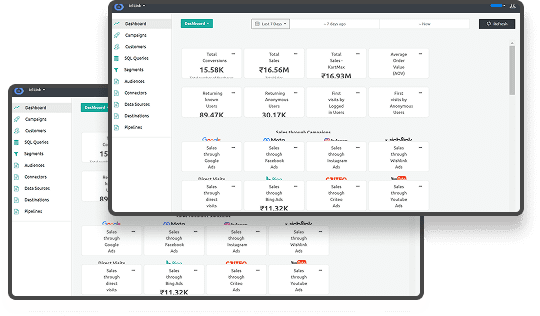
With Event IQ, teams can see these unified profiles and insights in one dashboard, making personalization and attribution easier than ever.
Also Read: Understanding First-Party, Second-Party and Third-Party Data: Strategies and Benefits
The Role of CDPs and Other Tools in Unification
A Customer Data Platform (CDP) is often at the heart of unified customer data initiatives, but it’s only one part of a larger ecosystem. To get true unification, businesses need a mix of collection, integration, and activation tools that work together seamlessly.
What a CDP Does
A CDP is a system that collects data from multiple touchpoints, unifies it into profiles, and makes it available to marketing and analytics tools.
Core functions include:
- Data ingestion from multiple channels.
- Identity resolution and profile management.
- Audience segmentation and activation.
- Secure data storage under compliance frameworks (GDPR, CCPA).
CDP vs. CRM vs. Data Warehouse
It’s common for teams to confuse these tools. Each serves a unique purpose:
| Tool | Primary Function | Limitations |
| CRM | Manages customer interactions and sales pipelines | Limited to known leads/customers |
| Data Warehouse | Stores large volumes of structured data | Requires technical expertise for analysis |
| CDP | Unifies and activates customer data across all channels | Works best when integrated with other systems |
Ingest Labs’ ecosystem acts as a bridge, providing real-time server-side tracking and identity resolution that feeds unified data into CDPs or warehouses for analysis.
When You Need More Than a CDP
While CDPs excel at organizing and activating data, they rely heavily on the accuracy of incoming signals. That’s where tools like Ingest IQ make the difference, enabling:
- Server-side data collection that’s immune to cookie loss or browser restrictions.
- Real-time synchronization with analytics and campaign tools.
- First-party data ownership, ensuring compliance and long-term sustainability.
Also Read: Differences and Use Cases of First-Party Data vs Third-Party Data
Why Unified Customer Data Matters: For Marketing, Sales, Product & CX
When customer data is unified, it’s not just marketing that benefits; every department across the organization becomes smarter and more connected.
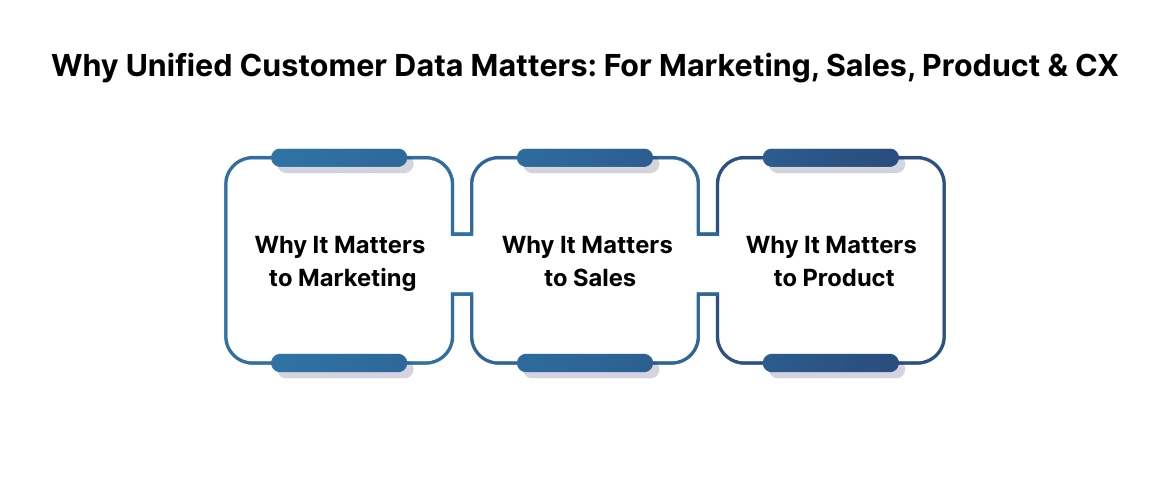
Here’s how unified data drives performance across key business functions.
1. Why It Matters to Marketing
Marketers rely on data to understand what resonates and what converts. But fragmented insights often mean guesswork instead of precision.
With unified customer data, marketers can:
- Identify audiences based on complete behavioral and transactional history.
- Personalize campaigns across channels in real time.
- Attribute conversions more accurately, understanding which touchpoints truly drive ROI.
- Reduce ad spend waste by targeting verified, high-intent users.
Example: A marketer can automatically suppress ads to existing customers who’ve already purchased, saving budget and improving experience — possible only with unified data.
Ingest Labs powers this precision through server-side tracking and identity resolution, ensuring no signal is lost across devices or browsers.
2. Why It Matters to Sales and Customer Success
For sales and support teams, context is everything. Unified data provides a complete history of customer interactions — from first click to latest conversation.
Benefits include:
- Access to updated, accurate customer profiles across CRM and communication tools.
- Predictive insights for upselling or churn prevention.
- Seamless collaboration between marketing-qualified and sales-qualified leads.
Scenario: A sales rep sees that a lead engaged with a demo video yesterday and visited the pricing page twice. This insight allows a timely follow-up with personalized context — increasing close rates and customer satisfaction.
3. Why It Matters to Product and CX Teams
Unified data gives product managers and experience designers a 360° understanding of user behavior, across app sessions, feedback loops, and purchase data.
With unified data, these teams can:
- Identify feature adoption trends and drop-off points.
- Improve onboarding experiences based on behavioral insights.
- Correlate support tickets with product usage to identify friction areas.
- Build stronger customer retention strategies backed by real evidence.
Event IQ helps teams visualize this journey in real time, enabling proactive CX improvements rather than reactive fixes.
Also Read: Benefits and Strategies of Centralized Data Management
Data Governance, Privacy, and Trust, Non-Negotiables
Unifying customer data is powerful, but it also comes with responsibility. Without strong data governance and privacy management, unification can easily turn into exposure or compliance risk.
Why Governance Matters
Data governance defines how customer data is collected, stored, and used.
It ensures consistency, accuracy, and compliance while maintaining customer trust.
Good governance practices include:
- Clear data ownership and accountability.
- Documented data standards and update schedules.
- Regular audits and quality checks.
- Defined access controls for different teams.
Ingest Labs automates many of these practices through controlled data pipelines, real-time validation, and centralized permission management.
Privacy Compliance in a Changing Landscape
Data privacy laws like GDPR (Europe) and CCPA (California) have reshaped how companies handle user data. Unified data systems must embed compliance at their core, not as an afterthought.
Critical compliance areas include:
- Consent management: Recording, updating, and respecting user consent preferences.
- Right to access/delete: Providing visibility and control to users over their data.
- Data minimization: Collecting only what’s necessary for defined purposes.
Example: When a customer opts out of tracking or email, that preference should reflect across every tool instantly, something achievable through unified, first-party data orchestration.
The Role of Transparency and Trust
Customers are more likely to share data when they trust a brand’s integrity and transparency.
Trust is built through:
- Transparent data policies and consent prompts.
- Consistent privacy practices across digital channels.
- Demonstrating real value in exchange for data (e.g., personalized experiences).
By implementing privacy-first tracking, Ingest Labs enables organizations to unify customer data without sacrificing compliance, strengthening both insights and relationships.
The Balance Between Insight and Ethics
It’s not enough to collect everything you can; you must collect what you should. Ethical data use drives long-term retention and brand loyalty, while careless data handling erodes trust.
Pro tip: Treat privacy not as a restriction, but as a competitive advantage. Businesses that manage data responsibly often outperform those that don’t.
Also Read: What You Need to Know About Consent Management
Getting Started: Strategy, People, and Process for Data Unification
Building unified customer data isn’t just a technology project; it’s a cross-functional initiative that blends strategy, people, and process. Below are practical steps to begin the journey and avoid common pitfalls.
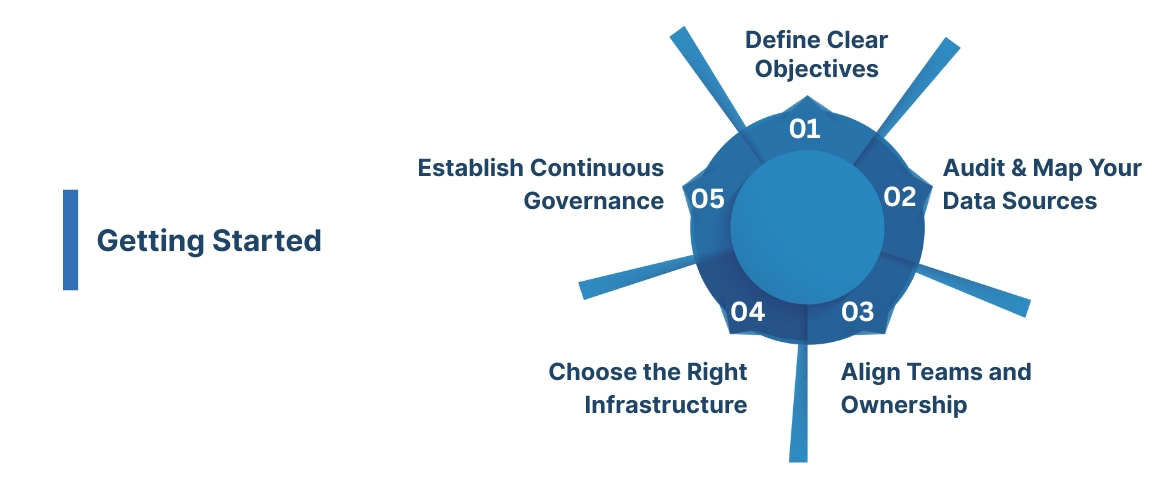
1. Define Clear Objectives
Start with clarity: What do you want to achieve with unified data?
Set measurable goals like:
- Increasing campaign ROI by 20%.
- Reducing data duplication by 50%.
- Improving retention or upsell metrics.
Defining outcomes early helps guide tooling decisions and align teams on shared KPIs.
2. Audit and Map Your Data Sources
Identify where customer data currently lives. Common systems include:
- CRM and marketing automation platforms.
- E-commerce and POS systems.
- Analytics dashboards (Google Analytics, Adobe).
- Advertising and campaign tools.
- Customer support and NPS platforms.
Create a data inventory, noting data owners, frequency of updates, and integration gaps.
Ingest Labs’ Ingest IQ simplifies this mapping by connecting multiple systems and streaming structured data in real time to a single environment.
3. Align Teams and Ownership
Unified data only works when people do.
Ensure collaboration across departments:
- Marketing defines campaign data requirements.
- Sales ensures CRM accuracy and updates.
- IT/Data teams manage integration and infrastructure.
- Compliance officers review privacy alignment.
Establish data stewards, individuals responsible for maintaining quality and consistency.
4. Choose the Right Infrastructure
Once objectives and ownership are clear, pick the right technology stack:
- CDP: For unified profiles and segmentation.
- Data Warehouse: For deep analytics and storage.
- Server-Side Tagging Platform (like Ingest Labs): For accurate, privacy-safe data capture.
Avoid over-engineering, start small, connect key sources, and scale as your maturity grows.
5. Establish Continuous Governance and Iteration
Data unification isn’t a one-time setup. Build a routine process to:
- Review data pipelines quarterly.
- Monitor tag performance and consent compliance.
- Update identity-matching logic as privacy rules evolve.
Ingest Labs provides real-time validation and monitoring tools so teams can track accuracy, compliance, and tag performance continuously.
Also Read: Ethical Data Collection driving customer loyalty and boosting business outcomes
Measuring the Impact of Unified Customer Data
Once your systems are unified, it’s time to measure the results, proving ROI is key to long-term success.
Key Metrics to Track
Here are metrics that reflect whether your unified data strategy is driving results:
| Metric | What It Measures | Why It Matters |
| Data Completeness Rate | % of records with full attributes | Ensures accurate targeting |
| Duplicate Record Rate | % of duplicate customer entries | Indicates data hygiene success |
| Customer Retention / CLV | Ongoing customer value | Measures business impact |
| Campaign ROI | Revenue vs. spend | Shows the efficiency of unified data use |
| Time to Insight | Time from data capture to actionable report | Reflects the agility of the system |
Beyond numbers, unified data drives measurable improvements in team workflow and experience:
Qualitative Improvements
- Faster reporting and reduced reliance on manual exports.
- Improved cross-departmental collaboration.
- Enhanced customer experiences through consistent messaging.
Continuous Refinement
Regularly reassess your unified data strategy:
- Review integrations and tagging for gaps.
- Update customer identifiers as privacy rules change.
- Use A/B testing to measure personalization improvements from unified insights.
Unified data is not a destination; it’s an ongoing process of refinement and optimization.
Conclusion
In an era defined by privacy regulations, cross-channel marketing, and real-time personalization, unified customer data is the foundation of modern growth.
It’s what enables you to:
- Understand your customers fully.
- Engage them consistently across every touchpoint.
- Build trust through compliance and transparency.
With Ingest Labs, you can unify customer data securely through:
- Ingest IQ for real-time, server-side tracking.
- Ingest ID for privacy-safe identity resolution.
- Event IQ for actionable analytics and insights.
Ready to unify your data and build smarter customer experiences?
Contact Ingest Labs today to see how unified customer data can transform your marketing precision and ROI.
FAQs
1. What is unified customer data?
Unified customer data combines all customer interactions across platforms into one accurate, consistent profile shared across teams.
2. How is it different from CRM data?
A CRM stores known customer interactions, while unified data merges all online and offline touchpoints for a complete customer view.
3. Why is unified customer data important?
It enables personalized marketing, accurate analytics, and consistent customer experiences across every channel.
4. What challenges do businesses face with unified data?
Common issues include disconnected systems, poor data quality, and privacy compliance, all solvable through structured, first-party data systems like Ingest Labs.
5. Is unified customer data privacy-compliant?
Yes, when managed with consent, secure infrastructure, and first-party data collection. Ingest Labs ensures GDPR and CCPA compliance by design.
6. What’s the link between unified customer data and a single customer view?
Unified data is the process; a single customer view is the result, one reliable profile built from unified data sources.