



Every click, scroll, or page view tells a story about how people experience a brand online. Yet most marketers only see fragments of that story. Across industries, the average website session lasts just over two minutes, while bounce rates continue to hover around 47%. At the same time, mobile traffic now accounts for nearly 65% of all visits, shifting how and where engagement happens.
Marketers are investing heavily in analytics and personalization tools to understand this behavior, but growing privacy constraints and disappearing cookies make it harder to follow users across their journeys.
The question is no longer just how visitors behave but how accurately that behavior can be captured, measured, and connected to outcomes.
Key Takeaways:
- User sessions reveal how people interact across touchpoints, but traditional cookie-based tracking no longer captures the full picture.
- Privacy regulations and browser restrictions have made first-party, server-side tracking essential for reliable analytics.
- Modern session data connects behavior across devices, creating a continuous and verifiable view of the customer journey.
- Session identity and consent-based tracking improve attribution accuracy and data trust.
What Is a User Session?
A user session captures the series of interactions a person has within a visit to a website or app, from the first page they land on to the moment they leave. It reflects the journey taken in that single visit: pages viewed, actions performed, and how long the visitor stayed active before the session end, typically after about 30 minutes of inactivity.
Marketers and analysts rely on session data to answer fundamental questions:
- Where do visitors enter and exit the site?
- How much time do they spend exploring content or products?
- What actions lead to conversions or drop-offs?
Each session is tagged with a unique identifier, allowing analytics systems to group multiple user actions into one cohesive experience. This is how metrics like average session duration or pages per session are calculated.
Together, they offer a baseline understanding of engagement and site performance before more advanced behavioral or attribution analysis takes place.
Also Read: How to Set Up a Customer Retargeting Campaign
How User Sessions Work
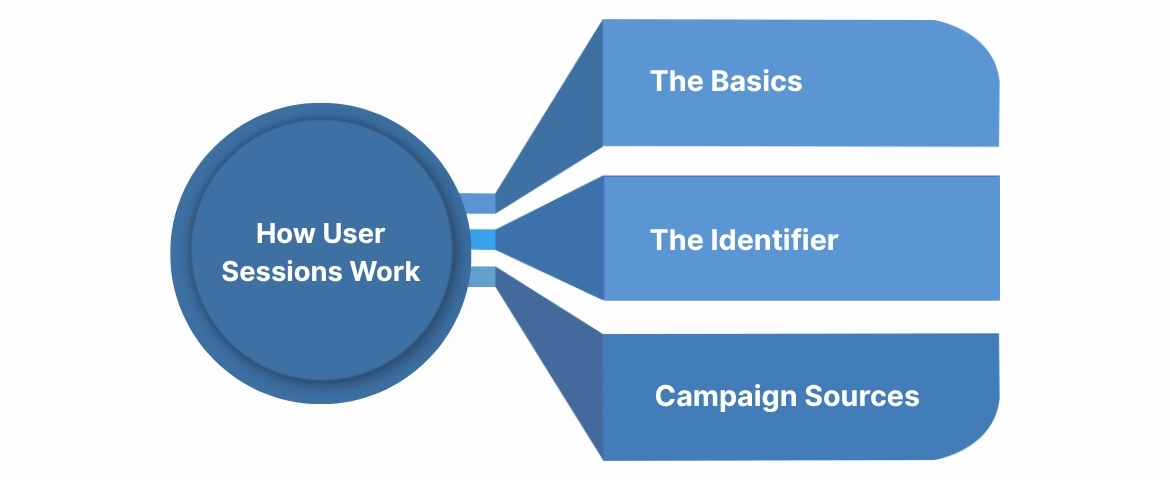
When a visitor lands on a website or opens an app, a new session begins. From that moment, every action, clicks, scrolls, page views, and form submission is recorded until the visitor leaves or becomes inactive.
1. The Basics
- A session continues as long as the user stays active.
- Most analytics tools end it after around 30 minutes of inactivity (a “session timeout”).
- Once the visitor returns, a new session starts automatically.
2. The Identifier
Every session is tagged with a unique ID that connects all actions within that visit.
- Historically, this ID lived in a browser cookie.
- The cookie helped analytics systems understand which actions belonged together.
- When cookies are cleared or blocked, that continuity breaks — and so does the accuracy of the data.
3. Traffic and Campaign Sources
Many analytics platforms also segment sessions by traffic source:
- A visit from a Google search and a visit from a paid ad are logged separately,
even if they happen minutes apart. - This helps marketers measure which channels bring visitors back and what drives engagement.
Why It Matters:
At scale, session data powers:
- Journey analysis — mapping how people navigate content.
- Drop-off tracking — identifying where engagement fades.
- Conversion optimization — revealing behaviors that lead to sales or sign-ups.
But the reliability of those insights depends on how accurately sessions are captured and linked, a growing challenge as browsers limit cookies and privacy rules tighten.
Why Traditional Session Tracking Is Failing
For years, marketers relied on browser-based tools to understand how users interacted with websites. But the methods that once powered clear insights are quickly losing reliability.
1. The Cookie Crackdown
Third-party cookies, the backbone of most session tracking, are disappearing.
- Google Chrome plans to phase them out completely by 2025 (Google Privacy).
- Safari and Firefox already block them by default.
Without cookies, analytics tools struggle to tie user activity together, leading to gaps in reporting and inaccurate attribution.
2. Browser and Device Limitations
Modern browsers restrict what data can be stored locally or shared across domains.
- Cross-device behavior (like switching from mobile to desktop) often gets counted as separate users.
- Ad blockers and privacy extensions further limit what tracking scripts can record.
The result? Fragmented user journeys and incomplete datasets.
3. Growing Privacy Regulations
Global privacy frameworks such as GDPR, CCPA, and LGPD are redefining how data can be collected and stored.
- Users must give explicit consent before any tracking occurs.
- Non-compliant cookies or scripts can lead to legal and reputational risks.
This new environment demands transparency, consent management, and a shift from third-party to first-party data practices.
4. Impact on Marketers and Analysts
Without reliable session data, teams face:
- Inconsistent metrics between analytics platforms.
- Difficulty connecting traffic sources to conversions.
- Limited visibility into user behavior over time.
The challenge is no longer just about tracking activity, it’s about maintaining accuracy, continuity, and compliance in how that data is captured.
Also Read: Best Practices for Handling PII Data
The Future of User Sessions
Marketers once viewed a user session as a snapshot, a single visit bounded by time or tab activity. That definition no longer fits today's digital environment, where a user's attention moves fluidly across devices, channels, and consent frameworks.
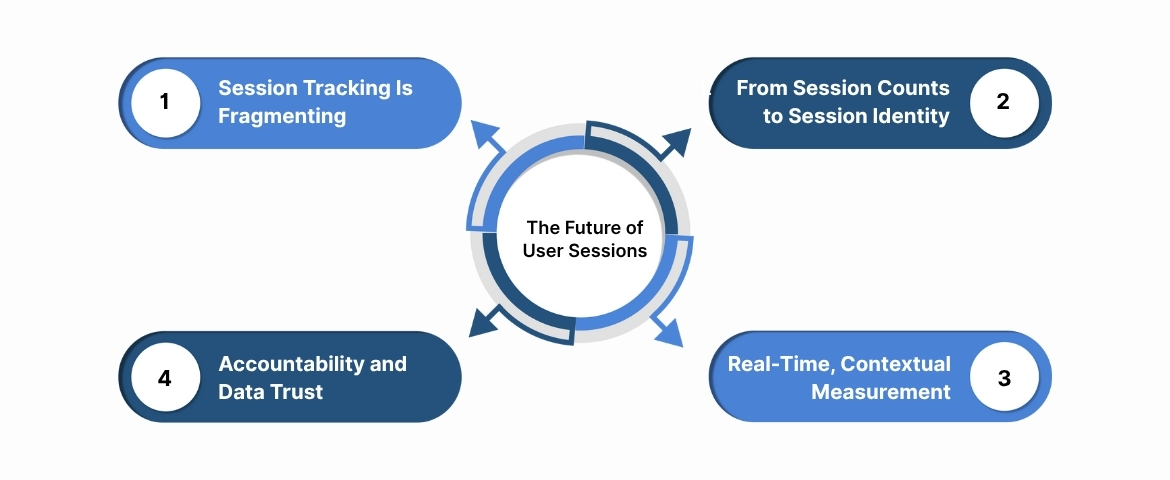
1. Session Tracking Is Fragmenting
Current analytics setups face measurable data loss.
- Studies show browser-based tracking can now miss up to 30–40% of interactions due to ITP, ETP, and ad-blocker restrictions.
- Mobile-first behavior complicates things further; nearly half of digital sessions start on mobile, but only a fraction are linked back to the same user when they return on desktop.
This means what marketers see as a “session” is often just a partial glimpse — one disconnected fragment of a larger journey.
2. From Session Counts to Session Identity
The next phase of analytics moves beyond session tallies to session identity, where each session represents a verified, first-party data record rather than a browser artifact.
Here, identifiers are generated and stored server-side, allowing continuity even when cookies expire or browsers reset IDs.
Instead of losing visibility after 30 minutes or a browser close, brands can sustain a consented view of engagement over time.
3. Real-Time, Contextual Measurement
In advanced systems, session boundaries aren't purely time-based. They can adapt dynamically:
- Reconnecting sessions when the same user reappears via authenticated login or persistent ID.
- Linking behavioral signals (like repeated search patterns or cart actions) to refine audience intent.
This contextual layer transforms session data from static analytics to actionable intelligence that supports personalization, optimization, and media attribution in real time.
4. Accountability and Data Trust
First-party, server-side session tracking also brings transparency and auditability — critical under frameworks like GDPR and CCPA. Data is collected directly by the brand, processed securely, and shared through consent-based pipelines.
The outcome is not just better visibility but trustworthy visibility, where every session captured can be validated against source systems.
How Ingest Labs Redefines User Sessions anf its Management
Ingest Labs reconceptualizes user sessions as unified, privacy-compliant data streams that connect every user action across channels. Its server-side infrastructure enables marketers to capture, organize, and interpret sessions with unmatched accuracy and transparency.
- Unifying Session Data: Ingest IQ centralizes event and tag management to capture user interactions across web, app, and backend environments in real time.
- Establishing Persistent Session Identity: Ingest ID assigns a secure first-party identifier to every visitor. This creates continuity between visits while maintaining compliance with privacy regulations.
- Transforming Data into Insight: Event IQ converts raw event streams into actionable analytics. It analyzes session behavior to reveal engagement trends, friction points, and intent signals.
- Embedding Data Trust and Compliance: All Ingest Labs products operate within a first-party, consent-based architecture. The platform enforces global data privacy requirements and provides full control over how session data is stored, processed, and shared.
Conclusion
The role of user sessions is shifting from counting visits to understanding behavior with accuracy and accountability. Reliable, compliant, and connected session tracking now determines how effectively teams analyze engagement and optimize performance.
Ingest Labs empowers organizations to move beyond cookie-based analytics and build a first-party data foundation that unifies every user interaction.
FAQs
1. What does a user session include?
A user session includes all interactions that occur during a single visit to a website or app, such as clicks, page views, scrolls, and transactions, until the visitor becomes inactive or leaves. It provides a snapshot of how users engage with content and features during that timeframe.
2. Why are traditional cookie-based user sessions unreliable today?
Browser restrictions, ad blockers, and privacy frameworks like GDPR and CCPA limit how cookies can track behavior. This causes incomplete or inaccurate data, making it harder to connect interactions across devices or visits.
3. How does server-side tracking improve session accuracy?
Server-side tracking processes user actions on secure servers rather than in browsers. This ensures consistent data capture, even when cookies are blocked, and allows first-party identifiers to connect sessions across devices in a privacy-compliant way.
4. What is the benefit of first-party session data for marketers?
First-party session data gives brands full ownership and control over their analytics. It supports accurate attribution, reliable audience segmentation, and regulatory compliance while maintaining customer trust through transparent data practices.
5. How do unified user sessions influence marketing performance and ROI?
When sessions are connected across platforms and channels, marketers gain a complete view of the customer journey. This unified visibility improves attribution accuracy, helps optimize media spend, and strengthens personalization strategies that directly enhance return on investment.