




Most brands track clicks, pageviews, and session duration, but overlook one of the clearest indicators of real intent: scroll depth. It’s the hidden layer of behavior analytics that reveals how far shoppers actually explore, what keeps them engaged, and where interest quietly drops off.
Imagine a user landing on a product page, skimming specs, scrolling through reviews, pausing at sizing details, then returning later from a retargeting email. Traditional metrics might count this as a simple visit, but scroll patterns expose which content mattered most, which sections created friction, and what ultimately drove the return visit.
As privacy rules limit tracking and signals disappear, scroll depth offers a reliable, privacy-safe way to understand intent, optimize re-engagement, and build journeys grounded in real shopper behavior.
Key Takeaways
- Scroll depth reveals real shopper intent by showing how far users engage beyond basic clicks, pageviews, or session time.
- It highlights which sections drive interest, hesitation, or drop-offs, guiding UX, content placement, and product-page improvements.
- Scroll insights power smarter re-engagement by triggering emails or prompts based on research depth and intent signals.
- Accurate scroll tracking requires standardized thresholds, consent checks, and server-side validation to avoid broken or duplicate events.
- Ingest Labs unifies scroll-depth tracking with durable IDs, clean schemas, and real-time validation for reliable, analytics-ready data.
What is Scroll Depth? A Simple Explanation
Scroll depth measures how far a user travels down a page, revealing the parts of your content that capture attention, create friction, or quietly lose the shopper’s interest.
Unlike clicks or pageviews, scroll depth shows the quality of engagement, not just the presence of it. It highlights intent signals like product research, review consumption, comparison behavior that typical analytics often miss.
Modern ecommerce sites include long product pages, editorial content, and dynamic sections. Without scroll tracking, marketers lose visibility into which elements drive conversions and which go unseen.
At its core, scroll depth helps brands answer:
- How far do users actually consume content?
- Which sections drive interest or abandonment?
- Are key product details being seen?
- Where should re-engagement triggers fire?
- Which pages deserve redesign or content restructuring?
How Scroll Depth Tracking Works
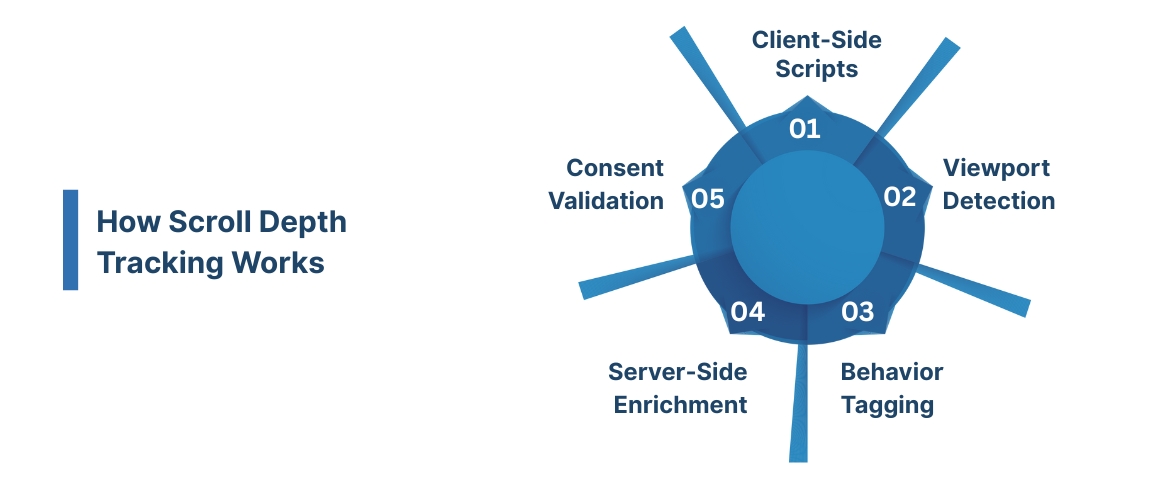
Scroll depth is captured through a combination of client-side measurement and consistent event governance. Here’s how it works:
- Client-side scripts: JavaScript monitors how far a user scrolls (25%, 50%, 75%, or full depth) and sends structured events to analytics tools.
- Viewport detection: Modern tracking checks element visibility, not just percentages, to identify when a user actually sees reviews, pricing, or CTAs.
- Behavior tagging: Scroll milestones are enriched with context such as time spent, product category, or engagement patterns for deeper insights.
- Server-side enrichment: Scroll events can be combined with server-side signals (like cart creation or purchase) for full-funnel intent analysis.
- Consent validation: Scroll tracking fires only after confirming user permissions, ensuring privacy-aligned behavioral analytics.
Together, these methods turn scroll depth from a simple measurement into a high-value signal that reveals content performance, shopper intent, and opportunities for more effective ecommerce re-engagement.
Similar Read: What Data is Google Analytics Unable to Track
Now that you have a better idea of how scroll depth tracking works, let’s explore why it’s essential for driving informed marketing decisions.
Why Scroll Depth Matters in 2025
Scroll depth has become one of the clearest signals of real user intent, especially as ecommerce journeys grow longer, more dynamic, and harder to measure. While clicks and pageviews show where users go, scroll behavior reveals how deeply they engage with product information, reviews, comparisons, and on-page content.
Without scroll tracking, brands lose visibility into critical micro-behaviors: users may skim past key sections, ignore trust badges, or drop off before reaching pricing or CTAs. These blind spots can distort analytics, weaken re-engagement strategies, and lower conversion efficiency.
Here’s why scroll depth is essential today:
Understand Real Engagement Quality
- Shows how far users consume content, not just whether they visited a page.
- Identifies which sections drive curiosity, hesitation, or abandonment.
- Reveals drop-off points that signal friction or information gaps.
Improve Personalization and Re-Engagement
- Enables intent-based triggers such as “viewed reviews but didn’t add to cart.”
- Helps tailor follow-ups (email, push, SMS) based on depth of product research.
- Distinguishes casual browsers from high-intent shoppers.
Optimize On-Page Experience
- Highlights unseen sections that need repositioning or shortening.
- Validates whether trust indicators, reviews, or USPs appear at the right place.
- Supports UX decisions with behavioral proof instead of guesswork.
Strengthen Analytics and Attribution
- Adds qualitative depth to metrics like product views and session time.
- Provides context that enhances funnel analysis and CRO testing.
- Enables more accurate segmentation for retargeting and lifecycle campaigns.
Future-Proof Measurement
- Works reliably even as cookies, identifiers, and tracking scripts face new limits.
- Captures meaningful engagement signals without requiring invasive tracking.
- Supports first-party data strategies built on real behavioral intent.
Scroll depth isn’t just a metric, it’s a lens into how shoppers think, explore, and decide.
Want scroll-depth data that’s clean, durable, and analytics-ready?
Ingest Labs helps brands route behavioral events like scroll depth through server-side pipelines with consistent schemas, real-time validation, and first-party identifiers. That means every engagement signal stays accurate, privacy-aligned, and ready for activation across your tools.
Challenges of Measuring Scroll Depth (And How to Solve Them)
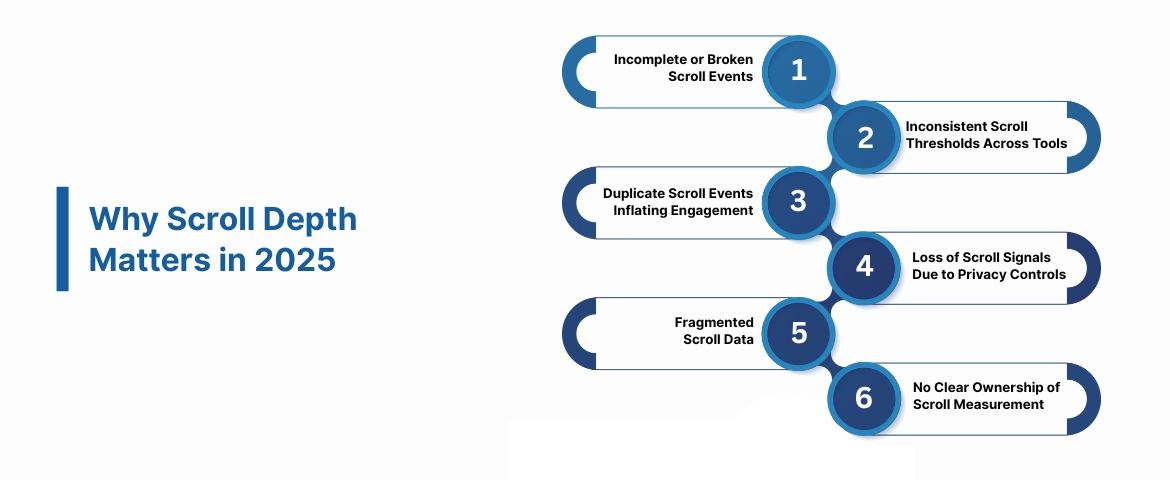
Scroll depth sounds like a simple metric, but capturing it accurately is far more complex. Browser restrictions, inconsistent event setups, and fragmented data pipelines often lead to unreliable measurements. When scroll-depth data is noisy or incomplete, teams misjudge content performance, engagement, and funnel drop-offs.
Below are the most common scroll-tracking challenges and how to solve them effectively:
1. Incomplete or Broken Scroll Events
Scroll tracking relies on client-side scripts that often fail due to ad blockers, script errors, or heavy page loads. As a result, some sessions record scroll progress while others don’t, creating erratic patterns that distort engagement insights.
Solution: Route scroll-depth events through a unified server-side pipeline once captured. Even if the front-end tracking varies, downstream consistency ensures analytics tools receive clean, usable data.
2. Inconsistent Scroll Thresholds Across Tools
One platform may track 25/50/75/100%, another uses 10% increments, and another logs a custom event. These mismatches make cross-tool reporting unreliable and prevent teams from comparing engagement across pages or campaigns.
Solution: Define a standard scroll-event schema (e.g., scroll_percentage, page_type, content_id). Enforce schema validation before events enter your warehouse or analytics tools.
3. Duplicate Scroll Events Inflating Engagement
Some scripts fire multiple scroll events for a single threshold, artificially boosting “engagement.” This makes sessions appear longer or more active than they actually are and can mislead optimization teams.
Solution: Apply deduplication logic in your event pipelines. Server-side validation ensures only one event per threshold is accepted.
4. Loss of Scroll Signals Due to Privacy Controls
Safari’s ITP, Firefox ETP, and consent frameworks frequently block client-side scripts, causing scroll events to disappear entirely. This creates drops in engagement that have nothing to do with user behavior.
Solution: Use first-party identifiers and consent-aware event routing. Even if front-end capture is limited, downstream systems maintain continuity and privacy alignment.
5. Fragmented Scroll Data Across Pages and Frameworks
Modern websites combine React, headless CMS blocks, and dynamic content loads. Scroll events may not fire consistently across these environments, leading to partial visibility into user journeys.
Solution: Normalize all scroll-depth events through a central processing layer. Real-time monitoring flags pages or templates where scroll events are missing.
6. No Clear Ownership of Scroll Measurement
Marketing, product, and engineering often assume someone else manages scroll tracking. This leads to silent failures that go unnoticed until a major reporting discrepancy appears.
Solution: Assign cross-functional ownership of behavioral events. Keep documentation, schemas, and validation automated to maintain quality across releases.
Accurate scroll-depth measurement isn’t just a UX metric, it’s a foundational signal for understanding content quality, engagement, and intent. By standardizing events, validating them server-side, and maintaining governance, brands get reliable behavioral insights they can trust.
Related Read: Event Tracking Tools for Google Analytics
Conclusion
Scroll depth is one of the most underrated signals in behavior analytics, yet it often suffers from inconsistent tracking, missing events, and unreliable client-side scripts. These gaps distort engagement insights, weaken content decisions, and break downstream reporting long before the data reaches analytics tools.
Ingest Labs solves this by stabilizing scroll-depth measurement through a unified event infrastructure. Ingest IQ ensures scroll events are captured consistently and delivered server-side for accurate processing. Ingest ID maintains durable, first-party recognition so scroll-depth data ties back to real user journeys, not fragmented sessions. Event IQ continuously audits event quality, detects missing thresholds, flags duplicates, and keeps the scroll-event schema clean and up to date.
Together, they turn scroll-depth tracking from a fragile front-end script into a dependable, insight-ready signal that strengthens content analytics, experimentation, personalization, and re-engagement workflows.
If you want scroll-depth data that’s accurate, durable, and analytics-ready, Ingest Labs can help. Book a demo today.
FAQs
1. How is scroll depth measured beyond simple percentage thresholds, and what are the implications?
Scroll depth can be tracked not just at fixed points like 25%, 50%, 75%, but also continuously at all scroll percentages or in pixel values. Measuring continuous scroll depth reveals more granular engagement patterns and helps identify precise drop-off zones rather than just broad engagement bands.
2. What are the challenges and best practices for implementing scroll depth tracking on complex, dynamic pages?
On pages with lazy loading, infinite scroll, or dynamically changing content heights, scroll depth calculations can be inaccurate. Best practice involves recalculating scrollable height after content loads and debouncing scroll events to reduce performance impact during rapid scrolling.
3. How do advanced analytics platforms use scroll depth data to optimize user experience and content layout?
Scroll depth data integrated with session recordings and heatmaps can pinpoint blocked or ignored content and validate UI changes. For instance, if users frequently scroll past a section but never interact with it, this might indicate poor visibility of calls to action or confusing navigation elements.
4. What limitations exist when using Google Analytics 4’s built-in scroll tracking, and how can they be overcome?
GA4 by default only tracks a single scroll event at 90%, missing insights from intermediate scroll points. This can be supplemented with Google Tag Manager to create custom scroll threshold triggers (e.g., 25%, 50%, 75%) for richer engagement analysis and event segmentation.
5. How can scroll depth tracking be used to create actionable scroll rate metrics across different page types?
Scroll rate is calculated by dividing the number of users reaching a specific scroll depth by total page visitors. By segmenting scroll rates by page type (landing page vs blog vs product page), marketers can tailor content length, CTAs, and page design to maximize engagement tailored to user intent.