How the Demise of Third-Party Cookies Impacts Online Advertising

What happens when access to 80% of cross-site audience signals is suddenly reduced, fundamentally altering the way campaigns reach buyers? U.S. marketers are experiencing this disruption now, as nearly half are actively overhauling their data strategies to deal with the change. As leading browsers pivot away from third-party cookies, the $250 billion digital advertising market is forced to adapt, with marketing leaders already questioning the reliability of new alternatives and third-party cookies’ advertising adoption surging in importance. The stakes for digital advertising have never been higher, as brands pivot strategies to retain control, stay compliant, and keep customer connections strong in the absence of old tracking methods.
Quick Overview
- Cookie Phase-Out: The removal of third-party cookies shifts focus to privacy and consent-based advertising strategies.
- Privacy & Regulations: Growing privacy concerns and laws like GDPR and CCPA demand transparent, consent-driven data practices.
- Challenges for Marketers: With less precise data, targeting accuracy, attribution, and costs become key hurdles in a cookieless world.
- Adaptation: Marketers should prioritize first-party data, contextual ads, privacy tools, and diversified measurement methods.
What is Third-Party Cookie Advertising?
Third-party cookies advertising refers to the use of cookies placed by external companies, not the website the user is visiting, to track their online behavior across different sites. These cookies collect valuable data on user preferences, allowing advertisers to deliver more personalized and targeted ads based on browsing history. As advertisers leverage this data, they can create highly relevant campaigns, boosting engagement and conversion rates by reaching the right audience with the right message at the right time.
However, with increasing concerns about privacy and data security, the reliance on third-party cookies is rapidly changing, leading to the upcoming phase-out of these tracking tools
What is Cookie Depreciation?
Cookie deprecation is the process of phasing out third-party cookies from browsers and ad technologies. These small files once powered ad targeting, retargeting, and audience building across multiple websites you rely on for campaigns. As browsers and regulators restrict their use, it limits how these cookies are created, read, or shared. This shift aims to protect user privacy, reduce cross-site tracking, and encourage transparent, consent-based data strategies for advertising.
As the digital ecosystem shifts toward a cookie-free landscape, it’s essential to understand the forces driving this change and what it means for your advertising strategies.
Why Are Third-Party Cookies Disappearing?
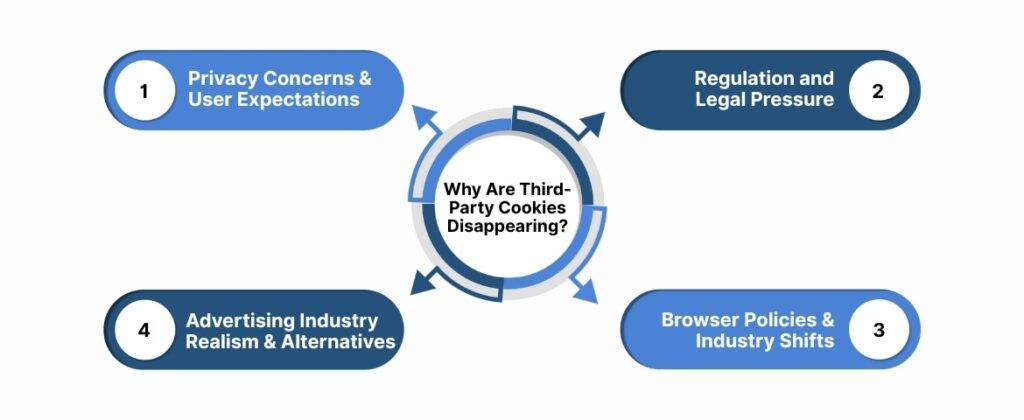
Third-party cookies are being phased out because online privacy expectations and data protection laws have evolved significantly. Advertisers can no longer rely on opaque tracking methods as users demand more transparency and consent. Here are the key factors driving this change and why it matters for your campaigns:
1. Privacy Concerns and User Expectations
People are far more aware of how data gets tracked and shared between websites. Cross-site tracking feels invasive and risks eroding trust with your audience over time. Stronger privacy expectations mean you need to build campaigns that respect user consent while still driving performance.
2. Regulation and Legal Pressure
Laws like GDPR and CCPA demand explicit opt-in consent, data minimization, and greater transparency for tracking. Traditional cookie-based tracking often conflicts with these regulations, putting your campaigns at risk of non-compliance. Adjusting your strategies early helps you stay compliant and avoid costly legal challenges.
3. Browser Policies and Industry Shifts
Safari and Firefox already block most third-party cookies by default, changing how audiences can be tracked. Chrome, holding the largest market share, plans to follow suit with its Privacy Sandbox framework. These browser updates mean you must explore privacy-focused solutions to keep campaigns measurable and effective.
4. Advertising Industry Realism and Alternatives
The industry is shifting toward privacy-friendly targeting approaches like contextual ads and first-party data collection. Aggregated measurement and identity solutions help maintain personalization without compromising privacy. Adopting these approaches early keeps you ahead while building campaigns that align with user expectations and regulations.
Understanding these factors will help you navigate the new landscape, where privacy is becoming a central consideration in advertising.
Challenges Posed by Google’s Cookie Deprecation
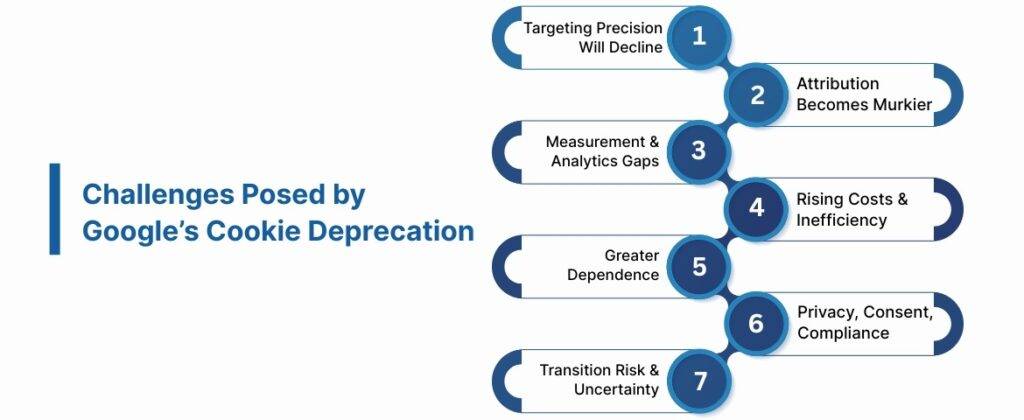
The end of third-party cookies introduces a mix of technical, strategic, and financial challenges for digital advertisers. Your ability to target, measure, and optimize campaigns becomes more complex without user-level tracking. Understanding these challenges helps you prepare early and reduce risks to campaign performance and ROI.
1. Targeting Precision Will Decline
Losing cross-site tracking reduces how accurately you can build audience segments or retarget engaged users. This may lead to wasted impressions and missed opportunities to convert interested visitors. You’ll need new data strategies to maintain the same level of relevance your campaigns previously achieved.
2. Attribution Becomes Murkier
Determining which ads truly drive conversions becomes harder when you cannot follow users across multiple sites. Multi-touch attribution models may become less accurate, making budget allocation more difficult. Adopting privacy-friendly tracking solutions can help preserve insight into performance while respecting user consent.
3. Measurement and Analytics Gaps
The data loss from cookie deprecation creates blind spots in understanding full customer journeys and campaign performance. Important signals like ad exposures or on-site behaviors may go untracked entirely. Filling these gaps requires investment in server-side tracking, enhanced conversions, or unified analytics platforms.
4. Rising Costs and Inefficiency
With less precise targeting, you risk spending more to acquire the same number of conversions. Broader targeting could result in a higher cost per acquisition (CPA) and wasted ad spend. Smarter use of first-party data and predictive modeling can help you keep campaigns profitable.
5. Greater Dependence on Walled Gardens
Platforms like Google, Meta, and Amazon offer powerful targeting through their first-party data but limit transparency. Relying too heavily on them can mean less control over your data and rising media costs. Diversifying your ad spend and building your own data assets helps maintain independence.
6. Privacy, Consent, and Compliance Complexity
Collecting first-party data requires clear user consent and compliance with global privacy regulations like GDPR and CCPA. Missteps can lead to reputational damage or costly fines. Having an advanced consent management process ensures you gather data responsibly while keeping campaigns legal.
7. Transition Risk and Uncertainty
Google’s shifting timeline for Privacy Sandbox and cookie phaseout creates uncertainty for long-term planning. Investing too early in unproven solutions might result in wasted time and resources. Staying flexible with a phased approach helps reduce disruption when standards finally stabilize.
As advertisers try to adjust to this new reality, it’s critical to understand how these challenges will manifest in day-to-day operations. Finding effective workarounds will be key to maintaining campaign performance.
Best Practices for Marketers in the Post-Cookie Era
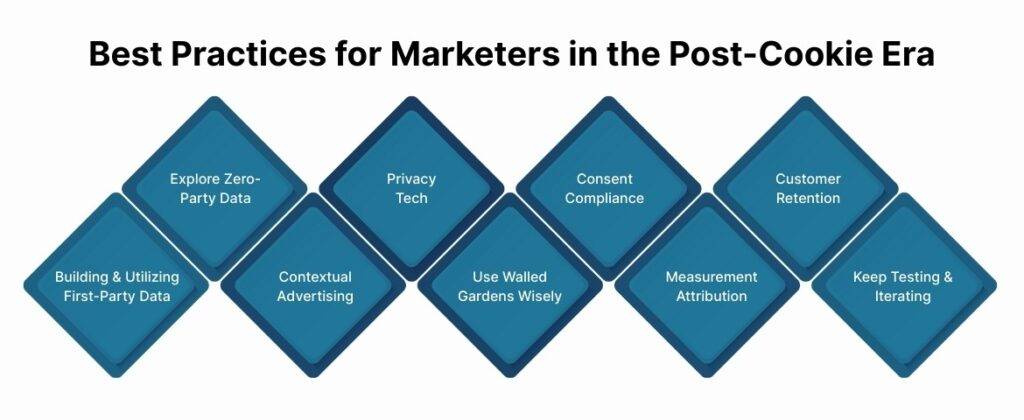
The end of third-party cookies means you need fresh strategies to keep campaigns measurable and compliant. Adjusting early helps you protect performance and avoid costly disruptions.
Here are the key practices you should focus on to succeed in a privacy-first, cookie-free environment:
1. Building and Utilizing First-Party Data
Collecting and activating first-party data becomes the foundation of future targeting strategies. This ensures audience insights stay reliable and privacy-compliant. Invest in infrastructure to store and use this data effectively.
Here’s how you can approach it:
- Collect data through sign-ups, loyalty programs, surveys, and gated content.
- Use CDPs to unify, clean, and activate the data for campaigns.
- Make sure consent is clearly collected and regionally compliant.
Ingest ID unifies first-party data, enabling real-time segmentation and personalization for precise targeting.
2. Explore Zero-Party Data
Zero-party data offers voluntarily shared insights like preferences and feedback, making personalization stronger. It is high quality and consistent. Combine it with first-party data to build deeper profiles.
Here’s what you can do:
- Use quizzes, polls, or surveys to collect declared user preferences.
- Integrate this data into campaigns for confident personalization.
- Keep experiences engaging to encourage voluntary sharing.
Event IQ integrates zero-party data for richer profiles and more meaningful campaign personalization.
3. Contextual Advertising and Content Alignment
Contextual targeting reduces reliance on personal identifiers by matching ads to page content. This keeps ads relevant while respecting privacy expectations. Renewed interest makes it a strong post-cookie solution.
Steps to implement:
- Match ad creatives to relevant article or page content.
- Use real-time page analysis to place ads in contextually relevant spots.
- Monitor performance to identify high-performing contexts.
Event IQ provides insights into page-level engagement to optimize contextual placements.
4. Adopt Privacy-Preserving Technologies
New APIs and privacy-first tools let you measure campaigns without exposing personal data. Early adoption keeps you ahead of compliance requirements. Pair these with robust tracking setups.
How to get started:
- Experiment with Google’s Privacy Sandbox solutions like Topics API.
- Use clean rooms or hashed IDs for secure data collaboration.
- Shift to server-side tracking where possible.
Ingest IQ delivers server-side tracking, bypassing browser limitations while staying privacy-compliant.
5. Use Walled Gardens Wisely
Platforms still offer strong targeting through first-party data, but heavy reliance limits control. Balancing spend across channels protects long-term flexibility.
Here’s how to balance usage:
- Run campaigns on major platforms, but diversify your mix.
- Negotiate for data transparency and reporting access.
- Build your own data assets alongside.
Event IQ gives you a full cross-channel performance view, reducing over-reliance on walled gardens.
6. Strengthen Consent and Compliance Processes
Clear consent builds trust and meets global privacy standards. A strong privacy framework keeps campaigns legally safe.
Here’s what to focus on:
- Use an advanced consent management platform (CMP).
- Keep privacy policies clear and up to date.
- Audit data practices regularly.
Event IQ ensures compliance with GDPR, CCPA, and other regulations through built-in consent tracking.
7. Diversify Measurement and Attribution Models
Relying on cookies alone no longer works for accurate performance tracking. Combining models gives a clearer view of ROI.
Steps you can take:
- Run media mix modeling and incrementality tests.
- Use server-side analytics to capture more events.
- Stitch user journeys with first-party data.
Ingest IQ provides robust server-side event tracking and reporting for dependable attribution.
8. Focus on Customer Relationships and Retention
As acquisition costs rise, retention becomes critical for profitability. Nurturing loyalty improves lifetime value and repeat purchases.
Ways to boost retention:
- Create loyalty programs with tangible rewards.
- Personalize follow-ups using behavioral data.
- Collect customer feedback to improve the experience.
Event IQ tracks behavior to trigger personalized retention campaigns at the right moments.
9. Keep Testing and Iterating
The post-cookie landscape is evolving fast, so adaptability is key. Ongoing testing helps you find what works.
Practical ways to iterate:
- Test different targeting models and ad formats regularly.
- Monitor performance under cookieless conditions.
- Stay updated on browser and platform changes.
Ingest IQ offers real-time monitoring so you can pivot campaigns quickly when trends shift.
As you consider the right approach, there’s more to uncover about the tools and strategies that will set you up for success in this new privacy-first digital era.
Also read: How to Create High-Converting Conversion Pages
What Marketers Should Do Now?
The shift away from third-party cookies requires proactive planning to avoid data loss and performance drops. Acting early helps you protect targeting accuracy and campaign ROI before cookie deprecation fully rolls out.
Here’s how you can prepare and future-proof your strategy:
- Audit what third-party cookies and tracking you currently depend on: which tags, pixels, and partners. Identify which ones are critical and which can be phased out.
- Map out your first-party data sources: website, app, customer profiles. See where there are gaps.
- Begin testing alternative targeting (contextual, behavioural on your owned properties) as early as possible.
- Invest in tools that help with measurement that don’t rely on third-party cookies: e.g., clean rooms, identity graphs, privacy sandbox tools, server-side analytics.
- Ensure your privacy/legal/compliance teams are involved early: consent, data storage, and data sharing will all be more scrutinized.
The urgency is clear, but there are practical steps to take right now that will lay the foundation for a more sustainable and effective advertising strategy moving forward.
Final Thoughts
The deprecation of third-party cookies marks a major turning point in third-party cookies advertising. It forces businesses to rethink how they collect, measure, and activate data while staying privacy-compliant. Preparing now ensures campaigns remain accurate, cost-efficient, and competitive in a cookieless future
Ingest Labs provides the tools you need to stay ahead of these changes. With Ingest IQ for server-side tracking, Ingest ID for first-party identifiers, and Event IQ for unified data intelligence, you can capture accurate customer signals, ensure privacy compliance, and deliver highly personalized experiences. These solutions help maintain strong attribution, improve campaign performance, and maximize ROI in a post-cookie world.
Ready to future-proof your marketing? Contact Ingest Labs today to explore tailored data solutions that keep your campaigns accurate and privacy-compliant.
Frequently Asked Questions (FAQs)
1. What are third-party advertising cookies?
Third-party advertising cookies are tracking mechanisms placed on users’ devices by external entities—advertising networks or data brokers—rather than the website they are visiting. These cookies collect user data across multiple sites to help advertisers build more targeted ad campaigns.
2. What is 3rd party advertising?
Third-party advertising refers to ad placements facilitated by external companies that aren’t directly affiliated with the website being visited. These advertisers track users across various sites, leveraging data to serve personalized and more relevant advertisements based on browsing behavior.
3. What is an advertising cookie?
An advertising cookie is a small file stored on a user’s device by an advertiser to track their online behavior and interactions. These cookies enable advertisers to deliver customized, behavior-based ads, improving campaign relevance and engagement.
4. How to identify 3rd party cookies?
To identify third-party cookies, marketers can use browser developer tools or check cookie settings in ad servers and tracking platforms. These cookies typically come from external domains that are not the site the user is currently visiting, signaling that the data is being collected by a third-party service.
5. How to identify first-party and third-party cookies?
First-party cookies are those set by the domain of the website a user is actively visiting, whereas third-party cookies are set by different domains, usually advertisers or data collectors. Marketers can distinguish between them by reviewing cookie properties in browser developer tools or cookie management platforms.
6. How to check which cookies are used?
To check which cookies are being used, digital marketers can use browser tools like cookie management software. Most browsers allow you to see a list of both first-party and third-party cookies under their privacy or security settings, helping you track and manage cookies across different platforms and campaigns.