



For digital marketers, e-commerce teams, and agencies managing multiple campaigns, missed insights can lead to abandoned carts, wasted ad spend, and low customer engagement. Predictive customer analytics helps solve this by turning past interactions; clicks, purchases, and dropouts, into forecasts, allowing you to anticipate churn, personalize campaigns, identify cross-sell opportunities, and improve ROI across channels.
The U.S. predictive analytics market is projected to grow at a 21.8% CAGR through 2034, showing that businesses adopting these insights can outperform competitors and make smarter, faster marketing decisions, while reducing wasted resources and increasing conversions.
Key Takeaways
- Use past customer data to forecast future behaviors, like churn risk or repeat purchases, to drive smarter marketing decisions.
- Employ machine learning models, hybrid techniques, and real-time data to fine-tune predictions and enhance personalization.
- Leading companies like Amazon and Netflix use sophisticated predictive systems to optimize product recommendations, forecast demand, and improve customer retention.
- Predictive analytics improves targeting, reduces churn, and maximizes ROI, helping businesses create more efficient, data-driven marketing campaigns.
What Is Predictive Customer Analytics?
Predictive customer analytics is the practice of using historical and real-time customer data to forecast future behaviors, such as which customers are likely to churn, which ones will buy again, or who’s primed for upsell. It transforms raw data into forward-looking signals.
While descriptive analytics tells you “what happened” and diagnostic analytics says “why it happened,” predictive analytics asks: “What will happen next?” This difference is powerful because it lets you act before outcomes occur.
For example:
- It can flag customers about to churn, so you intervene early.
- It can identify which users are likely to respond to cross-sell offers.
- Predictive analytics estimates expected lifetime value (eLTV) for new leads using lookalike or early behavioral signals.
Predictive customer analytics is a core capability in modern marketing stacks, especially in a post-cookie world where first-party data is becoming more valuable. But how exactly does it work in practice? Let’s break down the key steps involved in making these predictions a reality for your marketing efforts.
How Predictive Analytics Works?
Predictive customer analytics turns raw customer data into actionable insights by combining data science, machine learning, and customer behavior analysis. Here’s a simplified breakdown of the workflow:
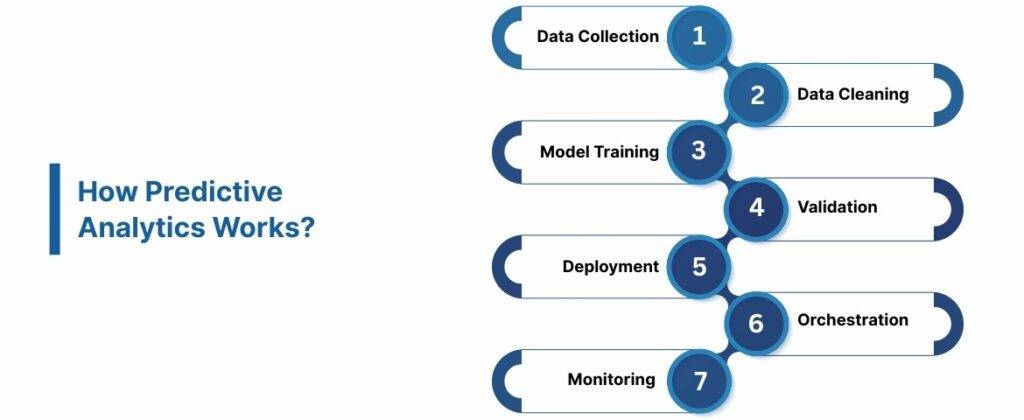
1. Data Collection & Integration
Every customer interaction, website clicks, purchases, email engagement, or support tickets creates valuable signals. By integrating these signals from tools like CRMs, ad platforms, and e-commerce systems, you get a unified dataset. This connected view ensures your predictions aren’t based on fragments, but the complete customer journey.
Example: An e-commerce store connects Shopify sales data with Google Ads clicks to see which campaigns drive repeat buyers.
2. Data Cleaning & Feature Engineering
Raw data usually comes with duplicates, gaps, and inconsistencies that weaken accuracy. Cleaning ensures models aren’t misled by missing values or outdated entries. Feature engineering then turns behavior (recency of purchase, browsing frequency, cart size) into variables that models can learn from.
Example: A retailer creates a “days since last purchase” feature to identify customers most at risk of churning
3. Model Training
Machine learning models such as logistic regression, gradient boosting, or neural networks are trained on labeled data. For example, they learn patterns that separate customers who churn from those who renew or purchase again.
This training phase helps the model “understand” signals that lead to repeat purchases, cart abandonment, or upsell opportunities.
Example: A subscription business trains a churn model using past customer cancellations to predict who might cancel next month.
4. Validation & Testing
Models must be tested to make sure they work beyond historical data. Metrics like ROC AUC, precision, and recall measure whether predictions are both accurate and useful. Validation protects you from relying on insights that might fail when applied to live campaigns.
Example: A fashion brand tests its upsell model on a holdout group and finds a 15% higher AOV in the predicted buyers.
5. Deployment & Scoring
Once validated, the model assigns probabilities—for instance, a customer’s likelihood of purchase or churn. These scores can be piped into marketing tools, CRMs, or CDPs to personalize outreach. For example, a high-value customer flagged as “at churn risk” can automatically receive a loyalty reward campaign.
Example: A travel agency scores customers and sends high-conversion prospects early access offers for holiday deals.
6. Action & Orchestration
The real power comes when predictions fuel automated decisions. Marketers can trigger retention offers, launch targeted ads, or push product recommendations without manual guesswork. This orchestration turns predictive customer analytics into a revenue engine instead of just a reporting tool.
Example: An ad agency uses churn predictions to adjust Facebook ad spend, focusing only on customers likely to convert.
7. Monitoring & Retraining
Customer behavior evolves, especially with new products, competitors, or shifting privacy regulations. Models degrade if not refreshed; this is called model drift. By retraining on fresh data, businesses keep predictions sharp and avoid campaign fatigue.
Example: A SaaS company retrains its model quarterly to account for seasonality in sign-ups and cancellations.
Also read: Kickstart Your Success with Cross-Channel Attribution Models
Once the underlying process is clear, the next step is to explore the analytical techniques that enable predictive customer analytics to deliver accurate, actionable insights.
What are predictive analytics techniques?
When you hear “predictive customer analytics,” you’re really talking about using techniques to forecast what your customers will do next, so you can act faster and smarter.
Here are some of the key techniques you’ll want to understand and apply:
- Regression analysis: You use this to estimate how different inputs affect an outcome (for example: how does a price drop impact repeat purchases?).
- Classification and decision trees: These techniques help you categorise customers (e.g., likely to churn vs likely to stay) and visualise how different choices or behaviours branch out.
- Neural networks / deep learning: When customer behaviour becomes complex, and relationships between signals are non-linear, you lean into neural nets to recognise patterns a simpler model might miss.
- Time-series & sequence modelling: Rather than just asking “will this customer purchase again?”, you ask “what sequence of behaviours will lead them to upgrade, churn, or cross-sell?”
- Propensity scoring & lookalike modelling: You estimate the likelihood a user will perform a given action (e.g., buy, churn) and then find others that look like your high-propensity users.
- Real-time scoring/streaming analytics: You’re not waiting until the week’s end; you’re taking live customer signals (clicks, carts, support interactions) to predict next steps and trigger actions in the moment.
With the process laid out, let’s look at the core techniques that turn predictive customer analytics from theory into actionable intelligence.
Uses and examples of predictive analytics
With these techniques established, the next step is understanding how predictive customer analytics translates into practical, high-impact use cases across industries.
Here are concrete uses you can apply today:
- Fraud detection: Monitoring behaviour in real time to detect anomalies (for example, unusual purchase activity) and block or flag risky transactions before they hit your ROI.
- Conversion and purchase prediction: Predict which visitors are most likely to convert, then tailor your ad spend or personalise messaging at the right moment to them.
- Risk reduction: If you’re in subscription services or finance adjacent, you can predict churn, defaults, or credit risk, and proactively engage with interventions.
- Operational improvement: Within e-commerce, you can forecast inventory needs, optimise logistics, and use predictive insights to keep supply chains lean and responsive.
- Customer segmentation & personalised journeys: You segment customers not just by what they did, but by what they’ll likely do, and tailor their journey accordingly (upsell, cross-sell, retain).
- Maintenance forecasting / lifecycle modelling: If you’re offering SaaS or usage-based products, you predict when a user will ramp down, upgrade, or churn and then engage before that happens.
- Cross-channel targeting and budget optimisation: You use predictive scores to focus your budget where customers are most likely to act, rather than blasting a broad audience and hoping for the best.
After mastering the foundational use cases, the next stage is adopting advanced strategies that refine accuracy, scalability, and real-time responsiveness in your predictive analytics initiatives.
Advanced Strategies for Predictive Customer Analytics
Once you’ve mastered the basics, you can adopt advanced strategies to extract even deeper insights and drive smarter marketing decisions. Here are some of the most effective tactics to elevate your predictive customer analytics efforts:
1. Ensemble & Hybrid Modeling
Ensemble and hybrid modeling combine multiple machine learning algorithms to improve prediction accuracy and reliability. Combining random forests with gradient boosting improves accuracy and robustness across customer segments.
- Improves Accuracy: Combining models captures nuances across various customer behaviors.
- Reduce Overfitting: Hybrid approaches generalize better to unseen data.
- Enhanced Marketing Decisions: More reliable predictions help tailor campaigns effectively.
Use Ingest IQ’s data streaming to feed unified first-party customer data into multiple models for ensemble predictions. Digital marketers and e-commerce teams can gain more reliable insights to enhance targeting, forecasts, and retention.
2. Time-Series & Sequence Modeling
Time-series and sequence models focus on predicting behavior over time instead of static snapshots. Models like LSTM, GRU, or Transformers capture temporal patterns in customer interactions for more precise forecasting. This approach is particularly useful for churn prediction, product usage trends, and customer lifecycle modeling.
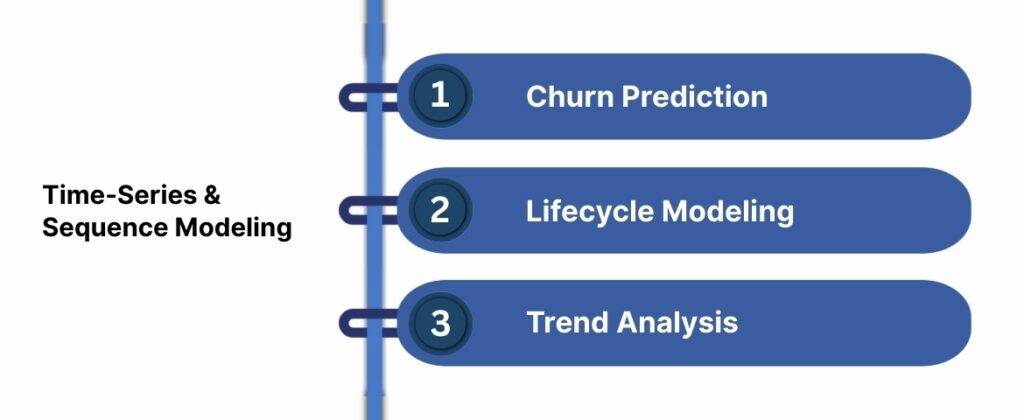
- Churn Prediction: Forecast when a customer might disengage based on usage patterns.
- Lifecycle Modeling: Understand progression from onboarding to repeat purchases.
- Trend Analysis: Detect seasonality or campaign effects on user behavior.
Utilize Event IQ to capture sequential event data (logins, purchases, clicks) and feed it into LSTM or GRU models. Marketing teams can anticipate customer behavior trends, plan retention campaigns, and optimize onboarding flows effectively.
3. Propensity Scoring & Lookalike Modeling
Propensity scoring assigns a likelihood of an action, helping you target the right customers at the right time. Lookalike modeling identifies prospects resembling your highest-value customers, scaling acquisition efficiently. Combined, these methods allow personalized campaigns that increase conversions and ROI.
- High-Value Targeting: Focus on users most likely to purchase or engage.
- Prospect Expansion: Find lookalike audiences to acquire new customers faster.
- Campaign Optimization: Prioritize efforts for maximum impact.
Use Ingest ID to unify cross-device customer profiles, then calculate propensity scores and generate lookalike segments. Agencies and e-commerce brands can efficiently target high-potential prospects, scale acquisition, and maximize marketing ROI
4. Behavioral Path Prediction
Behavioral path prediction forecasts a sequence of actions rather than single events, improving personalization. It helps anticipate what a user might do next, such as moving from trial to upgrade or adding items to the cart. This enables proactive campaigns that increase engagement and reduce churn.
- Journey Forecasting: Predict the most likely next steps in the user journey.
- Upsell & Cross-Sell: Trigger recommendations at the right moment.
- Retention Campaigns: Intervene before disengagement occurs.
Track multi-touch customer events via Ingest IQ and Event IQ for behavioral path modeling. You can proactively trigger upsell, cross-sell, or retention campaigns exactly when the customer is most likely to convert.
5. Real-Time Scoring & Streaming
When connected to your real-time ML scoring infrastructure, Ingest Labs can forward predictions to marketing tools for rapid personalization. Streaming predictions into marketing platforms supports immediate personalization, notifications, or UI adjustments. This reduces latency between insight generation and action, increasing campaign effectiveness.
- Instant Personalization: Adjust content, offers, or messaging live.
- Push Notifications: Send timely alerts based on predicted intent.
- Dynamic UI Adjustments: Tailor the website or app experience instantly.
When connected to your real-time machine learning scoring infrastructure, Ingest Labs can forward predictions to your marketing tools so you can respond quickly to customer behavior.
6. Cohort-Level Forecasts & Lift Modeling
Cohort-level forecasting evaluates trends for groups instead of individuals to understand broader impact. Lift modeling measures the incremental effect of campaigns, helping quantify the true ROI of marketing efforts. Together, these strategies refine resource allocation and campaign prioritization.
- Group-Level Insights: Spot trends among segments of customers.
- Campaign ROI Measurement: Understand which initiatives drive real results.
- Resource Allocation: Focus on campaigns that deliver measurable lift.
Aggregate cohort event data in Event IQ and apply lift modeling to evaluate campaign performance. Helps digital marketing managers optimize spend across segments, measure true ROI, and replicate winning campaigns.
7. Explainability & Attribution Integration
Explainable AI ensures you understand why models make specific predictions, increasing trust and actionability. Integrating predictive analytics with attribution connects insights directly to campaign performance. This helps teams make informed, data-driven decisions that improve both engagement and spend efficiency.
- Model Transparency: Tools like SHAP and LIME reveal drivers behind predictions.
- Attribution Linking: Tie predicted outcomes to specific marketing campaigns.
- Improved Decisions: Allocate budget and strategies based on actionable insights.
Export model predictions and integrate with Tag Manager attribution workflows for campaign-level insights. Marketing teams gain transparency, making decisions more confidently and effectively linking predictions to revenue results.
8. Adaptive Feedback Loops
Adaptive feedback loops capture outcomes from predictions and feed them back into retraining processes. This continuous learning keeps models accurate as customer behavior evolves or new trends emerge. It ensures predictive analytics remains relevant and actionable over time.
- Continuous Improvement: Models update based on real outcomes.
- Behavioral Adaptation: Adjust predictions as customer preferences shift.
- Campaign Refinement: Optimize messaging and offers based on model feedback.
Use Ingest IQ’s data streaming to send real-time event outcomes back into your predictive models. This keeps predictions accurate over time, ensuring campaigns adapt to evolving customer behaviors and market trends.
9. Cross-Domain Signals & Third-Party Data
Enhancing first-party data with compliant third-party or external signals can strengthen predictive power. Demographics, firmographics, or macro trends provide a richer context for accurate predictions. This approach broadens insights while keeping data privacy at the forefront.
- Enhanced Segmentation: Combine multiple data sources for better targeting.
- Improved Accuracy: External signals help refine probability scores.
- Privacy-First Insights: Integrate safely without violating regulations.
Ingest Labs supports compliant integrations with approved external data providers, depending on your tech stack and permissions.
Let’s talk about how these insights are helping businesses meet goals, from better targeting to increasing conversions.
Also read: Understanding the Importance and Meaning of Conversion Attribution
Key Advantages of Predictive Customer Analytics
Predictive customer analytics helps marketing, e-commerce, and advertising teams make smarter decisions, increase conversions, and create more personalized customer journeys.
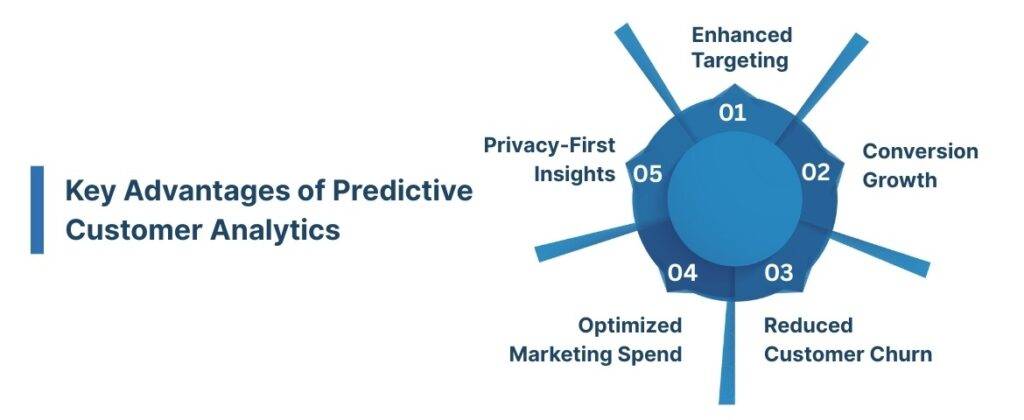
1. Enhanced Targeting and Personalization
Unifying customer profiles across devices and platforms gives you a complete view of user behavior, allowing campaigns to deliver highly relevant recommendations and offers. For example, an online shopper browsing on mobile can be shown products previously viewed on desktop, improving engagement and purchase likelihood. Ingest ID in Ingest Labs consolidates cross-device data in real time, enabling you to personalize campaigns effectively while maintaining full privacy compliance.
2. Increased Conversion Rates
Real-time scoring of customer actions lets you trigger offers or messages at the exact moment a user is most likely to convert. For instance, a subscription service can detect when a trial user is about to churn and immediately provide a personalized discount to encourage sign-up. Ingest IQ in Ingest Labs captures user behavior server-side and generates actionable predictive scores, helping you increase conversions precisely when it matters most.
3. Reduced Customer Churn
Analyzing sequential behavior helps identify at-risk customers before they disengage, allowing for proactive retention campaigns. For example, a SaaS company can detect inactive users and send personalized reminders or offers to re-engage them. Event IQ in Ingest Labs tracks user journeys and provides predictive churn insights, so you can take targeted actions to retain high-value customers.
4. Optimized Marketing Spend
Forecasting segment-level responses allows your teams to allocate budgets efficiently, focusing on audiences that will deliver the highest ROI. For example, an advertising agency can direct ad spend toward high-propensity users during a new product launch, reducing wasted costs. Event IQ in Ingest Labs generates cohort-level predictions, enabling smarter budget allocation and maximizing campaign effectiveness.
5. Privacy-First Insights
Collecting and analyzing data without exposing sensitive user information ensures compliance with GDPR, CCPA, and other privacy laws while still producing actionable predictions. For instance, an e-commerce site can recommend products based on behavior patterns without ever sharing personal identifiers. Ingest IQ and Tag Managerin Ingest Labs provide server-side data collection and governance, letting you generate predictive insights safely and compliantly.
Let’s take a closer look at some of the challenges you might face while implementing predictive customer analytics.
Limitations of Predictive Customer Analytics
While predictive customer analytics delivers powerful insights, it’s important to understand potential challenges to set realistic expectations.
1. Data Quality & Governance
Predictive models depend on accurate, complete, and consistent data. Missing or outdated customer records can reduce prediction accuracy and distort insights. Establishing strong data governance, regular validation, and centralized tracking ensures every prediction reflects real user behavior and not incomplete datasets.
Ingest IQ in Ingest Labs helps maintain high-quality, unified data through server-side tracking, but it still requires continuous data validation and monitoring by your team.
2. Model Maintenance & Drift
Customer behavior and market conditions evolve quickly. Without regular retraining, models lose accuracy, a problem known as model drift. Setting up continuous feedback loops and periodic retraining helps your models stay relevant and capture new behavioral patterns effectively.
Event IQ in Ingest Labs supports continuous feedback loops and retraining, but your team needs to manage model updates for optimal performance.
3. Integration Complexity
Connecting predictive insights with existing marketing tools, CRMs, and analytics systems often requires technical expertise. Inconsistent data formats or disconnected workflows can delay action. Using server-side tracking and unified data platforms simplifies integration, ensuring predictions translate into measurable marketing outcomes.
Ingest Labs allows integration of compliant third-party or external datasets, though the quality and relevance of external data sources directly affect prediction reliability.
4. Interpretability & Transparency
Complex machine learning models sometimes provide accurate predictions without clear reasoning. This lack of transparency can make it difficult to justify decisions. Incorporating explainable AI techniques helps teams understand why predictions occur, increasing confidence, accountability, and alignment with compliance standards.
Ingest IQ and Tag Manager in Ingest Labs enable real-time scoring and action triggers, but teams must configure workflows carefully to utilize predictions effectively.
Final Thoughts
Predictive customer analytics is no longer optional; it’s essential for businesses aiming to make smarter marketing decisions, improve conversions, and deliver personalized experiences at scale. By utilizing customer behavior, historical data, and predictive models, companies can anticipate trends, reduce churn, and allocate marketing budgets more effectively. Implementing these strategies ensures a competitive edge in today’s data-driven, privacy-conscious digital landscape.
Ingest Labs makes these capabilities accessible and actionable with its suite of solutions. Ingest IQ provides server-side tracking and real-time data streaming for precise measurement, Ingest ID Ingest ID unifies user identifiers across devices and sessions to support building customer profiles in your analytics or CDP systems. Event IQ unifies cross-channel data to optimize campaigns and reduce cart abandonment. Together, these tools help you turn predictive insights into concrete marketing actions while maintaining compliance with global privacy regulations.
Try Ingest Labs free trial for 30 days! See how it helps improve conversions and personalize customer experiences.
FAQ
1. What is predictive analytics?
Predictive analytics is a method of using the past history, statistical algorithms, and machine learning to forecast the probability of future events. It assists companies in predicting customer behavior and trends, as well as making sound decisions based on the data.
2. How does predictive analytics differ from forecasting?
While forecasting estimates future values based on historical data, predictive analytics assesses the probability of specific outcomes, allowing for more targeted and actionable insights. For example, forecasting might predict overall sales, whereas predictive analytics can identify which customers are likely to make a purchase.
3. What are the main benefits of using predictive analytics in business?
Predictive analytics enables businesses to reduce churn, personalize marketing efforts, optimize resource allocation, and improve decision-making processes by providing insights into future trends and behaviors.
4. Which industries benefit the most from predictive analytics?
Industries such as healthcare, finance, retail, manufacturing, and logistics utilize predictive analytics to enhance customer experiences, manage risks, and streamline operations. For instance, insurers use it for risk assessment, while retailers apply it for inventory management.
5. What challenges should businesses consider when implementing predictive analytics?
The issues common to it are data quality problems, model drift, complexities of integration, and the requirement of an experienced workforce. These demands include effective data governance, lifelong model testing, trainers, and technology investments.