




Is your mobile ad spend still delivering the measurable ROI your business expects? For many marketing and e-commerce teams, performance is becoming harder to track.
Mobile device ID tracking, once the foundation of attribution and targeting, is rapidly failing. You are losing critical conversion signals, attribution models are weakening, and compliance risks are rising across the United States and Canada.
The challenge is not small. According to industry reports from Wifitalents, 54% of digital advertisers view ad fraud as a major threat, driving up acquisition costs and compromising the accuracy of their metrics. At the same time, North American privacy laws now classify mobile identifiers as personal information, increasing regulatory pressure on legacy tracking methods.
This guide shows you what has changed and how to rebuild your mobile data strategy with consent-driven, first-party identity solutions.
Key Takeaways
- Mobile device ID tracking is failing due to OS restrictions, low ATT opt-ins, and privacy laws.
- Loss of IDFA/GAID visibility weakens attribution, targeting, and optimization across mobile campaigns.
- Rising ad fraud and compliance risk make legacy device-based tracking unreliable in 2026.
- First-party identity and server-side tracking restore accurate, consented mobile measurement.
- An integrated identity and tracking stack is required for privacy-safe attribution and unified mobile data.
What is Mobile Device Tracking?
Mobile device tracking has been used by marketers and app developers to understand user behavior, attribute app installs, and deliver targeted advertising across mobile properties. The method relied on identifiers assigned by operating systems. These IDs were resettable but persistent enough to connect impressions, clicks, and conversions.
In 2026, this system is no longer dependable. Operating systems have restricted access, regulations require explicit consent, and user opt-in rates have fallen dramatically. You now need a more stable and compliant foundation to maintain attribution and campaign performance.
Why Device ID Tracking Was Used
For years, mobile device ID tracking was the cornerstone of cross-app and cross-channel marketing, enabling digital marketers and advertising agencies like you to perform four critical functions reliably:
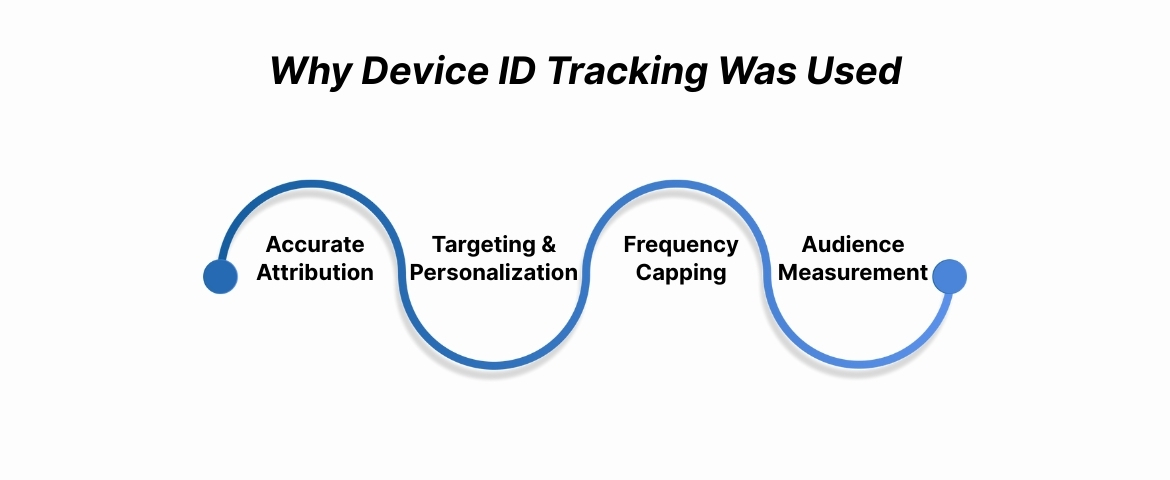
- Accurate Attribution: This was the primary function. You could link a user's exposure to a specific ad (e.g., an ad impression on App A) to a later conversion event (e.g., an app install or purchase on App B).
- Targeting and Personalization: The IDs allowed you to build custom audience segments based on behavior tracked across multiple apps, delivering highly personalized advertising campaigns.
- Frequency Capping: You relied on the device ID to limit the number of times a single user saw the same ad creative, preventing ad fatigue and wasted ad spend.
- Audience Measurement: The IDs provided the unique count necessary to measure campaign reach and effectiveness, allowing you to precisely calculate key metrics like ROAS and CPA.
Without reliable device-level signals, these functions break down, forcing you to rebuild your measurement and identity strategy. This shift makes it essential to understand why device IDs became so central in the first place and what types of identifiers marketers have traditionally relied on.
Types of Device Identifiers and Their Risks
Digital advertising has traditionally relied on several types of identifiers, which can be grouped by their persistence and, more critically, their compliance risk in North America:
| Identifier Type | Examples | Persistence & Control | Compliance Risk (US/Canada) |
| OS-Level Advertising IDs | IDFA (Apple), GAID (Google) | Resettable by user; Controlled by platform | High Risk (Due to low opt-in and deprecation) |
| Permanent Hardware IDs | IMEI, Serial Numbers | Permanent; Non-resettable | Illegal for Marketing (Highly sensitive PI) |
| Inferred Identifiers | Digital Fingerprinting, IP as ID | Semi-persistent; Inferred | Extreme Risk (Bypasses consent, non-compliant) |
| First-Party Identifier | Hashed Login, Ingest ID | Persistent; Controlled by You | Low Risk (Consent-driven and compliant) |
The table above clearly illustrates that relying on OS-level and inferred IDs introduces uncontrollable risk. Your business must shift away from the legacy IDs toward the stable, compliant first-party identity provided by Ingest ID.
Understanding the different device identifiers and the risks they carry sets the stage for an even bigger shift underway. As stricter privacy laws, platform policies, and user expectations evolve, they're fundamentally reshaping how mobile ID tracking works and what marketers can realistically rely on next.
How Privacy Trends are Reshaping Mobile ID Tracking in 2026
The collapse of device ID tracking is the result of global privacy standards that prioritize explicit user choice and minimize personal data exposure. You now operate in an ecosystem that demands active consent, transparency, and data minimization.
1. Regulatory Pressure Across North America
Laws such as the CCPA, the California Privacy Rights Act (CPRA), and Canada’s proposed Consumer Privacy Protection Act (CPPA) treat many device identifiers as personal information when they can be linked to an individual. These laws require you to:
- Honor opt-out and do-not-share requests
- Provide clear explanations of data collection
- Maintain auditable consent mechanisms
- Restrict sharing of personal identifiers with third parties
Using opaque device ID tracking makes compliance extremely difficult.
2. Rise of Privacy-Enhancing Technologies
To adapt, the industry is moving to PETs that emphasize:
- Aggregated insights rather than individual profiles
- Consent-first identity systems
- Secure and privacy-preserving attribution paths
Data Clean Rooms and browser-based frameworks like Google's Privacy Sandbox are examples. You must transition from individual device tracking to first-party identity and aggregated analysis to stay compliant.
This strategic pivot emphasizes that adopting first-party solutions is not optional; it is required to operate legally and effectively in the US and Canadian markets in 2026.
Also Read: First-Party vs Third-Party Cookies Explained
With privacy regulations tightening and platforms restricting access to user identifiers, the cracks in legacy tracking methods are now fully exposed. This leads to the bigger problem ahead.
The Problem: Why Mobile Device ID Tracking is Failing You
The backbone of mobile advertising, relying on persistent, cross-app identifiers, is dissolving, leaving your campaigns blind.
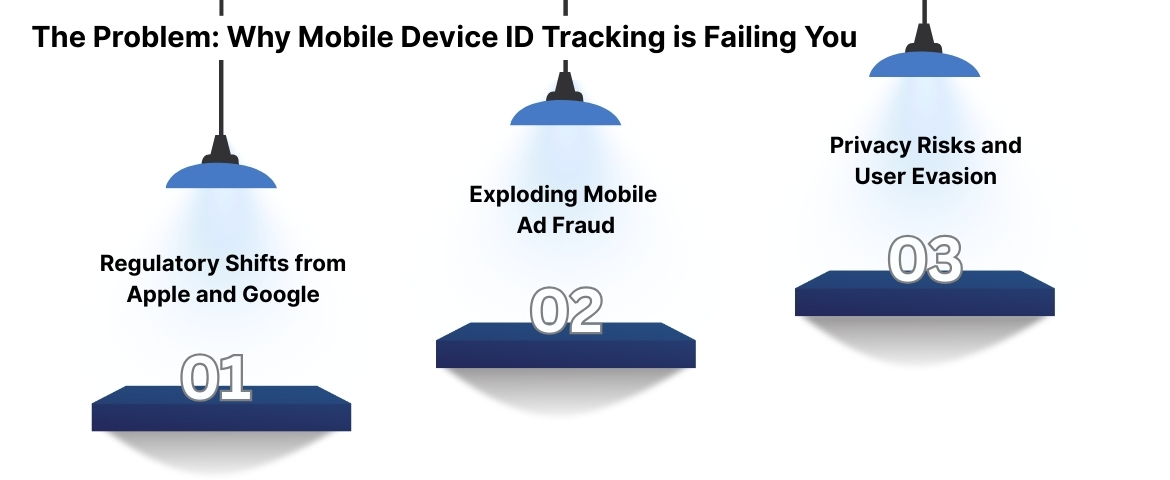
1. Regulatory Shifts from Apple and Google
Apple's App Tracking Transparency (ATT) framework requires explicit user consent for IDFA tracking. Opt-in rates average around 25 to 30 percent, meaning most iOS traffic is now unattributable. Android is moving toward a similar model through the Privacy Sandbox for Android.
The result is a sharp reduction in the attribution data you receive.
2. Exploding Mobile Ad Fraud
Mobile ad fraud continues to grow and is projected to exceed $41.4 billion globally in 2025, as per Spider AF. High CPM environments like the United States and Canada face intensified fraud, including SDK spoofing, click injection, and fake installs. These tactics inflate your acquisition costs and corrupt your reporting.
Note: Ad fraud is particularly acute in North America due to its high CPMs, reinforcing the need for fraud-resistant first-party data solutions.
3. Privacy Risks and User Evasion
Device IDs create legal and reputational risk because of their persistent tracking nature. Unlike cookies that expire, device IDs were designed to be persistent, making tracking harder for users to avoid, which escalates scrutiny under privacy regulations. Users have started limiting data exposure through:
- ATT opt-outs
- Ad personalization restrictions
- VPN usage
- Device-level privacy settings
- Private relay functions
The more users evade tracking, the more data you lose from OS-level identifiers. Let's understand the impact of user control.
The Technical Challenge of User Control
| User Action | Impact on Your Data | Ingest Labs Counter-Solution |
| Reset or Limit Advertising ID Usage | Voids attribution links and prevents accurate retargeting. | Ingest ID helps maintain a consistent first-party ID when you provide a hashed login or registration identifier, ensuring it carries through your event streams in a privacy-aligned way. |
| Use a VPN or Disable Location Tracking | Masks the IP address and location signals, making probabilistic matching difficult. | Ingest IQ uses server-side data to secure consented event data, not relying on IP/location as a primary identifier. |
| Block Device Fingerprinting | Reduces the ability to infer identity where deterministic data is unavailable. | Event IQ focuses on high-quality, deterministic first-party data, reducing reliance on risky inferred methods. |
Also Read: Web Analytics vs Mobile Analytics: Key Differences Explained
Moreover, device tracking data, if exposed or improperly shared, can be exploited by cybercriminals or sold to third parties, directly damaging your customer trust and brand equity.
Is mobile ad fraud crushing your ROI? Stop guessing and start validating your mobile traffic. Learn how Ingest Labs'server-side data collection prevents fraudulent events from entering your analytics by contacting us today.
The Solution: Shifting from Device ID Tracking to First-Party Identity
The future of mobile attribution is not tied to Apple or Google. It is tied to an internal, consent-driven first-party identity that you control. You must replace device-based tracking with three essential components:
1. First-Party Mobile Identifiers (Ingest ID)
Instead of relying on Apple's or Google's IDs, you must create your own internal, pseudonymized ID, a unique hash tied to the user's login or registration. This method aligns perfectly with Ingest ID.
Benefit: Since you collect the data directly with consent, this ID allows for high-accuracy deterministic matching within your proprietary ecosystem, enabling precise retargeting and personalization.
2. Server-Side Tracking for Mobile Events (Ingest IQ)
Browser-based tracking is prone to data loss on both the web and mobile. Server-side tracking moves data collection off the device's operating system and onto your secure server, reducing data loss from OS restrictions and preventing fraudulent events by validating data before processing.
Benefit: This provides you with a complete, accurate, and fraud-resistant dataset, ensuring that every conversion, event, and in-app action is captured and attributed reliably, bypassing browser or app limitations.
3. Unified Customer Data Platforms (Event IQ)
Event IQ can help monitor and validate the consistency of your event data across web and app sources when configured, but it is not a CDP and does not unify CRM or customer records.
Benefit: This allows you to build a complete, compliant customer profile, enabling real-time segmentation and the confident application of privacy-enhancing technologies (PETs) for data analysis and compliant activation across all channels.
Note: With Ingest IQ’s centralized event routing and Event IQ’s monitoring (when enabled), you can improve cross-channel event consistency and validate conversion data in real time from a single dashboard.
Moving to first-party identity gives brands a privacy-safe, future-proof foundation for attribution. But the industry's response doesn't stop there. As device IDs fade, multiple players (DSPs, SSPs, publishers, and measurement partners) are innovating new ways to maintain precision and accountability.
To understand the full cycle, it's important to look beyond brand-owned identity and examine the broader industry alternatives to device ID tracking.
Broader Industry Alternatives to Device ID Tracking
You cannot rely exclusively on your first-party data; a diversified approach is essential. Here are some broader industry solutions you should implement alongside your first-party strategy to avoid an exclusive reliance on device ID tracking.
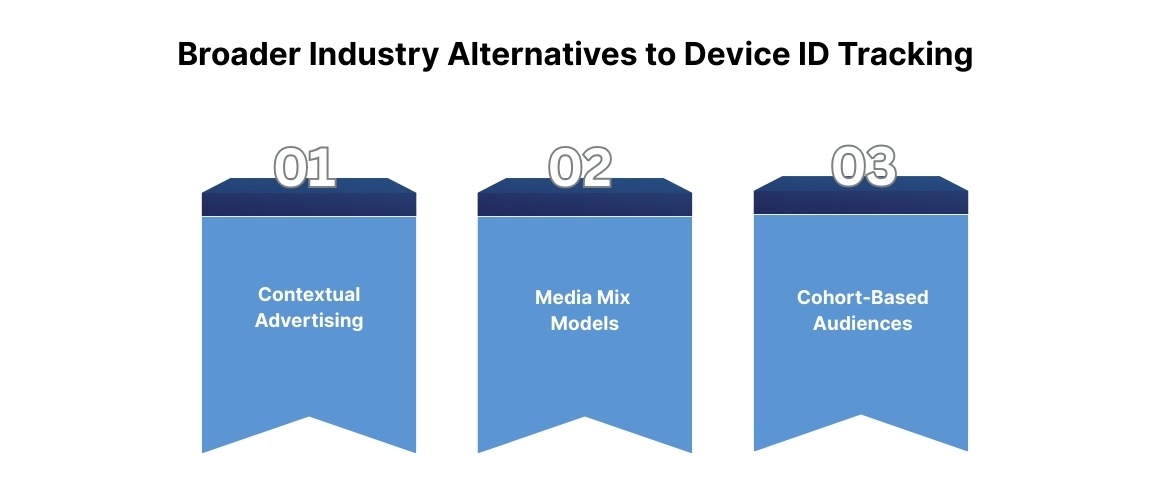
1. Contextual Advertising
Contextual targeting aligns ads with the content users are viewing rather than their behaviors. Modern models use real-time content analysis and AI to match ads with themes, sentiment, and relevance.
Contextual audiences are built by analyzing the content a user is currently viewing instead of relying on their past browsing behavior or device identifiers. With advances in data processing and AI, platforms can now generate these audiences instantly by interpreting the information on the page in real time.
2. Media Mix Models (MMM)
MMM uses a macro-level analysis to determine how different marketing channels contribute to results. It incorporates variables such as channel spend, sales trends, timing effects, and economic conditions. With individual tracking becoming less available, MMM has regained importance as a dependable framework for measuring return on ad spend.
3. Cohort-Based Audiences
You must integrate with new privacy-preserving browser mechanisms. Google's Privacy Sandbox initiative, which is replacing individual tracking on the Chrome browser, uses a cohort-based approach:
Google's Chrome browser is designed to group users into a small set of interest topics derived from their recent browsing activity. This approach anonymizes groups based on common interests, allowing you to target broad segments without accessing individual device ID tracking data.
These industry workarounds highlight just how urgently marketers need dependable identity signals in a post-Device ID world. To truly restore accuracy, compliance, and operational efficiency, you need more than temporary fixes; you need a smarter data foundation. That's what Ingest Labs delivers.
How Ingest Labs Solves Your Mobile Identity Challenges
You need an integrated platform that restores accuracy, strengthens compliance, and simplifies mobile tracking. Ingest Labs gives you three essential components to rebuild your identity and measurement framework.
Ingest IQ: Server-Side Mobile Event Capture
Ingest IQ captures mobile signals directly from your app and routes them through your secure server.
- Eliminates reliance on third-party SDKs
- Reduces fraud by validating events before they reach analytics
- Provides accurate attribution data for retargeting
- Delivers up to 99 percent event accuracy
Ingest ID: Deterministic First-Party Identifier
Ingest ID replaces device-level identifiers with a consent-based identity that works across mobile web and app environments.
- Uses hashed login data
- Maintains privacy alignment
- Supports cross-session and cross-device recognition
Event IQ: Unified Customer Data and Compliance
Event IQ centralizes all your data across web, app, and CRM sources.
- Consolidates customer profiles
- Ensures compliance with CPRA, CCPA, and CPPA
- Supports real-time segmentation and activation.
Note: With Ingest ID's privacy-compliant identity graph and Ingest IQ's first-party server-side tracking, you can recognize users accurately across devices and capture deeper journey insights without relying on third-party cookies.
Ingest Labs helps you fix the chaos in your mobile identity stack, so you finally have data you can trust. The natural next question is: what should you do with this advantage? Here are your most impactful next steps.
Action Plan For Transitioning to a Strong First-Party Mobile Strategy
Follow these steps to transition from unstable mobile device ID tracking to a solid first-party system:
- Step 1: Migrate to Server-Side Tracking
Use Ingest IQ to move your event capture from the device to your secure server. - Step 2: Establish a First-Party Identity Framework
Implement Ingest ID to identify logged-in or registered users with a pseudonymized identifier.
- Step 3: Unify Your Data
Deploy Event IQ to merge web and mobile data, restore journey visibility, and build actionable segments. - Step 4: Activate Data Across Your Channels
Use your unified identity and server-side events for compliant audience activation and retargeting.
Final Thoughts
The shift from device ID tracking to first-party identity is unavoidable, but it gives you the opportunity to build a more accurate, compliant, and resilient data strategy. Your success depends on owning your data, strengthening your attribution, and ensuring every signal aligns with North American privacy standards.
Ingest Labs gives you the tools to make this transition simple. Ingest IQ restores your measurement accuracy through server-side tracking. helps maintain consistent first-party identifiers, when they exist, and consent is present, supporting more reliable personalization and retargeting. Event IQ unifies all your customer data into a compliant, actionable profile.
If you are ready to protect your mobile ad spend, improve attribution, and strengthen compliance, schedule a demo with Ingest Labs today. Our platform helps you solve the exact mobile data challenges you face in 2026.
Don't let outdated device ID tracking cost you another quarter in lost revenue. Schedule a demo with Ingest Labs today to see how our platforms can solve your mobile data loss and compliance challenges!
FAQs
1. Is digital fingerprinting a viable alternative to device IDs?
No. Fingerprinting lacks consent, is discouraged by regulators, and carries significant compliance risk in the United States and Canada.
2. Does SKAdNetwork solve mobile attribution?
It provides aggregated conversion data but lacks user-level visibility. Combining SKAdNetwork with server-side data from Ingest IQ fills these gaps.
3. Why is the IMEI number not used?
IMEI numbers are classified as sensitive hardware identifiers and cannot be used for measurement or targeting.
4. What is the immediate financial impact of poor mobile tracking?
You will see higher acquisition costs and weaker ROAS due to fraud, missing data, and reduced algorithmic optimization on media platforms.
5. How does server-side tracking improve mobile attribution accuracy compared to device ID tracking?
Server-side tracking processes events directly on your secure server rather than the user's device. This removes OS-level restrictions, eliminates blocked SDK signals, and ensures every app event is validated before reaching your analytics or ad platforms. The result is consistent, lossless mobile attribution even without IDFA or GAID.
6. Can first-party identifiers replace device IDs for cross-device and cross-session tracking?
Yes. A consent-based first-party identifier, such as Ingest ID, creates a persistent hashed ID tied to the user rather than the device. This allows accurate cross-device and cross-session linking, supports deterministic attribution, and remains compliant with US and Canadian privacy laws.