




Marketing teams today do not have a data problem. They have an integration problem.
Your customer data lives everywhere: ad platforms, analytics tools, CRMs, e-commerce systems, and mobile apps.Each system tells part of the story, but none of them show the full customer journey. As privacy regulations tighten across the US and Canada and third-party cookies continue to fade, fragmented data now directly affects attribution accuracy, ROAS, and growth decisions.
Marketing data integration brings these systems together into a unified, privacy-compliant view of marketing performance. It enables accurate attribution, faster insights, and more confident optimization in a cookieless environment. This guide explains the types of marketing data integration, why it matters for modern businesses, and the challenges teams must address to implement it effectively.
Key Takeaways
- Marketing data integration unifies fragmented data from ad platforms, CRMs, analytics, e-commerce, and mobile apps into a single, actionable view.
- First-party data stack relies on integration for accurate collection, identity resolution, storage, and activation across campaigns.
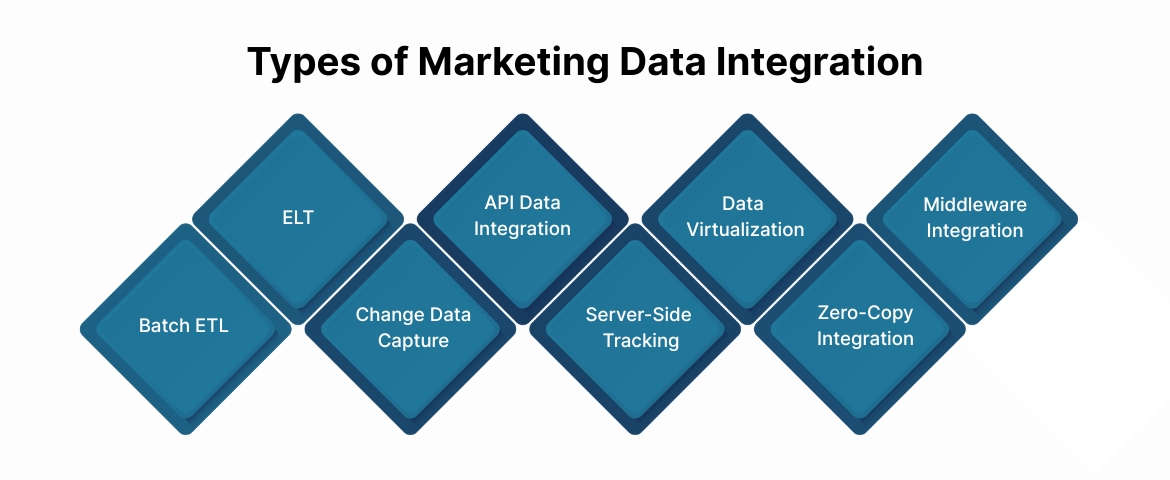
- Types of integration include Batch ETL, ELT, CDC, API, Server-Side Tracking, Data Virtualization, Zero-Copy, and Middleware, each suited for different use cases.
- Integration drives measurable business impact: improves attribution, ROI tracking, personalization, real-time decision-making, and team collaboration.
- Challenges exist, including data fragmentation, inconsistent formats, privacy compliance, API instability, and real-time processing limits, but can be addressed with structured best practices.
What Is Marketing Data Integration?
Marketing data integration is the process of connecting data from marketing and customer-facing systems into a unified view for measurement, analysis, and activation. It brings together data from ad platforms, analytics tools, CRMs, e-commerce systems, and mobile apps so your team can evaluate performance using one consistent data foundation.
Unlike general data integration, which focuses on data movement and storage, marketing data integration is built for speed and accuracy. It ensures marketing signals are captured correctly, tied to the right user, and available for attribution and optimization. Without it, teams rely on fragmented metrics, leading to wasted ad spend and slower decisions. In a privacy-first, cookieless environment, marketing data integration has become a core requirement for performance.
Marketing vs. IT Data Integration: Key Differences
Marketing and IT teams both integrate data, but they do so for different reasons and with different success criteria. These differences explain why marketing teams need integration built specifically for measurement and growth.
| Aspect | Marketing Data Integration | IT or General Data Integration |
| Primary objective | Improve attribution and campaign performance | Move and synchronize data across systems |
| Typical data sources | Ad platforms, analytics, CRM, e-commerce, apps | ERP, finance, HR, internal databases |
| Time sensitivity | Near real time or real time | Mostly batch-based |
| Identity focus | User-level and cross-device identity | System-level or record-level data |
| Core outcomes | ROAS optimization, personalization, insights | Reporting accuracy and system consistency |
| Business impact of errors | Wasted ad spend and poor decisions | Delayed reports or data mismatches |
For marketing teams, delayed or missing data directly affects budget allocation and growth outcomes. That is why marketing data integration prioritizes identity resolution, signal accuracy, and activation readiness rather than simple data movement.
How Integration Fits in the First-Party Data Stack
Marketing data integration works as a step-by-step flow that keeps first-party data accurate, connected, and usable across the marketing lifecycle:
- Data Collection: Customer interactions are captured from websites, mobile apps, ad platforms, and CRM systems.
- Ingestion: Events are collected and sent to a central system in a consistent format, without loss or duplication.
- Identity Resolution: Individual events are tied to the same user across devices and sessions using first-party identifiers.
- Storage and Analysis: Unified data is stored in a CDP or data warehouse, where it can be queried and analyzed.
- Activation: Clean, unified data is used for attribution, audience targeting, personalization, and campaign optimization.
When any step in this flow breaks, downstream systems rely on incomplete or delayed data. This directly impacts attribution accuracy, insights, and marketing performance.
Ingest Labs server-side tracking with Ingest IQ provides accurate and reliable data collection across all customer touchpoints, making first-party integration faster and privacy-compliant.
Types of Marketing Data Integration
Marketing data integration comes in several forms, each designed to solve specific business challenges in attribution, personalization, and campaign optimization. Choosing the right type allows teams to reduce data fragmentation, accelerate insights, and maximize ROI across multi-channel marketing efforts.
1. Batch ETL (Extract → Transform → Load)
Batch ETL is a structured process where marketing data is extracted from various systems, transformed to a standard format, and loaded into a centralized warehouse at scheduled intervals. It is ideal for scenarios where high data volume and consistency matter more than real-time responsiveness, such as monthly performance reports or long-term trend analysis.
Why you need it:
- For large-scale dashboards or executive reporting
- When consolidating multiple marketing platforms with predictable schedules
- To maintain data consistency across campaigns with historical performance analysis
Benefits:
- Ensures accuracy and uniformity across datasets
- Reduces manual reconciliation efforts for large volumes of data
- Supports long-term trend identification and strategic decision-making
2. ELT (Extract → Load → Transform)
ELT loads raw data into a warehouse first, transforming it there. It leverages cloud warehouses’ scalability and allows on-demand analytics and flexible transformations. This approach enables teams to work with large volumes of data quickly, supporting advanced analytics and iterative campaign optimization.
Why you need it:
- For cloud-based warehouses optimized for on-demand transformation
- When running advanced analytics or AI-driven campaign insights
- To support dynamic, multi-channel campaign measurement without extra staging
Benefits:
- Faster transformations with less infrastructure overhead
- Scales with growing datasets and analytics complexity
- Enables experimentation and testing of new marketing hypotheses
3. Change Data Capture (CDC)
CDC captures and replicates only changes in data in real time, keeping analytics, personalization, and attribution engines up to date. It ensures your marketing decisions are based on the latest customer behavior, avoiding delays that can impact performance and ROI.
Why you need it:
- When optimizing ads or campaigns in near real time
- For personalized messaging triggered by user behavior
- To maintain consistent data for multi-channel campaign adjustments
Benefits:
- Reduces latency in marketing decisions
- Ensures analytics and targeting engines work with the most current data
- Improves precision in attribution, personalization, and campaign ROI
4. API Data Integration
API integration enables real-time or near-real-time data exchange between systems such as CRMs, ad networks, analytics platforms, and e-commerce tools. It allows marketers to avoid manual uploads, directly synchronizes data, and supports automated workflows.
Why you need it:
- To synchronize multiple SaaS marketing tools seamlessly
- For dashboards and campaign reporting that require up-to-date information
- When coordinating multi-channel campaigns without heavy manual processes
Benefits:
- Provides fresh, accurate data for decision-making
- Reduces errors from manual consolidation or delays
- Supports automated, responsive marketing strategies
5. Server-Side Tracking & Tag Management
Server-side tracking moves data collection from the browser to a server, minimizing signal loss and improving data quality in privacy-first, post-cookie environments. It provides a higher-fidelity view of customer behavior across devices, ensuring attribution and personalization remain accurate.
Why you need it:
- To maintain attribution accuracy in a cookie-less environment
- For consistent multi-channel measurement and optimization
- To protect first-party data privacy while reducing signal loss
Benefits:
- Preserves first-party data integrity for accurate reporting
- Enables personalization and targeting based on reliable signals
- Improves campaign ROI by reducing gaps in marketing data
Using Ingest Labs’ Ingest IQ, server-side tracking becomes seamless and privacy-compliant, providing a unified, reliable data stream for marketers without requiring complex client-side implementation.
6. Data Virtualization & Federated Queries
Data virtualization allows querying data across multiple systems without physically moving it. Federated queries provide a unified view, giving marketing teams access to combined datasets in real time.
Why you need it:
- For rapid access to multiple marketing sources
- When ad-hoc reporting is required without a full warehouse build
- To minimize storage costs while maintaining analytic flexibility
Benefits:
- Provides near real-time insights across platforms
- Supports faster, informed decision-making
- Reduces duplication and infrastructure overhead
7. Zero-Copy Integration
Zero-copy integration lets teams query source data directly without creating duplicates, preserving data integrity while supporting real-time analysis. This ensures marketers act on the most current data while avoiding unnecessary storage or processing delays.
Why you need it:
- To access live data instantly for campaign dashboards
- When cross-platform segmentation requires real-time updates
- For personalization engines that must respond to current behavior
Benefits:
- Eliminates storage overhead and ETL delays
- Ensures data integrity and accuracy
- Supports dynamic, responsive marketing actions
8. Middleware Integration
Middleware connects marketing systems, standardizes and routes data, and ensures it is consumable downstream without full consolidation. It acts as a bridge between tools, enabling seamless communication while enforcing governance and privacy rules.
Why you need it:
- To integrate new marketing tools quickly without building custom pipelines
- For real-time or batch workflows across multiple platforms
- To enforce privacy and governance rules before activation
Benefits:
- Simplifies integration and reduces technical complexity
- Ensures consistent, high-quality data for attribution and personalization
- Keeps the marketing stack agile and scalable for future growth
By understanding the different types of marketing data integration and their strategic value, your team can choose the right approach to ensure accurate, timely, and privacy-compliant data flows that drive better marketing decisions and measurable ROI.
Benefits of Marketing Data Integration for Your Business
Marketing data integration connects all your marketing and customer systems into a single, accurate view. This unified approach enables faster decisions, precise attribution, and personalized campaigns that directly impact ROI and customer engagement.
- Create a unified view of data: Consolidates ad platforms, CRMs, analytics, and e-commerce data for consistent metrics, accurate attribution, and reliable customer profiling.
- Enable real-time insights and agility: Continuous data ingestion lets teams react to trends, adjust campaigns, and reallocate budgets quickly.
- Improve ROI tracking and performance measurement: Multi-touch attribution and advanced ROI calculations reveal channel and campaign effectiveness for optimized spend.
- Enhance collaboration across teams: A single source of truth aligns marketing, sales, and finance on consistent metrics and dashboards.
- Increase efficiency and scalability: Automated ingestion and transformation reduce errors and allow the marketing stack to grow without overhead.
- Deliver a seamless customer experience: Accurate, integrated data enables personalized messaging and consistent experiences across channels.
- Support data-driven decisions: Provides a complete view of campaigns and customer journeys, replacing guesswork with actionable insights.
Integrated marketing data gives your team the clarity and agility to optimize campaigns, improve customer experiences, and drive measurable growth.
The Challenges of Marketing Data Integration
Marketing data integration is essential, but it comes with its own set of challenges that can impact campaign performance and decision-making if not addressed properly. Organizations often face issues stemming from data silos, inconsistent formats, privacy regulations, and real-time processing limitations.
These obstacles make it difficult to achieve a unified, accurate, and actionable view of marketing performance.
- Data fragmentation and disconnected sources: Customer data is scattered across ad platforms, CRMs, analytics tools, and e-commerce systems, creating inconsistent metrics and partial visibility across channels.
- Inconsistent formats and schema mismatches: Platforms use different data formats, identifiers, and naming conventions, requiring complex transformations before analysis.
- Constant API instability and evolving connector requirements: Frequent API changes can break pipelines, creating ongoing operational burdens and manual maintenance.
- Technical complexity and resource scarcity: Integrating multiple systems requires expertise in APIs, schema mapping, real-time ingestion, and pipeline orchestration, which many marketing teams lack.
Poor data quality and duplication: Incomplete records, duplicates, and outdated customer information distort analytics, attribution, and decision-making. - Real-time processing limitations and latency: Legacy batch pipelines delay insights, reducing agility, A/B testing accuracy, and optimization opportunities.
- Legacy system and infrastructure constraints: Older systems lack modern integration capabilities, forcing costly workarounds and manual data handling.
- Privacy, security, and compliance overhead: GDPR, CCPA, and other regulations require consent tracking, encryption, and access controls, adding architectural complexity and governance responsibilities.
Overcoming these challenges requires a structured integration framework, automated data governance, and privacy-first tools to ensure accurate, timely, and actionable marketing data across all channels.
Also read: The Privacy Revolution in Marketing: A Guide to Navigating the New Landscape
How to Implement Marketing Data Integration: Best Practices
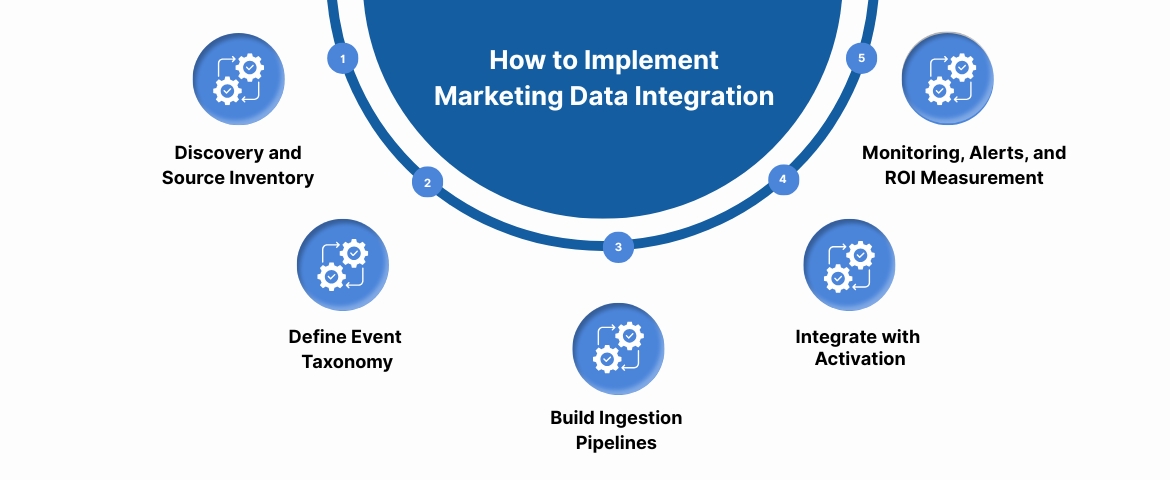
Implementing marketing data integration effectively requires a structured, phased approach that prioritizes high-value data sources, ensures accuracy, and supports privacy-first strategies. Following a roadmap reduces errors, improves attribution, and makes marketing data actionable across campaigns and channels.
Phase 1: Discovery and Source Inventory
What to do:
- Create a catalog of all marketing data sources (ad platforms, CRMs, analytics, e-commerce systems, mobile apps).
- Prioritize sources based on business impact, volume, and relevance to campaigns.
- Identify gaps or technical limitations for future pipeline planning.
Implementation guidance:
- Focus on high-value sources first to achieve early wins.
- Document source formats, refresh schedules, and field mappings.
- Align sources with KPIs to ensure measurable outcomes.
Phase 2: Define Event Taxonomy and Identity Strategy
What to do:
- Standardize event naming, structure, and definitions across platforms.
- Implement persistent first-party identifiers (similar to Ingest ID) to connect users across devices and channels.
- Integrate consent management to comply with GDPR, CCPA, and other regulations.
Implementation guidance:
- Map key conversion events like “Add to Cart,” “Purchase,” or “Lead Form Submission.”
- Link multi-device sessions using first-party identifiers for accurate attribution.
- Store consent flags alongside events for real-time enforcement in activation systems.
Phase 3: Build Ingestion Pipelines (Batch + Streaming)
What to do:
- Set up pipelines to ingest batch and real-time data into a central system.
- Use server-side pipelines for high-value events to reduce signal loss.
- Ensure pipelines are modular, scalable, and easy to monitor.
Implementation guidance:
- Stream website clickstream data in near real-time for campaign optimization.
- Batch-import historical CRM or ad performance data for trend analysis.
- Automate data validation at ingestion to prevent duplicates or incomplete records.
- Use cloud-native tools (Snowflake, BigQuery, Redshift) to scale with growing datasets.
Phase 4: Integrate with Activation/Destination Systems
What to do:
- Connect unified marketing data to ad platforms, CDPs, analytics dashboards, and data warehouses.
- Ensure flows are synchronized, privacy-compliant, and structured for activation.
- Enable real-time audience segmentation, personalization, and optimization.
Implementation guidance:
- Sync customer segments to ad platforms for precise targeting.
- Feed conversion events to personalization engines to trigger dynamic content.
- Map fields carefully to avoid misalignment in campaigns.
- Test end-to-end flows before scaling and update as new platforms are added.
Phase 5: Monitoring, Alerts, and ROI Measurement
What to do:
- Implement monitoring for tag firing, pipeline health, and data anomalies.
- Set up dashboards and alerts to track data quality, timeliness, and ROI.
- Regularly audit pipelines to ensure compliance and reliability.
Implementation guidance:
- Create dashboards showing ingestion rates, error counts, and anomalies.
- Set alerts for missing conversions or delayed event streams.
- Calculate multi-touch attribution using unified data to optimize budgets.
- Establish playbooks for anomaly resolution and pipeline recovery.
Following this phased roadmap with tactical implementation steps ensures your marketing data integration is accurate, privacy-compliant, and scalable, empowering your team to make real-time decisions, optimize campaigns, and maximize ROI.
Conclusion
Marketing data integration is essential for modern marketing teams to unify customer data, ensure accurate attribution, and make real-time, data-driven decisions. Implementing a structured roadmap with privacy-first practices turns fragmented insights into actionable strategies that directly impact ROI. Businesses that master integration gain agility, reliable analytics, and a foundation for scalable marketing growth.
With Ingest Labs, your team can simplify and accelerate this process:
- Ingest ID: First-party identity resolution to support more accurate attribution and measurement
- Event IQ: Unified customer data for actionable insights and personalization
- Ingest IQ: Server-side tracking for privacy-compliant, reliable data collection
Take your marketing to the next level, request a demo today and see how Ingest Labs can unify and optimize your marketing data.
FAQs
1. How does marketing data integration improve customer journey analysis?
Marketing data integration unifies customer interactions from all touchpoints into a single view. This allows teams to trace the customer journey, identify drop-off points, and optimize messaging for better conversions and reduced ad spend.
2. What is the difference between real-time and batch data integration?
Real-time integration captures updates as they happen, supporting immediate decision-making. Batch integration processes data at scheduled intervals, suitable for historical reporting and trend analysis.
3. How does privacy compliance affect marketing data integration?
Privacy compliance dictates how data is collected, stored, and shared. Integration must enforce consent, secure sensitive information, and log compliance actions to avoid legal risks and maintain customer trust.
4. Can small businesses benefit from marketing data integration?
Yes. Unified data helps small businesses understand channel performance, reduce manual reporting, and run targeted campaigns efficiently without large technical teams.
5. What makes marketing data integration succeed or fail?
Success requires consistent event naming, scalable pipelines, and strong data governance. Failure often comes from unstandardized data, poor monitoring, or misalignment with business goals. Choosing the right tools ensures reliability.