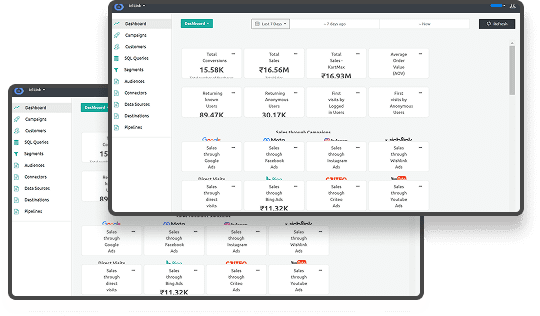





In 2025, 83% of marketers say data‑driven marketing is essential to business growth, and 76% of organizations increased their investment in data analytics tools in the last year, underscoring how critical analytical insights are for performance and decision‑making.
For digital marketing teams at e‑commerce brands, SaaS companies, and agencies in the US and Canada, understanding campaign performance isn’t optional. It’s a strategic necessity to boost return on ad spend (ROAS), improve customer engagement, and optimize multi‑channel initiatives. Despite this urgency, many organizations still struggle to unify data and extract insights that translate into revenue‑driving actions.
Marketing analytics bridges that gap. It empowers you to measure what’s working, what’s not, and where you should invest next. With privacy regulations such as CCPA/CPRA and PIPEDA tightening and third‑party data becoming less reliable, effective analytics rooted in first‑party data helps you stay compliant, protect customer trust, and drive long‑term growth.
Key Takeaways
- Marketing analytics enables businesses to collect, analyze, and interpret campaign data to make informed decisions and optimize ROI.
- Proper analytics helps overcome common challenges such as fragmented data, inaccurate attribution, and limited personalization, turning these into opportunities for growth and efficiency.
- Understanding the different types of marketing analytics, including descriptive, diagnostic, predictive, and prescriptive, allows teams to improve strategy and anticipate future outcomes.
- Tracking core metrics and KPIs, such as engagement, cost efficiency, channel performance, and attribution, provides actionable insights to enhance marketing performance.
- Tools like Ingest Labs’ Ingest IQ, Ingest ID, and Event IQ strengthen analytics by ensuring accurate tracking, unified customer identities, and structured event data for smarter decisions.
What is Marketing Analytics?
Marketing analytics is the process of collecting, analyzing, and interpreting data from your marketing activities to understand performance, optimize campaigns, and make informed strategic decisions.
Unlike market research, which focuses on broad market trends and consumer behavior, marketing analytics zeroes in on actual marketing actions, customer interactions, and performance across channels. It helps businesses track the effectiveness of campaigns, measure ROI, and adjust strategies based on real-time insights.
To get actionable insights, businesses often begin by gathering data from key touchpoints, including:
- Website engagement metrics such as page views and bounce rate
- Campaign performance indicators like conversion rates
- Email marketing results, including open rates and click-through rates (CTR)
- Social media interaction and audience engagement
- Usage patterns within mobile apps
- Leads generated through various marketing channels
By monitoring these metrics, organizations can gain a clear picture of what drives results, where improvements are needed, and how to allocate resources effectively.
Why Marketing Analytics Matters for Modern Businesses
Marketing analytics is not just about collecting data; it equips organizations to make informed decisions, optimize campaigns, and improve overall marketing performance. Here’s why it is essential for modern businesses:
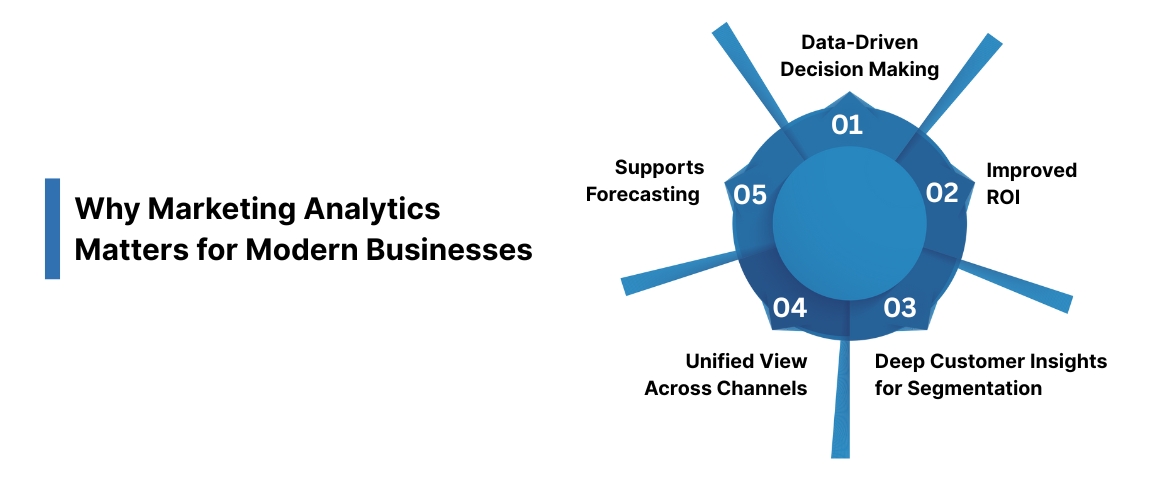
1. Data-Driven Decision Making
- Moves organizations away from intuition-based marketing and guesswork.
- Provides concrete insights to guide campaign strategy, budget allocation, and channel prioritization.
- Enables teams to test hypotheses, compare outcomes, and refine tactics based on real results.
2. Improved ROI and Campaign Optimization
- Identifies high-performing channels and campaigns, allowing resources to be focused where they matter most.
- Helps detect underperforming campaigns early, minimizing wasted ad spend.
- Supports A/B testing and multivariate testing to optimize creative, messaging, and targeting.
3. Deep Customer Insights for Segmentation and Personalization
- Analyzes audience behavior to identify segments, preferences, and engagement patterns.
- Supports personalized messaging across email, social, web, and mobile channels.
- Helps increase conversion rates, retention, and lifetime value by delivering relevant experiences.
4. Unified View Across Channels
- Combines data from web, mobile apps, social media, email, and offline channels for a holistic view.
- Enables accurate cross-channel attribution, showing how each touchpoint contributes to conversions.
- Reduces data silos, allowing teams to make cohesive marketing decisions across departments and platforms.
5. Supports Forecasting and Predictive Planning
- Uses historical data to anticipate future outcomes and trends.
- Allows businesses to plan campaigns proactively, adjusting strategy before performance issues arise.
- Supports predictive insights for budgeting, resource allocation, and marketing strategy.
By using these benefits, businesses can transform marketing data into actionable insights that drive growth, optimize spend, and improve customer experiences.
Also read: Tips to Optimize Your Marketing ROI
Types of Marketing Analytics
Marketing analytics spans several categories, each helping you understand a different part of your business performance. When you combine these types, you get a complete picture of how customers move across your channels, how campaigns perform, and where growth opportunities exist. Here are the key types every business should know.
1. Campaign Analytics
Campaign analytics measures how your paid and organic campaigns perform across platforms like social media, email, search, and display. It helps you understand whether your campaigns are influencing users to take meaningful action and where your budget is producing the strongest results.
What it helps you track:
- Engagement across each channel
- Conversions and assisted conversions
- Cost efficiency metrics such as CPA, CPL, and ROAS
Business value:
- Shows which campaigns are performing and which need optimization
- Helps you refine targeting, messaging, and channel mix
- Creates a repeatable feedback loop for continuous improvement
2. Web Analytics
Web analytics tells you how visitors interact with your website. It highlights where they come from, how they move through your pages, and what stops them from completing key actions. This data is essential for improving the user journey and increasing conversions.
Insights you can access:
- Page-level performance
- Funnel progression
- Drop-off points and friction areas
Business value:
- Helps optimize landing pages and website flows
- Supports A/B testing and conversion rate improvements
- Gives clarity on how site experience impacts marketing performance
3. Product Analytics
Product analytics helps you understand how users interact with your digital product or app. It focuses on usage patterns, feature adoption, and customer engagement inside your product. Businesses use these insights to improve the in-product experience and nudge users toward key actions.
What you can uncover:
- Feature engagement and usage frequency
- User onboarding patterns
- Retention and churn indicators
Business value:
- Helps create a smoother product experience
- Supports feature improvements that drive revenue
- Guides lifecycle marketing with usage-based insights
4. Behavioral Analytics
Behavioral analytics focuses on user tendencies over time. By analyzing how customers browse, purchase, click, or drop off, you can build more accurate segments and deliver messaging that matches their intent. This helps you personalize your marketing and improve engagement.
Key data points:
- Purchase history
- Browsing behavior
- Repeat activity and engagement signals
Business value:
- Helps build more meaningful customer segments
- Supports personalization across email, ads, and product experiences
- Improves conversion rates through better timing and relevance
Together, these analytics types give your team a clearer understanding of customer behavior, campaign performance, and growth opportunities, allowing you to make smarter and more confident marketing decisions.
Also read: How to Create High-Converting Conversion Pages
Core Metrics & KPIs Every Marketing Team Should Track
When you measure the right KPIs, you get a clear picture of how your marketing efforts contribute to revenue and long-term growth. These are the metrics most teams rely on to understand performance and make smarter decisions.
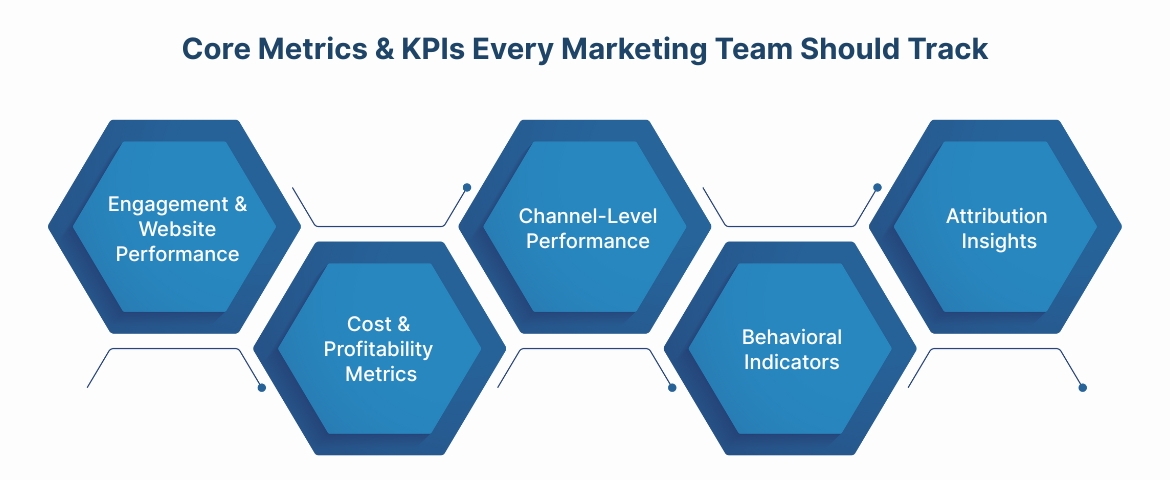
Engagement & Website Performance
These metrics tell you how people interact with your website and content:
- Conversion rate shows how effectively you turn visitors into customers or leads.
- CTR (Click-Through Rate) reflects how compelling your ads and CTAs are.
- Bounce rate, session duration, and page views help you understand user behavior and the quality of your traffic.
Tracking these numbers helps you spot friction points and identify content or pages that need improvement.
Cost & Profitability Metrics
Every marketer needs to know whether their campaigns justify the spend:
- CPA and CPL help you understand the cost of acquiring a lead or customer.
- ROAS reveals how much revenue your ad spend actually generates.
- CAC and CLV/LTV give you a long-term view of customer value and profitability.
When these cost metrics rise unexpectedly, it’s often a sign of targeting issues, channel inefficiencies, or broken user journeys.
Channel-Level Performance
If you run campaigns across multiple platforms, you need visibility into where your best traffic comes from:
- Impressions, engagement, and traffic by channel highlight visibility and reach.
- Performance can vary significantly across devices and geographies, especially for paid channels.
This view helps you shift budgets toward the channels that contribute the most to conversions or revenue.
Behavioral Indicators
Behavior metrics show how users behave after they land on your site:
- Cart abandonment reveals checkout friction.
- Retention rate and repeat purchases show whether customers stick around.
- Engagement actions (video views, form submissions, scroll depth) help you understand interest levels.
If you’re running an e-commerce or subscription business, these numbers directly influence lifetime value.
Attribution Insights
Attribution helps you understand which campaigns or touchpoints drive conversions:
- First-touch models highlight what brought a user into your funnel.
- Last-touch shows what triggered the final conversion.
- Multi-touch attribution gives you a complete view of how each channel contributes.
Better attribution leads to smarter budget allocation and more accurate performance tracking.
Building a Marketing Analytics Framework That Scales
A strong marketing analytics setup helps your team rely on accurate insights instead of guesswork. These steps guide you in building a reliable foundation that supports better reporting, clearer attribution, and smarter decision-making across all your channels.
1. Define Goals and KPIs
Clear goals help your analytics efforts stay focused and meaningful. Without defined outcomes, data becomes overwhelming and hard to translate into decisions. Start by aligning your analytics plan with the business results you want to achieve.
Set clear objectives such as:
- Increasing conversions or qualified leads
- Reducing CAC
- Improving ROAS across channels
- Boosting customer retention or repeat purchases
Choose KPIs that match those goals, including:
- Conversion rate and CTR
- Cost per acquisition
- Return on ad spend
- Lifetime value
2. Audit Your Existing Data Infrastructure
Before improving your analytics, you need to understand your current setup. Many businesses discover tracking gaps, inconsistent naming, or lost data signals during this step. An audit uncovers these issues early so you build on a stable foundation.
Review components such as:
- Website and app tracking setup
- Pixel configuration and event coverage
- CRM and marketing automation connections
- Data accuracy issues
Look for common issues like:
- Duplicate or missing events
- Broken conversions
- Browser restrictions causing signal loss
3. Choose the Right Tracking Architecture
Your tracking architecture determines how reliable your analytics will be long term. As privacy regulations tighten and browsers restrict cookies, server-side and first-party approaches provide stronger, more consistent data for measurement.
This helps you address:
- Cookie limitations
- Ad blocker interference
- Inaccurate browser-based tracking
- Cross-device inconsistencies
Outcome: A stable, future-proof data foundation that improves attribution and reporting.
4. Integrate All Marketing Channels and Touchpoints
Analytics becomes far more valuable when your data sources work together. Integrating all touchpoints helps you understand how customers move across channels instead of analyzing each one in isolation.
Channels to unify include:
- Website and mobile app
- Email and SMS
- Paid ads (Meta, Google, TikTok, LinkedIn)
- CRM and sales data
- E-commerce platforms
Benefits of a unified setup:
- Clearer customer journeys
- Stronger segmentation
- More accurate cross-channel insights
5. Set Up Analytics and Attribution Logic
Your attribution framework shapes how your team interprets performance. Setting clear rules ensures consistency across reports and avoids confusion when multiple teams rely on the same data.
Decide on models like:
- First-touch
- Last-touch
- Multi-touch
- Time-decay or data-driven attribution
Also define:
- Core conversion events
- Event naming standards
- Channel classifications
6. Build Dashboards and Reports for Stakeholders
Dashboards translate raw data into insights that are easy to understand and act on. Different teams need tailored reports, so building role-specific views ensures everyone gets the information they care about most.
Examples of dashboard types:
- Campaign performance dashboards
- Funnel and journey views
- Revenue and ROAS analytics
- Audience behavior insights
Focus on:
- Trends over time
- Channel comparisons
- Budget and allocation impact
7. Use Insights to Optimize Campaigns
The real value of analytics comes from applying insights, not just reporting them. Once you identify what works and what does not, you can adjust your strategy to drive stronger performance.
Optimize areas such as:
- Targeting and audience segments
- Messaging and creative variations
- Budget distribution
- Landing page experience
- Retargeting flows
Goal: Faster, more confident decisions backed by real data.
8. Maintain Compliance and Privacy Standards
Privacy is no longer optional. For businesses operating in the US and Canada, your analytics setup must respect regional standards to avoid legal issues and maintain customer trust.
Key areas to manage:
- CCPA and CPRA compliance
- PIPEDA requirements
- Consent collection and transparency
- Secure data handling
This protects:
- Brand reputation
- Customer trust
- Long-term data stability
Common Challenges Businesses Face in Marketing Analytics
Even with access to marketing data, many organizations struggle to turn insights into actionable strategies. Common challenges include:
- Wasted marketing spend: Incomplete or fragmented data can cause campaigns to underperform, leading to misallocated budgets and lower ROI.
- Tracking multi-channel customer journeys: Businesses often find it difficult to connect customer interactions across websites, mobile apps, social media, and offline channels, resulting in an incomplete picture of the customer journey.
- Inaccurate attribution: Without proper analytics, it’s challenging to determine which campaigns or channels drive conversions, making ROAS calculations unreliable.
- Limited segmentation and personalization: Inconsistent or missing data prevents marketers from tailoring messages effectively to specific audience segments.
- Missed optimization opportunities: Without actionable insights, businesses may fail to identify underperforming campaigns, audience behaviors, or trends, leading to lost growth opportunities.
By recognizing these challenges, organizations can prioritize the right data infrastructure, tracking solutions, and analytical tools to overcome obstacles and improve marketing outcomes.
How Ingest Labs Strengthens Your Marketing Analytics
Ingest Labs helps you fix the biggest gaps in marketing analytics by giving you clean, consistent, and privacy-ready data at the source. As a Server-Side / First-Party Data Solutions provider, it ensures that your insights are accurate, your attribution is reliable, and your marketing decisions are grounded in trustworthy data.
Ingest IQ Improves Tracking Accuracy
Ingest IQ shifts your media and event collection from unreliable browser scripts to stable server‑side tracking, improving data quality for analytics and ad platforms. This ensures more accurate reporting, stronger attribution, and higher-quality platform signals, giving your team confidence in every marketing decision.
Ingest ID Unifies Customer Identities
Ingest ID assigns a persistent first-party identifier to each user, creating a clear, unified view of the customer journey. It reduces identity fragmentation, enables cleaner segmentation, and improves multi-touch attribution across campaigns.
Event IQ Delivers a Unified Event View
Event IQ consolidates all collected data into a single structured event stream and gives your team the intelligence needed to analyze journeys, funnels, and campaign performance at scale. This provides consistent behavioral insights, enhances funnel analysis, and ensures high-quality datasets for analytics and campaign optimization.
Together, these tools strengthen your analytics foundation, reduce wasted spend, and help your team make faster, more confident decisions.
Conclusion
Marketing analytics is now a core driver of growth. When your data is accurate, unified, and rooted in first-party signals, every part of your marketing operation becomes more effective. You allocate budgets with confidence, understand what truly drives conversions, and uncover opportunities that would otherwise stay hidden.
Ingest Labs helps you build that level of clarity. With Ingest IQ, Ingest ID, and Event IQ working together, your team gets cleaner data, stronger attribution, and a far more reliable foundation for decision-making. The result is better optimization, less wasted spend, and a marketing engine that performs consistently across channels.
If you want to strengthen your analytics and create a data setup you can trust, Ingest Labs is the right place to start. Book a demo to see how Ingest Labs can transform your marketing analytics and help you make smarter, faster, and more profitable decisions.
FAQs
1. What is the difference between attribution modeling and marketing analytics?
Attribution modeling assigns credit to touchpoints that lead to conversions. Marketing analytics is broader, analyzing overall performance, forecasting, segmentation, and campaign optimization.
2. What are UTM parameters and why are they important?
UTM parameters are URL tags that track the source, medium, and campaign. They help identify which campaigns or traffic sources drive visits and conversions.
3. How can multivariate testing improve marketing analytics?
Multivariate testing evaluates multiple content or page element variations simultaneously, showing which combinations drive the best user engagement and conversions.
4. What is operational analytics in marketing?
Operational analytics uses real-time data to monitor campaign performance and make rapid adjustments for better engagement and conversions.
5. What is attitudinal analytics and how does it complement behavioral metrics?
Attitudinal analytics combines user sentiment or survey data with behavioral tracking to explain why users act a certain way, not just what they do.
6. How do I ensure data quality for marketing analytics?
Ensure consistent event tracking, avoid duplicates, validate sources, and unify identifiers. High-quality data improves reporting accuracy and attribution reliability.