




For years, third-party cookies have been the backbone of digital advertising, attribution, and cross-site measurement. But as privacy expectations evolved and regulators stepped in, browsers began rethinking how much tracking should happen by default.
Google Chrome’s journey toward a cookieless future has become the most closely watched signal in this shift. While Google has delayed a full shutdown of third-party cookies, the broader reality hasn’t changed. Third-party cookie deprecation is already underway in practice, driven by browser restrictions, evolving consent requirements, and declining data reliability.
Teams that continue to rely heavily on third-party cookies are already seeing attribution gaps, inconsistent reporting, and rising acquisition costs, often without visibility into the underlying cause.
This guide explains what cookie deprecation means, how Google is navigating the transition in Chrome, and what businesses can do to prepare before performance erodes.
Key Takeaways
- Third-party cookies are already unreliable across Safari and Firefox, and increasingly inconsistent in Chrome, causing attribution gaps and underreported conversions.
- Cookie deprecation breaks retargeting, cross-site tracking, and multi-touch attribution, forcing marketers to rebuild their data infrastructure around first-party signals.
- Server-side tracking, first-party identifiers, and consent-based collection replace cookie-dependent systems with more accurate, privacy-compliant alternatives.
- Waiting for a final deadline means accepting years of degraded data quality. Teams that act now build a competitive advantage as cookie coverage continues declining.
- Ingest Labs helps marketers transition to cookieless infrastructure through server-side tracking, first-party identity, and unified customer data, with minimal ongoing engineering involvement.
What Is 3rd Party Cookie Deprecation?
Third-party cookie deprecation is the gradual phasing out of cookies set by domains outside the site a user visits.
What Are Third-Party Cookies Used For?
Third-party cookies enable several critical marketing functions:
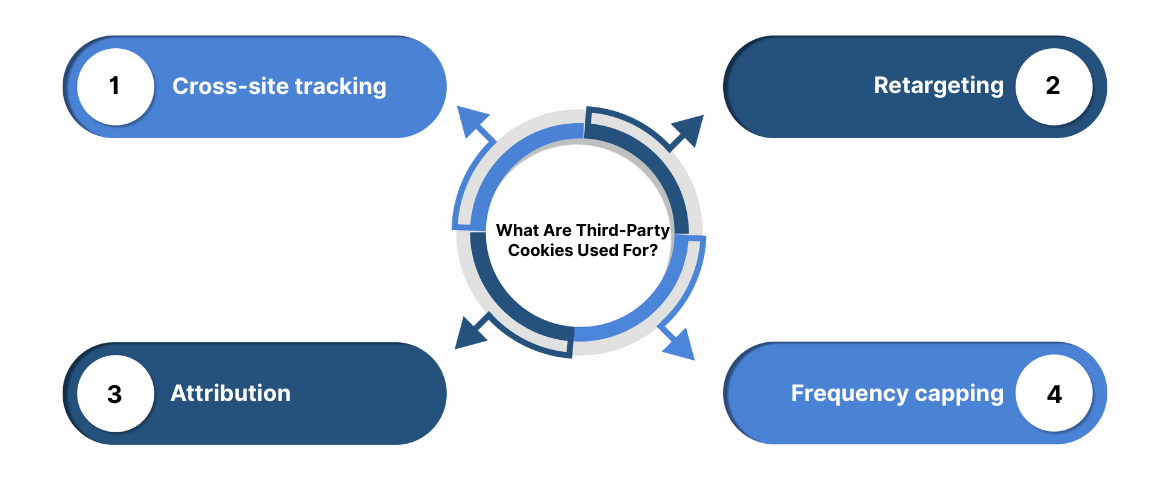
- Cross-site tracking allows advertisers to follow user behavior across multiple websites, building profiles of interests and intent.
- Retargeting uses this data to show ads to users who previously visited your site but didn't convert.
- Attribution connects conversions back to the marketing touchpoints that influenced them, helping teams understand which channels drive results.
- Frequency capping prevents users from seeing the same ad repeatedly by tracking impressions across sites.
Without third-party cookies, each of these functions requires alternative infrastructure.
What Does "Deprecation" Actually Mean?
Deprecation doesn’t mean cookies vanished overnight. It means they’re losing reliability. For example, Safari’s Intelligent Tracking Prevention blocks most third-party cookies by default, Firefox applies similar restrictions in standard mode, and Chrome allows users to control third-party cookie access.
The impact is gradual. Attribution grows less accurate, retargeting audiences shrink, and more conversions appear as “direct” traffic. Your tracking infrastructure still works, but with growing gaps and weaker signals.
So what caused all this in the first place?
Why Browsers Decided to Kill Third-Party Cookies?
The shift away from third-party cookies stems from converging pressure across regulation, technology, and user expectations.
- Privacy laws like GDPR and CCPA made cross-site tracking a compliance risk by requiring explicit user consent, shifting cross-site data collection away from default practices.
- Browser-level privacy enforcement followed, with Apple, Mozilla, and eventually Google implementing technical restrictions that limit third-party cookies independent of traditional consent mechanisms.
- User trust became a factor as well. Rising privacy concerns, banner fatigue, and higher consent rejection rates pushed browsers to make privacy the default.
- Platform risk compounded as companies like Apple and Google positioned privacy as a competitive advantage, accelerating the timeline for cookie removal across their ecosystems.
Digital marketing built its infrastructure on third-party cookies simply because they were available, not because they were the best solution. Now that the foundation is being dismantled, teams are ready to rethink data collection, especially in Chrome.
The Role of Google Chrome in 3rd Party Cookie Deprecation
Chrome dominates with roughly 63.7% of global browser share, so its cookie policies shape most web traffic.
Original Phase-Out Plan
In 2019, Google launched the Privacy Sandbox to replace third-party cookies with privacy-preserving APIs for ad targeting, measurement, and fraud prevention—without cross-site tracking. The full removal timeline moved from 2022 to 2024, then was postponed indefinitely.
Why Google Paused Full Removal
Publishers worried about revenue loss, advertisers doubted Privacy Sandbox could match cookie functionality, and UK regulators probed potential anti-competitive behavior. Building a replacement while satisfying scrutiny made the original timeline unrealistic.
Chrome’s Current Approach
Since 2024, Chrome has expanded user controls over cookies, while Incognito mode blocks third-party cookies by default. Privacy Sandbox APIs continue to develop, but adoption and effectiveness remain limited.
The result? Chrome shifted cookie deprecation from mandatory to user-controlled. For marketers, this means tracking becomes inconsistent, data coverage shrinks, and measurement accuracy drops.
Teams that adapt are building infrastructure that works across privacy settings, such as server-side tracking with Ingest Labs, which reduces browser-level data loss and improves consistency.
Also Read: Why Cookie-Free Websites Are Winning in a Privacy-First World
5 Things That Actually Break When 3rd Party Cookies Stop Working?
The impact of cookie deprecation manifests as performance degradation rather than complete failure. Systems still function, but with growing inaccuracy that compounds over time.
- Attribution gaps appear first. Conversions that would previously be attributed to paid ads or email campaigns now show as "direct" traffic because the tracking link broke somewhere in the cross-site journey. Multi-touch attribution models lose visibility into earlier touchpoints, overvaluing the final click.
- Underreported conversions follow as tracking pixels fail to fire or can't match users across sessions. The data says performance declined, but often what declined is measurement accuracy, not actual results.
- Retargeting breaks when cookies can't identify which users visited your site. Audience pools shrink. CPMs often increase as you compete for a smaller, less precisely targeted group.
- CAC inflates because attribution systems can't connect conversions to their actual sources, making some channels appear less efficient than they are. Budget gets reallocated based on incomplete data.
- Audience quality signals degrade as platforms lose the cross-site data that informed their targeting algorithms.
For ecommerce, this means cart recovery and recommendations fail. For B2B, lead scoring and multi-week journeys break. For performance marketers, conversions go unseen, and feedback loops fail. The impact is gradual, but the effects begin immediately.
Also Read: Third-Party Cookie Restrictions: Challenges and Solutions
Every day you operate with degraded tracking is another day of incomplete data feeding into decisions. Waiting only makes it worse. So what actually replaces cookies once they're gone?
4 Cookieless Alternatives That Actually Work
Moving away from third-party cookies doesn't mean giving up on tracking. It means changing where your data lives and how you collect it.
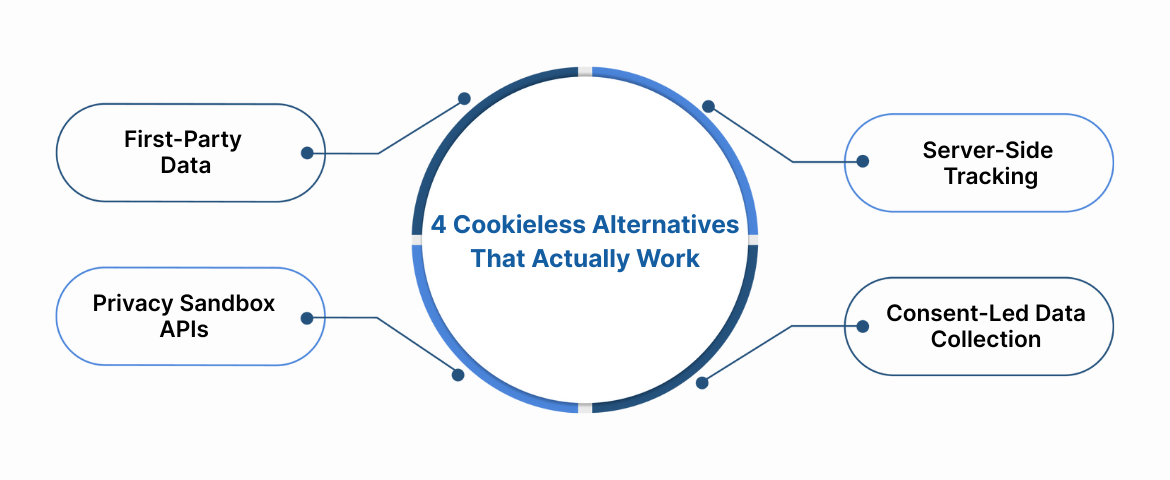
1. First-Party Data
First-party data comes directly from your own properties, your website, app, CRM, email, or customer accounts. You own it, users consent to it, and it lasts because it doesn’t rely on cross-site tracking. Users share it through logins, forms, purchases, and opt-ins.
The limitation is coverage. It only tracks activity on your properties, not behavior across the web. You lose pre-site and cross-site visibility, but you gain reliability. First-party data works across browsers, avoids privacy blockers, and aligns with regulatory requirements when properly consented.
2. Server-Side Tracking
Server-side tracking shifts data collection from the browser to your server. Instead of relying on JavaScript tags that browsers block, your server sends events directly to analytics tools, ad platforms, or data warehouses.
This improves accuracy, bypasses blockers, speeds up page loads, and gives you full control over what data you share.
The tradeoff is setup complexity. Server-side tracking requires more technical work than adding pixels. But for teams that care about accurate attribution in a cookieless world, Ingest Labs makes it accessible without developers. Our platform simplifies server-side setup while giving marketing teams greater control over data flow.
3. Privacy Sandbox APIs
Google’s Privacy Sandbox introduces APIs that support ad targeting and measurement without cross-site tracking. The Topics API shares interest-based signals, the Attribution Reporting API links ads to conversions, and FLEDGE enables retargeting without identifying users across sites.
These APIs run only in Chrome and depend entirely on Google’s ecosystem. They lack cross-browser support, see limited adoption, and still prove their effectiveness. For Chrome-heavy traffic, Privacy Sandbox can complement other methods, but it doesn’t replace a broader cookieless infrastructure.
4. Consent-Led Data Collection
Consent management platforms (CMPs) help collect user permissions while maintaining compliance with GDPR, CCPA, and other privacy laws. But beyond compliance, consent-based approaches improve signal quality. Users who actively consent to tracking often represent higher-intent segments worth prioritizing.
The challenge is that consent rejection rates vary wildly by region and how you implement it. Teams relying only on consented cookie tracking face big coverage gaps. But when you combine consent with first-party data and server-side tracking, it becomes part of a layered approach instead of a single point of failure.
The future of marketing measurement isn't any one replacement technology. It's a combination of owned data, server-side collection, and privacy-first design working together.
Also Read: Guide to Cookieless Targeting and Future Strategies
Now let's get practical about implementation.
6 Steps to Prepare for 3rd Party Cookie Deprecation
Transitioning away from third-party cookies isn't a single project. It's infrastructure modernization that touches attribution, data collection, audience targeting, and compliance. But it can be approached systematically.
- Audit current tracking dependencies. Map which systems rely on third-party cookies: your analytics platform, ad pixels, attribution tools, retargeting audiences, and A/B testing software. Identify which functions break when cookies are blocked. Test your site with cookies disabled to see what stops working.
- Identify cookie-reliant platforms. Not all tools depend equally on cookies. Some platforms have already shifted to alternative methods. Others remain cookie-dependent and will require replacement or reconfiguration. Understanding which platforms in your stack are at risk helps prioritize migration efforts.
- Move key events server-side. Start with high-value conversion events: purchases, form submissions, and account creations. Implement server-side tracking for these events first to ensure attribution accuracy on the metrics that matter most. Expand to other events based on impact.
- Strengthen first-party identifiers. Build systems that encourage logins, account creation, or email capture earlier in the customer journey. The more users you can identify through first-party methods, the less you depend on cross-site cookies for continuity.
- Align consent and tracking strategy. Ensure your consent management doesn't just check compliance boxes. It preserves data quality. Design consent flows that explain value exchange clearly. Segment audiences by consent status so you can measure differences in data coverage.
- Test attribution differences. Run parallel tracking using cookie-based and cookieless methods to understand how results differ. Build baseline comparisons while cookies still work for some traffic. This gives you a reference point for interpreting data once coverage declines further.
The goal isn't to perfectly replicate what cookie-based systems did. It's to build infrastructure that works reliably across all browsers, devices, and privacy configurations.
That infrastructure becomes your competitive advantage as cookie coverage keeps declining. Ingest Labs provides everything you need.
How Ingest Labs Helps Marketers Navigate 3rd Party Cookie Deprecation
As third-party cookies become less reliable, many marketing teams find themselves choosing between engineering-heavy solutions and privacy tools that prioritize compliance over performance.
In reality, few teams achieve accurate tracking, clean attribution, and privacy compliance simultaneously, especially as browsers, platforms, and regulations continue to change.
This is where Ingest Labs fits into the cookieless conversation.
Built for a Cookieless, Privacy-First Web
As third-party cookies lose reliability, many teams get stuck between complex, engineering-heavy solutions and privacy tools that ensure compliance but hurt performance. Few manage accurate tracking, clean attribution, and privacy compliance at the same time. Ingest Labs fills that gap.
Ingest Labs helps marketers move beyond third-party cookies without rebuilding their entire stack. The platform simplifies tag management, strengthens first-party data, and enables server-side tracking with minimal coding requirements.
We offer:
- Reliable tracking without third-party cookies: Ingest IQ moves tracking server-side to capture signals browsers block, improve attribution across web and mobile, and reduce data loss from consent rejection, ad blockers, and iOS restrictions.
- Usable first-party identity: Ingest ID assigns a privacy-safe, first-party identifier to track journeys across sessions and devices, improve attribution, and power personalization, without third-party cookies.
- Unified data and actionable insights: Event IQ unifies data from ads, analytics, CRMs, and product events so teams can track key actions in real time, analyze cross-channel performance, and activate insights for growth.
- Privacy compliance without sacrificing performance: Ingest Labs supports GDPR, CCPA, and global privacy standards through consent-based, ethical data collection, while preserving the data quality marketers need.
3rd party cookie deprecation signals a shift in data maturity. Teams that invest in first-party data, server-side tracking, and unified customer intelligence adapt faster as privacy standards evolve. Ingest Labs makes that transition practical, scalable, and marketer-friendly.
Final Takeaway
Third-party cookie deprecation isn’t a browser issue. It’s a data infrastructure problem already hurting conversions. Tracking reliability is weakening, attribution accuracy is declining, retargeting pools are shrinking, and acquisition costs are rising due to incomplete data.
Waiting for a final deadline won’t fix this; it only extends unreliable measurement. Teams that adapt early don’t just survive cookie deprecation. They gain an advantage while others’ data falls apart.
Ingest Labs helps you build cookieless infrastructure. Ingest IQ enables server-side tracking, Ingest ID powers first-party identity, and Event IQ unifies customer data.
The result? Accurate measurement across browsers and privacy settings, full visibility into customer journeys, and decisions driven by complete data.
Cookieless marketing is inevitable. You can lead the shift or play catch-up. Get started with Ingest Labs and reduce data loss caused by declining cookie reliability.
FAQs
Q1. Are third-party cookies completely going away?
Third-party cookies are blocked by default in Safari and restricted in Firefox, and are now user-controlled in Chrome. While they're not completely gone, their reliability and coverage continue declining as more browsers restrict them and more users opt out.
Q2. Does Google still use third-party cookies in Chrome?
Chrome still supports third-party cookies, but users can now choose to block them. Incognito mode blocks them by default. Google is developing Privacy Sandbox APIs as alternatives, though full cookie removal has been postponed indefinitely.
Q3. Is GA4 affected by cookie deprecation?
GA4 can operate without third-party cookies when properly configured, but its accuracy improves with server-side implementation and first-party data integration. Cookie-based GA4 setups face the same coverage gaps as other cookie-dependent tools.
Q4. Can server-side tracking replace cookies?
Server-side tracking addresses many limitations of cookie-based tracking by moving data collection to your server, where browser restrictions don't apply. However, it works best when combined with first-party identifiers rather than as a complete replacement for all cookie functions.
Q5. How does consent impact cookieless tracking?
Cookieless tracking methods like server-side implementation and first-party data still require consent under privacy regulations. The advantage is that these methods work more reliably than third-party cookies once consent is obtained, and they often face lower technical blocking even when consented.