



Your Meta Ads budget may be leaking due to attribution blind spots. You see the numbers in Ads Manager. You see the sales in your Shopify or Stripe dashboard. But they do not match. Every week, the gap grows wider. You blame the creative. You blame the audience. You even blame the Meta algorithm. You are looking at the wrong culprit.
The real reason for your performance drop is sitting in the pockets of billions of people. It is Safari. Specifically, it is a piece of technology called Intelligent Tracking Prevention (ITP).
Apple designed ITP to protect user privacy. For digital marketers, it acts as a blindfold. It deletes your cookies. It cuts your attribution windows. It shrinks your retargeting pools until they are useless. If a customer clicks your ad on Monday but buys the following Tuesday, Safari may prevent Meta from attributing that conversion accurately.
Meta calls this "signal loss." You call it a waste of money. Let's break it down.
Key Takeaways
- Meta Ads ROAS drops are often driven by data loss and attribution gaps, not just creative or targeting issues.
- Safari’s Intelligent Tracking Prevention (ITP) limits cookies to 24 hours–7 days, breaking attribution and misclassifying paid conversions as “Direct.”
- Traditional marketing data stacks rely on browser-side tracking, which no longer works in a privacy-first web.
- Server-side tracking alone is often insufficient when it still relies on short-lived browser identifiers.
- A first-party marketing data stack powered by Ingest IQ and Ingest ID with persistent identity and server-side event capture helps restore attribution accuracy, improves algorithmic learning signals, and can reduce CPA over time.
What Is a Marketing Data Stack and Why It’s Breaking)
A marketing data stack is the collection of tools and infrastructure marketers use to collect, identify, store, and activate customer data across channels, including pixels, analytics platforms, CDPs, ad platforms, and CRMs.
Most modern marketing data stacks were built for a cookie-based web. As browsers like Safari restrict tracking, these stacks lose visibility, attribution accuracy, and optimization signals, especially for paid media.
What Is Safari ITP and Why It Restricts Browser-Based Tracking
Safari is not just a browser; it is the primary gateway for a large, high-value segment of mobile web users. In the United States, Safari holds over 50% of the mobile browser market share. These users typically have higher disposable income. They are the people you want to reach.
Apple introduced ITP in 2017. Since then, they have updated it dozens of times. Each update makes it harder for the Meta Pixel to do its job.
Originally, the Pixel relied on third-party cookies. These cookies allowed Meta to track users as they moved from Facebook to your website and back again. Apple killed third-party cookies years ago. Marketers moved to first-party cookies to compensate. Then, Apple began restricting those, too.
The 7-Day Expiry Problem
Many first-party cookies set via JavaScript are subject to a seven-day expiration window in Safari under ITP. This happens even if you have a great relationship with your customer. If a user visits your site and does not come back within seven days, Safari deletes the cookie.
The 24-Hour Reset
It gets worse. If a user clicks an ad that contains "link decoration" (like the fbclid parameter Meta uses), Safari may limit cookie lifespan to as little as 24 hours when link decoration or known tracking domains are involved. This happens if the referring domain is classified as a tracker. Meta is always classified as a tracker.
Here is why this matters. Most high-ticket items or complex services have a consideration cycle longer than 24 hours. If your customer needs two days to "think about it," your tracking is already dead.
Why Does Safari ITP Break Marketing Attribution?
Safari ITP breaks marketing attribution by deleting or shortening cookie lifespans, which severs the link between ad clicks and conversions. When this happens, platforms like Meta can no longer attribute purchases to campaigns, causing underreported ROAS and poor optimization.
When Safari deletes the tracking cookie after seven days (or 24 hours), the link between the ad click and the purchase is severed. When that customer finally buys on day eight, Meta sees a "new" visitor coming from "Direct" traffic.
The Hidden Costs of Missing Data
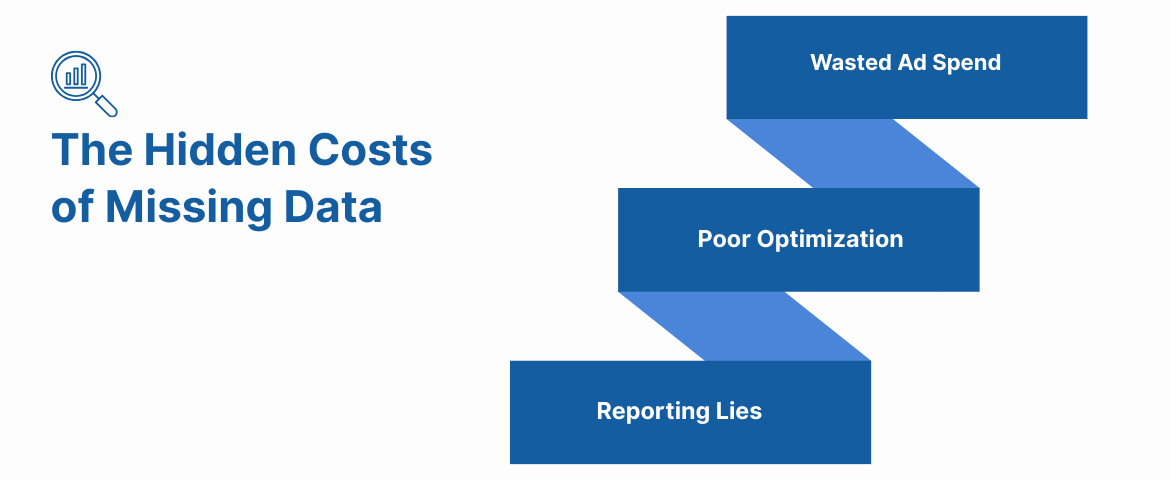
- Wasted Ad Spend: You keep showing ads to people who already bought because Meta thinks they are still prospects.
- Poor Optimization: The Meta algorithm relies on "conversion signals" to learn. When Safari hides 30% of your conversions, the algorithm learns 30% slower.
- Reporting Lies: Your ROAS looks lower than it actually is. You might turn off a winning campaign because the data says it isn't working.
Let's look at the math. If you spend $10,000 and Safari hides $3,000 worth of sales, your reported ROAS drops from a healthy 3.0 to a measly 2.1. Most marketers would kill that 2.1 campaign. You would be killing your most profitable engine.
Why Retargeting Is Dying a Slow Death
Retargeting used to be the "easy button" for ROI. You show an ad to someone who looked at a product but didn't buy. It works because the intent is high.
Safari ITP has significantly reduced the reliability and scale of browser-based retargeting.
Because cookies expire so quickly, your "Website Visitor" audiences are constantly shrinking. If a user browses your site on a Monday and you try to retarget them the following Tuesday, they might not be in your audience anymore. Safari has already expired the browser-based identifier.
The Lookalike Degradation
Your Retargeting audiences feed your Lookalike audiences. When your seed data is thin and inaccurate, your Lookalikes become "un-alikes." You end up paying to show ads to people who have no interest in your product.
Next steps: We need to examine why the current "standard" solutions are failing.
Why Most Marketing Data Stack Fixes Don’t Work
Many teams attempt to fix attribution loss by adding server-side tracking or implementing Meta’s Conversions API. While these tools improve data delivery, they still rely on browser-generated identifiers that Safari limits or deletes.
Without a persistent, first-party identity layer, most marketing data stacks continue to lose attribution signals, even when server-side tracking is enabled.
The Myth of the "Server-Side" Silver Bullet
When Apple launched iOS 14.5 and tightened ITP, Meta pushed everyone toward the Conversions API (CAPI). The idea was simple. If the browser blocks the data, send the data directly from your server to Meta's server.
CAPI is better than the Pixel alone, but it is not a complete solution.
Many CAPI implementations still rely on browser-generated identifiers for initial user matching. If the browser sets an fbp or fbc cookie that expires in 24 hours, the server-side event you send on day three won't have a valid ID to match it to a user.
CNAME Cloaking Is Not Enough
Some developers try to bypass ITP using CNAME cloaking. They make the tracking server look like a subdomain of the main site (e.g., track.yourwebsite.com). Safari caught on to this years ago. ITP now detects CNAME cloaking and caps those cookies at seven days, too.
You cannot outrun Apple's engineers with simple redirects. You need a persistent, first-party identity layer that does not depend on browser cookie lifetimes.
How Analytics Becomes a Hall of Mirrors
Safari ITP does not just mess with Meta. It ruins your Google Analytics (GA4) data too.
When a cookie expires, GA4 treats the returning user as a brand-new visitor. This inflates your "New User" count and crashes your "Returning User" metrics.
The Rise of "Direct" Traffic
Have you noticed a massive spike in "Direct / None" traffic in your reports? That “Direct” traffic often represents unattributed paid or email traffic affected by cookie expiration.
- User clicks Meta Ad (Safari sets 24-hour cookie).
- User leaves.
- User returns 48 hours later via a bookmarked link or by typing your URL.
- Safari has deleted the ad cookie.
- GA4 sees no campaign data.
- The sale is attributed to "Direct."
This makes your organic efforts look better than they are and your paid efforts look worse. You end up making strategic decisions based on a fantasy.
Rebuilding the Marketing Data Stack for a Cookieless Web with Ingest Labs
Instead of relying on short-lived cookies, Ingest Labs creates a persistent data layer that ensures marketing platforms receive accurate, durable signals. At Ingest Labs, we rebuild the marketing data stack around first-party identity and server-side data collection, removing the browser as the source of truth.
Near 100% Event Capture
Instead of just "sending events," Ingest IQ creates a persistent, server-side environment that handles the heavy lifting of identity. We don't just hope the browser keeps the cookie alive. We help ensure event data reaches Meta more reliably by removing browser-level blockers from the delivery path.
Most Meta Pixel setups miss 20% to 40% of events due to ad blockers and ITP. Ingest IQ uses advanced server-side processing to capture a significantly higher percentage of clicks, add-to-cart events, and purchases.
When you capture more complete and consistent event data, the Meta algorithm gets "smarter" twice as fast. Your cost per acquisition (CPA) drops because the machine finally has the map it needs to find your customers.
180-365 Day Persistence
While Safari tries to kill your tracking in 24 hours, Ingest ID enables long-term identity persistence (typically 180–365 days) using first-party, consent-aware signals.
Ingest ID is a proprietary identity graph that works behind the scenes. It links users across sessions and devices without relying on fragile JavaScript cookies.
Imagine a customer who sees your ad in June but doesn't buy until December.
- Standard Pixel: Lost the lead in June.
- Standard CAPI: Lost the lead in July.
- Ingest ID: Can associate the December conversion with earlier engagement signals from June when consent and matching conditions allow.
This gives you a true view of your Long-Term Value (LTV). You can finally see which "Top of Funnel" awareness campaigns are actually driving sales six months down the line.
Comparison Table: Standard vs. Ingest
In a traditional marketing data stack, attribution relies on browser-side cookies that expire quickly under Safari ITP. When those cookies disappear, conversion data is lost, retargeting pools shrink, and performance reporting becomes unreliable.
Ingest ID and Ingest IQ by Ingest Labs replace this fragile layer with persistent server-side identity, enabling higher event capture rates, accurate attribution windows, and consistently enriched signals for advertising and analytics platforms.
| Feature | Standard Meta Pixel | Basic CAPI Setup | Ingest IQ + Ingest ID |
| Cookie Lifespan (Safari) | 24 Hours - 7 Days | 7 Days | 180 - 365 Days |
| Event Capture Rate | ~60-70% | ~85% | ~95–99% (implementation-dependent) |
| Retargeting Accuracy | Low (Shrinking pools) | Medium | High (Persistent pools) |
| Attribution Accuracy | Poor (Broken by ITP) | Moderate | Significantly Improved |
| Algorithmic Learning | Slow / Stalled | Average | Faster and more stable learning |
The Real-World Impact on Your Meta Ads Performance
What happens when you switch from "guessing" to "knowing"?
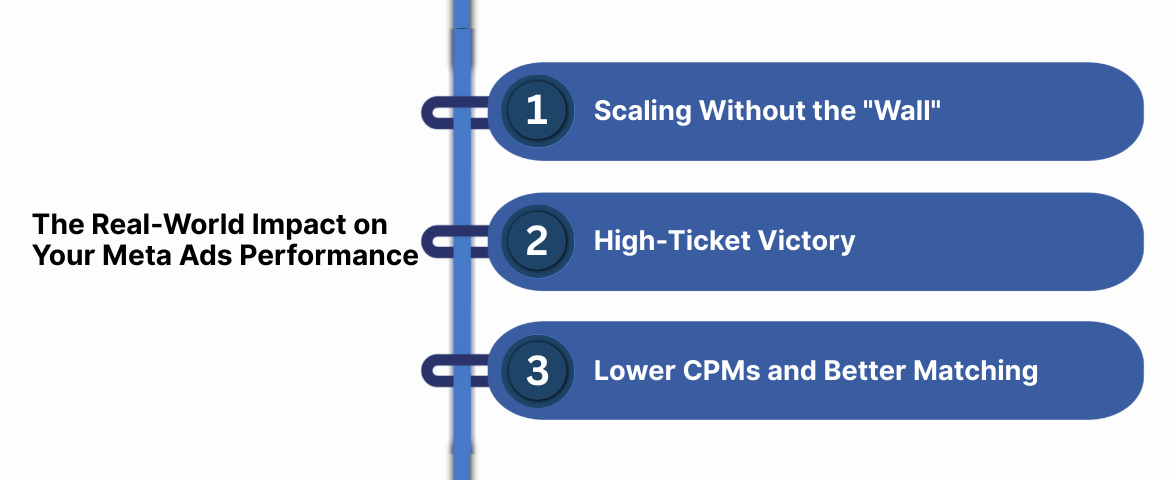
1. Scaling Without the "Wall"
Most advertisers hit a wall. They can spend $500 a day profitably, but at $1,000, the ROAS collapses. This often happens because the algorithm doesn't have enough high-quality data to scale. By feeding Meta 30% more conversions via Ingest IQ, you give the algorithm the "fuel" it needs to break through that ceiling.
2. High-Ticket Victory
If you sell products over $500, your customers do not buy on the first click. They visit your site four or five times over three weeks. Safari ITP destroys the tracking for 100% of those journeys. With Ingest ID, you see the full path. You stop over-optimizing for the "last click" and start investing in the ads that actually start the conversation.
3. Lower CPMs and Better Matching
Meta rewards advertisers who provide high-quality data. By improving your Event Match Quality (EMQ) score toward the upper range, you often see a decrease in your CPMs. Meta trusts your data, so it places your ads more effectively.
Your Next Move
The "privacy-first" web is not a trend. It is the new reality. Google Chrome is following Safari's lead in phasing out tracking capabilities. If you are still relying on a basic browser pixel, you are operating a business with one eye closed.
You do not need to let Safari dictate your profitability.
By implementing a first-party identity solution like Ingest IQ and Ingest ID, you take back control of your data. You stop the "Direct" traffic leak. You fix your retargeting. Most importantly, you give your Meta Ads the signal they need to actually perform.
Stop letting browser-level signal loss distort your attribution and ad performance.
Ready to reclaim your ROAS?