




Recent research shows that 21 % of marketersfind data collection harder because consumers hesitate to share personal information. This challenge sits inside a much larger shift. Google is removing third-party cookies, major platforms are tightening tracking rules, and new privacy regulations continue to raise the compliance bar. These changes push brands to rely more heavily on information gathered directly from their own audiences.
That pressure makes first-party data more valuable than ever, yet collecting and tracking it is no longer straightforward. Browser restrictions interrupt event flows, client-side scripts get blocked, and inconsistent consent signals disrupt attribution. Many teams face accuracy gaps while trying to adjust their systems to this new environment.
This blog explains the most reliable ways to track first-party data in a privacy-first environment. You will learn what to collect, how to collect it, and how to keep your measurement stack future-ready.
Key Takeaways
- First-party tracking is now the only consistent way to understand customer behavior as third-party cookies and external trackers disappear.
- Most teams lose data because their event flows are fragile, inconsistent, or built on scripts that no longer fire reliably under new privacy rules.
- Clean tracking requires a stable server-side foundation, unified schemas, consent-aware event logic, and continuous validation.
- First-party data fuels accurate measurement, dependable attribution, and better personalization without risking compliance.
- Ingest Labs solves the gaps by delivering server-side events that help keep every tool aligned.
What First-Party Tracking Really Means
First-party tracking refers to information you collect directly through your own site or app rather than depending on third-party cookies. These signals come from actions like visits, clicks, carts, and form submissions, and they remain far more reliable than third-party methods, even as browsers tighten privacy rules. Because the data flows through channels you control, you avoid the gaps that happen when scripts break or get blocked.
This gives your marketing team a clearer picture of what people actually do. You get stronger attribution, more accurate audience insights, and a consistent understanding of how users move from interest to conversion.
In real terms, this looks like a purchase captured on your server and sent to an ad platform, a form submission arriving cleanly in your CRM, a returning visitor recognized when your own first-party identifier is available, or a cart event passed directly into your analytics tools.
How First-Party Tracking Works
First-party tracking works when your data flows through channels you control. The goal is to capture user actions directly and deliver them to your analytics and marketing tools without relying on third-party scripts.
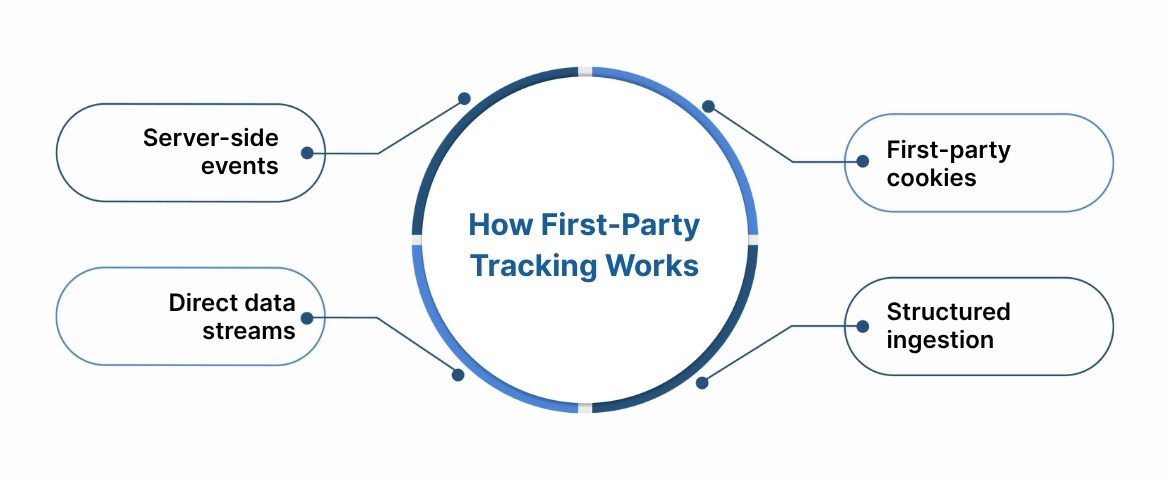
The core methods usually look like this:
- Server-side events: Key actions like purchases, signups, and conversions are sent from your server to platforms such as Meta, Google, or your analytics tools.
- First-party cookies: User activity is stored under your own domain, so returning visitors can be recognized consistently.
- Direct data streams: Form fills, logins, carts, and page interactions move straight from your site or app into your CRM or analytics stack.
- Structured ingestion workflows: Events follow a consistent schema so data remains clean, compliant, and ready for reporting or activation.
Third-Party vs First-Party Tracking
Third-party and first-party tracking matters collect data in completely different ways. One depends on external platforms following users across the internet, while the other relies on information gathered directly through your own properties.
This shift changes how much control you have, how reliable your data is, and how confident you can be in your measurement.
Third-Party Tracking
Third-party tracking relied on data collected by external platforms that followed users across multiple sites. It powered a huge part of digital advertising for years, but the entire system depended on shared cookies and browser behavior you could not control.
What it used to enable
- Cross-site profiling built from shared cookies
- Pixel-based attribution that depended on browser cooperation
- Retargeting models fed by external data networks
Why does it no longer work well
- Browser restrictions remove the cookies these systems rely on
- App privacy rules block external trackers automatically
- Security policies limit scripts from unknown vendors
- Brands face data ownership and compliance risks when information leaves their ecosystem
First-Party Tracking
First-party tracking focuses on data captured directly through your own site or app. The information flows through your domain, your consent flow, and your systems, which keeps the signals stable even as external tracking methods collapse.
What it allows you to do
- Capture user actions directly without relying on shared cookies
- Record events under your own domain for higher accuracy
- Maintain consent signals more consistently across user journeys.
- Improve attribution with fewer missing or blocked events
Here is a comparison for your quick view
| Aspect | Third-Party Tracking | First-Party Tracking |
|---|---|---|
| Data Source | External networks following users across sites | Your own site or app |
| Reliability | Breaks when browsers block scripts or cookies | Stable because events come from your domain |
| Attribution | Pixel-based and often incomplete | More accurate with fewer missing signals |
| Privacy Compliance | High risk because data leaves your ecosystem | Strong alignment since data stays under your control |
| Use Cases | Retargeting, cross-site profiling | Measurement, personalization, audience insights |
| Future Readiness | Declining due to privacy rules | Increasingly essential and sustainable |
Related: Understanding First-Party, Second-Party, and Third-Party Data: Strategies and Benefits
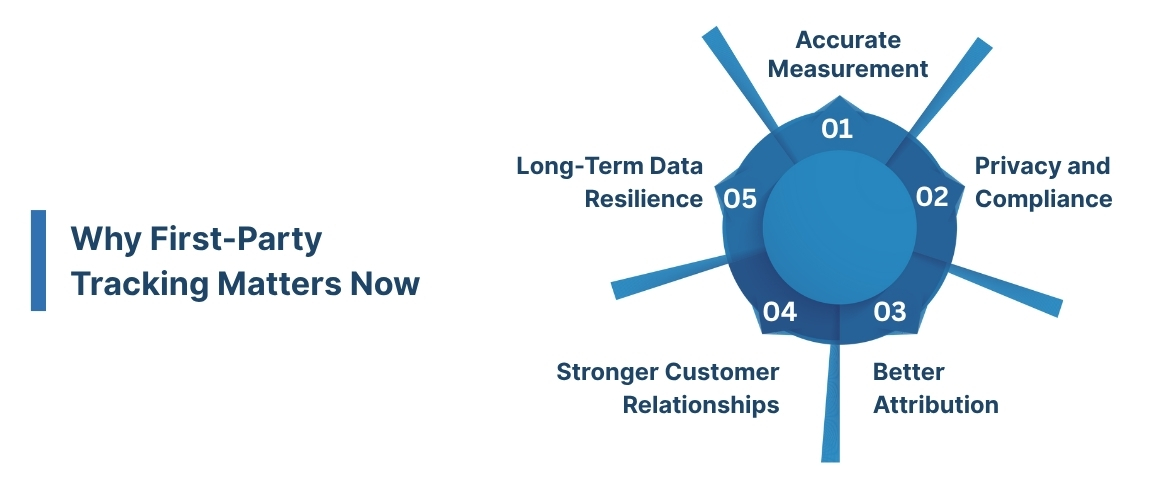
Why First-Party Tracking Matters Now
Audience behavior has changed. People share less information, expect more transparency, and want control over how brands use their data. At the same time, the data landscape has shifted from broad, third-party profiling to privacy-aligned signals such as first-party and zero-party data.
This creates a new reality where first-party data becomes the most valuable asset in your marketing stack. It powers personalization, supports compliant growth, and keeps your campaigns running even as external tracking continues to disappear.
Here is why tracking it properly has become essential.
Accurate Measurement
- Reduces signal loss by capturing actions at the point where they actually happen, not where a third-party script hopes to detect them.
- Keeps performance reporting stable because server-side events remain visible even when browsers block client-side scripts.
- Preserves critical conversion paths that would otherwise vanish under new privacy restrictions.
Privacy and Compliance
- Aligns naturally with GDPR, CCPA, and CPRA because the data stays within your ecosystem rather than being pushed to external networks.
- Creates consent flows users can understand and accept, which improves both compliance and conversion rates.
- Provides clear, owned logs that make audits predictable instead of stressful.
Better Attribution
- Uses identifiers that your brand controls, which keeps user journeys consistent even when platforms limit tracking windows.
- Can reconnect cross-device actions when identifiers or logins are available.
- Removes the guesswork from funnels by reducing the number of missing or misfired events.
Stronger Customer Relationships
- Captures direct opt-in signals that reflect genuine intent, not inferred behavior from unrelated browsing.
- Supports personalization that feels helpful instead of invasive because it is based on choices the user made.
- Can strengthen trust when paired with transparent consent experiences, which improve engagement rates across email, ads, and on-site experiences.
Long-Term Data Resilience
- Works with far less dependence on browser policies, which protects your measurement even as Chrome, Safari, and Firefox introduce new restrictions.
- Reduces dependence on vendor pixels that can break without warning.
- Builds a durable foundation that adapts to new privacy rules without forcing you to rebuild your entire stack.
Want a tracking setup that survives the next wave of privacy changes?
Ingest Labs gives you clean, server-side events, durable identifiers, and a unified first-party data stream that keeps your reporting accurate even when everything else becomes harder to track.
6 Challenges Teams Face With First-Party Tracking
The ideal version of first-party tracking is clean and predictable. Every key action gets captured once, consent logic stays consistent, events follow a unified structure, and the data flows smoothly into analytics, CRM, and ad platforms.
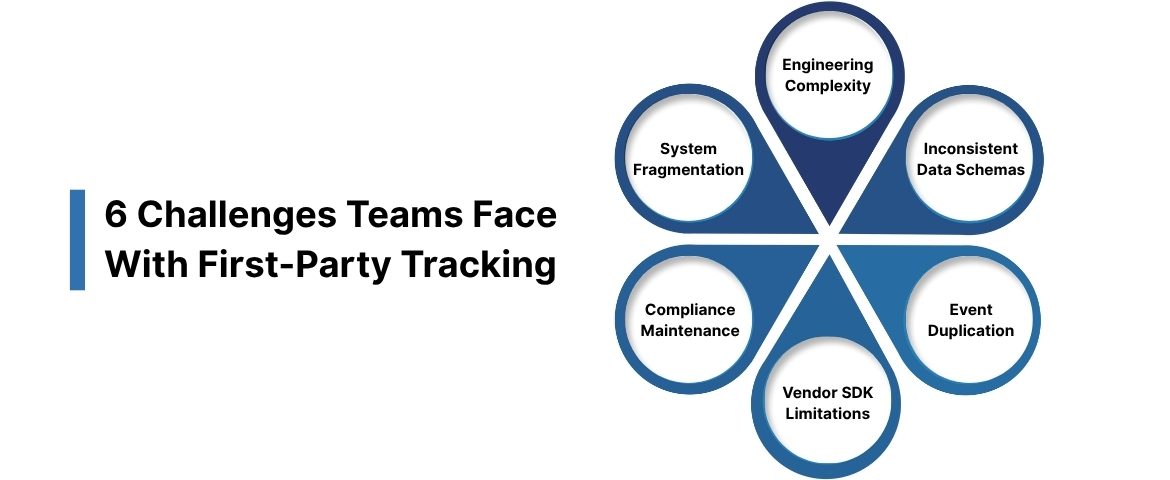
In reality, few teams achieve this. Most stacks were built on top of years of patches, old pixels, and fragmented ownership. When privacy rules changed, teams tried to fix small pieces rather than rebuild the foundation. That is where the cracks appear. Here is what usually goes wrong, why it happens, and what it looks like inside a real marketing setup.
1. Engineering Complexity
Many teams underestimate how much coordination first-party tracking demands. A single checkout event might pass through multiple tools, each introducing its own dependency.
Small changes, such as redesigning a page or swapping a form plugin, often break entire event flows without triggering any alerts.
A common example is a campaign going live while server-side events only fire for logged-in users, leaving most conversions untracked.
2. Inconsistent Data Schemas
Over time, teams track the same action in different formats because each tool has its own naming rules. This creates mismatched properties, values, and event names that make dashboards contradict one another. You end up with several versions of the truth, none of which are fully reliable.
A typical example is three variations of the same event appearing across platforms, each treated as a separate signal.
3. Event Duplication
Teams often run client-side and server-side tracking together without realizing that both are firing the same event. Ad platforms then double-count conversions, skew reporting, and optimize toward inflated numbers.
Performance looks strong at first, but it becomes less accurate with every campaign. Many brands realize the issue only after the budget has been wasted and attribution no longer aligns with tangible outcomes.
4. Vendor SDK Limitations
Teams assume vendor SDKs handle first-party tracking well, but most cannot manage strict consent logic or complex customer journeys. They also conflict with other scripts, especially when browsers introduce new privacy changes.
A common issue is a lightweight analytics SDK blocking a server-side event trigger, breaking tracking in ways that remain invisible until reporting collapses.
5. Compliance Maintenance
Consent rules evolve frequently, but tracking setups rarely keep pace. A banner might stay unchanged for years while underlying requirements shift, creating silent compliance gaps. Even small sequencing issues cause problems, such as events firing before the consent tool finishes loading.
These gaps only surface during audits or legal reviews, long after the data has been collected incorrectly.
6. System Fragmentation
Most teams collect data in silos. CRM tracks one version of an action, analytics tracks another, and ad platforms receive a third. Without a shared identity or schema, no system fully matches.
Marketers are left comparing numbers that never line up, unsure which one reflects reality. It is common to see signups, purchases, or conversions reported differently across tools, even when they point to the same interaction.
Best Practices for Implementing First-Party Tracking
Teams often rely on superficial tracking when handling first-party data. They capture a few clicks, drop in a pixel, and assume the foundations are solid. That approach breaks quickly because first-party data only performs when the structure behind it is intentional.
Successful tracking has a clear purpose, a clean schema, and a flow that remains consistent even when your site, tools, or campaigns change. Here is how to set it up in a way that delivers dependable results.
Map Events to Actual Business Goals
Tracking works only when every event ties back to a real outcome. Many teams collect dozens of actions that never inform decisions, while ignoring the ones tied to revenue, retention, or activation.
Start with the journeys that matter and build outward instead of capturing everything and hoping for insight.
Use Server-Side Tagging
Client-side scripts break easily under new privacy controls, but server-side tagging captures the action closer to the source.
This protects critical signals such as purchases, signups, and lead submissions. It also reduces noise by removing unnecessary browser dependencies.
Create a Consistent Naming Schema
Data loses value when every tool uses its own version of an event. A consistent schema avoids confusion and keeps reporting aligned across analytics, CRM, and ad platforms.
When naming stays predictable, teams spend less time interpreting dashboards and more time acting on them.
Reduce Client-Side Scripts
Stacking multiple pixels, SDKs, and tracking tags creates delays, conflicts, and silent failures.
Streamlining the client layer makes the system faster, more stable, and less likely to break when browsers update privacy rules. A lighter setup also improves user experience and conversion rates.
Validate Data Pipelines Continuously
Tracking is not a set-and-forget practice. Pages change, tools update, and campaigns introduce new flows. Regular validation helps prevent silent data loss that often goes unnoticed for weeks.
Instead of relying on dashboards to reveal problems, teams should verify the pipeline before issues appear.
Keep Consent Management Integrated
Consent cannot sit as a separate layer. It needs to be wired directly into your event logic so the system respects user choices at every step. When consent is integrated, events fire only when they are allowed to, keeping the entire stack compliant and stable.
Also read: Mastering the use and activation of First-Party Data
Conclusion
First-party tracking has become the backbone of modern marketing because it gives you clean, consent-aligned data at a time when external tracking continues to shrink.
But the reality is that tracking and handling this data is harder than it looks. Teams struggle with broken event flows, inconsistent schemas, duplication, compliance gaps, and tool fragmentation. These issues pile up quietly until reporting becomes unreliable and campaigns start optimizing against the wrong signals.
Ingest Labs reduces these issues by providing a stable, privacy-first data foundation without most of the usual complexity. Ingest IQ streamlines server-side tracking so critical events stay accurate. Ingest ID provides durable identifiers that keep attribution clear even as platforms restrict visibility. Event IQ helps unify customer actions into a clean, compliant stream so tools receive consistent data. Together, they replace scattered tracking efforts with a system built to last.
If you want to strengthen your first-party data strategy and eliminate the gaps holding your marketing back, explore how Ingest Labs can support your next stage of growth. Book a demo today.
FAQs
1. Why is first-party tracking more reliable than third-party cookies?
First-party tracking relies on data collected directly through your own site or app. Because the signals come from your domain, they do not disappear when browsers block third-party cookies or when platforms limit cross-site tracking. This keeps your measurement consistent even as privacy rules change.
2. What types of events should I prioritize in a first-party tracking setup?
Focus on actions tied to revenue, intent, and customer progression. Examples include purchases, lead submissions, account creation, checkout steps, and product views. These signals help you understand the journey that matters instead of collecting noise.
3. How do server-side events improve data accuracy?
Server-side events bypass many of the issues that break client-side scripts, such as ad blockers, browser restrictions, and rendering delays. This ensures your most important conversions reach analytics, CRM, and ad platforms without missing or duplicating data.
4. What causes most tracking setups to fail over time?
Most failures come from silent issues like schema drift, SDK conflicts, page-level updates, duplicated events, or consent logic that is not properly integrated. These problems stack gradually until reporting becomes unreliable and attribution breaks without warning.
5. How does Ingest Labs help teams build a future-ready tracking system?
Ingest Labs provides a unified, privacy-first tracking infrastructure built around server-side accuracy and clean data pipelines. Ingest IQ handles event delivery, Ingest ID maintains stable user recognition, and Event IQ unifies customer actions into one stream. This removes the fragmentation and technical overhead that cause most first-party tracking systems to fail.