




Are your data-driven marketing efforts hitting a wall? You’ve invested heavily in collecting consent-driven first-party data, yet your customer profiles still feel thin, static, and ineffective for personalization. This challenge has intensified since Apple’s App Tracking Transparency (ATT) framework disrupted third-party tracking, research shows conversion-optimized Meta campaigns saw a 37% drop in click-through rates post‑ATT, leaving brands with fewer reliable external signals.
As we move into 2026, it’s clear that raw first-party data alone isn’t enough. To stay competitive, you need context, depth, identity unification, and real-time activation.
This guide walks you through first-party data enrichment, compliance-led strategies, identity best practices, and the modern technology stack required to transform fragmented customer signals into high-value, actionable intelligence.
Key Takeaways
- First-party data alone is not enough for strong marketing results.
- You need to enrich it to add missing details and make it more useful.
- Enriched data helps you personalize better, target better, and reduce wasted spending.
- Tools that unify identity and activate data in real time work best.
- A privacy-safe setup is essential as laws tighten and tracking continues to decline.
What is First-Party Data
First-party data refers to the information customers willingly share across your owned digital properties, your website, mobile app, or authenticated experiences. This includes behavioral signals like pages viewed, products browsed, and past purchases, along with personal details such as names, emails, or phone numbers provided during sign-ups or transactions.
It also extends to CRM-stored insights gathered through direct interactions, including sales inquiries, support conversations, and service ticket history, all of which help build a fuller, more accurate customer profile.
Why is First-Party Data Important?
First-party data matters because it’s both reliable and directly collected from your customers. Since it originates from your own channels, it provides accurate insights into audience behavior, preferences, and engagement patterns. This level of precision allows you to deliver highly personalized marketing and customer experiences while maintaining strict control over data usage, an essential requirement for meeting privacy and compliance standards in the US and Canada.
Now that you understand why first-party data is so critical in a privacy-first environment, you can look at the practical ways it strengthens your marketing and measurement. The following use cases show where it delivers the most impact.
Key Use Cases of First-Party Data
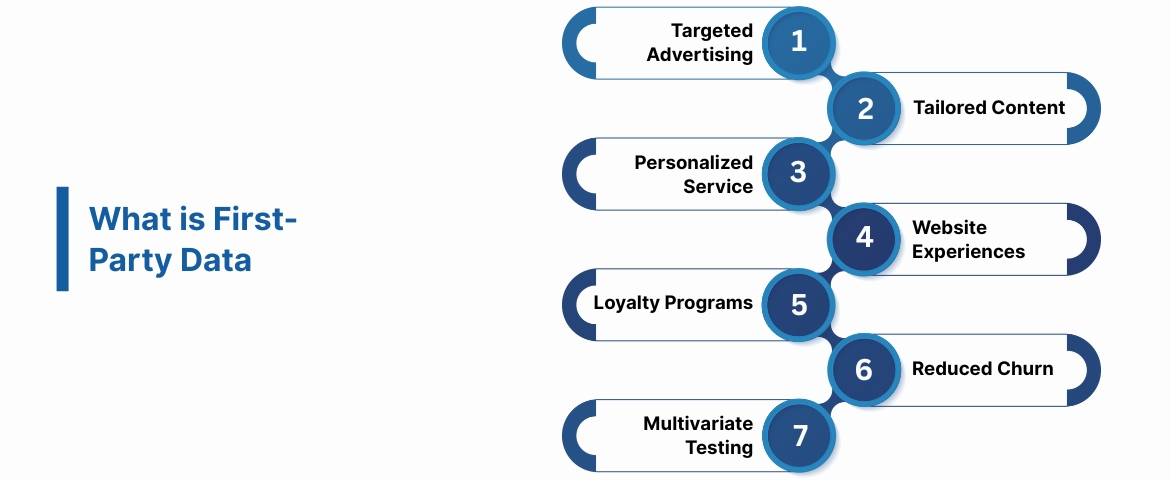
First-party data is more than a privacy-compliant alternative to third-party cookies. It is a strategic asset that strengthens targeting, personalization, retention, and overall customer experience. Here are the core use cases where it delivers the highest value:
- Targeted Advertising: Build accurate segments using purchase history and on-site behavior to improve ROI through lookalike audiences, retargeting, and dynamic recommendations.
- Tailored Content: Personalize website pages, emails, and on-site messaging based on user intent and journey stage to increase engagement and conversions.
- Personalized Customer Service: Equip support teams with complete customer profiles to resolve issues quickly and provide context-aware interactions.
- Improved Website Experiences: Offer relevant products, optimized search results, and personalized homepage layouts to boost conversion rates.
- Loyalty Programs: Use behavioral data to deliver tiered rewards, personalized incentives, and targeted win-back campaigns.
- Reduced Churn: Identify at-risk customers early and trigger proactive retention workflows.
- A/B and Multivariate Testing: Run deeper experiments with meaningful customer segments and measure long-term impact on LTV.
These use cases highlight the value of first-party data, but the impact depends on how complete and accurate that data is. Let us understand the business challenges of raw first-party data.
Also Read: How to Start A/B Testing on Shopify: A Beginner’s Guide
The Business Challenge: Why Raw First-Party Data is Not Enough
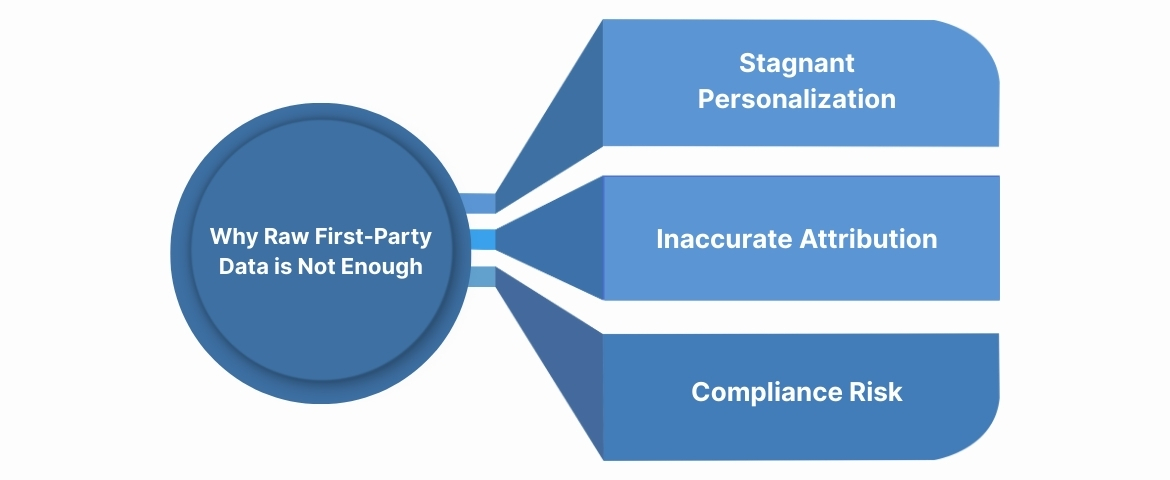
Raw customer data (purchases, clicks, and basic demographics) provides an incomplete picture of your audience. For medium to large enterprises, this lack of depth leads to three key pain points:
- Stagnant Personalization: Generic segments limit personalization to simple attributes (e.g., “recently viewed product X”), failing to address the user’s intent or value.
- Inaccurate Attribution: Without combining behavioral and offline data (such as CRM loyalty status), your attribution models underestimate the true lifetime value (LTV) of a customer acquired through a specific channel.
- Compliance Risk: Fragmented data stored across multiple systems increases the difficulty of honoring user consent and managing data access requests, thereby raising legal risks under North American privacy laws, such as the CCPA/CPRA and CPPA.
First-party data enrichment solves these issues by adding context and structure to your existing records, creating the robust profiles necessary for precision targeting.
Need to transform fragmented customer data into high-impact, enriched profiles?
Event IQ is Ingest Labs’ Customer Data Platform that unifies first-party events, manages consent, builds audiences, and orchestrates data across tools. It provides the structured foundation required for compliant first-party data enrichment. Contact us for a consultation to see your data unified and optimized.
What is First-Party Data Enrichment?
First-party data enrichment is the process of appending new, relevant data points to your existing customer records to deepen your understanding and improve activation across marketing channels.
This process involves integrating data from internal sources, such as CRM systems, transaction histories, loyalty programs, and support interactions, with external data that is either purchased, licensed, or inferred (like geographic or firmographic data), all while respecting user consent.
The Two Dimensions of Enrichment
Effective enrichment depends on strengthening your data in two key areas. Together, these dimensions shape how reliably you can activate and analyze customer insights.
- Vertical Enrichment (Adding Depth): Appending data points directly related to the customer’s interaction with your brand.
- Example: Combining a website visitor’s browsing history with their post-purchase support tickets and their loyalty tier from the CRM. This creates a detailed, holistic view of the customer’s journey and sentiment.
- Horizontal Enrichment (Adding Breadth): Connecting the profile to external, compliant data sources to append demographic or contextual layers from external, compliant enrichment providers (e.g., census-based attributes).
- Example: Appending US Census data based on a customer’s zip code to understand their general household economic profile (without using sensitive PII).
Also Read: Best Practices for Handling PII Data
How To Enrich First-Party Data
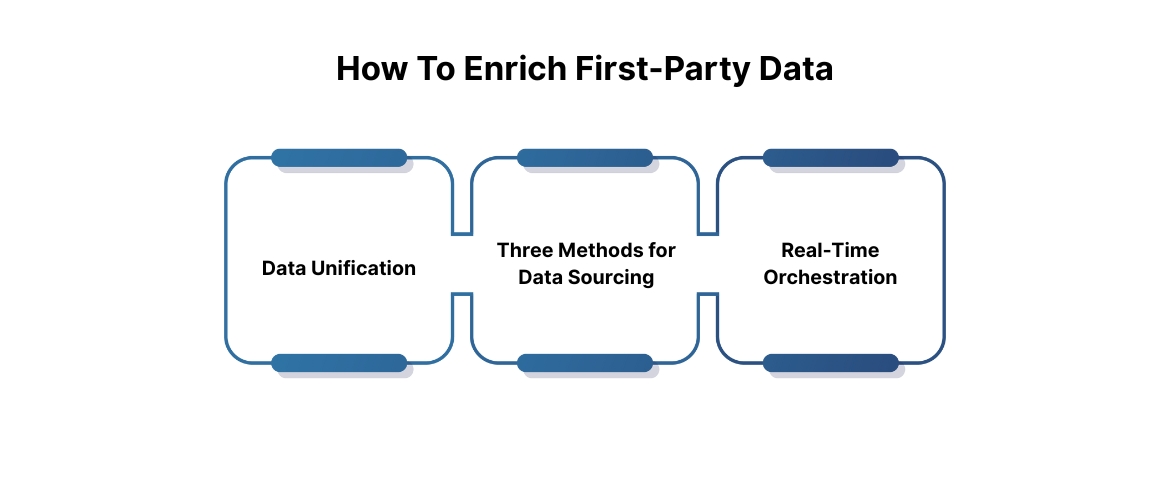
Effectively managing first-party data enrichment requires a structured, compliant process built on a robust data architecture.
1. Data Unification and Identity Resolution
Before you can enrich data, you must unify it. This involves collecting data from all sources (web, app, offline POS, CRM) and linking it to a single, persistent identifier.
- Identity Resolution: Using a first-party identifier (like Ingest ID) to deterministically match data fragments across devices and channels. For instance, linking a user’s web session ID to their hashed email from the CRM.
- Data Standardization: Cleaning, normalizing, and transforming messy raw data into a consistent format, ensuring all fields (e.g., date formats, address fields) align before merging.
2. Three Methods for Data Sourcing
Once data is unified, you must acquire the additional data points. Marketers typically approach this through three distinct methods:
A. Ask Your Customers for More Info (Surveys and Forms)
You can use surveys and forms to gather additional details from new and returning customers, helping you enhance and expand the first-party data you already hold. The upside is that you access reliable data, but potential drawbacks exist:
- People may forget to fill out your forms, leading to incomplete data collection.
- Creating personalized forms can be time-consuming, diverting resources from core marketing tasks.
B. Collect Info Manually
Another option to enrich existing first-party data is to manually browse social media, company websites, and business or review platforms to get additional information and build comprehensive records.
- Drawbacks: Manual enrichment at scale is next to impossible, requiring extensive time finding additional info on each person or company. This method is resource-intensive and has a higher risk of mistakes due to monotony and human fatigue.
C. Rely on Enrichment Tools (The Automated Approach)
Enrichment tools open the door to vast amounts of data from various sources, like public databases and websites or social media platforms, and allow you to easily extract it. Using these tools is the best method for enhancing your first-party data because they automate the entire process and give you access to dozens of useful data points.
In this case, you use the existing first-party data as the basis and enrich it with external data (sometimes classified as third-party data). This winning combination allows you to:
- Build a comprehensive database rapidly.
- Optimize resources by automating labor-intensive tasks.
- Improve efficiency and segmentation accuracy.
3. Activation and Real-Time Orchestration
Enriched data is only valuable if you can use it immediately and consistently across all marketing touchpoints.
- Segmentation: Create sophisticated segments based on enriched attributes (e.g., “High LTV, High Churn Risk, Lives in a High-Growth Zip Code”).
- Real-Time Activation: Use the enriched segments to trigger personalized communications, dynamic ad creative updates, or specialized offers immediately across channels (e.g., social media, email, website).
Once your enrichment workflow is in place, the real value emerges in how these enriched profiles improve marketing performance. Let’s look at the tangible business benefits that first-party data enrichment delivers.
Benefits of First-Party Data Enrichment
First-party data enrichment is not just a technical necessity; it is a direct driver of marketing ROI. By transforming thin records into unified, high-value profiles, you gain substantial business advantages:
| Key Benefit | Business Outcome for You | How Ingest Labs Supports It |
| Maximized Return on Ad Spend (ROAS) | Precision targeting based on enriched attributes (LTV, intent), ensuring campaigns reach the most valuable prospects. | Ingest IQ provides reliable event data; Event IQ creates high-value segments for media activation. |
| Deeper, Real-Time Personalization | Orchestrating timely, relevant interactions (e.g., specific discounts for high-value customers upon abandonment). | Event IQ unifies CRM and real-time events, enabling instant, granular decision-making. |
| Future-Proofing Compliance and Trust | Centralized control over all data attributes ensures consistent application of privacy rules (CCPA/CPRA). | Event IQ enforces user consent decisions across data flows by ensuring events and segment activations respect opt-in and opt-out status. This ensures compliance with frameworks like CCPA/CPRA. |
| Enhanced Customer Lifetime Value (LTV) | Ability to accurately predict churn and identify upselling opportunities through enriched behavioral scores. | Ingest ID provides the persistent first-party identifier needed to link behavioral, CRM, and enrichment data across systems, enabling accurate LTV modeling. |
Understanding these benefits is easier when you can see how enriched data actually differs from raw, unstructured information. The table below highlights these differences side by side.
Raw vs. Enriched First-Party Data
| Metric | Raw First-Party Data | Enriched First-Party Data |
| Personalization | Basic and low accuracy. | Real-time and high accuracy. |
| Segmentation | Limited attributes | Deep behavioral plus demographic layers. |
| Attribution | Fragmented | 360-degree customer journey insights. |
| Compliance | Higher risk due to silos. | Centralized consent enforcement. |
| ROI Impact | Moderate | High and measurable. |
Seeing the contrast between raw and enriched data makes one thing clear: achieving meaningful impact requires a structured approach. Here’s how to build an enriched first-party data strategy that delivers real results.
How to Build an Enriched First-Party Data Strategy
Building a first-party data strategy involves developing a comprehensive plan to collect, manage, and activate data gathered through your owned channels. You need to approach this as an enterprise-wide project.
- Define goals & success metrics.
- Build customer trust
- Create journey maps & unify cross-channel data
- Fill data gaps with enrichment
- Invest in the right first-party data platform
If you want a platform that streamlines identity resolution, event accuracy, and real-time activation, Ingest Labs offers an integrated approach designed for 2026’s privacy-first ecosystem.
Choosing the Best Enrichment Tools: Factors To Consider
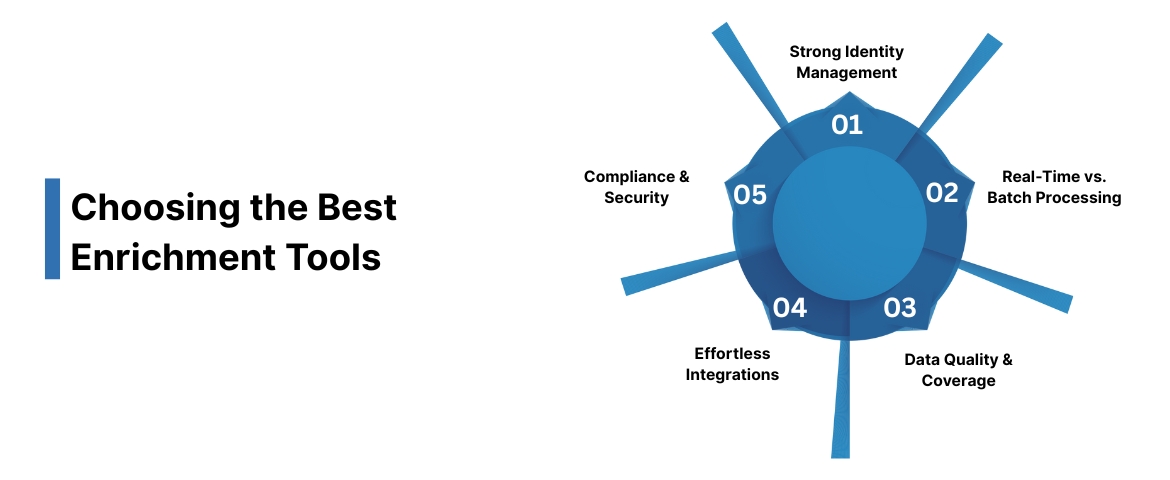
Choosing an automated enrichment tool is a significant investment. You must look beyond a simple feature list and evaluate vendors based on core capabilities essential for sustained, compliant performance in the North American market.
- Strong Identity Management: The tool must unify fragmented data using a persistent first-party identifier to create an accurate Customer 360.
- Real-Time vs. Batch Processing: Prefer real-time enrichment for instant personalization and lead qualification, and not overnight batch updates.
- Data Quality & Coverage: Ensure the vendor verifies data across multiple sources and frequently refreshes datasets to maintain accuracy.
- Effortless Integrations: Enriched data should sync instantly with your CRM, automation tools, and ad platforms without complex ETL work.
- Compliance & Security: Confirm transparent data sourcing and adherence to SOC 2, GDPR, and CCPA/CPRA to reduce risk. These laws are especially important for North American e-commerce, retail, and subscription brands that rely heavily on enriched first-party data for personalization.
As you evaluate enrichment tools, it’s equally important to consider the partners supplying the underlying data. This brings us to the critical compliance role played by first-party data providers.
The Critical Role of First-Party Data Providers in Compliance
Strategic partnerships with first-party data providers and specialized data aggregators are essential, but they introduce compliance overhead that you must manage meticulously:
- No raw PII sharing without a Data Processing Agreement (DPA).
- Consent alignment, confirming your privacy policy covers enriched data use.
- Transparent sourcing, especially for CCPA/CPRA requirements in the US and Canada.
- Clean room matching, using hashed IDs so neither party sees unhashed PII.
Note:Many trusted first-party data providers now offer data clean room environments. These platforms allow you and the provider to securely match customer data (via hashed IDs, like Ingest ID) without either party ever viewing the other’s raw, unhashed PII.
This approach maintains privacy, reduces risk, and supports fully compliant enrichment. But achieving this consistently requires more than policies; it requires the right infrastructure. Ingest Labs’ integrated platform makes this level of accuracy and compliance operational from day one.
Ingest Labs’ Integrated Solution for Data Enrichment
Ingest Labs provides the integrated technology stack required to execute complex, compliant first-party data enrichment without needing extensive coding resources.
1. Ingest ID: The Foundation for Enrichment
The most significant barrier to enrichment is fragmented identity. Ingest ID provides the necessary first-party identifier assigned to each unique visitor.
- Benefit: This ID facilitates accurate deterministic matching, allowing you to seamlessly merge web events (collected via Ingest IQ) with CRM attributes and external data provider signals, creating a unified foundation for all enrichment efforts.
2. Ingest IQ: Capturing and Transforming Events
Ingest IQ significantly improves event capture reliability by moving collection server-side, reducing data loss from browser restrictions and ad blockers.
- Benefit: Server-side collection is more accurate and resilient than client-side tagging. It allows you to collect, transform, and stream raw event data directly to the Event IQ CDP, ensuring the source data for enrichment is complete and reliable.
3. Event IQ: Real-Time Orchestration and Compliance
Event IQ is the customer data and intelligence platform that specializes in the final stage of first-party data enrichment, i.e., unification, segmentation, and activation.
- Enrichment Engine: Event IQ acts as the central hub, providing the framework to ingest, cleanse, and normalize data from internal systems (e.g., Salesforce, ERPs) and integrate compliantly with external data providers.
- Compliance Gateway: Event IQ manages all customer consent signals, ensuring that any segment or personalized experience generated from the enriched profile respects user opt-out status across all channels. This is crucial for your ongoing compliance in North America.
Conclusion
The margin for error in digital marketing is shrinking. Unenriched, siloed data is a liability that guarantees poor targeting, wasted ad spend, and regulatory exposure. First-party data enrichment is no longer an optional optimization; it is the required foundation for all effective, compliant marketing programs in 2026.
The Ingest Labs platform provides accurate, real-time collection and unification of first-party data, improving reliability and consistency across your marketing systems. Moreover, it helps in navigating through the UI, optimizing the built-in Tag Manager, utilizing the Media Data Platform, and monitoring site performance.
If you’re looking for platforms to unify identity, enrich customer profiles, and activate data instantly, exploring Ingest Labs’ documentation or requesting a walkthrough can help you understand what a modern first-party data architecture should look like. Book a demo today.
FAQs
1: What is the difference between data cleaning and data enrichment?
Data cleaning is the process of enhancing the accuracy and reliability of the data you already have (e.g., correcting spelling, removing duplicates). Data enrichment focuses on improving the quantity and context of the data by adding new, valuable attributes (e.g., LTV score, inferred income bracket) to the existing, cleaned records.
2: Why is first-party data enrichment more compliant than using third-party data?
Enrichment relies primarily on adding data to profiles you already own and control, often using internal data or compliant external data matched in a secure, consented manner. Third-party data relies on data collected by others without a direct relationship with your customer, which is the exact practice being restricted by global privacy laws.
3: Can my existing CRM system handle data enrichment?
CRMs are excellent sources for internal enrichment (e.g., sales data), but they typically lack the identity resolution, real-time event streaming, and media activation capabilities required to perform true, cross-channel first-party data enrichment and activation at scale. This requires a dedicated CDP like Event IQ.
4: How often should I enrich my customer data?
You should enrich transactional and static data (like CRM attributes) daily or weekly. However, behavioral data (web/app events collected by Ingest IQ) should be processed and used for real-time segmentation (via Event IQ) as close to instantaneously as possible to enable highly relevant personalization.
5: How does first-party data enrichment improve identity resolution?
Enrichment adds missing details and connects fragmented records, making it easier to match customer actions to a single ID. This boosts accuracy, match rates, and personalization.
6: Why is real-time activation important for enriched first-party data?
Real-time activation lets you use enriched data instantly across channels, improving targeting, personalization, and ROAS while the customer is still engaged.