



Ever wondered why your Facebook ad conversions seem lower than expected, even when your campaigns are running perfectly?
With privacy changes like iOS 14+ App Tracking Transparency and browser restrictions, traditional Facebook tracking methods are losing their reliability. Missing conversions, incomplete attribution, and declining ROAS are increasingly common for campaigns that rely solely on Pixel and browser cookies.
That’s where Facebook cookieless tracking comes in. By leveraging server-side tracking, first-party identifiers, and privacy-safe data modeling, marketers can improve measurement reliability, support ad optimization, and gain better visibility into customer journeys, even in a cookieless world.
In this guide, you’ll discover exactly what cookieless tracking is, why it matters for your Facebook ads, and how to implement a solution that supports more reliable conversion measurement, attribution analysis, and privacy compliance.
At a glance
- Pixel alone can miss conversions due to iOS restrictions, ad blockers, and browser limits. Server-side tracking with Conversion API captures what Pixel misses for more accurate measurement.
- Cookieless tracking uses server-side events, first-party IDs, and Aggregated Event Measurement to improve attribution accuracy and boost ROAS.
- Implementing cookieless tracking involves moving events server-side, connecting to CAPI, building first-party identity, prioritizing key events, validating data, and unifying your analytics.
- Ingest Labs simplifies the process with Ingest IQ, Ingest ID, and Event IQ, delivering privacy-compliant tracking, real-time insights, and minimal developer effort.
- Delaying adoption risks lost revenue, while implementing cookieless tracking helps recover lost conversion signals, optimizes campaigns, and improves attribution across channels.
Your Facebook Tracking Is Broken, And It's Not Your Fault
Facebook Pixel and third-party cookies were historically used to track user actions across websites and apps. For years, this system worked reliably for many advertisers. Then everything changed.
Privacy rules tightened. Browsers evolved. Users demanded control over their data. And suddenly, the tracking infrastructure that powered your campaigns started crumbling.
Here's what's breaking your tracking right now:
- iOS 14+ App Tracking Transparency (ATT) limits data sharing. Users can opt out of tracking with a single tap. Most do.
- Safari and Firefox block third-party cookies by default. Chrome has also announced increased restrictions on third-party tracking. Browser vendors have increasingly restricted third-party tracking by default.
- Ad blockers prevent Pixel from recording events. More users install them every day. Your tracking code never even loads.
- Fragmented data leads to inaccurate attribution. You're missing conversions and wasting ad spend on the wrong audiences.
If you're still relying on browser cookies, you're losing visibility into your campaigns. Many organizations have already adapted their measurement strategies.
The problem isn't going away. It's accelerating. Which brings us to the solution that's replacing the old system entirely.
Here's What Actually Works Now
Cookieless tracking measures user actions without relying on browser cookies. It's not a workaround. It's a fundamentally better approach.
Instead of depending on browser-based data that gets blocked, Facebook increasingly relies on:
- Server-side tracking through Conversion API (CAPI). Events are sent directly from your server to Facebook. No browser involvement required.
- First-party identifiers like hashed emails, phone numbers, and login IDs. These create persistent user profiles that survive across sessions.
- Aggregated Event Measurement (AEM) for privacy-compliant reporting. Facebook prioritizes your most valuable events while respecting user privacy.
- Modeled conversions when direct tracking is limited, using aggregated signals and statistical modeling.
This approach supports more consistent attribution analysis. It improves audience targeting. And it provides better signals for ad delivery systems, even in a cookieless environment.
The shift isn't just about compliance. It's about collecting more resilient data under modern privacy constraints. Let’s show you exactly what I mean.
Also Read: Why Cookie-Free Websites Are Winning in a Privacy-First World
The Hidden Cost You're Already Paying
Let's be clear about what you're losing without cookieless tracking. The numbers are worse than most advertisers realize.
- Conversion data is disappearing. Campaigns that rely solely on Pixel can miss reported conversions. You're paying for results you can't see. Facebook thinks your campaigns are underperforming when they're actually working.
- ROAS calculations may be incomplete due to missing conversion data. When Facebook can't track conversions, it can't optimize your campaigns. You're spending money on the wrong audiences while your best prospects never see your ads.
- Retargeting audiences are shrinking. Without accurate user data, your custom audiences become less effective. Your ads reach fewer qualified prospects each month.
- Attribution becomes increasingly unreliable. You can't tell which campaigns drive results. Budget decisions become guesswork instead of strategy.
The businesses winning right now aren't the ones with bigger budgets. They're the ones with better tracking strategies. Now let's look at your actual options for making this happen.
7 Practical Strategies to Solve Facebook Cookieless Tracking in 2026
Facebook cookieless tracking doesn’t have to be complicated. By combining server-side methods, first-party data, and smart analytics, marketers can maintain accurate attribution, optimize campaigns, and comply with privacy regulations.
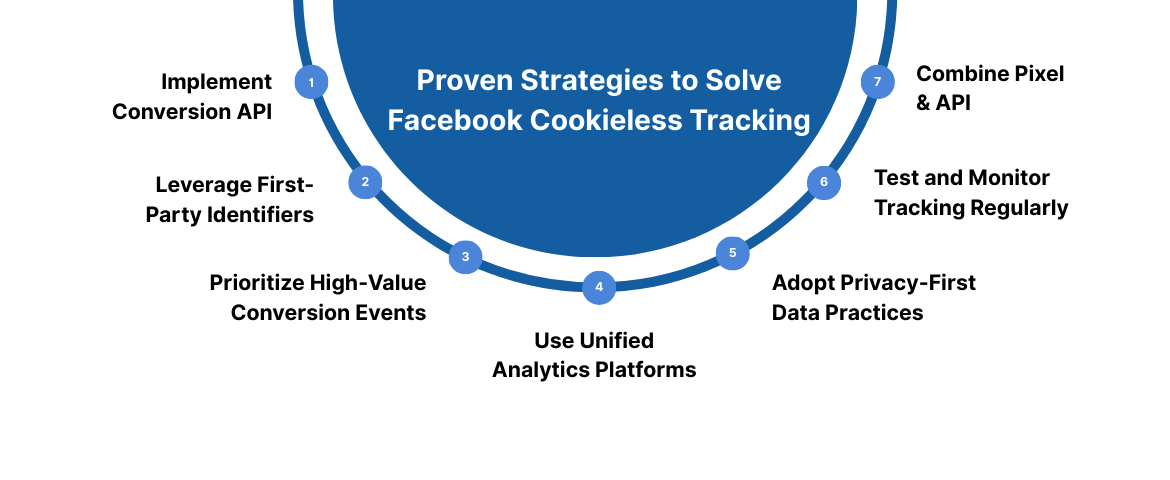
Here are 7 strategies that work in 2026:
1. Implement Server-Side Tracking with Conversion API
Move key conversion events from the browser to the server. Server-side tracking helps improve event capture, even when cookies are blocked or users opt out. Use event deduplication to prevent double-counting between Pixel and server events, giving Facebook a complete view of your conversions. Platforms like Ingest IQ reduce the operational complexity of server-side tracking.
2. Leverage First-Party Identifiers
Collect consented, hashed identifiers such as emails or login IDs to support persistent, privacy-aware identity resolution. First-party IDs help connect user actions across devices and sessions, improving attribution accuracy, retargeting, and campaign optimization.
3. Prioritize High-Value Conversion Events
With Aggregated Event Measurement (AEM) limiting the number of trackable events, focus on the most impactful actions, like purchases, leads, or signups. Prioritizing key events ensures your conversion reporting remains accurate and actionable.
4. Use Unified Analytics Platforms
Integrate data from Facebook, CRMs, web analytics, and other marketing tools into a single platform. Unified analytics provides a complete view of user journeys, reduces blind spots, and empowers data-driven decisions across campaigns.
5. Adopt Privacy-First Data Practices
Ensure your tracking respects GDPR, CCPA, and other privacy regulations. Collect consent where required, anonymize data when possible, and rely on server-side methods instead of third-party cookies to maintain data quality without compromising compliance.
6. Test and Monitor Tracking Regularly
Regular audits of your events help maintain accuracy and reliability. Check that server-side and Pixel events align, monitor event match rates, and troubleshoot discrepancies to ensure your campaigns are measured correctly.
7. Combine Pixel and Conversion API for a Hybrid Approach
Running both Facebook Pixel and Conversion API together provides redundancy and maximizes match rates. Pixel captures browser events, CAPI captures server-side events, and deduplication ensures accurate reporting. This hybrid setup gives Facebook the most complete picture of conversions, improving ad delivery and optimization.
The best approach? Combine server-side tracking with first-party identity and attribution. This delivers the most accurate results without creating a maintenance nightmare.
Also Read: Cookieless Advertising Strategies for a Privacy-First Future in 2026
But implementing this isn't as simple as flipping a switch. You need the right solution. Here's what to look for.
What Separates Good Cookieless Tracking Solutions From Ordinary Ones
Not all cookieless tracking solutions deliver the same results. Some create more problems than they solve.
Before implementing anything, make sure your solution does this:
- Captures all relevant conversion events server-side. Partial tracking limits measurement accuracy. You need complete coverage, or you're still guessing.
- Uses first-party identifiers for reliable user matching. Anonymous data limits identifiers, reducing the optimization effectiveness of Facebook. You need persistent identifiers that follow users across sessions.
- Ensures privacy compliance. GDPR, CCPA, and other regulations aren't optional. Ingest Labs supports compliance—it does not “handle compliance automatically.
- Streams real-time data to your analytics platforms and CDPs. Delayed data means delayed decisions. You need insights now, not tomorrow.
- Supports multi-channel attribution. Facebook isn't your only channel. Your tracking shouldn't treat it that way. You need a unified view.
- Provides actionable insights for campaign optimization. Data without context is noise. You need clear recommendations, not spreadsheets.
- Reduces reliance on developer resources. Your engineers have better things to do than manage tracking tags. Look for no-code or low-code solutions.
A solution that checks all these boxes ensures you don't lose visibility, revenue, or audience intelligence. Now, let’s walk you through exactly how this works in practice.
The Six Steps That Actually Get This Done
Implementing Facebook cookieless tracking seems complex. But a structured approach makes it manageable. Here's the exact process that works.
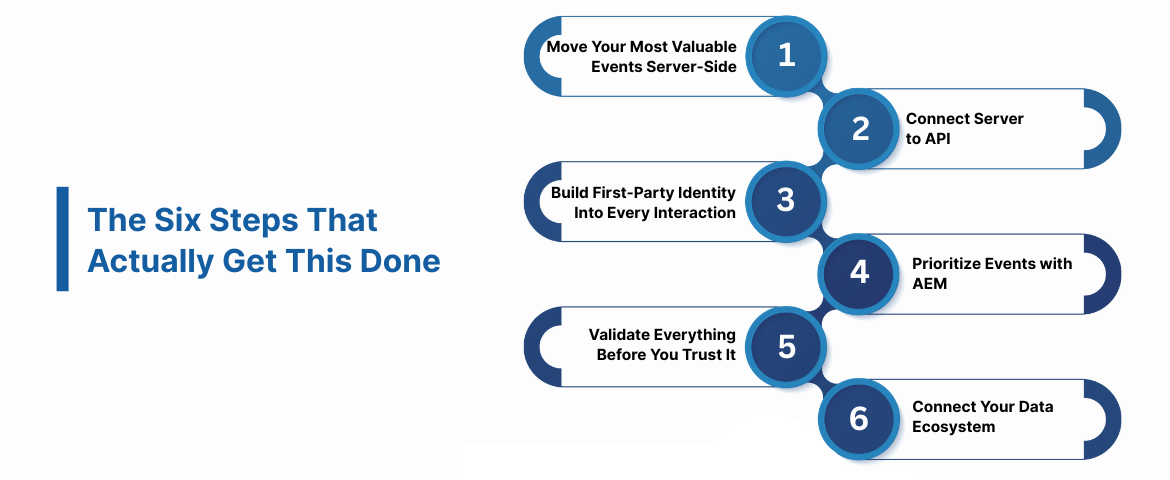
Step 1: Move Your Most Valuable Events Server-Side
Start with your most valuable events: purchases, leads, and signups. These are your money events. Get them tracked accurately first.
Track key user actions that indicate intent, not just transactions. Form views, product views, and add-to-cart events all matter for optimization.
Step 2: Connect Your Server to Facebook's Conversion API
Send server-side events directly to Facebook. This requires configuring your server to communicate with Facebook's API endpoint.
Deduplicate events using event IDs. This prevents double-counting when Pixel and CAPI both fire for the same action.
Step 3: Build First-Party Identity Into Every Interaction
Use hashed email, phone, or login ID to identify users. This creates persistent profiles that follow users across sessions and devices.
Assign a unique identifier to every visitor, even anonymous ones. This improves cross-device matching significantly and enables better retargeting.
Step 4: Prioritize Your Events With Aggregated Event Measurement
Define your top-priority events for Facebook campaigns. AEM limits you to eight events per domain, so choose carefully.
These events determine what Facebook optimizes for. Get this wrong, and your campaigns optimize for the wrong outcomes.
Step 5: Validate Everything Before You Trust It
Test event tracking thoroughly. Use Facebook's Events Manager to verify events are firing correctly and reaching Facebook's servers.
Check event match rates. Anything below 70% needs investigation. High match rates mean better optimization and lower costs.
Monitor gaps continuously. Attribution isn't set-it-and-forget-it. Things break. Tracking drifts. Regular audits prevent revenue loss.
Step 6: Connect Your Data Ecosystem
Combine Facebook data with other platforms for complete insights. Use this data for retargeting, lookalike audiences, and conversion optimization.
Build a single source of truth for customer data. Your analytics platform, CDP, and Facebook should all speak the same language.
This process works. But it's time-consuming and technical. Which is why smart marketers are using platforms that handle this automatically. Ingest Labs supports these implementation steps through managed server-side tracking and reduced engineering involvement.
Let's look at what happens when you implement cookieless tracking correctly.
What Happens When You Get This Right
Cookieless tracking isn't just about compliance. It can materially improve measurement confidence and operational efficiency over time. But the difference becomes even clearer when you compare the two approaches side by side.
| Feature | Without Cookieless Setup | With Cookieless Solution |
| Event Capture | Pixel only, partial coverage | Server-side with broader coverage |
| User Matching | Incomplete, limited by ATT | First-party ID, cross-device matching |
| Attribution | Fragmented, missing data | Multi-channel, accurate view |
| Compliance | Risk of GDPR/CCPA violations | Designed to support privacy-aligned data collection |
| Campaign Optimization | Limited by missing data | More informed ROAS analysis |
| Developer Load | High maintenance burden | Minimal ongoing work |
The difference is clear. Investing in cookieless tracking pays off in accuracy, efficiency, and ad performance.
And some solutions make this transition easier than others. Here's what the best ones look like.
How the Right Platform Handles Facebook Cookieless Tracking for You
Ingest Labs offers a complete suite that makes cookieless tracking seamless. No piecemeal solutions. No integration headaches. Just complete tracking that works.
- Ingest IQ: Server-side tracking across web and mobile apps. Captures events that browser-based tools miss. Streams data in real-time to your analytics platforms and CDPs.
- Ingest ID: First-party identifier for every user. Improves attribution and enables personalization. Works across devices and sessions without requiring logins.
- Event IQ: Unified analytics with cross-channel insights. Analytics-assisted insights that improve visibility into customer journeys from first touch to conversion.
Business benefits you'll see immediately:
- Accurate conversion tracking without cookies or complex developer work. Implementation takes days, not months.
- Privacy-aware data handling is embedded across platform workflows. Supports workflows designed to align with GDPR, CCPA, and global privacy requirements. You stay compliant without thinking about it.
- Real-time, actionable insights for optimizing ROAS. No more waiting for data to load or reports to refresh.
- Faster campaign execution with minimal coding required. Your team focuses on strategy and creativity, not technical implementation.
This is what modern tracking infrastructure looks like. Complete, compliant, and actually usable. If you are ready to eliminate Facebook tracking gaps and improve measurement inputs used for optimization, start with Ingest Labs today.
Also Read:Guide to Cookieless Targeting and Future Strategies
Final Thoughts
Facebook cookieless tracking is essential for Facebook advertisers. With browser restrictions and privacy rules limiting traditional tracking, implementing server-side tracking, first-party IDs, and unified analytics helps recover lost conversion signals, support attribution analysis, and align tracking with privacy requirements while enabling real-time insights.
Take the first step with Ingest Labs. Our platform combines Ingest IQ, Ingest ID, and Event IQ to deliver cookieless Facebook tracking that’s accurate, privacy-safe, and ready to scale.
Book a demo with Ingest Labs today and regain full control over your Facebook conversion tracking.
FAQs
Q1: Can I use cookieless tracking alongside Facebook Pixel?
Yes. Running Facebook Pixel with Conversion API (CAPI) ensures more accurate tracking. Pixel handles browser-based events, CAPI captures server-side events, and event deduplication prevents double-counting. This hybrid setup maximizes event match rates and gives Facebook a complete picture of conversions.
Q2: How is cookieless tracking different from cookie consent banners?
Cookie consent banners request permission to use cookies, while cookieless tracking eliminates reliance on cookies using server-side events and first-party IDs. Consent is still required under GDPR and CCPA, but data quality improves because fewer events are blocked by users.
Q3: Will cookieless tracking work for B2B lead generation campaigns?
Absolutely. B2B conversions often span multiple sessions and devices. Server-side tracking captures the full journey, and first-party identifiers connect anonymous visitors to known leads. This improves attribution for longer sales cycles and complex funnels.
Q4: How does cookieless tracking affect Facebook ad delivery and algorithm performance?
Cookieless tracking can improve the quality of signals used for Facebook’s optimization. More complete and accurate conversion data allows the algorithm to identify high-value audiences, improve delivery, and reduce cost per conversion. Higher event match rates generally provide better optimization signals to ad platforms.
Q5: Do I need technical expertise to implement cookieless tracking?
Not necessarily. Platforms like Ingest Labs simplify setup with server-side tracking, first-party IDs, and analytics, all without heavy coding—so marketers can implement cookieless tracking efficiently and reliably.