



Your dashboards may be misleading you. Meta reports a 4.0 ROAS. Google claims 5.5. The email shows a 20% conversion rate. On paper, you should be doing $5M this quarter. In reality, Shopify and your bank account say $3.5M.
The missing revenue was often never real. It’s often the result of attribution collision, multiple platforms claiming credit for the same conversion and inflating performance metrics.
At the same time, your highest-value customers are being misattributed. A user discovers your brand on mobile, researches on desktop, and converts weeks later on another device. Because these touchpoints aren’t connected, the acquisition channel appears to fail, and budgets get cut where long-term growth actually begins.
For modern CMOs, this isn’t an analytics issue. It’s a scaling risk.
This guide explains why traditional conversion tracking methods break down in a privacy-first, multi-device world, and why a unified, identity-driven architecture is required to establish a true single source of truth.
Key Takeaways
- Most existing conversion tracking methods fail to deliver a complete customer journey, resulting in duplicated attribution, missing conversions, and unreliable ROAS.
- Browser-based tracking can no longer reliably support accurate measurement, as privacy controls like Safari ITP, ad blockers, and parameter stripping disrupt cross-device and long-window attribution.
- Data loss directly impacts paid media performance, limiting how effectively platforms like Google and Meta can optimize campaigns and control acquisition costs.
- Modern conversion tracking requires a server-side, first-party data architecture with persistent identity resolution, not isolated pixels or platform-specific attribution models.
- Ingest Labs provides an end-to-end platform designed to support this architecture, combining Ingest IQ (server-side tracking), Ingest ID (cross-device identity resolution), and Event IQ (data unification and activation) to deliver a single source of truth for scalable, privacy-first growth.
What “Conversion Tracking Methods” Actually Mean in 2026
Modern conversion tracking methods are not individual scripts or platforms. They are systems, ways of collecting, connecting, and interpreting customer signals across time, devices, and channels.
At a high level, every conversion tracking method falls into one of three categories:
1. Client-side tracking: Browser-based pixels that fire JavaScript events (GA4, Meta Pixel, Google Ads tags).
2. Server-side tracking: Events routed through a first-party server before being sent to ad platforms (Conversion APIs, server containers).
3. Identity-based tracking: Persistent user identification that links sessions, devices, and touchpoints into a single customer record.
Most D2C brands believe they are using “advanced” conversion tracking methods because they have pixels installed and CAPI enabled.
In reality, many are running a fragmented hybrid, client-side tools fighting browser restrictions, server-side tools operating without identity, and platforms attributing conversions in isolation.
The result is not a better measurement. It is conflicting truths.
To understand why modern conversion tracking methods fail in practice, and how to fix them, we need to examine what’s actually broken inside the modern D2C data stack.
Why Most Conversion Tracking Methods Fail in Practice
Many D2C brands today use 12 to 20 distinct tools to manage the customer journey. You have:
- Commerce: Shopify, Magento, BigCommerce.
- Ads: Meta, Google, TikTok, Snap, Pinterest.
- CRM/Email: Klaviyo, HubSpot, Attentive, Postscript.
- Analytics: GA4, Mixpanel, Heap.
- Support: Gorgias, Zendesk.
- Testing: VWO, Optimizely.
Each of these tools operates in a vacuum. They are Data Silos.
The Mechanics of the Silo Problem
The fundamental issue is that these tools do not share a common language for "Identity."
1. The Cookie Disconnect: Google Analytics identifies a user by a browser cookie (_ga). Meta uses a browser cookie (_fbp). Shopify uses a customer ID or email hash. If a user clears their cache, switches browsers, or moves to a new device, the link is broken across all three.
2. Walled Garden Incentives: Ad platforms are incentivized to claim credit. Meta's default attribution window (1-day view, 7-day click) is designed to capture as much credit as possible, often overlapping with Google's relentless brand search attribution.
3. The API Gap: Most connections between these tools are flimsy "point-to-point" integrations. Your Shopify-to-Klaviyo integration might pass purchase data, but it doesn't pass the context of the ad click that drove the initial visit.
These structural flaws don’t just distort dashboards. They actively destroy decision-making.
Let’s look at a typical high-ticket D2C journey to see how silos destroy value.
- Day 1 (Mobile): User sees a TikTok ad for a premium espresso machine. They click, browse, but don't buy.System Record: TikTok logs a click. Mobile Safari may set a cookie that expires within 24 hours when tracking parameters are present.
- Day 3 (Desktop): User remembers the brand. Googles it. Clicks a search ad. Browses the specs. Adds to cart. Abandons.
- System Record: Google Ads logs a click. Shopify logs an abandoned cart (but doesn't know it's the TikTok user).
- Day 10 (Tablet): User gets a retargeting email (captured from a popup on Day 3). They click the link on their iPad. They buy.
- System Record: Klaviyo claims 100% attribution. Shopify records the sale.
The CMO's Report:
- TikTok says: "0 Conversions. CPA: Infinite."
- Decision: Kill the campaign.
- Google says: "0 Conversions."
- Decision: Lower bids.
- Klaviyo says: "1 Conversion."
- Decision: Send more emails.
TikTok created the demand. Google captured the intent. Email closed the deal. By killing TikTok, you shut off the top of the funnel, and your email revenue will dry up in 30 days. You are steering the ship based on a map that is 66% blank.
And just as damaging as these internal blind spots is what’s happening outside your stack.
External Constraints That Break Client-Side Conversion Tracking
While your internal tools are fighting for credit, the external environment is actively trying to blind you.
Apple’s Intelligent Tracking Prevention (ITP) has fundamentally changed the economics of digital advertising. It is not just a privacy feature; it significantly restricts data persistence.
The 7-Day Death Sentence
Standard client-side tracking pixels (the JavaScript snippets you paste into your theme) are at the mercy of the browser.
- First-Party Cookie Cap: In Safari (which commands 50%+ of mobile traffic in the US), client-side cookies are often capped at 7 days.
- Link Decoration Cap: If Safari detects tracking parameters in the URL (like fbclid or gclid), it caps the cookie at 24 hours.
If you sell a product that requires consideration, furniture, luxury fashion, electronics, software, your sales cycle is likely longer than 24 hours. This means that for a significant portion of mobile traffic, long-window attribution becomes unreliable using standard pixels.
The Ad Blocker Reality
Beyond ITP, consumer behavior has shifted.
- Ad Blockers: ~40% of users employ ad blockers that prevent tracking scripts from loading entirely.
- iOS 17+ Privacy: Link tracking protection now strips parameters from URLs in Mail, Messages, and Safari Private Browsing automatically.
On their own, each of these restrictions sounds manageable. Together, they create a compounding effect that quietly erodes the data your growth engine depends on.
If you lose 30% of your conversion data due to ITP and ad blockers, your CAC hasn't actually gone up. Your visibility of the efficiency has gone down. However, the algorithmic impact is real. Meta and Google need data to optimize. Feeding them significantly less data limits the effectiveness of their optimization models, which does eventually raise your real CAC.
If your conversion tracking depends on the browser, it will fail—no matter how well it’s configured.
The Only Conversion Tracking Architecture That Scales
To solve this, we must invert the model. We cannot rely on the browser (client-side) to be the source of truth. We cannot rely on disparate tools to talk to each other politely.
We need a centralized, server-side infrastructure that acts as the brain of your marketing operation.
Enter the Ingest Labs ecosystem: Event IQ, Ingest IQ, and Ingest ID.
1. Ingest IQ: The Server-Side Collection Engine
Ingest IQ moves the data collection point from the user's fragile browser to your secure server.
- How it works: Instead of the browser sending data directly to Meta/Google, the browser sends data to your own subdomain (e.g., data.yourbrand.com). Because this is a first-party context, Safari is far less likely to block it.
- Bypassing Blockers: Ad blockers look for calls to facebook.com or google-analytics.com. They do not block calls to your own domain.
- The Result: You capture near 100% of events. Every page view, add-to-cart, and checkout is recorded, regardless of the user's browser settings.
2. Ingest ID: The 365-Day Identity Graph
This is the core differentiator. Collecting data is useless if you cannot link it to a human.
Ingest ID is a proprietary identity resolution engine. When a user visits your site, Ingest ID assigns them a persistent identifier.
- Persistence: Unlike a browser cookie that dies in 7 days, Ingest ID persists server-side for 180 to 365 days.
- Stitching: It uses deterministic signals (email hash, phone number, login ID) and probabilistic and deterministic signals (such as IP, user agent, and authenticated identifiers), applied in a privacy-aware manner to stitch sessions together.
The "Ghost" Customer Resolved:
Remember our TikTok-Google-Email user?
With Ingest ID, when the user clicks the email link on the iPad (Day 10), the system recognizes the user profile. It looks back and sees the "anonymous" desktop visit from Day 3 and the mobile click from Day 1. It unifies them into one "Golden Record."
3. Event IQ: The Unification & Activation Hub
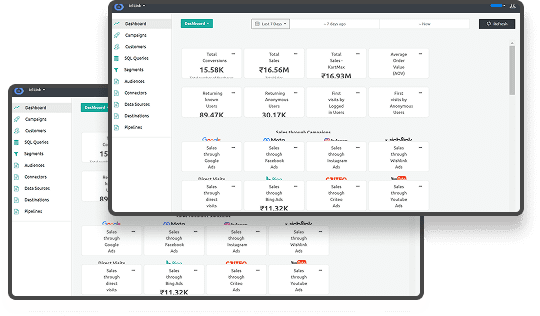
Event IQ is the dashboard where this data comes to life. It acts as the central nervous system, ingesting data streams from:
- Ad Platforms: (Cost, Impressions, Clicks)
- Commerce: (Orders, Revenue, Refunds)
- Site Traffic: (Events, Behaviors)
It normalizes this data into a single schema. Then, it pushes the "enriched" data back out to your platforms. This is the point where most conversations stop, at infrastructure.
But infrastructure is only valuable for what it enables. When conversion tracking is accurate, unified, and persistent, the strategy itself changes.
What Becomes Possible Once Conversion Tracking is Accurate?
Once you have a single source of truth, you move from "surviving" to "dominating." Here are the advanced capabilities accessible to marketers running on this infrastructure.
Capability A: The Feedback Loop (Conversion API 2.0)
Standard CAPI implementations are often flawed because they lack a strong Match Quality Score.
- The Ingest Difference: Because Ingest IQ captures 100% of events and Ingest ID enriches them with up to 20 data points (email, IP, User Agent, Click ID, etc.), the data we send back to Meta/Google via CAPI is incredibly rich.
- Impact: Your Event Match Quality (EMQ) scores hit 9.0/10 or higher. Meta trusts your data more. Your CPMs drop. Your custom audiences populate faster.
Capability B: Long-Window Attribution
Stop optimizing for the "impulse buy." With extended attribution windows (up to 180–365 days), you can finally measure the LTV impact of your top-of-funnel campaigns.
- Strategy: You can run "Brand Awareness" video campaigns on YouTube and actually see the revenue they generate 6 months later. This allows you to bid aggressively on keywords your competitors think are "unprofitable."
Capability C: Advanced Segmentation & Suppression
With a unified view, your segmentation becomes surgical.
- The "Whale" Suppression: Automatically exclude your top 5% of customers (by LTV) from seeing generic 10% off acquisition ads. Save that budget for new users.
- Cross-Sell Prediction: Identify users who bought Product A (Shampoo) 30 days ago but haven't bought Product B (Conditioner). Push a custom audience to Meta for a specific "Complete the Set" creative.
Capability D: Profit-Based Bidding
Most marketers bid on ROAS (Revenue). But Revenue is vanity; Profit is sanity.
- The Event IQ Advantage: You can ingest your COGS (Cost of Goods Sold) and shipping costs into Event IQ. The platform can then calculate estimated profit per order and send that value to Google/Meta as the conversion value.
- Result: The algorithms optimize for your bottom line, not just your top line. They stop selling low-margin products that inflate revenue but bleed cash.
Historically, capabilities like these were reserved for companies with dedicated data teams and seven-figure infrastructure budgets. That assumption no longer holds.
Operationalizing Modern Conversion Tracking (Without Engineers)
Historically, building a server-side data warehouse required a team of data engineers, a Snowflake instance, and six months of work.
Ingest Labs changes the delivery model.
Pre-Built Connectors
Event IQ comes with "pipelines", pre-built connectors for the modern D2C stack.
- Sources: Shopify, Magento, WooCommerce, Stripe, Recharge.
- Destinations: Meta CAPI, Google Ads Enhanced Conversions, TikTok Events API, Klaviyo, GA4.
The Setup Process
1. DNS Configuration: We set up a first-party subdomain (e.g., metrics.yourbrand.com).
2. Tag Deployment: A single line of code replaces your messy container of 50 pixels.
You get enterprise-grade data infrastructure without hiring a single engineer. When the technical barriers fall away, what remains is a strategic decision, one that will define how competitive your organization can be over the next decade.
Conclusion
The era of "easy" digital marketing is over. The "Wild West" of third-party cookies, loose privacy laws, and perfect browser tracking is gone.
We are now in the era of First-Party Data Sovereignty.
You have two choices:
1. The Status Quo: Continue relying on fragmented tools, accept 30% signal loss as "the cost of doing business," and let Safari dictate your growth ceiling.
2. The Single Truth: Implement a server-side identity layer. Capture more complete event data. Link touchpoints across time and devices. See a clearer picture.
The brands that win in 2026 will not be the ones with the best creative or the biggest budgets. They will be the ones with the best data.
Stop guessing. Start knowing.
Schedule a technical deep-dive with an Ingest Labs Architect today.